







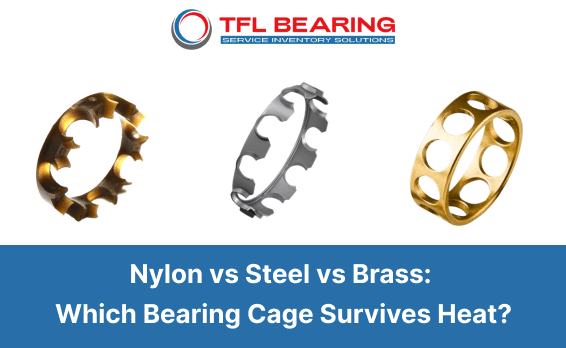

Quick Summary: In high-temperature bearing applications, bearing rings rarely fail first—the cage is usually the weakest structural link. While Polyamide (Nylon/PA66) cages offer whisper-quiet operation and low friction, they degrade rapidly above 120°C. Pressed Steel provides a cost-effective solution up to 250°C–300°C, while Machined Brass is essential for harsh high-heat applications combining temperatures over 200°C with severe vibration or shock loads.
When sourcing industrial bearings, buyers and engineers routinely verify basic part numbers (like 6208 or 6312), radial clearance, and seal types. However, an innocent omission of the cage suffix—such as receiving a Polyamide cage (TN9/TVP) instead of pressed steel (J) or machined brass (M)—is one of the most common causes of rapid, unexplainable catastrophic failure in thermal environments.
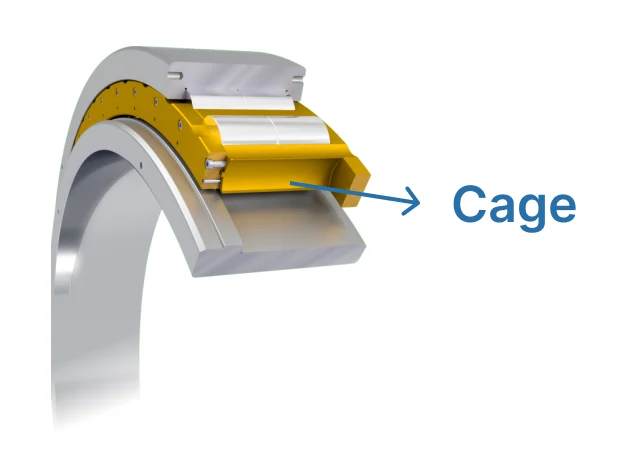
Bearing rings made from through-hardened chrome steel retain basic dimensional stability up to 120°C–150°C, and heat-stabilized rings endure up to 350°C. But if your cage melts, fractures, or embrittles, rolling elements lose uniform separation, bunch up, and lock the shaft instantly.
Quick Material Comparison: Thermal Limits & Trade-Offs
| Cage Material | Typical Suffixes | Max Continuous Temp | Vibration & Shock Resistance | Key Advantage / Main Limit |
|---|---|---|---|---|
| Polyamide 66 (Nylon + Glass Fiber) | TN9, TVP, P | 100°C to 120°C | Moderate | Ultra-quiet, lowest friction / Rapid oxidation & embrittlement above 120°C |
| Pressed Sheet Steel | J, (Standard/Blank) | 250°C to 300°C | Good | Low cost, chemically inert / Vulnerable to fatigue under extreme cyclic vibration |
| Machined Solid Brass | M, MA, MB, MP | 250°C to 300°C | Exceptional | Superior thermal conductivity, heavy shock tolerance / Higher cost and weight |
4 Real-World Application Scenarios: Selecting the Right Cage
To understand which cage material survives high heat, review these 4 practical industrial scenarios:
Scenario 1: High-Speed Textile Spindles & Small Clean Blowers (85°C – 105°C)
The Operational Context: Precision automated spinning machines or cleanroom exhaust blowers running continuously at high speeds (3,000–6,000+ RPM) where operating temperatures hover between 85°C and 105°C.
Recommended Bearing Configuration: Deep Groove Ball Bearing (e.g., 6205) with a Polyamide 66 (Nylon / TN9) Cage.
Why It Excels: As established in technical data sheets for 25% glass-fiber reinforced polymers (such as BASF Ultramid®), polyamide provides high modulus and dimensional retention below 110°C. The ultra-lightweight polymer minimizes centrifugal loads and startup inertia, dampening running noise and heat generation inside electric drives.
Scenario 2: Industrial Drying Oven Centrifugal Exhaust Fan (130°C – 165°C)
The Operational Context: A continuous powder coating curing line or wood-drying kiln exhaust fan rotating at 1,750 RPM on a direct-drive shaft. Hot air transfers along the shaft, maintaining housing temperatures around 140°C.
Recommended Bearing Configuration: Deep Groove Ball Bearing (e.g., 6309-C3) with a Pressed Steel (J / Standard) Cage and high-temperature polyurea grease.
Why It Excels: Standard PA66 begins thermo-oxidative chain scission at these temperatures, leading to cage pocket breakage within hundreds of hours. Pressed steel effortlessly handles continuous exposure up to 250°C, avoids chemical breakdown from synthetic base oils, and keeps procurement costs minimal.
Scenario 3: Vibrating Screen & Heavy Crusher near Heat Sources (160°C – 220°C)
The Operational Context: A heavy aggregate vibrating screen or asphalt mixing plant conveyor pulley adjacent to drying burners. The bearings endure heavy radial loads, continuous 5G–10G centrifugal vibration shocks, and ambient heat reaching 180°C.
Recommended Bearing Configuration: Spherical Roller Bearing (e.g., 22218) with a Machined Solid Brass (M/MB) Cage and expanded C4 clearance.
Why It Excels: Under violent cyclic acceleration, stamped sheet steel risks weld-joint fatigue and pocket fracture. Solid machined brass delivers high mechanical strength, rapid heat conductivity away from contact points, and emergency boundary lubrication during micro-slip friction events.
Scenario 4: Furnace Bogie Wheels & Tunnel Kiln Conveyors (250°C – 350°C+)
The Operational Context: Brick or ceramic kiln cars moving incrementally (1–10 RPM) through heat zones exceeding 300°C where conventional fluid greases carbonize.
Recommended Bearing Configuration: Specialized High-Temperature Deep Groove Ball Bearing with Full Solid Graphite Segment / Dry Lubricated Spacer (or open stamped steel with dry MoS₂ film).
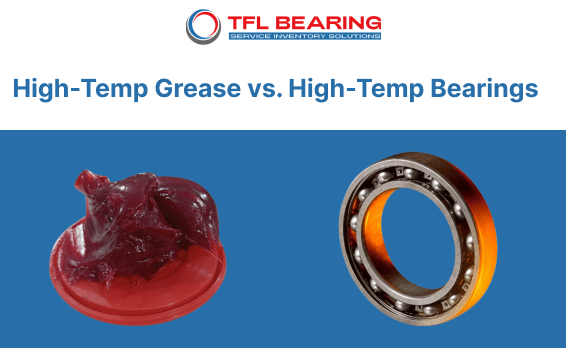
Why It Excels: Above 250°C, traditional grease evaporates. As explained in our guide on High-Temp Grease vs. Dedicated High-Temp Bearings, these furnace-duty bearings replace fluid lubricants with self-transferring solid graphite spacers to prevent metal-to-metal welding.
Purchasing Trap: The Omitted Suffix
“Many buyers request standard parts like ‘6310-2RS’ expecting steel cages. If an overseas supplier stocks cheaper TN9 (nylon) variants to reduce cost and noise, installing them in a 140°C fan will melt the cage within days. Always explicitly specify cage material suffixes (e.g., -J or -M) in your RFQ.”
Summary Checklist: Which Cage Material Should You Specify?
- Choose Polyamide (Nylon): Operating under 100°C, high RPM applications, low-noise requirements (e.g., precision servos, HVAC indoor blowers, household appliances).
- Choose Pressed Steel: Operating between 110°C and 200°C, steady non-vibrating industrial equipment, medium-to-high speeds, cost-conscious projects.
- Choose Machined Brass: Operating over 150°C with severe cyclic vibration, heavy shock loads, rapid acceleration/deceleration, or heavy processing plants (e.g., steel mills, mining shakers, railway traction motors).

Unsure About Cage Suffixes & Heat Limits for Your Project?
Prevent premature cage failure and unexpected production downtime. Share your shaft speed, ambient heat, and load profile with our engineering team for a verified technical review and quotation.
Consult an Application EngineerQ1: Can a nylon (polyamide) bearing cage survive a brief temperature spike to 130°C?
Glass-fiber reinforced PA66 can handle peak spikes up to 130°C–140°C for brief periods. However, sustained operation above 115°C rapidly accelerates polymer oxidation and embrittlement, causing cage pockets to snap.
Q2: Why are brass cages preferred in heavy vibration even at moderate temperatures?
Machined brass cages are one-piece or precision-riveted solid metal structures. Unlike thin stamped steel, brass absorbs massive cyclic inertia and impact shocks without fatigue cracking, while its natural lubricity protects rolling elements from scuffing.
Q3: What suffix indicates a steel cage on a deep groove ball bearing?
For most deep groove ball bearings, a pressed steel cage is standard and often has no suffix (or uses ‘J’ on certain brands). Conversely, machined brass is designated by ‘M’, ‘MA’, or ‘MB’, and polyamide by ‘TN9’ or ‘TVP’.
Technical Standards & Material References:
1. STLE (Society of Tribologists and Lubrication Engineers): Technical reviews on the chemical compatibility and thermal degradation of engineering plastics exposed to synthetic lubricant additive packages.
2. DuPont™ Zytel® / BASF Ultramid® Engineering Manuals: Thermal aging characteristics and tensile modulus properties of 25% glass-fiber reinforced polyamide 66 (PA66-GF25) under continuous heat exposure.