







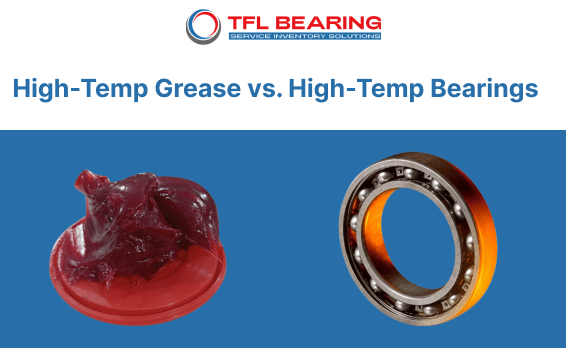


Quick Summary: Custom-repacking standard deep groove ball bearings with specialty high-temperature fluorinated grease (PFPE/PTFE) frequently costs more than purchasing off-the-shelf high-temperature bearings due to raw material chemical costs ($200–$600+/kg) and labor-intensive offline rework. However, substituting them with standard catalog high-temperature bearings without checking operating speed can trigger immediate catastrophic failure, as most furnace-grade high-temp bearings rely on dry solid graphite rather than grease and are strictly limited to low-speed rotations below 100–300 RPM. For extreme heat exceeding 400°C–800°C or zero-outgassing vacuum chambers, ceramic bearings serve as the ultimate grease-free alternative.
When sourcing standard deep groove ball bearings (such as the 6200 or 6300 series), international buyers frequently request custom lubrication: “Can you repack these standard bearings with high-temperature grease?”

To an overseas purchasing manager, this sounds like a negligible add-on—just a different tube of grease during packaging. Yet, when the quotation arrives, buyers are often shocked: the surcharge for custom high-temp greasing can exceed the unit cost of the bare bearing itself, making the assembly more expensive than a dedicated off-the-shelf high-temperature bearing.
When suppliers encounter this cost inversion, the natural commercial reaction is: “Why pay more for custom repacking? Just switch to our dedicated high-temperature bearings.” While commercially logical, blindly doing so in rotating equipment is one of the most common engineering pitfalls in industrial procurement.
Why Custom High-Temperature Grease Costs So Much
The price paradox comes down to chemical formulations and the economics of manual rework rather than supplier markup:
- Extreme Chemical Raw Material Costs: Standard ball bearings utilize mineral-oil lithium or polyurea greases costing roughly $3 to $8 per kilogram. In contrast, high-temperature fluorinated lubricants (PFPE/PTFE formulations like Chemours Krytox or specialty Klüber Lubrication) cost between $200 and $600+ per kilogram. In small bearings, the grease inside the cavity can easily cost more than the precision steel rings.
- Labor-Intensive Rework Logistics: Deep groove ball bearings are mass-produced on fully automated lines. Injecting custom grease requires taking pre-assembled bearings offline, carefully prying off rubber seals (2RS) or metal shields (ZZ) without causing micro-deformation, ultrasonic solvent degreasing to eliminate anti-rust oils, vacuum drying, metered micro-injection (25%–35% fill rate), and manual re-shielding.
- Batch Economics: For low-to-medium volume orders (500 to 2,000 units), the manual technician hours and chemical purge waste far outweigh the unit cost of automated mass manufacturing.
Expert Engineering Insight
“High-temp grease prevents lubricant oxidation and fluid breakdown, while high-temp bearings prevent metallurgical softening and geometric thermal binding. They address entirely different failure modes and cannot be swapped based on unit price alone.”
Do Dedicated High-Temperature Bearings Actually Use High-Temp Grease?
A common misconception among buyers is that ordering a “high-temperature bearing” guarantees a pre-greased bearing packed with premium fluid grease. In engineering reality, the lubrication method inside a high-temperature bearing depends entirely on the temperature threshold:
- Medium-High Heat (150°C to 200°C): High-Temp Fluid Greases. At this range, bearings are heat-stabilized (typically S1 temper) and filled with polyurea, complex sulfonate, or synthetic hydrocarbon (PAO) greases. These retain their lubricating oil film and fully support high-speed motors and exhaust fans.
- Transition Heat (200°C to 250°C): Fluorinated (PFPE) Greases. Standard synthetic oils oxidize rapidly above 200°C. Only highly stable perfluoropolyether (PFPE) lubricants can survive in fluid form, requiring premium non-contact metal shields.
- Extreme Heat (250°C to 350°C+): Solid Lubrication Only (No Grease). Above 250°C, virtually all fluid greases—regardless of price—evaporate, cake, and carbonize into hard abrasive residue. Dedicated bearings in this range (such as kiln car bearings) abandon fluid grease altogether, instead utilizing solid graphite crowns, graphite paste, or molybdenum disulfide (MoS₂) dry films.

The Substitution Trap: High-Temp Grease vs. Dedicated High-Temp Bearings
Standard deep groove ball bearings and specialized high-temperature units target fundamentally different operating profiles:
| Engineering Parameter | Standard Bearing + High-Temp Grease | Dedicated High-Temp Bearing (VA201 / Graphite) |
|---|---|---|
| Max Continuous Temp | 120°C to 150°C (limited by GCr15 steel temper) | 200°C to 350°C+ (specialized heat stabilization) |
| Limiting Speed (n · dm) | High (up to 3,000–6,000+ RPM) | Extremely Low (often limited to < 100–300 RPM) |
| Internal Radial Clearance | Normal (CN) or C3 | C4 or C5 Extra-Large (pre-set for thermal growth) |
| Lubrication Mechanism | Hydrodynamic fluid film (oil bleeding) | Solid graphite transfer or dry self-lubrication |
| Cold Vibration / Noise | Minimal (smooth running for electric motors) | Noticeable play/rattle until full thermal expansion |
Two Failure Modes You Must Avoid
1. The Speed Trap (Overheating & Seizure): Synthetic high-temperature greases provide an elastohydrodynamic oil film at elevated rotational speeds (e.g., industrial fans, exhaust blowers, and textile motors running at 1,500–3,000 RPM). Conversely, standard commercial high-temperature deep groove bearings—such as those following the SKF High Temperature Bearing standard—frequently rely on dry graphite cages or segmented guide blocks. If mounted to a high-speed motor shaft, these bearings will overheat, disintegrate, and lock up within hours.
2. The Radial Clearance Trap (Vibration & Chatter): Catalog high-temperature bearings come standard with C4 or C5 radial internal clearance to accommodate the thermal expansion of the inner ring on hot shafts. If your application only runs at 100°C to 120°C, the steel will never expand enough to absorb that built-in clearance. The result is excessive shaft play, violent vibration, motor air gap variation, and accelerated raceway fatigue.
What About Ceramic Bearings? The Zero-Lubrication Alternative
When operating environments exceed 350°C—or when fluid grease outgassing cannot be tolerated—full ceramic bearings emerge as a third engineering pathway:
- Silicon Nitride (Si₃N₄): Withstands extreme temperatures up to 800°C–1,000°C with zero loss in surface hardness. Silicon nitride possesses a thermal expansion coefficient roughly 25% that of chrome steel, drastically reducing the danger of thermal seizing. It delivers natural dry self-lubrication without relying on oil films.
- Zirconia (ZrO₂): Rated for temperatures up to 400°C–500°C. Its thermal expansion coefficient is much closer to steel (~80%), simplifying interference shaft fits and reducing stress cracks in thermal shock cycles.
- Where Ceramic Wins: Ideal for vacuum heating chambers, semiconductor wafer processing, chemical vapor deposition (CVD) equipment, and medical sterilization tunnels where zero grease vapor is permitted.
- The Engineering Trade-Off: Ceramic materials are brittle under shock loads. In heavy-vibration mechanical conveyors, raceways risk catastrophic cracking. Combined with unit costs 5x to 15x higher than steel bearings, ceramic bearings are a precision problem-solver for extreme environments, rather than a universal budget alternative to high-temperature steel bearings.

Sourcing Decision Checklist
- Choose Custom Grease + Standard Bearing if: Operating speed exceeds 800–1,000 RPM, temperatures remain between 100°C and 140°C, and smooth, low-vibration operation is critical (e.g., electric motors, centrifugal fans, automated lines).
- Choose Dedicated High-Temperature Bearings if: Continuous operating temperatures reach 180°C–350°C, and equipment rotates at low speeds (< 300 RPM). Typical use cases include kiln cars, powder coating curing ovens, glass lehrs, and damper dampers.
- Choose Full Ceramic Bearings if: Temperatures exceed 400°C, clean vacuum conditions forbid grease outgassing, or chemical vapor corrosion would destroy steel raceways.
Need Clarification on Your High-Temperature Application?
Avoid costly line shutdowns and unnecessary surcharge markups. Share your operating RPM, radial load, and steady-state operating temperature with our technical engineering team for an application-specific quotation.
Request an Engineering ReviewQ1: Can standard GCr15 bearing steel handle temperatures above 150°C if repacked with 300°C grease?
No. Above 120°C–150°C, standard chrome bearing steel undergoes metallurgical transformation (retained austenite decomposition), leading to dimensional instability and loss of hardness (temper softening). Even if the grease survives, the bearing raceways will indent, deform, and fail under load.
Q2: Why does an open-box high-temperature bearing feel loose at room temperature?
High-temperature bearings are ground with enlarged C4 or C5 radial internal clearances. They are engineered to feel loose at 20°C room temperature so that when the shaft and inner ring expand under severe heat, the clearance normalizes to operational levels without binding the rolling elements.
Q3: What lubricant is used in bearings operating above 250°C?
Above 250°C, conventional fluid greases carbonize. These bearings rely almost exclusively on solid lubrication, such as solid graphite inserts, graphite cages, or dry molybdenum disulfide (MoS₂) coatings, which transfer a lubricating layer without evaporating.
Q4: When should I choose a ceramic bearing instead of a high-temperature steel bearing?
Choose full ceramic bearings (Si₃N₄ or ZrO₂) when operating temperatures exceed 400°C, when the application runs in a vacuum or cleanroom requiring zero lubricant outgassing, or when corrosive chemical vapors would degrade metal surfaces.