







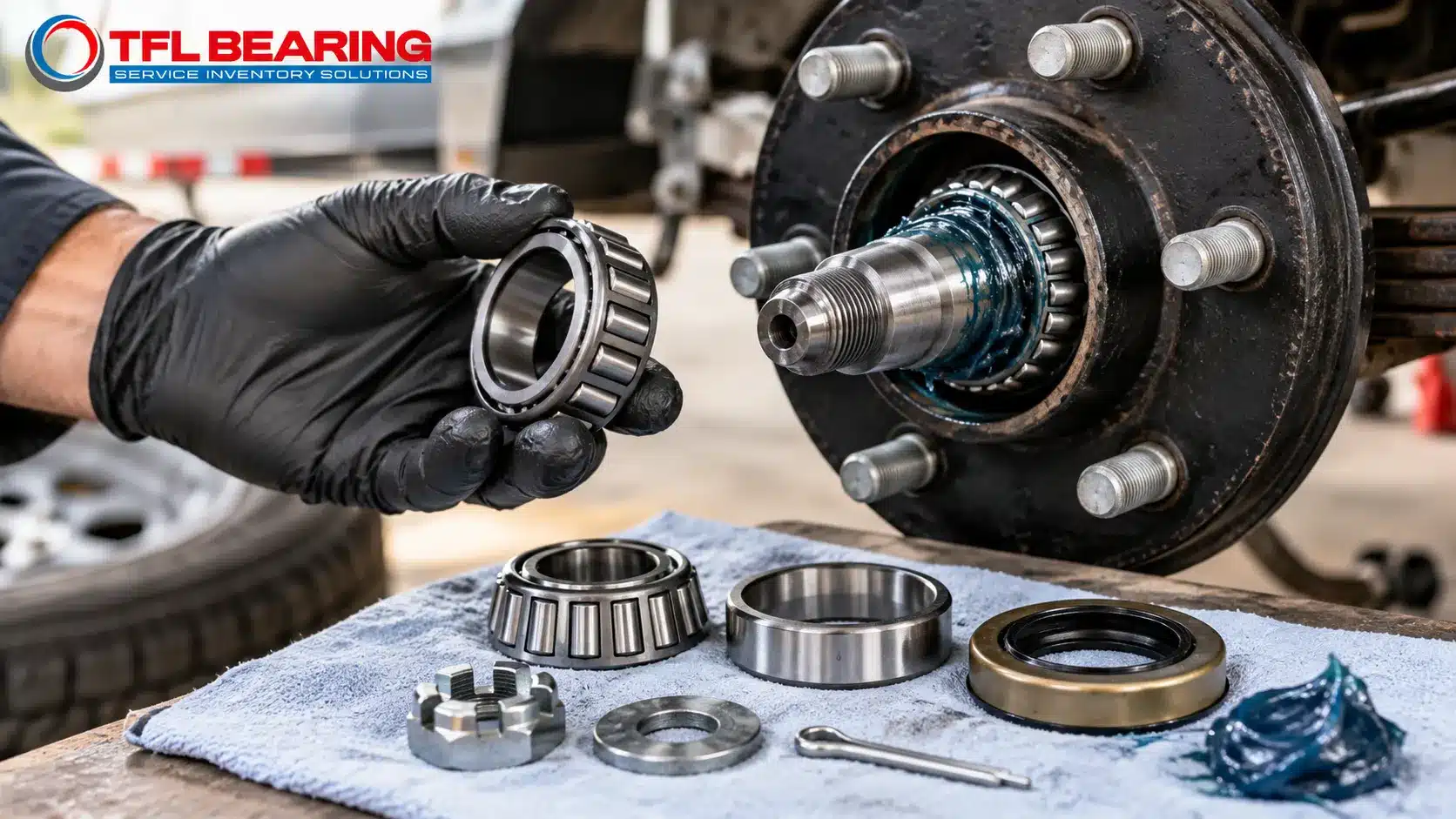
Trailer bearings are the tapered roller bearings inside each wheel hub that let the wheel spin smoothly on the axle spindle while carrying the load. Every hub has two: a larger inner bearing and a smaller outer bearing. Service them every 12 months or 12,000 miles, and they’ll keep you rolling safely for years.
Ignore them, and a cheap part can strand you on the highway. A worn bearing can overheat, seize and even let a wheel come off. This guide covers sizes, grease, how to repack trailer bearings, warning signs and when to replace them.
Quick answers
- Service interval: every 12 months or 12,000 miles, whichever comes first.
- Most common size: L68149 inner and L44649 outer on 3,500 lb axles.
- Grease: NLGI #2 lithium complex wheel bearing grease.
- Nut setting: seat the bearings at about 50 ft lb, back the nut off, then finger tighten.
- Replacing: change the bearing and race together, and always fit a new seal.
What are trailer wheel bearings and how do they work?
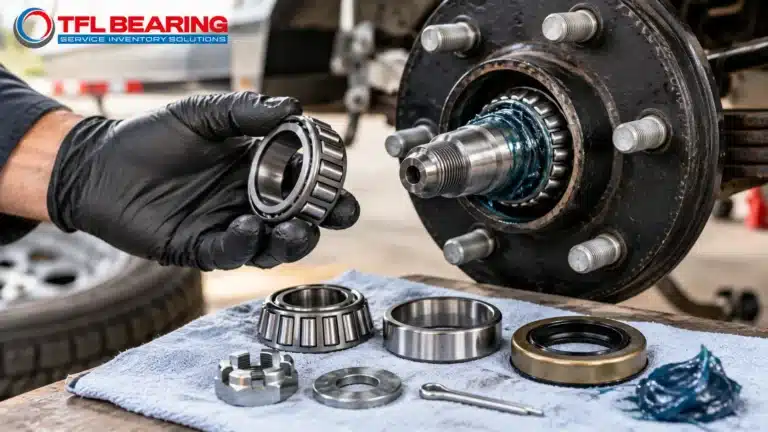
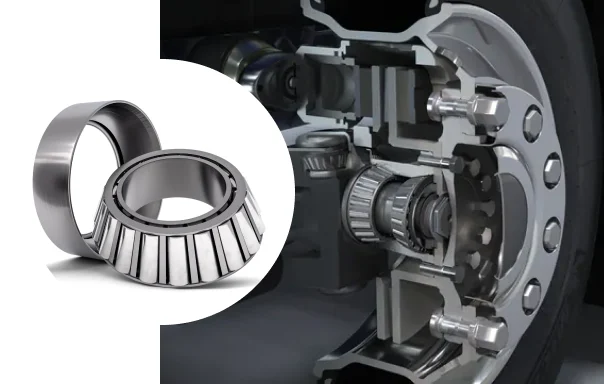
Trailer wheel bearings are tapered roller bearings. Each one has a cone (the inner ring that holds the rollers) running inside a cup, also called a race, pressed into the hub. Trailer hub bearings work in pairs that face each other. A grease seal behind the inner bearing keeps dirt and water out.
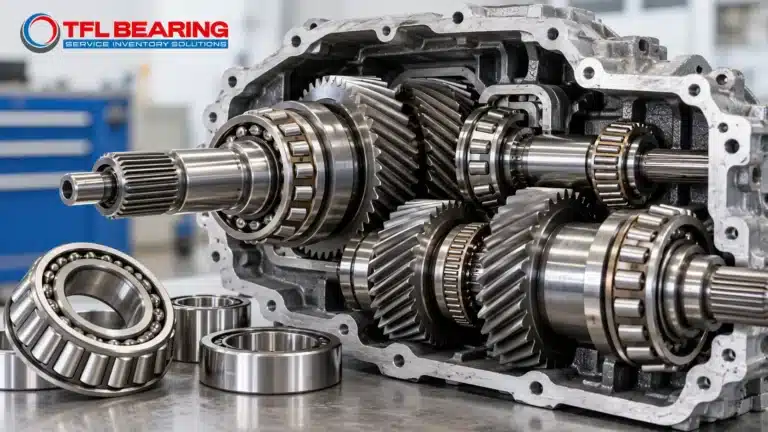
Picture the rollers as tiny rolling pins set at an angle. That angle lets them carry the trailer’s weight and the sideways push you get on every turn. Want the engineering details? Our guide to tapered roller bearings explains cones, cups and load ratings.
A complete trailer wheel bearing kit usually holds both bearings, both races and a seal. Some kits also include a cotter pin and a washer.
What size trailer bearing kit do I need?
Read the part number stamped on your old bearing and race, then match it exactly. If the number has worn off, measure the bearing bore (the hole in the middle) with calipers. Size follows axle capacity and spindle type, so a 3,500 lb axle and a 7,000 lb axle use very different bearings.
| Axle rating | Inner bearing (bore) | Outer bearing (bore) | Races (inner / outer) |
|---|---|---|---|
| 2,000 lb | L44643 | L44643 | L44610 / L44610 |
| 3,500 lb (#84 spindle) | L68149 (1.378 in) | L44649 (1.063 in) | L68111 or L68110 / L44610 |
| 5,200 to 7,000 lb | 25580 (1.75 in) | 15123, LM67048 or 14125A (1.25 in) | 25520 / matching race |
Use this chart as a starting point, not a rule. Two hubs on similar axles can use different races, so the L68149 can sit in an L68111 or an L68110 cup. Always check the numbers on your actual parts before you order.
How often should you repack trailer bearings?
Most axle makers recommend cleaning, inspecting and repacking every 12 months or 12,000 miles. Treat that as the maximum. Tow long distances, launch in saltwater, or leave the trailer parked for months? Check them sooner.
You can also run a quick check between services. Jack up each wheel, spin it and listen. Then grab the tire at the top and bottom and rock it. A tiny bit of play is normal. Clunking, grinding or roughness isn’t.
How do you repack trailer wheel bearings?
Repacking means you remove the hub, clean out every trace of old grease, inspect the parts, force fresh grease through the rollers and set the nut correctly. You’ll need a jack, jack stands, a punch or seal puller, grease, a new seal and a torque wrench.
- Lift the trailer, support it on jack stands and remove the wheel.
- Pry off the dust cap. Remove the cotter pin, nut, washer and outer bearing, then slide off the hub.
- Drive out the old seal and inner bearing from the back of the hub.
- Clean every part with solvent until no old grease remains, then let it dry.
- Inspect the rollers and races. Replace both as a set if you see pitting, rust, flaking or blue heat marks.
- Pack each bearing. Put grease in your palm and press the wide end of the bearing into it until grease squeezes out between the rollers. Wipe a light coat on each cup.
- Fit the inner bearing and tap in a new seal. Slide the hub on, then add the outer bearing, washer and nut.
- Adjust the nut. Spin the hub slowly while tightening it to about 50 ft lb. Loosen it without turning the hub, then finger tighten until it’s just snug. Back it off only enough to line up the cotter pin hole, then fit a new pin.
That 50 ft lb step only seats the bearings. Never leave the nut there, or the bearings will run hot.
What is the best trailer bearing grease?
Use a proper wheel bearing grease, not general chassis grease. The common axle maker spec is a lithium complex grease with a dropping point of at least 215°C (419°F). The dropping point is simply the temperature where grease melts and runs off.
Most owners choose NLGI #2, which feels about as thick as peanut butter. For boat trailers, a marine lithium complex grease resists water better, and calcium sulfonate grease suits harsh saltwater use. Never mix grease types. Clean out the old grease first.
So, how do you grease trailer bearings between full repacks? Some hubs have a grease fitting in the spindle end that lets you pump grease in while you turn the wheel. Go slowly. Overfilling can push grease past the rear seal and onto the brakes.
What’s different about boat trailer bearings?
These hubs get dunked, often while they’re still hot from the highway. As a warm hub cools in cold water, the air inside shrinks and can pull water past the seal. Let your hubs cool for a while before you launch.
Watch for grease on the hull or trailer frame near a wheel. That usually means a seal is leaking. Saltwater also speeds up rust, so rinse the hubs with fresh water and inspect them more often. For corrosion resistant options, see our marine bearings page.
What are the signs of bad trailer wheel bearings?
Most failing bearings give you warnings first. Look and listen for:
- Grinding, growling or rumbling from one wheel
- A hub that’s too hot to touch after a drive
- Wheel wobble or play when you rock the tire
- Uneven tire wear on one wheel
- Grease leaking onto the wheel or brake parts
- Blue or dark heat marks near the hub or drum
A hot hub isn’t always the bearing’s fault. A dragging brake also heats the hub, so check the brake adjustment on that wheel too.
Trailer wheel bearing replacement: repack, replace or both?
| What you find | What to do |
|---|---|
| Clean, smooth bearings, no play | Repack and fit a new seal |
| Pitting, rust, flaking or heat marks | Replace bearings and races together |
| Grease leaking from the back of the hub | Replace the seal, then inspect the bearings |
| Scored spindle or damaged hub | Replace the hub and have the spindle checked |
| Unknown service history | Do a full inspection before towing |
Always replace a bearing and its race as a matched pair. A new cone running in a worn cup won’t last long.
Buying for a fleet, workshop or store? Numbers like L68149 are industry standard sizes made by many brands. A bearing cross reference helps you confirm equivalent parts before you place an order.
Common mistakes to avoid
- Leaving the spindle nut tight. Overtightened bearings run hot and fail fast.
- Reusing the old seal. Seals are cheap, so they always fit a new one.
- Mixing different grease types or brands.
- Pumping grease until the rear seal pops out.
- Ordering by axle rating alone instead of reading the part numbers.
- Launching a boat while the hubs are still hot.
- Replacing the bearing but keeping the worn race.
Limitations of this guide
This guide covers standard grease packed hubs. Oil bath hubs, sealed unitized hubs and some special axles follow different rules. Always check your axle maker’s manual first. If you’re unsure, a trailer shop can inspect the hubs for you.
Conclusion
Healthy trailer bearings come down to three habits: match the right part numbers, use the right grease and set the nut correctly. Service them every year or 12,000 miles, and more often for boat trailers.
Your next step is simple. Jack up one wheel this week, spin it and read the bearing numbers. Need bearings in volume for a fleet, workshop or store? Request a quote from our team with your part numbers.
FAQs
Can I keep towing with a bad wheel bearing?
Only slowly, to the nearest safe spot. A failing bearing can seize, lock the wheel or even let the wheel come off.
Do new bearings come packed with grease?
Loose bearings usually don’t, so pack them before you install them. Some complete hub assemblies come pre greased. Check the product details.
Should I replace the bearings on both sides of the axle?
It’s a smart habit. Both hubs have covered the same miles and loads. If one has failed, the other may not be far behind.
Are trailer wheel bearings the same as car wheel bearings?
Not usually. Many cars use sealed hub units. Most trailers use serviceable tapered roller bearings that you clean and repack.
Does TFL Bearing supply bearings for trailer hubs?
TFL Bearing is a China based sourcing partner. It supplies tapered roller bearings, checks cross references and inspects orders before shipment, with ISO 9001 and IATF 16949 certified quality. Send your part numbers to confirm availability and the MOQ.