







Pillow block bearings are mounted bearings that hold a spinning shaft parallel to a flat surface. They use a bolt down housing with a bearing inside. You’ll find them on conveyors, fans, pumps and farm machines. This guide covers the types, how to read sizes, and the mistakes that wear them out early.
What Is a Pillow Block Bearing?
A pillow block bearing is a ready to mount unit with two parts: an insert bearing and a housing with a flat base and bolt holes. You bolt the housing to the frame, slide the shaft through the insert and lock it. Your machine doesn’t need a precision machined bearing seat.
Most inserts have a rounded outer ring that sits in a curved bore. This lets the insert tilt slightly, like a ball in a socket, so it can forgive small alignment errors. JLCMC (2026) notes that this tilt is limited to a range each manufacturer sets.
What Are the Main Types of Pillow Block Bearings?
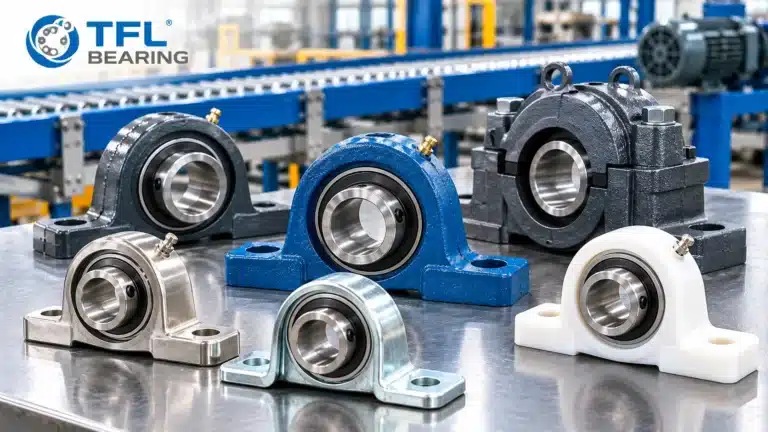
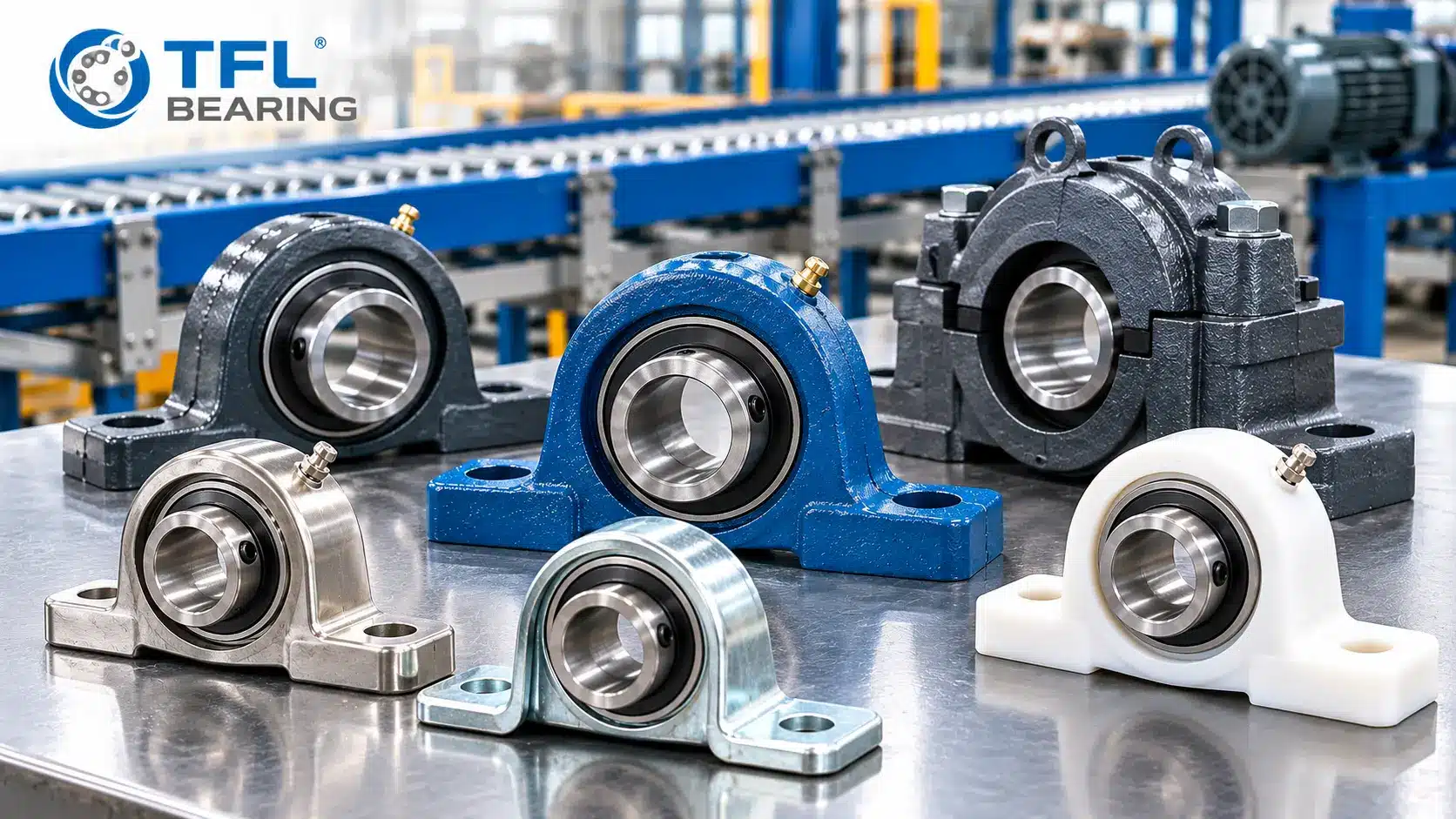
Pillow block bearings differ by housing style, housing material and how the insert locks to the shaft. Solid cast housings such as the UCP series handle most light and medium duty work. Split housings carry heavy loads. Stamped steel, stainless and plastic housings suit light duty, wet or food grade jobs.
| Type | Housing | Best for | Watch out for |
|---|---|---|---|
| Solid cast iron pillow block (UCP) | One piece cast iron | Conveyors, fans, pumps | Heavy; can crack under impact |
| Stamped steel | Pressed sheet steel | Light, low cost machines | Much less rigid |
| Stainless or thermoplastic | Corrosion resistant | Food, washdown, marine | Lower load and heat limits |
| Split pillow block bearing assembly (SAF style) | Two piece cast iron, ductile iron or cast steel | Mining, paper mills, heavy conveyors | Higher cost, careful setup |
| Tapped base | Threaded holes in the base | Bolting from underneath | Bolt pattern must match |
Cast iron pillow block bearings are the usual starting point because cast iron is stiff and absorbs vibration well. The downside is weight.
Pillow Block vs Plummer Block: What’s the Difference?
Strictly speaking, a pillow block has a solid housing, while a plummer block has a split housing with a removable cap. In daily trade talk, though, many suppliers use both names for the same part. So always check the drawing before you order. The two can look alike in a catalog but fit very differently on your machine.
Split units shine when the shaft can’t come out. You lift the cap, swap the bearing and close it again. NSK’s SAF split blocks cover shafts from 1 7/16 to 10 1/2 inches and use spherical roller bearings for normal to heavy loads. For replacement inserts, see our spherical roller bearings.
How Do You Read Pillow Block Bearing Sizes?
Break the part number into three pieces:
- Letters show the style. UC plus P means a set screw insert in a pillow housing.
- Three digits give the series and, on metric units, the bore size.
- An extra number (printed after a dash in catalogs) gives an inch bore, counted in sixteenths of an inch.
So UCP205 fits a 25 mm shaft, and UCP205 16 fits a 1 inch shaft, because 16 sixteenths make one inch.
| Part number | Shaft size | Common search |
|---|---|---|
| UCP204 | 20 mm | metric pillow block |
| UCP204 12 | 3/4 inch | 3/4 pillow block bearings |
| UCP205 | 25 mm | metric pillow block |
| UCP205 16 | 1 inch | 1 inch pillow block bearing |
| UCP206 20 | 1 1/4 inch | 1 1/4 pillow bearing |
Here’s a real trap. A 1 inch shaft measures 25.4 mm. That looks close to 25 mm, but it won’t slide into a UCP205 bore. Going the other way, a 25 mm shaft sits loose in a 1 inch insert. Measure with calipers, not a tape measure.
How Do You Choose the Right Pillow Bearing?
To choose pillow block bearings, start with shaft size and load, then match speed, environment and locking method:
- Ball inserts suit moderate loads at higher speeds.
- Roller inserts handle heavy and shock loads.
- Pick seals that keep out the dust or water on your site.
- Choose a housing that survives the environment, and confirm the bolt pattern fits your frame.
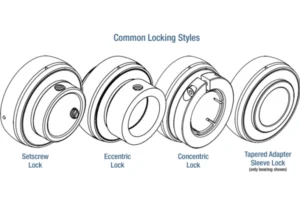
The locking method matters more than most buyers think. Pillow block bearings use three main locking options:
- Set screws. This is the cheapest and quickest. The screws can mark the shaft and may loosen under hard vibration.
- Eccentric collar. It grips tighter as the shaft turns, so it handles vibration better. Turn it the same way the shaft rotates, or it can work loose.
- Adapter sleeve. A tapered sleeve with a lock nut, used for heavy or fast duty. It costs more and takes more care to fit.
Farm machines are a good example. Harvesters and balers flex as they work, so self aligning pillow blocks suit them, and they’re easy to service in the field. Our agricultural bearings page covers that sector in more detail.
What Mistakes Shorten the Life of Pillow Block Bearings?
The biggest mistakes are:
- Buying a metric unit for an inch shaft.
- Mixing one brand’s insert with another brand’s housing.
- Over greasing.
- Bolting the unit to an uneven base.
Each one cuts the service life of pillow block bearings. Most are easy to avoid with calipers, a torque wrench and the maker’s data sheet.
Here’s why each one matters:
- Mixing brands. NTN Americas advises using an insert and housing from the same maker, since fits can vary slightly between brands.
- Over greasing. Extra grease raises heat and seals drag. Pump it in slowly.
- Warped base. A twisted mounting surface distorts the housing bore and wears the bearing faster.
- Precision work. The self aligning design adds a little give, so these units aren’t suited to machine tool spindles.
Have an old part number from another brand? Our bearing cross reference guide helps you match dimensions before you reorder.
Money tip: if the housing is still sound, replace only the insert. NTN Americas says that can be 30 to 40% more cost effective than buying a complete unit.
What Are the Warning Signs of Failure?
Watch for these signs that pillow block bearings are failing:
- Grinding or squealing noises.
- A housing that runs hotter than identical units nearby.
- Metal flakes in the grease, which point to wear.
- Milky grease, which means water got in.
- Shaft play, cracked feet, or bolts that keep loosening.
Catch these early and you can often swap only the insert.
Conclusion
Choosing the right pillow block bearings comes down to four checks: the exact shaft size in inch or metric, load and speed, environment, and locking method. Get those right and a simple bolt on unit will run quietly with very little fuss.
Your next step: measure your shaft, write down the old part number, and use our request a quote page to ask whether we can source a match. Careful measuring is the fastest way to pick pillow block bearings that last.
FAQs
Can pillow block bearings take axial loads?
Ball inserts handle moderate axial loads in both directions, but they’re built mainly for radial loads. For heavy thrust, check the bearing’s axial rating first.
What’s the difference between a pillow block and a flange bearing?
Pillow block bearings bolt to a flat surface parallel to the shaft. Flange bearings bolt to a surface at a right angle to the shaft. Both often use the same insert.
How tight should set screws be?
Tighten them to the maker’s torque using a calibrated wrench. Too tight can deform the inner ring. Too loose lets the shaft slip.
Can I regrease a sealed unit?
Not if it’s sealed for life. Units with a grease fitting can be relubricated on the maker’s schedule.
Does TFL Bearing help match replacement parts?
Yes. TFL checks dimensions, load ratings, tolerance, clearance and seal type, works under ISO 9001 and IATF 16949 quality systems, and inspects orders before they ship.