









Short answer: There is no single universal temperature that makes every bearing “too hot.” A bearing becomes a concern when temperature keeps rising, moves away from its normal baseline, appears after maintenance, or comes with vibration, noise, lubricant problems, smoke, smell, discoloration, or other failure symptoms.
A hot bearing is a symptom, not a complete diagnosis.

A rolling bearing can become warm during normal operation. Rolling friction, lubricant movement, seal contact, load, speed, housing design, and nearby heat sources all affect bearing operating temperature. A housing that feels hot does not automatically prove that the bearing is failing.
The better questions are practical. Is the temperature stable? Is it still increasing? Is it above baseline? Did the change begin after lubrication, alignment, replacement, shaft repair, or belt adjustment? Is vibration or noise increasing?
A real-world maintenance case shared on Reddit, “Bearing fails and melt the housing”, shows a failure that progressed far enough to damage the surrounding housing. It is not a technical authority for temperature limits, but it illustrates a maintenance lesson: a bearing issue can become shaft, housing, and equipment damage if abnormal operation continues.
The real danger is not simply that a bearing becomes hot. The concern is abnormal heat that indicates lubrication, clearance, fit, load, alignment, or internal damage problems.
What Is a Normal Bearing Operating Temperature?
There is no single normal operating temperature that applies to every rolling bearing.
A small electric motor bearing, conveyor pulley bearing, gearbox bearing, pump bearing, industrial fan bearing, and high-speed spindle bearing should not be judged by the same temperature expectation. Their size, speed, load, lubricant, seals, cooling path, housing mass, ambient temperature, and duty cycle are different.
SKF’s temperature-limit guidance shows why simple numbers can mislead. Rings, rolling elements, cage material, seals, lubricant, and dimensional stabilization can impose different limits. A temperature acceptable for one design or lubricant may be unsuitable for another.
For this reason, “bearing temperature too high” must be judged in context. Machine OEM limits, bearing manufacturer instructions, lubricant guidance, and plant reliability procedures take priority over generic internet advice.
Absolute Temperature vs. Temperature Trend
NSK’s bearing handling guidance explains that bearing temperature normally rises after startup and then reaches a stable condition during test running. That pattern is very different from a bearing that keeps climbing during steady operation.

A bearing that rises, reaches equilibrium, and remains stable may be operating normally for that machine. A bearing that rises, continues rising, and does not stabilize deserves investigation. The second pattern suggests that heat generation and heat dissipation are not balancing.
This is why bearing temperature trend is often more useful than one isolated reading. One measurement tells you where the bearing is at that moment. A trend tells you whether the condition is stable, improving, or moving toward failure.
Compare the Bearing With Its Normal Baseline
The most useful comparison is usually the bearing’s own history. A bearing position that has operated at a stable temperature for months and then suddenly runs hotter under similar conditions has changed for a reason.
SKF’s inspection and monitoring guidance treats abnormal temperature changes as condition-monitoring signals. Compare the current reading with historical readings, similar bearings, drive-end and non-drive-end positions, identical machines, current load, and ambient conditions.
If one conveyor pulley bearing is much hotter than the matching bearing at the other end, the comparison is useful. If a pump bearing runs hotter after a rebuild, the timing matters.
Why Does a Bearing Run Hot?
Bearing overheating has many possible causes. Adding grease or installing a new bearing may not fix the problem if the root cause is fit, clearance, alignment, contamination, or load.
Too Much Grease
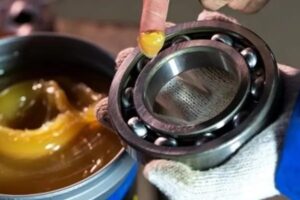
Overgreasing is a common cause of a bearing running hot. When too much grease is packed into the bearing or housing, the rolling elements churn through excess grease. That churning increases drag, and drag becomes heat.
Timken identifies excessive grease as a cause of high operating temperature and damage. This is why “hot bearing means add more grease” is not always correct.
A newly regreased bearing may show a temporary temperature change as grease distributes and excess grease purges. Persistent high temperature still requires investigation.
Too Little Lubricant
Too little lubricant creates the opposite problem. Rolling contacts need an adequate lubricating film. If that film is not present, friction and surface stress increase.
The progression can be simple: insufficient film, increased friction, surface distress, wear, heat, and accelerated bearing damage.
Low lubricant quantity may come from missed relubrication, leakage, poor delivery, grease hardening, oil starvation, contamination, or a lubrication system fault.
Incorrect Lubricant
The wrong lubricant can also raise temperature. The viscosity may be unsuitable for the speed and load. The grease may be too stiff for a high-speed bearing. The lubricant may not suit the operating temperature, or different greases may be incompatible.
There is no universal grease grade for all bearings. Lubricant selection depends on bearing type, speed, load, temperature, sealing, contamination, and maintenance practice.
Excessive Bearing Preload or Insufficient Internal Clearance
Operating clearance is not always the same as the initial bearing clearance printed in a catalog. It can be changed by shaft fit, housing fit, thermal expansion, mounting method, and load. Preload is relevant only to bearing arrangements designed to use it.
Too little effective clearance can increase internal friction and heat. Excessive preload can also increase heat generation and reduce bearing life. NSK lists insufficient clearance and excessive preload among conditions that can lead to abnormal temperature or seizure.
This point matters during replacement. A bearing may match the old part by bore, outside diameter, and width, but still have the wrong internal clearance, cage, tolerance class, seal arrangement, or application specification.
Shaft or Housing Fit Is Too Tight
An interference fit changes the shape and effective dimensions of the bearing rings. If the shaft fit or housing fit is too tight for the application, internal clearance can be reduced.
Reduced operating clearance can increase internal load, friction, and temperature. Correct fit depends on bearing type, load direction, ring rotation, materials, temperature difference, and machine design. This article is not a universal ISO fit chart.
Misalignment or Mounting Error
Misalignment changes load distribution inside the bearing. Instead of carrying load evenly, the bearing may experience localized stress. That can increase friction, temperature, vibration, and surface damage.
Possible causes include shaft misalignment, housing misalignment, distorted housing, incorrect shoulder geometry, poor seating, improper installation, or mounting damage.
Excessive Load
A hot bearing is not always a defective bearing. The operating condition may have changed.
Radial overload, axial overload, shock load, process load increase, excessive belt tension, coupling forces, or fan imbalance can raise internal stress and heat.
Excessive Speed
Higher speed generally increases frictional heat generation. The problem becomes more serious when high speed is combined with the wrong lubricant, low operating clearance, contact seal friction, excessive preload, or contamination.
Bearing design, cage, lubricant, seal type, load, and heat dissipation all affect speed capability.
Seal Friction
Seal contact can generate heat. A damaged seal, incorrect seal, contaminated sealing surface, or inappropriate seal arrangement can add drag at the bearing position.
Contamination
Water, dust, metal particles, and process debris can damage lubricant and bearing surfaces. Contamination may increase friction, vibration, and wear.
Heat rises as friction increases. If the contamination source remains, a replacement bearing can fail in the same way.
The Bearing May Already Be Damaged
Heat can be the original cause of a problem, but it can also be a symptom of internal damage that has already begun.
Raceway distress, rolling-element damage, cage damage, scoring, lubrication breakdown, or early seizure can all generate additional heat. Once severe damage exists, adding grease may not restore the bearing.
Three Temperature Signals That Matter More Than a Generic Limit
1. The Temperature Does Not Stabilize
A stable operating temperature and a continuously increasing temperature are different conditions. If temperature continues to climb during steady operating conditions, investigate the cause.
NSK’s test-running guidance supports this distinction. Normal running should move toward a stable temperature condition. Continued temperature rise can indicate friction, lubrication, clearance, mounting, or load problems.
2. The Temperature Suddenly Changes From the Established Baseline
A machine that has operated consistently for months should not be ignored when one bearing position suddenly becomes hotter. The timing of the change is diagnostic information.
Ask what changed immediately before the temperature changed: bearing replacement, grease quantity, lubricant type, alignment, shaft or housing repair, belt tension, process load, operating speed, or seal replacement.
3. Heat Appears With Other Failure Symptoms
Temperature alone does not identify the exact failure mode. Heat combined with other symptoms is more concerning.
Heat plus vibration can suggest mechanical damage or uneven loading. Heat plus unusual noise may indicate internal deterioration. Heat plus leakage, smell, discoloration, smoke, or grease breakdown is a higher-risk condition.
NSK and Timken connect severe bearing damage with symptoms such as abnormal temperature, scoring, discoloration, deformation, and seizure. Multiple symptoms should trigger a more urgent inspection than temperature alone.
Housing Temperature Is Not Exactly Bearing Internal Temperature
Maintenance teams often measure the external bearing housing because it is practical and repeatable. That reading is useful, but it is not identical to the temperature at the rolling contacts inside the bearing.
Housing surface temperature is affected by housing material, wall thickness, sensor position, airflow, ambient temperature, nearby heat sources, and machine structure. There is no fixed conversion from housing temperature to internal rolling-contact temperature.
What Happens If You Keep Running an Overheating Bearing?
Stage 1: Abnormal Heat
Abnormal heat can change lubricant behavior, accelerate grease deterioration, change operating clearance, and increase friction. Severity depends on bearing design, lubricant, load, speed, and duration.
Stage 2: Accelerated Surface Damage
If lubrication film becomes inadequate or internal friction remains high, surface distress can develop. Scoring, wear, and local damage may follow. Temperature may rise further as the surfaces become rougher.
Stage 3: Severe Bearing Damage
Severe damage may include spalling, cage damage, heavy scoring, discoloration, or deformation. At this point, overheating may be the result of internal bearing damage already in progress.
Stage 4: Seizure
NSK treats seizure as a severe condition associated with heat generation, discoloration, softening, deformation, melting, and lockup depending on the failure mode. Once seizure develops, the machine can no longer be treated as a simple hot-running condition.
Stage 5: Secondary Machine Damage
The severe housing-damage case mentioned earlier is a useful reminder here. Continued abnormal operation can move the repair scope beyond the bearing itself.
Once a bearing reaches severe seizure or destructive failure, the repair scope can extend beyond the bearing itself. The shaft, housing, seals, mounting surfaces, adjacent components, coupling, and alignment may all require inspection.
Stage 6: Unplanned Downtime
What could have been cause inspection plus bearing replacement can become bearing replacement, shaft repair, housing repair, alignment work, and extended machine downtime.
That is the main maintenance risk. The cost is not only the bearing. It is the damage path created by continued operation under abnormal conditions.
Should You Keep Running a Hot Bearing?
Do not use a generic red-yellow-green internet temperature chart as the shutdown rule. Use the machine OEM limits, bearing manufacturer instructions, plant safety procedures, and condition-monitoring data.
Lower Concern
Lower concern means the temperature rises after startup, reaches a stable level, remains close to historical baseline, and appears without unusual noise, vibration, leakage, smell, smoke, or visible deterioration. The machine should still remain within OEM and manufacturer limits.
Requires Investigation
Investigate when temperature is higher than baseline, changes after maintenance, increases over time, or differs from a similar bearing under similar conditions. Review lubrication, replacement parts, fit, alignment, load, and measurement method.
High Concern
High concern means the temperature continues rising or appears with increasing vibration, abnormal noise, smoke, burning smell, visible lubricant degradation, discoloration, or rapidly worsening machine behavior.
Machine OEM limits, bearing manufacturer instructions, and plant safety procedures always take priority over generic internet temperature advice. Do not continue operating equipment that may be unsafe.
How to Troubleshoot a Bearing That Is Running Hot
Step 1: Confirm the Measurement
Check whether readings are taken at the same location, with the same method, and with the same instrument where possible. Confirm sensor mounting, infrared measurement angle, ambient temperature, airflow, and nearby heat sources.
Inconsistent measurement points can create false trends. A reading on a thin cover may not match a reading on the main bearing housing.
Step 2: Review the Temperature Trend
Find out when the increase started. Check whether the temperature is stable or still climbing. Compare it with the historical baseline and review whether it changes with load, speed, ambient temperature, or production condition.
Step 3: Ask What Changed
Review recent bearing replacement, lubrication, lubricant type, grease quantity, shaft repair, housing repair, alignment, belt tension, process load, operating speed, and seal replacement.
Maintenance Principle
If the temperature problem started immediately after a maintenance change, investigate that change first. The timing does not prove causation, but it often points to the most efficient diagnostic path.
Step 4: Check Lubrication
Review lubricant type, quantity, condition, relubrication interval, contamination, and delivery method. Do not automatically add more grease.
Step 5: Check Fit, Clearance and Installation
Review shaft fit, housing fit, internal clearance, preload if applicable, mounting method, seating, and alignment. A dimensionally correct replacement bearing can still create trouble if the clearance or application specification is wrong.
Step 6: Compare Temperature With Vibration and Noise
Use temperature as one condition-monitoring signal, not the only signal. Compare it with vibration, noise, visual inspection, lubricant condition, and operating history. Temperature monitoring alone cannot identify every failure mode.
Step 7: Inspect the Removed Bearing
Do not immediately discard the failed bearing. Inspect it for discoloration, scoring, spalling, cage damage, contamination, lubricant condition, wear pattern, and ring condition.
The failure appearance can provide evidence about the root cause. Do not diagnose the full failure from color alone.
The Bearing Failed: Should You Just Install the Same Replacement?
Not automatically.
If the old bearing overheated, replacing it without understanding the failure cause may repeat the problem. Before selecting a replacement, verify the full bearing designation, dimensions, internal clearance, cage, seals or shields, tolerance or precision class where applicable, load, speed, lubrication, fit, operating temperature, application, and mounting arrangement.
This is especially important when replacing SKF, FAG/Schaeffler, NSK, NTN, Timken, or other industrial bearings with an alternative. The goal is to verify a technically suitable replacement when the original brand is unavailable, expensive, discontinued, or has a long lead time.
Bore x outside diameter x width only confirms basic dimensional compatibility. It does not confirm full application interchangeability. Different bearings may vary in clearance, cage, sealing, lubrication, speed capability, precision, internal design, and application suitability.
Note: TFL Bearing is an independent trading supplier. SKF, FAG/Schaeffler, NSK, NTN, Timken, and other brand names are used for identification and technical reference only. Replacement suitability must be verified against the complete bearing designation and operating conditions.
Bearing Overheating Troubleshooting Checklist
| Check | Why It Matters |
|---|---|
| Temperature trend | Shows whether the condition is stable or worsening |
| Historical baseline | Identifies abnormal change |
| Grease quantity | Both excess and insufficient grease can increase temperature |
| Lubricant type | Incorrect viscosity or lubricant selection can affect friction |
| Internal clearance | Insufficient operating clearance can increase heat |
| Shaft/housing fit | Excessive interference can reduce clearance |
| Alignment | Misalignment can create uneven loading |
| Load | Overload can increase internal stress and heat |
| Speed | Higher speed generally increases frictional heat |
| Vibration | Helps identify developing mechanical problems |
| Noise | May indicate internal deterioration |
| Bearing condition | Existing damage may itself generate heat |
Frequently Asked Questions
How hot is too hot for a bearing?
There is no universal temperature that applies to every bearing. The limit depends on bearing design, lubricant, seals, cage, machine design, ambient temperature, speed, load, and manufacturer instructions. A rising trend, sudden change from baseline, or heat with vibration and noise is usually more useful than one isolated reading.
Is it normal for a new bearing to run hot?
A newly installed or recently lubricated bearing may run differently during initial operation. However, persistent heat or a temperature that keeps increasing should trigger checks for lubrication quantity, lubricant type, fit, clearance, alignment, and preload where applicable.
Can too much grease cause a bearing to overheat?
Yes. Excess grease can force rolling elements to churn through the lubricant, increasing drag and heat. Timken identifies overgreasing as a cause of high operating temperature. Adding more grease is not always the correct response to a hot bearing.
Can a bearing overheat because the fit is too tight?
Yes, depending on the bearing and application. Excessive shaft or housing interference can reduce operating clearance. Reduced clearance can increase internal load, friction, and temperature. Fit should be checked together with bearing clearance, thermal expansion, and mounting conditions.
Can an overheated bearing damage the shaft or housing?
Yes, in severe failure cases. Once bearing damage progresses to seizure or destructive failure, the repair scope can extend beyond the bearing. The shaft, housing, seals, mounting surfaces, and adjacent components may require inspection, as shown by the severe housing-damage case mentioned earlier.
Should an overheated bearing always be replaced?
Not every temperature increase automatically means replacement. A bearing that experienced significant overheating should be evaluated for discoloration, raceway damage, cage damage, lubrication breakdown, abnormal vibration or noise, and surface damage. Machine procedures and bearing manufacturer recommendations take priority.
Find the Cause Before Installing Another Bearing
Replacing an overheated bearing without identifying the root cause can lead to repeat failure. The unresolved cause may be lubrication, fit, clearance, alignment, excessive load, excessive speed, contamination, or incorrect replacement specification.
If you are replacing an SKF, FAG, NSK, NTN, Timken, or other industrial bearing, send the complete bearing designation together with the machine application, speed, load conditions, and failure symptoms. These details help verify whether a replacement matches more than the basic dimensions.
Need Replacement Bearing Verification?
Send the full bearing designation, application details, speed, load, lubrication condition, and failure symptoms. TFL Bearing can help review suitable replacement options for industrial equipment.