








Tiny ball bearings in precision instruments ensures virtually frictionless rotation, exact shaft alignment, and minimal acoustic noise within confined microscopic spaces. These high-precision components are the mechanical backbone of surgical tools, optical encoders, and aerospace sensors, directly dictating the ultimate accuracy and lifespan of the device.
Are you struggling with jittery sensor readings, excessive heat generation, or unacceptable noise levels in your micro-motor designs?
When engineering life-saving medical devices or sensitive optical equipment, standard commercial-grade bearings simply cannot meet the microscopic tolerances required. The margin for error is non-existent. Relying on sub-par rotational components often leads to catastrophic instrument failure or severe measurement inaccuracies.
In this comprehensive guide, we will break down:
- The strict acoustic and friction requirements for medical and optical devices.
- How high speed miniature ball bearings for electric motors push the RPM limits.
- The critical difference between ABEC-1 and ABEC-7 in long-term stability.
- Selecting the correct cage and lubrication for micro-environments.
Strict Requirements in Medical Devices & Precision Instruments
The Critical Need for Ultra-Low Starting Torque
In the realm of precision instrumentation—such as meteorological anemometers, robotic surgical arms, or aerospace gyroscopes—the ability to initiate movement with the absolute minimum amount of force is paramount. This metric is known as starting torque.
If a tiny ball bearing exhibits high starting torque, the instrument will suffer from “stiction” (static friction). In a sensor, this translates to dead bands where minor physical changes are not recorded. To achieve ultra-low torque, the bearing must feature immaculately ground raceways, perfectly spherical rolling elements (often grade 10 or higher), and a highly controlled internal clearance that prevents micro-binding before the rotation even begins.
Acoustic Noise Control in Sensitive Environments
While industrial bearings focus primarily on load capacity, tiny ball bearings designed for precision instruments face an entirely different primary enemy: acoustic noise and vibration.
Consider a motorized surgical handpiece operating at tens of thousands of revolutions per minute. Any microscopic imperfection in the bearing raceway generates high-frequency harmonic vibrations. According to biomedical engineering studies published via the National Center for Biotechnology Information (NCBI), excessive vibration in surgical tools not only causes accelerated surgeon hand fatigue but can also induce localized tissue damage.
To combat this, bearings used in these environments must undergo stringent acoustic testing. For engineers developing solutions in this highly regulated space, exploring our specialized components for medical bearings can provide the foundational quietness and sterilization resistance required for FDA or CE compliance.
Expert Insight from Jessica Jia (TFL Bearing): “A common mistake in precision instrument design is evaluating a bearing based solely on its running torque. In our testing facility, we often see bearings that run smoothly at 10,000 RPM but exhibit unacceptable ‘catchiness’ at start-up. For true precision, the starting torque must be mathematically verified to ensure your sensors and micro-motors respond instantly.”

Pushing RPM Limits in Micro-Motors & ZV Noise Standards
Engineering High Speed Miniature Ball Bearings for Electric Motors
As precision instruments become more compact, the micro-motors driving them must spin exponentially faster to generate the required torque and airflow. When engineering high speed miniature ball bearings for electric motors, the internal geometry must be flawlessly optimized to handle extreme rotational velocities without overheating or vibrating.
A prime example of this precision engineering is the widely utilized 684ZZ bearing. With a 4mm bore and a compact 9mm outer diameter, this specific geometry is a staple in medical robotics, high-RPM cooling fans, and precision sensor spindles. To review the exact dimensional tolerances and dynamic load ratings required for such demanding micro-applications, explore the technical specifications of our 684ZZ metric size standard miniature ball bearing.
Decoding ZV1, ZV2, and ZV3 Vibration Levels
In precision instrumentation, you cannot rely solely on dimensional tolerance to guarantee quiet operation. Engineers must also evaluate the bearing’s acoustic performance using the ZV vibration velocity standard, which measures the micro-vibrations generated during rotation.
- ZV1: The baseline standard for general commercial electric motors. Acceptable for consumer electronics but often too noisy for sensitive lab equipment.
- ZV2: A significant step up in raceway super-finishing. Suitable for high-quality stepper motors, drones, and general robotics where moderate noise reduction is required.
- ZV3 / ZV4: The absolute pinnacle of quiet running. The raceways are ultra-honed to eliminate microscopic peaks and valleys. This is the mandatory standard for surgical handpieces, hard disk drives, and optical sensors where zero-vibration is critical.
Balancing Centrifugal Force at 40,000+ RPM
When a micro-motor surpasses 40,000 RPM, the laws of physics become the primary obstacle. At these extreme speeds, the centrifugal force acting on the tiny steel balls is immense, violently pushing them outward against the outer ring raceway.
If the raceway is not perfectly spherical (exhibiting high roundness error) or if the internal clearance is incorrect, this centrifugal force generates rapid sliding friction. This leads to a sudden thermal spike that degrades the grease and seizes the bearing in seconds. True precision manufacturing ensures that ball diameter variation is kept to an absolute minimum, distributing the centrifugal load perfectly evenly across the bearing’s pitch circle.
Expert Insight from Jessica Jia (TFL Bearing): “Clients often ask why a standard off-the-shelf bearing burns out in their high-speed prototype within hours. The culprit is almost always micro-vibration acting as a catalyst for heat. By upgrading the raceway finish to a ZV3 or ZV4 standard, we drastically reduce the internal friction coefficient, allowing the bearing to run significantly cooler and quieter, even beyond 50,000 RPM.”
ABEC-5 and ABEC-7: The Foundation of Long-Term Stability
Why ABEC-1 Fails in Precision Optical and Surgical Tools
ABEC-1 bearings are mass-produced with relatively wide tolerance bands. While perfectly acceptable for a standard conveyor roller or a household appliance, placing an ABEC-1 bearing inside a precision optical encoder or a robotic surgical arm is a recipe for system failure. The ABEC standards mandate extremely strict controls over bore size and outer diameter as the precision class increases.
In optical systems, even a micrometer of unexpected shaft movement can cause a laser to miss its target or a high-resolution lens to blur an image. ABEC-5 and ABEC-7 tolerances mandate extremely strict controls over bore size, outer diameter, and most importantly, ring parallelism. This ensures the bearing seats perfectly square in the instrument housing, eliminating angular misalignment from the very beginning of the assembly process.
Radial Runout Tolerances: The Microscopic Difference
Radial runout is the measure of how much the rotating inner ring wobbles off its perfect theoretical center axis while spinning.
In an ABEC-1 bearing, the allowable radial runout is relatively loose. However, in an ABEC-7 miniature bearing, this allowable wobble is reduced to mere microns. Consider a surgical bone drill: excessive runout causes the drill bit to vibrate, creating a larger hole than intended and increasing patient trauma. The strict runout tolerances of ABEC-7 ensure the instrument tip rotates exactly where the surgeon commands, with absolute zero deviation.
Hardware Configuration: Cages and Lubricants
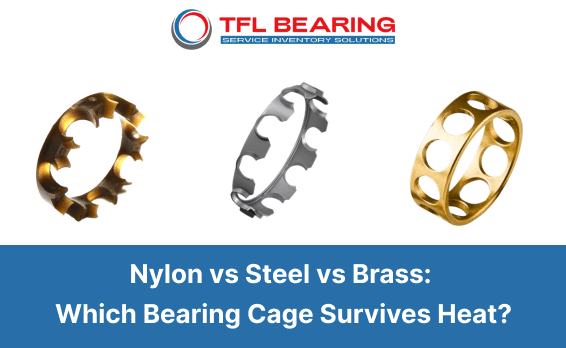
Retainer Options: Stainless Steel vs. Phenolic Resin
The cage (or retainer) separates the rolling elements to prevent them from colliding and grinding against each other. In tiny ball bearings, the cage material significantly impacts the maximum RPM and acoustic output.
- Stainless Steel Ribbon Cages: The industry standard. They are highly durable, cost-effective, and perform exceptionally well in general-purpose precision instruments where extreme speeds are not the primary concern.
- Phenolic Resin or Polyamide (Crown Cages): For ultra-high-speed and low-noise applications (like dental turbines), non-metallic cages are superior. They are lighter, generate far less friction, and possess self-lubricating properties, which drastically reduces harmonic vibration at 50,000+ RPM.
Lubrication: Synthetic Greases vs. Instrument Oils
In microscopic spaces, a fraction of a milligram of lubricant changes everything. The choice between grease and oil dictates the bearing’s starting torque and maintenance cycle.
Synthetic instrument oils offer the absolute lowest starting torque, making them mandatory for highly sensitive meteorological sensors and gyroscopes. However, oil migrates easily and often requires a sealed housing or a continuous misting system. Conversely, low-viscosity synthetic greases (like specific Kyodo Yushi or Klüber formulations) channel well, stay within the bearing, and provide a “lubed-for-life” solution, albeit with a slight penalty to initial rotational drag.
Collaborative Engineering: We Suggest, You Decide
Navigating the complex matrix of retainer materials, ZV noise ratings, and synthetic lubricants is challenging. When you bring your precision instrument blueprints to us, our engineering team will thoroughly analyze your operational environment—evaluating RPM limits, torque requirements, and sterilization protocols.
High-End Replacements: Cost-Effective Manufacturing Solutions
The Move to Premium Chinese Manufacturing
Historically, aerospace and medical device engineers defaulted to a handful of European or Japanese bearing brands, accepting premium prices and rigid lead times. Today, the global supply chain has shifted. High-end Chinese manufacturing facilities have invested heavily in automated CNC grinding, cleanroom assembly, and advanced acoustic testing.
This evolution means that engineers no longer have to sacrifice precision to achieve cost-efficiency. By sourcing directly from an advanced manufacturing hub, procurement teams can secure ABEC-5 and ABEC-7 miniature bearings that meet or exceed international performance benchmarks at a fraction of the traditional cost.
Seamless Drop-in Replacements for Global Giants
Redesigning a medical device or optical encoder to accommodate a new bearing size is a costly engineering nightmare. That is why TFL focuses on providing exact dimensional equivalents to the major global brands.
Whether you need an ultra-thin section bearing, an extended inner ring, or a specialized ZV3 acoustic rating, our production lines are tooled to match international standard nomenclature exactly. By partnering with a dedicated miniature ball bearing supplier that controls the forging, grinding, and QC processes in-house, you gain a reliable, scalable drop-in replacement strategy that protects your margins and your instrument’s reputation.
Expert Insight from Jessica Jia (TFL Bearing): “Transitioning to a new supplier for precision instruments is daunting. That’s why we don’t just send catalogs. We provide full inspection reports, roundness graphs, and acoustic readouts for your specific trial batch. We prove the drop-in capability with hard data before you ever authorize a mass production run.”

Frequently Asked Questions
Why is starting torque critical in precision instruments?
In devices like optical encoders or meteorological sensors, high starting torque causes “stiction” or dead bands, meaning the instrument will not register tiny physical changes. Tiny ball bearings must be engineered with perfect raceways and low-viscosity lubrication to ensure they rotate instantly under minimal force.
What is the ZV vibration standard for miniature bearings?
The ZV standard measures the acoustic noise and micro-vibration a bearing generates while spinning. ZV1 is standard commercial quality. ZV2 offers moderate noise reduction. ZV3 and ZV4 indicate ultra-honed raceways that produce virtually zero harmonic vibration, which is mandatory for sensitive surgical tools and aerospace gyros.
Should I use oil or grease for a high-speed micro-motor?
It depends on your torque and maintenance constraints. Oil provides the absolute lowest friction and highest possible RPM, but it can migrate out of the bearing. Specially formulated low-drag synthetic greases are often preferred because they stay inside the bearing, offering a maintenance-free lifespan with only a minimal increase in initial drag.
Can TFL bearings replace standard brands in medical devices?
Yes. TFL manufactures exact dimensional drop-in replacements for major global brands. We engineer our ABEC-5 and ABEC-7 tiny ball bearings to match international standard nomenclature, allowing you to upgrade your supply chain without redesigning your instrument’s housing or shaft.
Secure High-Precision Drop-in Replacements Today
Stop overpaying for standard instrument bearings. Upgrade your supply chain with TFL’s ABEC-7, ZV3-rated tiny ball bearings. We provide the hard acoustic data and engineering recommendations; you make the final configuration call for your proprietary design.
Explore Medical & Instrument Specs | Request Sample Inspection Reports