







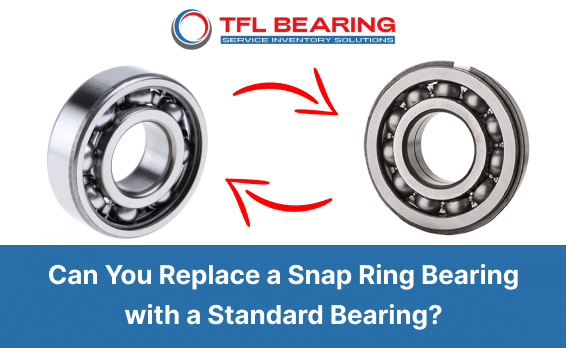

During emergency machinery repairs, scheduled overhauls, or counter inquiries at industrial supply shops, technicians and buyers frequently face the same inventory bottleneck: an original bearing with an external locating snap ring (such as a 6204NR) must be replaced, but the local distributor or warehouse only has standard deep groove ball bearings (6204) on the shelf.
A preliminary caliper measurement indicates full compatibility: both components share identical boundary dimensions—20 mm bore (d), 47 mm outside diameter (D), and 14 mm width (B). The replacement bearing slides into the housing bore with an identical fit tolerance.
However, can you safely replace a snap ring bearing with a standard bearing?
In nearly all industrial and power transmission assemblies, the answer is no. While the boundary dimensions match, their axial retention mechanics are fundamentally different. Installing a standard bearing without snap ring groove into a housing engineered around a locating snap ring will cause axial walking, shaft misalignment, and severe mechanical failure.
The Core Mechanical Function of Snap Ring Bearings
To evaluate interchangeability, one must analyze why machine designers specify snap ring groove ball bearings rather than plain radial bearings.
In conventional bearing arrangements, a plain ball bearing requires two points of external axial confinement:
- An internal housing shoulder (abutment) ground into the casting to stop inward travel.
- An external retaining cover plate, threaded locknut, or internal circlip to stop outward travel.
Standard Housing Arrangement:
   Housing Wall           Shaft
  +------------------+    |
  | [Housing Step]   |    |
  |      +-------+   |    |
  |      |Bearing|===|====+  <-- Trapped between internal housing step
  |      +-------+   |    |      and external retaining cover plate
  | [Retaining Plate]|    |
  +------------------+    |

Snap Ring (Through-Bore) Arrangement:
   Housing Wall           Shaft
  +------------------+    |
  |  Straight Bore   |    |
  |      +--[NR]-+   |    |
  |      |Bearing|===|====+  <-- Snap Ring rests flush against outside casting face;
  |      +-------+   |    |      housing requires zero internal shoulders
  +------------------+    |
Bearings with locating snap rings (designated by suffix NR under ISO 464 international standards) eliminate the need for internal housing machining:
- Straight-Through Machining: The machine casting can be bored straight through from one end without counter-boring internal steps.
- Axial Positioning via Snap Ring: The spring-steel snap ring, seated in a precision-ground circumferential groove in the outer ring, seats directly against the outer casting face.
- Axial Space Optimization: Eliminating bolt-on retaining caps significantly reduces the overall axial footprint in machine tools, automotive transmissions, and industrial gearboxes.
When conducting a snap ring bearing replacement, the locating ring is not an auxiliary feature; it is the primary structural component locking the shaft assembly along the axial plane.
6204 vs. 6204NR: Dimensional Identity vs. Functional Incompatibility
Evaluating 6204 vs 6204NR shows why dimensional interchangeability can be deceptive:
| Technical Parameter | Standard Bearing (6204) | Snap Ring Bearing (6204NR) | Engineering Result of Direct Substitution |
|---|---|---|---|
| Bore Diameter (d) | 20 mm | 20 mm | Perfect fit on shaft seat |
| Outside Diameter (D) | 47 mm | 47 mm | Exact housing bore fit |
| Width (B) | 14 mm | 14 mm | Identical envelope dimension |
| Outer Ring Profile | Continuous, smooth cylinder | Precision-machined annular slot | Standard outer ring lacks locating boundary |
| Locating Hardware | None (Requires housing shoulders) | Hardened spring-steel snap ring | Complete loss of axial retention in through-bores |
| Axial Thrust Retention | Clamped via housing end-cover | Direct shear resistance of snap ring | Bearing free to wander under dynamic vibrations |

Failure Modes: What Happens When a Standard Bearing is Substituted?
If a standard bearing lacking a snap ring groove is pressed into a through-bore casting, the following progression of failures will occur:
1 Outer Ring Creep and Axial “Walking”
Even with an interference or transitional fit in the housing bore, rolling elements subject the outer ring to micro-flexing and cyclic radial loads. Combined with operational vibrations and temperature cycles, the outer ring begins to “walk” axially inside the bore.
2 Misalignment of Drivetrain Elements
If the bearing supports a shaft connected to helical gears, pulleys, or sprockets, the axial thrust will continuously push the shaft. A migration of only 0.5 mm to 2.0 mm alters the gear contact pattern, leading to edge loading, tooth spalling, and sudden lockup.
3 Real-World Case Study: Bandsaw Lower Wheel Failure
A classic example occurs during the restoration of vintage machinery, such as the Powermatic 141 14″ bandsaw discussed on Sawmill Creek. The lower wheel shaft runs through a straight-bored cast-iron housing originally located by two 6204 bearings with snap rings.
When operators substitute standard 6204 bearings because they “fit the housing and shaft perfectly,” dynamic blade tension and rotational vibration immediately pull the assembly out of alignment. Without the snap ring seating against the cast-iron exterior face, the bearings “work themselves into the housing.” The lower wheel drifts axially, throwing the blade off its tracking tires and causing the wheel hub to grind directly into the cast frame.
Debunking the Myth: Can You “Grind Your Own Groove” on a Standard Bearing?
In workshop discussions, technicians occasionally consider taking a standard bearing and cutting a snap ring groove into the outer ring using a lathe carbide insert, high-speed tool, or abrasive wheel.
From a metallurgical and structural standpoint, this should never be done:
- Through-Hardened Material Structure: Industrial bearing rings are forged from high-carbon chromium bearing steel (GCr15 / SAE 52100) and heat-treated to HRC 58–64. Cutting or dry-grinding this material generates excessive surface friction heat, creating localized Heat-Affected Zones (HAZ) and micro-cracks at the groove root.
- Stress Concentration (Kt): Factory snap ring grooves are cut prior to heat treatment, followed by precision grinding and radius deburring according to DIN 5417 standards. An improvised groove introduces sharp root notches that concentrate hoop stresses under radial deflection.
- Outer Ring Rupture: Under cyclic loading, micro-fissures propagate rapidly along the improvised groove circumference, causing the outer ring to fracture and expelling the rolling elements directly into the machine.
Reverse Interchangeability: When Can You Swap Them?
Interchangeability is strictly unidirectional:
- Using a 6204NR to replace a standard 6204: Permissible. If you remove the snap ring from the 6204NR, it can function as a standard bearing in conventional stepped housings. The unfilled groove does not degrade basic dynamic radial load ratings (Cr) under standard operational parameters, provided the groove does not conflict with housing lubrication ports or oil seals.
- Using a 6204 to replace a 6204NR: Prohibited, unless the machine housing is permanently modified with an external secondary clamping plate or machined retaining sleeve to take up the axial thrust.

Suffix Decoding & Cross-Brand Interchange Table
Purchasing errors often stem from conflicting brand numbering systems. For example, legacy American equipment documentation (such as MRC) uses “G” to designate a snap ring groove, whereas modern international standards use “N” or “NR”.
Refer to the interchange table below when identifying replacement units:
| Specification Standard / Brand | Groove Only (No Ring) | Groove + Snap Ring Installed | Shielded + Snap Ring | Rubber Sealed + Snap Ring |
|---|---|---|---|---|
| ISO 464 / International | N | NR | ZN / ZNR | RSN / 2RSNR |
| SKF / TFL Bearing | N | NR | 2ZNR | 2RSHNR / 2RSNR |
| MRC (Legacy American) | G | G (with ring included) | SZZG / FFG | STTG / PPG |
| NSK / NTN | N | NR | ZZNR | DDU NR / LLU NR |
| Koyo (JTEKT) | N | NR | ZZNR | 2RSNR |
Example: If an older service manual specifies an MRC 204SZZG, the modern metric drop-in replacement is a 6204-2ZNR (equipped with two metal shields and one outer locating snap ring).
Technical FAQs: Snap Ring Bearing Replacement
Q1: Can Loctite or an interference sleeve replace the snap ring?
No. Retaining compounds (such as Loctite 609 or 680) are engineered to prevent micro-fretting and rotational slip under radial loads. They lack the continuous shear strength required to resist dynamic, cyclic axial thrust over fluctuating operational temperatures.
Q2: Is the snap ring included automatically when ordering an “N” bearing?
No. Suffix N designates that the outer ring possesses the precision groove, but no snap ring is supplied. Suffix NR confirms that the matched spring-steel snap ring is installed in the groove.
Q3: How do I measure the snap ring groove if the original part number is worn off?
You must record four dimensions using a blade micrometer and depth caliper per ISO 464:
- Distance from the outer ring face to the near groove edge (a).
- Groove width (b).
- Groove bottom diameter (d1).
- Outer ring chamfer dimension (r0).
Sourcing OEM-Grade Snap Ring Bearings
To prevent unplanned downtime and machinery damage, always replace worn units with factory-ground locating assemblies. Review our full dimensional catalog of deep groove ball bearings with snap ring grooves covering ISO standard and custom radial clearance configurations.