









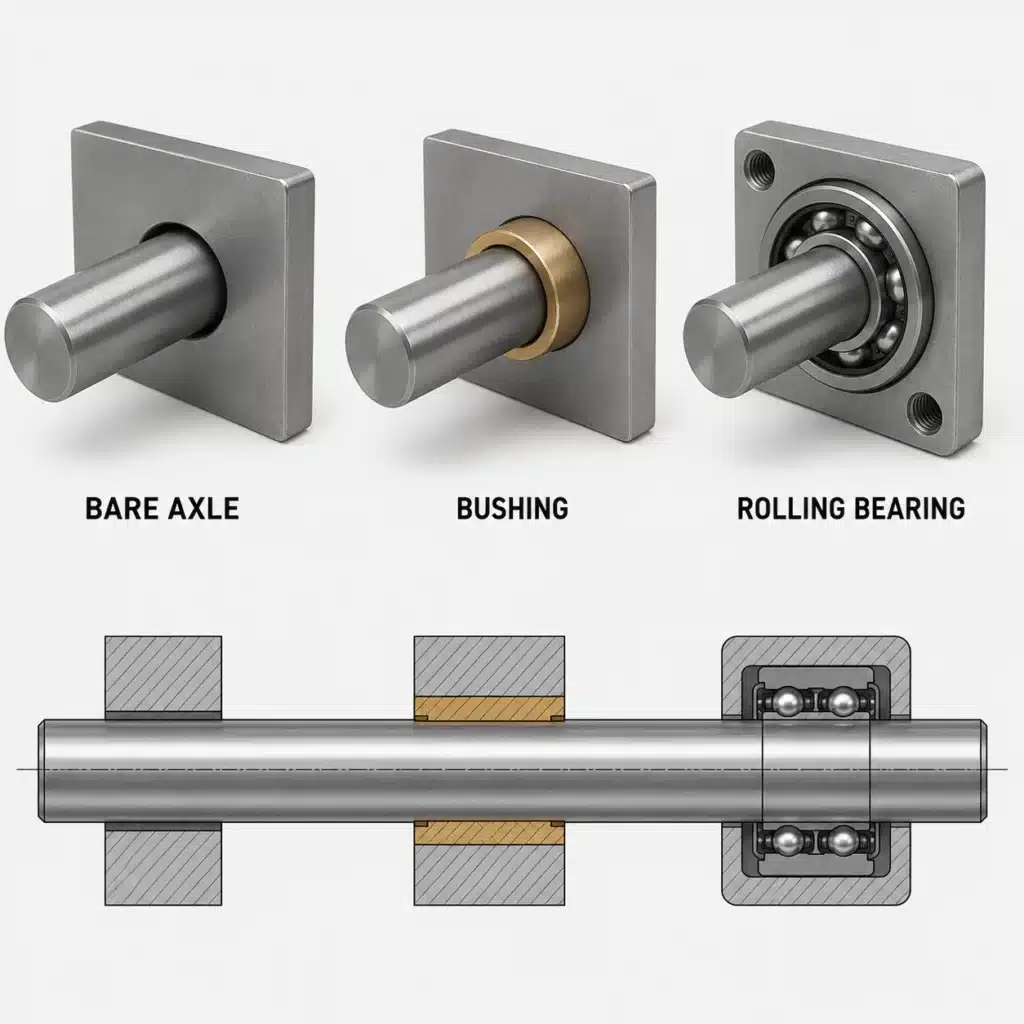
When a shaft, pin, axle, or rotating component needs support, the choice is not simply “use a bearing” or “save money with a hole and pin.” A bare axle, a bushing, and a rolling bearing each solve a different problem.
A bare axle offers the simplest structure and the lowest initial cost. A bushing adds a replaceable sliding surface for low-speed or oscillating motion. A rolling bearing reduces friction and gives better control at higher speed or higher precision.
The difficult part is knowing when the simple option is still acceptable—and when it will create more wear, heat, noise, or repair work later.
This guide compares bearing vs. bushing vs. bare axle for linkages, pivots, conveyor rollers, automation equipment, motor shafts, agricultural machinery, and other mechanical assemblies. The goal is to help engineers, purchasing teams, and equipment builders choose a support arrangement that matches the actual motion, load, and service conditions.
Bearing vs. Bushing vs. Bare Axle: The Basic Difference
All three designs allow one component to move relative to another, but they handle friction and wear in different ways.
- A bare axle in a hole allows the shaft or pin to slide directly against the surrounding material.
- A bushing, also called a sleeve bearing or plain bearing, places a replaceable sliding layer between the shaft and housing.
- A rolling-element bearing uses balls or rollers to replace most sliding contact with rolling contact.
This difference affects more than friction. It also changes the required housing accuracy, lubrication method, replacement cost, allowable speed, noise level, and expected clearance over time.
A bare axle may be enough where relative movement occurs only a few times during the equipment’s service life. A bushing often works well for slow movement under heavy load. A rolling bearing is usually the better direction for continuous rotation, low torque, controlled clearance, or accurate positioning.
The most expensive option is not always the best option. The right choice is the one that protects the important parts of the machine without adding unnecessary complexity.
When Can a Bare Axle Work?
In a bare-axle design, the shaft, pin, or axle moves directly inside a drilled, bored, punched, or machined hole. There is no separate wear component between the two surfaces.
The attraction is easy to understand. The part count is low, machining can be simple, and assembly is fast. For a prototype, low-duty mechanism, or support position with almost no relative movement, this can be a reasonable design.
The weakness is that the machine structure itself becomes part of the wear pair. Every movement takes place directly between the shaft and the hole.
With repeated motion, the surfaces can experience adhesive wear, abrasion, galling, corrosion, and gradual clearance growth. The original round hole may become oversized or out of shape. Once that happens, the supported component can shift under load instead of holding its intended position.
Jessica’s Practical View: Clearance Growth Is the Real Problem
This failure as tolerance widening. It is usually not a sudden break. The fit becomes looser little by little.
As clearance increases, the pin begins to strike the sides of the hole. The arm may shake, alignment may change, and the load is no longer distributed evenly. These impacts then speed up the wear.
The costly part is often not the axle. It is the bracket, linkage arm, welded frame, casting, or rotating body around it. Repair may require welding, fitting a sleeve, reboring the hole, or replacing a much larger component.
A bare axle is most defensible when:
- The assembly is mainly static and has very little relative movement.
- Movement is extremely infrequent.
- The equipment has a short planned service life.
- The surrounding hole is inexpensive and easy to replace.
- Additional clearance will not affect safety, noise, alignment, or accuracy.
Whenever two components move regularly against each other, the design question should usually be: which replaceable component should take the wear?
Why Bushings Are Often the Practical Middle Choice
A bushing fits between the shaft and the housing. The shaft still slides, but it slides against a material chosen for wear, friction, and load support.
This simple change protects the main structure. When clearance eventually increases, the bushing can be replaced instead of repairing the shaft support, arm, or housing.
Bushings are widely used in hinges, pivots, suspension joints, lifting equipment, agricultural machinery, construction equipment, low-speed automation arms, and oscillating linkages.
Their main advantage is the large contact area around the shaft. This gives them good radial load capacity in a compact space, especially when motion is slow, intermittent, oscillating, or exposed to shock.

Main Advantages of a Bushing
- Compact structure: a thin sleeve can fit into a small housing.
- Good load distribution: the shaft is supported over a broad surface.
- Useful under shock and vibration: many bushing materials tolerate impact well.
- Lower component cost: a bushing is often less expensive than a complete rolling-bearing arrangement.
- Simple replacement: the bushing becomes the planned wear part.
- Material flexibility: bronze, steel-backed, polymer, composite, and self-lubricating designs are available for different environments.
Calling a bushing a sacrificial component does not mean it is a poor solution. In many machines, that is exactly its purpose. It wears in a controlled and replaceable way so the shaft, housing, and frame last longer.
Where a Bushing Starts to Struggle
A bushing works through sliding contact. Its friction is therefore generally higher than that of a rolling bearing.
At low speed, this may not be a serious problem. The sliding contact can even help damp vibration. At higher speed or during continuous rotation, however, friction creates heat and increases the demand on lubrication.
Small oscillating movements can also be difficult. If the movement does not spread lubricant across the full contact area, part of the sliding interface may remain under boundary lubrication. Contamination and wear particles can make the condition worse.
A bushing may carry a heavy radial load successfully and still be the wrong choice when the machine needs:
- Continuous high-speed rotation
- Low starting or running torque
- Low heat generation
- Tight radial or axial clearance
- Accurate runout or positioning
- Long, repeatable motion with limited maintenance
When a Rolling Bearing Becomes the Better Choice
A rolling-element bearing places balls or rollers between an inner and outer raceway. The contact still has friction, but most of the movement is rolling rather than sliding.
This makes rolling bearings suitable for applications where speed, efficiency, accuracy, and predictable motion matter more than minimum part cost.

Consider moving from a bushing or bare axle to a rolling bearing when the application requires one or more of the following:
- Continuous full rotation
- Higher operating speed
- Lower friction and drive torque
- Lower operating temperature
- Controlled radial or axial clearance
- Higher rotational accuracy
- Support for radial, axial, or moment loads
- Repeatable service life under a defined duty cycle
At this stage, “bearing vs. bushing” is no longer the final question. The next question is which rolling bearing type matches the load path and mounting structure.
For General Continuous Rotation: Deep Groove Ball Bearings
For many rotating shafts, the first option to review is a deep groove ball bearing.
Deep groove ball bearings are common in motors, fans, pumps, gearboxes, conveyors, rollers, and general machinery. They offer low friction, relatively high speed capability, simple installation, and broad model availability.
They mainly support radial load but can also carry moderate axial load in both directions. This makes them a useful general-purpose choice when the shaft rotates continuously and the application does not require unusually high rigidity or moment-load capacity.
Compared with a bushing, the main benefit is lower friction during continuous rotation. If a sliding support is generating too much heat or torque, a correctly selected ball bearing may improve efficiency and motion quality.
For Heavy Radial Load and Rigidity: Cylindrical Roller Bearings
When radial load and stiffness become more important, a cylindrical roller bearing may be more suitable.
Ball bearings use point contact between the balls and raceways. Cylindrical rollers create line contact. This wider contact helps the bearing carry heavier radial loads and limits deflection under load.
Cylindrical roller bearings are commonly used in industrial gearboxes, large motors, compressors, machine tools, rolling equipment, and other heavily loaded rotating systems.
The trade-off is that they usually demand more attention to alignment, shaft and housing fits, lubrication, cage design, and axial location. They should be selected because the load and rigidity require them—not simply because a roller bearing appears stronger.
For Compact Combined Loads: Crossed Roller Bearings
Some rotating assemblies must carry radial load, axial load, and overturning moment in a very limited space. Separate radial and thrust bearings may make the system too large or introduce more accumulated error.
In this situation, a crossed roller bearing can support loads from several directions in one compact bearing position.
Crossed rollers are arranged alternately at right angles. This arrangement gives the bearing high rigidity and makes it useful in robotic joints, rotary tables, indexing systems, medical equipment, machine-tool swivels, and precision automation platforms.
Its value is not only space saving. One integrated bearing can simplify the surrounding structure and improve rotational accuracy. However, the housing stiffness, mounting surfaces, preload, fastening method, and installation procedure must all be controlled carefully.
For Motors Exposed to Electrical Current: Insulated Bearings
Some bearing failures are caused by the electrical environment rather than by mechanical load alone.
In motors, generators, variable-frequency-drive systems, wind turbines, railway equipment, and other rotating machines, stray current may pass through the bearing. Electrical discharge across the rolling contact can damage the raceway and lubricant, leading to pitting, fluting, noise, vibration, and early failure.
An electrically insulated bearing is one possible protection method. The insulating layer helps interrupt the electrical path through the bearing position.
This example shows why speed and load are not the only selection factors. Electrical current, contamination, temperature, sealing, lubrication, and maintenance access may all change the correct solution.
Bearing vs. Bushing vs. Bare Axle Comparison Table
| Design Option | Best-Suited Motion | Main Advantage | Main Limitation | Typical Applications |
|---|---|---|---|---|
| Bare axle in a hole | Static or extremely infrequent movement | Lowest initial cost and fewest parts | Wear occurs directly on the shaft and structure | Simple pivots, short-life equipment, lightly used supports |
| Bushing / plain bearing | Low-speed, oscillating, intermittent, or pivoting movement | Compact, load tolerant, and replaceable | Higher friction and heat at continuous high speed | Linkages, hinges, agricultural equipment, lifting systems |
| Deep groove ball bearing | Continuous general rotation | Low friction, good speed, and broad availability | Limited rigidity under very heavy radial or moment loads | Motors, fans, pumps, conveyors, rollers |
| Cylindrical roller bearing | Continuous rotation under heavy radial load | High radial capacity and rigidity | Requires accurate alignment and mounting | Gearboxes, industrial motors, machine tools |
| Crossed roller bearing | Precise rotation with combined and moment loads | Multi-directional load support in a compact space | Sensitive to mounting accuracy and preload | Robotics, rotary tables, indexing equipment |
| Electrically insulated bearing | Rotation in equipment exposed to shaft current | Helps reduce electrical erosion through the bearing | Must be part of a complete electrical protection plan | Motors, generators, VFD systems, wind turbines |
How to Choose Between a Bearing, Bushing, and Bare Axle
Start with the motion. It usually removes at least one option immediately.
- Almost no movement: a bare axle may be sufficient if wear of the surrounding hole is acceptable.
- Slow pivoting or oscillation: a bushing is often the practical starting point.
- Continuous rotation: review rolling-bearing options.
Then check the load and the required motion quality.
1. Define the Motion
Is the relative motion static, oscillating through a small angle, indexing occasionally, rotating intermittently, or running continuously? A design that works for ten movements per day may not work for ten movements per second.
2. Identify the Load Direction
Confirm whether the load is radial, axial, combined, impact, or an overturning moment. A bushing mainly supports radial load. A rolling bearing can be selected for more specific load combinations.
3. Check Speed and Duty Cycle
Speed alone does not describe the duty. A shaft that runs for five seconds every hour has a different thermal condition from one that runs continuously. Review operating time, start-stop frequency, and peak speed together.
4. Decide How Much Clearance Is Acceptable
A loose agricultural pivot and a precision indexing table do not need the same motion control. Define the acceptable play, runout, stiffness, positioning error, and noise level before choosing the component.
5. Review the Surrounding Structure
Check the available bore, outside diameter, width, shaft shoulders, housing wall thickness, mounting access, and machining capability. A bearing may perform well on paper but fail if the housing is too flexible or the mounting seats are inaccurate.
6. Plan Lubrication and Sealing
Will the support position use grease, oil, a self-lubricating bushing, or a sealed bearing? Is relubrication possible? Dust, water, chemicals, and washdown conditions should be considered before the component is ordered.
7. Compare Replacement Cost, Not Only Purchase Price
A bare axle may cost the least at assembly. But if it damages a welded frame, the repair cost can be much higher than the cost of a bushing. A rolling bearing may have the highest unit price, but it can be justified when it reduces energy loss, improves accuracy, or prevents frequent maintenance.
The useful comparison is the cost of the complete support arrangement over its service life—not just the price of one part.
A Quick Selection Checklist
Before requesting a quotation or making a design decision, collect the following information:
- Motion: static, oscillating, indexing, intermittent rotation, or continuous rotation
- Speed: normal speed, maximum speed, and operating duration
- Load: direction, normal load, peak load, and impact condition
- Dimensions: shaft diameter, housing bore, available width, and surrounding space
- Accuracy: allowable clearance, runout, stiffness, and positioning requirement
- Lubrication: grease, oil, self-lubricating material, or sealed-for-life design
- Environment: dust, moisture, heat, chemicals, vibration, or electrical current
- Maintenance: replacement access, inspection interval, and expected service life
- Procurement: quantity, target delivery time, brand preference, and equivalent-model acceptance
If the application has almost no movement and the hole is inexpensive, a bare axle may be enough. If it is a slow, heavily loaded pivot, start with a bushing. If it rotates continuously or requires low friction, low heat, high rigidity, or accurate positioning, review a rolling bearing.
Why Work With an Independent Bearing Supplier?
A support or motion problem does not always arrive with a complete bearing number. The starting point may be a worn hole, a noisy motor, an overheated sleeve, a drawing with limited space, or an old BOM part that is no longer easy to buy.
As an independent trading supplier and supply-chain integrator, TFL Bearing can compare more than one product category. The suitable answer may be a bushing, a standard ball bearing, a cylindrical roller bearing, a crossed roller bearing, or a special insulated solution.
This approach is useful in three situations:
- New designs: compare support arrangements before the shaft and housing dimensions are fixed.
- Replacement projects: review whether the original part should be replaced directly or whether the wear pattern points to a larger design issue.
- Procurement problems: check technically acceptable alternatives when the original model, brand, or quantity is difficult to source.
For a new design, send the shaft size, housing space, motion type, load direction, speed, duty cycle, and service-life target. For a replacement, send the existing part number, photos, machine position, failure symptoms, and required quantity.
Need help comparing a bearing, bushing, or bare-axle design? Send your drawing, BOM, part number, or application details to TFL Bearing for a selection and sourcing review.
Frequently Asked Questions
What is the main difference between a bearing, bushing, and bare axle?
A bare axle moves directly against the surrounding hole. A bushing adds a replaceable sliding surface between the shaft and housing. A rolling bearing uses balls or rollers to reduce sliding friction and improve speed, efficiency, and motion control.
Is a bushing better than a bearing?
A bushing is often better for low-speed, high-load, oscillating, or shock-loaded applications. It is compact, economical, and easy to replace. A rolling bearing is usually better for continuous rotation, higher speed, lower friction, controlled clearance, or accurate positioning.
When is a bare axle acceptable?
A bare axle may be acceptable for static supports, very infrequent movement, short-life equipment, or structures where gradual hole wear does not affect safety or performance. It is a higher-risk choice when the surrounding part is expensive or difficult to repair.
Why use a bushing instead of running a pin directly in a hole?
A bushing creates a planned wear surface. When clearance increases, the bushing can be replaced without repairing the main housing, arm, or frame. It can also provide a better friction pair and a more controlled fit than direct metal-to-metal contact.
When should I upgrade from a bushing to a rolling bearing?
Review a rolling bearing when the supported shaft or rotating component runs continuously, operates at higher speed, generates too much heat, requires low torque, or needs better runout, stiffness, clearance control, or positioning accuracy.
Which bearing type is suitable for high radial load?
Cylindrical roller bearings are commonly selected for high radial load and high rigidity because the rollers create line contact with the raceways. The final selection must also consider speed, alignment, axial location, lubrication, and housing stiffness.
Can a bushing handle shock loads?
Many bushings perform well under shock and vibration because the load is distributed over a broad sliding surface. The result still depends on bushing material, shaft hardness, lubrication, fit, load level, and the direction of impact.
What information is needed to compare bearing vs. bushing vs. bare axle?
Provide the shaft diameter, housing size, motion type, speed, load direction, load level, duty cycle, environment, lubrication method, expected life, and allowable clearance. Existing part numbers, drawings, and photos of worn components are also useful.