








In bearing procurement and replacement, suffix codes are frequently treated as secondary details. However, when specifying deep groove ball bearings designed for axial location, misunderstanding a single letter in the suffix can halt an entire production line.
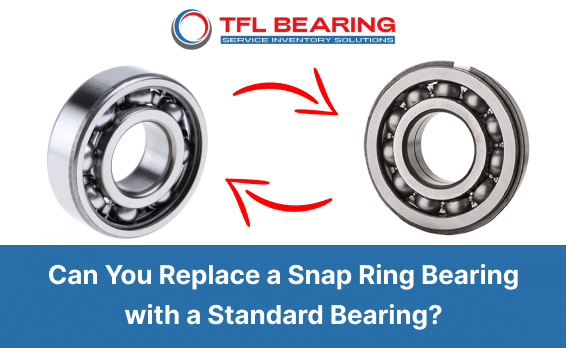
One of the most common and costly purchasing mistakes occurs when differentiating between an N vs NR bearing. A buyer orders a series of bearings assuming that the letter “N” denotes the complete snap ring assembly, only to unpack the shipment and discover outer rings with bare annular grooves—completely lacking the retaining rings required to secure them into the machine housing.
Whether you are configuring a new mechanical design or sourcing an urgent replacement for vintage equipment, this engineering guide clarifies the exact NR bearing meaning, deconstructs complex shield/groove designations, and outlines how to confirm specifications when original part markings are obliterated.
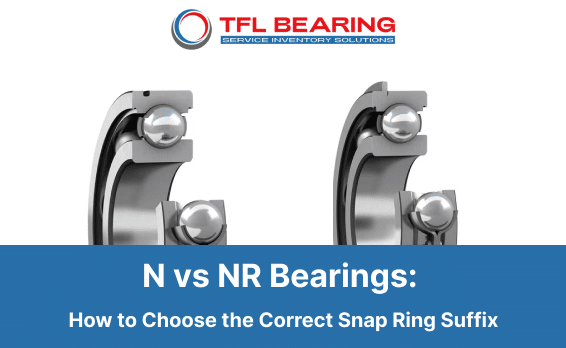
The Critical Difference: Bearing Suffix N vs. NR
Under international rolling bearing standards (such as ISO 464), the distinction between suffix N and NR is absolute:
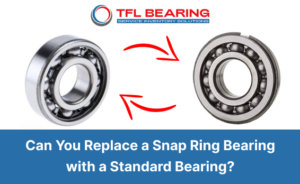
- Bearing Suffix N: Specifies a bearing with an annular snap ring groove precision-ground into the cylindrical outer ring, supplied without the snap ring.
- Bearing Suffix NR: Specifies a bearing with a snap ring groove in the outer ring, supplied complete with the matching spring steel snap ring (circlip) installed or packaged within the unit box.

Why Do Manufacturers Sell Suffix “N” Without the Ring?
If an assembly requires a snap ring to locate the bearing, why produce the N variation at all?
- Automated Mass Assembly: High-volume automotive transmission builders often feed proprietary retaining rings directly through robotic end-effectors, preferring loose rings sourced in bulk.
- Specialized Snap Ring Metallurgy: Standard rings are stamped from carbon spring steel (such as 65Mn or SAE 1070). Severe marine or corrosive washdown environments demand 304 or 316 stainless steel circlips, requiring engineers to order
Nbearings and fit specialized rings separately. - Inventory Consolidation: Maintenance cribs can stock loose standard snap rings compliant with DIN 5417, purchasing lower-cost
Ninventory to fulfill both plain-groove and ring-retained needs.

Decoding Complex Suffixes: Shields, Seals, and Ring Orientations
In practical applications, bearings rarely operate open. They incorporate metal dust shields (Z) or synthetic rubber contact seals (RS) to retain grease and prevent contaminant ingress.
Combining these protective elements with snap ring grooves produces composite suffixes that can be confusing to cross-reference:
| Bearing Designation | Shield / Seal Configuration | Groove Status | Snap Ring Included? | Primary Application Field |
|---|---|---|---|---|
| 6205 N | None (Open type) | Yes (ISO 464) | No | Enclosed oil-lubricated gearboxes |
| 6205 NR | None (Open type) | Yes (ISO 464) | Yes | Standard straight-bore gear cases |
| 6205 ZN | Single steel shield | Yes | No | Intermediate shafts with external grease feed |
| 6205 ZNR | Single steel shield | Yes | Yes | Drive motors with one-sided grease chamber |
| 6205 2ZN | Dual steel shields | Yes | No | OEM assembly lines using external circlips |
6205 2ZNR (or ZZNR) | Dual steel shields | Yes | Yes | Factory-greased electric tools, pumps |
6205 2RSNR (or 2RSHNR) | Dual contact rubber seals | Yes | Yes | Severe dust, moisture, and washdown units |
Understanding 2ZNR Bearing Meaning and Shield Orientation
What is the exact 2ZNR bearing meaning?
2Z(orZZ): Non-contact metal shields pressed into both the front and back faces of the outer ring, retaining factory polyurea or lithium grease for life.N: A precision locating groove ground into the outer diameter.R: A calibrated spring steel retaining ring seated in the groove.
Single-Shield Orientation Rule (ZNR): On bearings with a single shield, international standards mandate that the shield is placed on the side opposite the snap ring groove. This prevents the expanded snap ring from interfering with the shield crimp profile during housing insertion.
For severe duty applications requiring contaminant exclusion, our line of bearings with locating snap rings is available with dual contact NBR lip seals (2RSNR) engineered to maintain rotational torque efficiency while sealing against particulate contamination.
How to Identify the Correct Suffix When Markings Are Worn or Illegible
In industrial maintenance, bearings removed from service often have their face stampings obliterated by fretting corrosion, abrasive slurry, or aggressive cleaning solvents.
Follow this 3-step physical audit to reverse-engineer the exact configuration before issuing a purchase order:

Step 1: Measure Boundary Dimensions
Record the primary dimensions using a vernier caliper or external micrometer:
- Bore (d), Outside Diameter (D), and Width (B).
- Example: 25 mm × 52 mm × 15 mm confirms a 6205 baseline envelope.
Step 2: Measure ISO 464 Groove Geometry
Use a depth micrometer and blade caliper to record three critical parameters:
- Distance to Groove (a): Distance from the reference outer ring side face to the nearest groove edge.
- Groove Width (b): The axial width of the annular recess.
- Groove Diameter (d1): Measure the depth of the groove (t). The bottom diameter is calculated as:
d1 = D − 2t
If a, b, and d1 align with ISO 464 tables, the bearing utilizes standard metric locating hardware.
Step 3: Inspect the Machine Housing Fit
Examine the bore casting where the bearing was seated:
- Scenario A (Through-Bore with No Internal Shoulders): The housing is a continuous cylinder. The bearing outer ring relies exclusively on the ring to stop axial drift. You MUST order suffix
NR. - Scenario B (Internal Housing Circlip Groove): The machine housing has an internal circlip groove cut into its own cast bore, and an external retaining ring is already seated in the casting. A bearing with suffix
Nor standard plain OD may be called for.
When procurement teams are uncertain whether an assembly demands custom groove offsets or standard metric sizing, cross-referencing our technical matrix for NR type ball bearings ensures full compatibility with factory housing tolerances.
Brand Suffix Cross-Reference Matrix
Different global bearing manufacturers utilize varying suffix abbreviations for shielded and sealed snap ring combinations. Review this cross-reference chart before substituting parts:
| Feature Specification | TFL Bearing / ISO | SKF | NSK | NTN | FAG / Schaeffler |
|---|---|---|---|---|---|
| Groove Only | N | N | N | N | N |
| Groove + Ring | NR | NR | NR | NR | NR |
| Two Shields + Ring | 2ZNR | 2ZNR | ZZNR | ZZNR | 2ZR.NR |
| Two Contact Seals + Ring | 2RSNR | 2RSHNR | DDU NR | LLU NR | 2RSR.NR |
| Snap Ring on Shield Side | ZNB | ZNB | ZNBR | ZNB | Special order |
Summary Checklist: Choosing Between N and NR
To eliminate order errors and unplanned mechanical downtime:
- Never assume Suffix N includes the circlip. If your technicians need a plug-and-play unit out of the box, always order
NR. - Verify environmental exposure. For dusty or moisture-prone equipment, specify
2RSNR; for high-speed, enclosed drive systems, select2ZNRor openNR. - Check dimensional compliance. Verify that replacement circlips conform to DIN 5417 shear limits to guarantee adequate axial retention under dynamic thrust loads.
Explore our comprehensive catalog of snap ring groove ball bearings to source standard, high-clearance (C3), and custom engineered locating bearings with direct factory trace certification.