









Marine crane bearings are mission-critical slewing and rolling components designed to handle massive axial loads, severe overturning moments, and extreme corrosive saltwater environments. Their structural integrity is the absolute baseline for safe offshore lifting operations.
Here is the reality of offshore lifting.
A sudden gust of wind or a shifting wave can instantly multiply the load on a deck crane.
If the bearing yields under this eccentric stress, the entire crane structure collapses.
In this technical guide, we will break down the exact engineering parameters required to survive rough sea conditions.
You will learn about:
- Overturning moment capacity for heavy-duty slewing rings.
- Multi-lip seal designs that block aggressive saltwater.
- Induction hardening depths required to prevent raceway spalling.
For operations demanding zero margin for error, understanding these specifications is critical before replacing any rotating components on your marine deck machinery.
Heavy-Duty Slewing and Roller Bearings for Marine Cranes
The dual-function of slewing rings in deck cranes
The slewing ring is the mechanical heart of any marine crane.
It must perform two contradictory functions simultaneously: support hundreds of tons of dead weight while allowing precise, low-friction rotation.
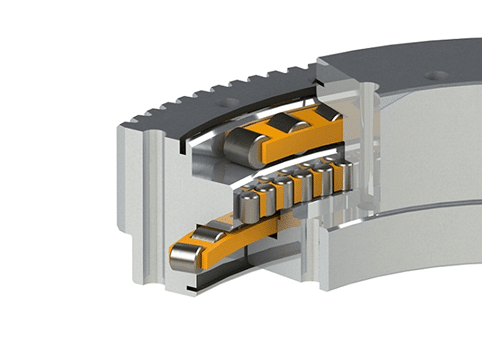
Unlike standard industrial bearings, marine slewing rings utilize a heavy-duty three-row roller configuration.
This design strictly separates the axial, radial, and tilting loads into distinct raceway paths, ensuring that a sudden shift in cargo weight does not cause localized micro-cracking.
High-capacity cylindrical roller bearings for winches and sheaves
Beyond the main rotation point, the lifting mechanism relies entirely on the winch drum and wire rope sheaves.
These components require bearings that can handle extreme radial forces generated by the tension of the lifting cable.
For these critical positions, we strongly recommend integrating high-capacity cylindrical roller bearings.
Their maximized line-contact geometry prevents the rollers from being crushed when a swinging load creates sudden shock impacts on the winch shaft.
Withstanding Axial and Overturning Moments Under Extreme Sea Conditions
Balancing static tilting moments in offshore lifting
Lifting a massive container on a rocking ship creates a lethal engineering scenario.
The center of gravity is pushed far outside the crane’s base, generating an immense overturning moment.
To counteract this, your marine crane bearing must possess an exceptional static load rating (C0).
The internal raceway geometry must be precisely machined to absorb these leveraged forces without allowing the raceway to deform plastically.
Dynamic load factor (fL) calculations for wind-resistant design
Offshore cranes do not operate in a vacuum.
High-velocity wind gusts constantly buffet the boom, creating unpredictable dynamic load spikes.
When selecting a replacement bearing, you must apply a rigorous dynamic load factor (fL) to your baseline calculations.
For severe marine applications, classification societies mandate an fL factor significantly higher than standard harbor cranes to ensure absolute structural safety during storm conditions.
Multi-Lip Sealing Protection for High-Salt Spray Environments
The three-stage barrier against saltwater ingress
Saltwater is highly corrosive and relentlessly seeks out microscopic vulnerabilities.
A standard single-lip seal will fail within weeks when exposed to continuous sea spray on an offshore rig.
Marine crane bearings demand a specialized multi-lip sealing system.
This design acts as a three-stage barrier: the outer lip deflects bulk wave water, the middle lip stops aerosolized salt, and the inner lip securely retains the critical lubricating grease.
Material selection for seawater-resistant seal lips
The geometry of the seal is useless if the material degrades under UV light or ozone exposure.
Standard Nitrile (NBR) rubber is entirely insufficient for extreme marine applications.
We engineer our seals using premium Fluoroelastomers (FKM / Viton) or highly saturated nitrile.
These advanced compounds maintain their elasticity in sub-zero arctic conditions and resist accelerated aging under the baking sun of tropical climates.
Expert Insight from Jessica Jia
In our accelerated environmental testing, we see standard commercial seals harden and crack after just a few months of simulated day-night temperature cycling on a ship’s deck. A cracked seal allows saltwater to emulsify the internal grease, destroying the bearing raceway in a matter of days. Always verify the seal material’s UV and ozone resistance ratings before authorizing a replacement for a deck crane.
Surface Anti-Corrosion Coating Standards and Hardening Depth
Zinc-nickel and thermal spray aluminum (TSA) coating benchmarks
Painting a marine bearing is not a corrosion strategy; it is merely a cosmetic band-aid.
To survive decades on a port terminal or offshore platform, the exposed surfaces must be metallurgically protected.
We utilize Thermal Spray Aluminum (TSA) or high-thickness Zinc-Nickel alloy plating.
These advanced coatings act as sacrificial anodes, providing active cathodic protection that stops rust from spreading even if the surface is scratched by a heavy steel cable.
Induction hardening layer depth: Ensuring raceway integrity
Marine cranes exert crushing, localized forces on the bearing raceway during a heavy lift.
If the surface is hard but the core is soft, the raceway will literally cave in—a catastrophic failure known as “core crushing.”
Our slewing rings undergo precise medium-frequency induction hardening.
We guarantee an effective case hardening depth sufficient to support extreme shock loads, ensuring the raceway maintains its perfect geometry under maximum crane capacity.
Failure Avoidance and Life Calculation for Port Crane Equipment
Preventing raceway spalling in intermittent high-load operations
Port cranes do not spin continuously; they swing, stop, hover, and reverse under immense loads.
This intermittent micro-movement squeezes the grease out of the load zone, leading to rapid metal-to-metal wear and raceway spalling.
To counteract this, you must implement a strict, automated lubrication protocol.
We highly advise reviewing our engineering team’s comprehensive guide on marine bearing lubrication maintenance to establish proper regreasing intervals for intermittent operations.
Life estimation models based on L10m standards
Predictive maintenance is infinitely cheaper than reactive downtime.
When selecting a marine crane bearing, you must demand L10m modified life calculations, not just basic theoretical lifespan numbers.
The L10m model factors in your actual operating conditions, including contamination levels, grease quality, and the specific dynamic load spectrum of your lifting equipment.
| Inspection Component | Recommended Interval | Critical Warning Signs (Red Flags) | Action Required |
|---|---|---|---|
| Multi-Lip Seals | Every 3 Months | Grease weeping or visible cracking | Schedule immediate seal replacement |
| Mounting Bolts | Every 6 Months | Loss of pre-tension torque | Re-torque to OEM specifications |
| Raceway Condition | Monthly (via sample) | Metallic particles in grease sample | Conduct ultrasonic (UT) inspection |
| Slewing Gear Teeth | Every 3 Months | Uneven wear patterns or pitting | Realign pinion and apply open gear grease |
*Note: This maintenance schedule is a baseline. Offshore platforms operating in severe storm corridors must increase inspection frequencies according to their specific classification society mandates.
Contact Engineering for Precise Crane Bearing Selection
Custom solutions for deck, harbor, and offshore cranes
Off-the-shelf bearings have no place in marine lifting operations.
Every vessel and port facility has a unique combination of maximum safe working loads (SWL), environmental exposure, and spatial constraints.
Selecting the wrong slewing ring or winch bearing will compromise your entire lifting geometry and invalidate your safety certifications.
Our engineering team specializes in configuring heavy-duty marine bearings that strictly comply with international maritime classification standards.
Whether you are retrofitting a 50-ton deck crane or designing a massive offshore heavy-lift vessel, we provide the metallurgical and dimensional precision you require.
Secure Your Offshore Lifting Operations Today
Do not risk catastrophic failure with substandard components. Submit your crane’s load parameters, and our engineers will provide a verified L10m life calculation and a custom bearing solution designed to withstand the harshest sea conditions.
Request a Technical Consultation & Quote
Frequently Asked Questions
What type of bearing is used in marine deck cranes?
Marine deck cranes primarily utilize heavy-duty three-row roller slewing bearings for the main rotational pivot. This design separates axial, radial, and tilting loads. Additionally, high-capacity cylindrical roller bearings are heavily used in the winch and sheave mechanisms to handle intense cable tension.
How do marine crane bearings resist saltwater corrosion?
Premium marine crane bearings utilize a multi-layered defense strategy. This includes advanced multi-lip seals made from UV-resistant Fluoroelastomers (FKM) to block saltwater ingress, combined with surface treatments like Thermal Spray Aluminum (TSA) or Zinc-Nickel plating to provide active cathodic protection against rust.
Why is L10m life calculation important for port cranes?
Standard theoretical lifespans do not account for the real world. The L10m modified life calculation factors in the specific operating conditions of a port crane, such as intermittent high-load swinging, grease contamination levels, and dynamic wind factors, providing a much more accurate predictive maintenance timeline.