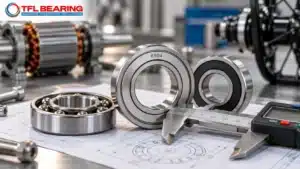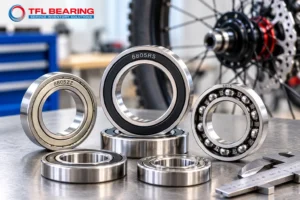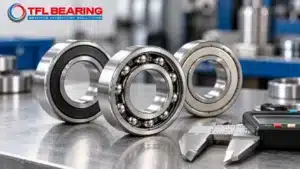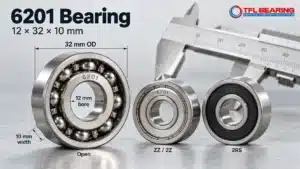







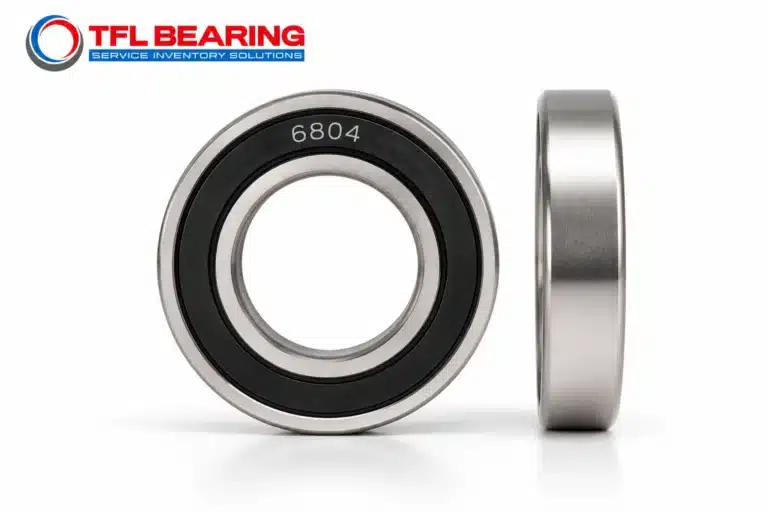
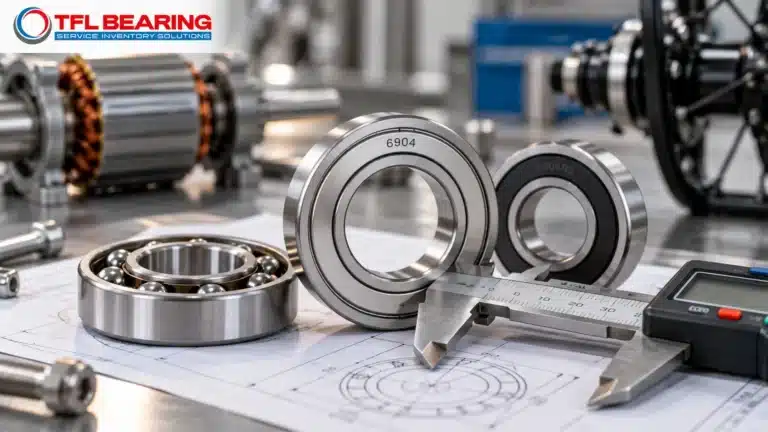
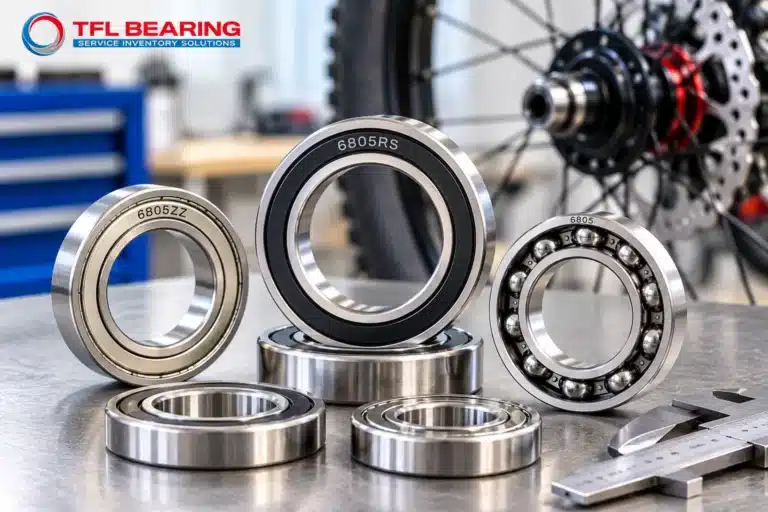
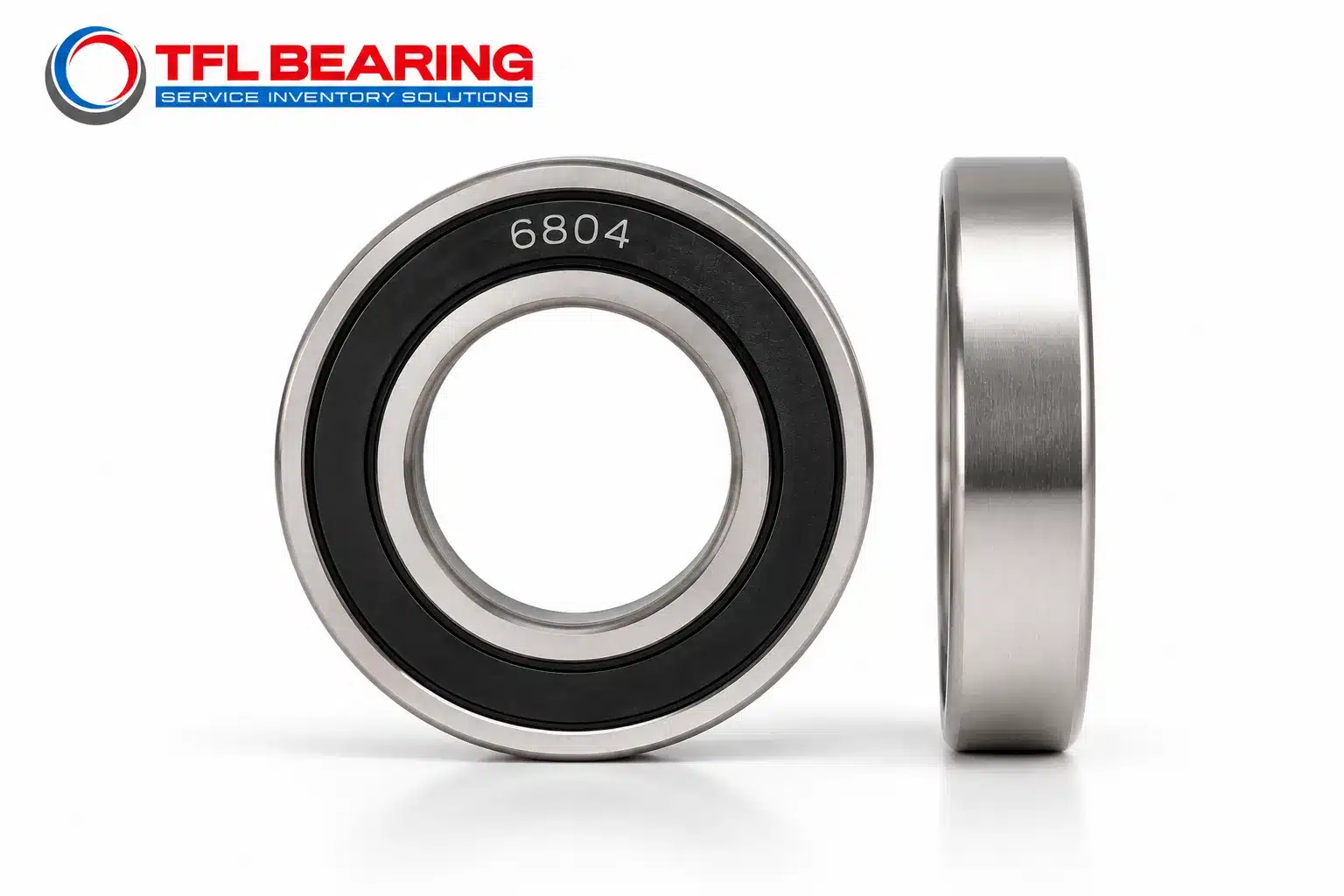
A 6804 bearing is a thin section, single row deep groove ball bearing with a 20 mm bore, a 32 mm outside diameter and a 7 mm width. Many brands sell the same size as 61804. It carries radial loads and light axial loads where space is tight.
This guide puts the size, load ratings, seal codes, tolerances and common mistakes in one place. That way you can order the right part the first time.
What Are the 6804 Bearing Dimensions?
The 6804 bearing dimensions are 20 x 32 x 7 mm, or 0.7874 x 1.2598 x 0.2756 inches. Those numbers are the bore (shaft size), the outside diameter (housing size) and the width. Every brand follows these ISO sizes, so any 6804 bearing fits the same shaft and housing.
To picture it, the 7 mm width is about as thick as a standard pencil.
| Specification | 6804 / 61804 (SKF data) |
|---|---|
| Bore (d) | 20 mm |
| Outside diameter (D) | 32 mm |
| Width (B) | 7 mm |
| Dynamic load rating (C) | 4.03 kN |
| Static load rating (C0) | 2.32 kN |
| Limiting speed, open | 28,000 r/min |
| Limiting speed, 2RS1 sealed | 13,000 r/min |
| Weight | about 0.018 kg (18 g) |
| Internal clearance | CN (normal) |
These figures come from SKF product data listed by RS Components (2026). The 6804 bearing weight of 0.018 kg also matches Schaeffler’s 6804H2RS listing on Kramp (2026). For standard steel options in other sizes, see our single row deep groove ball bearings.
Is 61804 the Same as a 6804 Bearing?
Yes. A 61804 bearing and a 6804 bearing share the same 20x32x7 size and swap directly. Only the name differs. SKF and FAG use the full ISO series code 618, while NSK, NTN, Nachi and Koyo shorten it to 6804. Still match the seal, clearance and precision class.
French retailer Alltricks (2026) notes that SKF’s current 61804 2RS1 replaced its older 6804 2RS1 name.
Here’s a catch most spec pages skip. Load ratings differ by brand. Schaeffler lists its 6804H2RS at 3,410 N dynamic and 1,970 N static (Kramp, 2026). That’s lower than SKF’s 4.03 kN and 2.32 kN. If your design runs near the limit, check that exact brand’s datasheet.
What Do ZZ, 2RS, LLB and LLU Mean?
These suffixes describe the closure on each side. ZZ means two metal shields. 2RS means two rubber contact seals. LLB is NTN’s rubber non contact seal, and LLU is NTN’s rubber contact seal. Contact seals block water and dust best, but they add friction and lower the top speed.
Think of a shield as a lid resting just above a jar. A contact seal is the lid screwed on tight.
| Version | Closure | Other brand codes | Dust and water protection | Speed impact |
|---|---|---|---|---|
| 6804 (open) | None | 61804 | None | Highest (SKF: 28,000 r/min) |
| 6804 ZZ | Two metal shields, non contact | 2Z, 61804 2Z | Good for dust, poor for water | Same as open |
| 6804 LLB | Two rubber seals, non contact | 2RZ (SKF) | Better than ZZ, poor for water | Same as open (NTN) |
| 6804 2RS | Two rubber seals, contact | 2RS1 (SKF), DDU (NSK), 2NSE (Nachi), H2RS (Schaeffler) | Excellent | Lower (SKF 2RS1: 13,000 r/min) |
| 6804 LLU | Two rubber seals, contact | NTN’s 2RS version | Excellent, very good for water | Limited by seal friction |
Protection notes follow NTN’s published comparison of its ZZ, LLB and LLU designs. Brand codes match MISUMI’s 6804 cross listing.
What about 6804RS vs a plain 6804? An RS has one rubber seal, and a plain 6804 bearing is fully open. If both sides face dirt, order 2RS.
Where Is the 6804 Ball Bearing Used?
A 6804 ball bearing fits anywhere a 20 mm shaft needs support in a slim housing. Common uses include bicycle bottom brackets, hubs and suspension pivots, robot joints, small gearboxes, rotary tables and packaging machines. Its thin rings save weight and space compared with heavier series.
Cyclists often know it as the Enduro 6804 sealed cartridge bearing. One Enduro reseller, Hi5Bikes (2026), says LLB seals suit hubs, while LLU seals suit suspension pivots.
For industrial builds where space is the limit, compare it with our thin section ball bearings range.
Steel, Stainless or Ceramic: Which Should You Choose?
Chrome steel (SAE 52100) suits most dry, indoor jobs and gives full load ratings. Stainless steel resists rust but carries less load. Hybrid ceramic pairs steel rings with ceramic balls for speed and electrical insulation. Full ceramic resists chemicals and magnetism, but it only suits light loads.
The stainless trade off is real. SKF lists its W 61804 2RS1 at 3.12 kN dynamic and 2.08 kN static (RS Components, 2026). That’s about 23% less dynamic capacity than chrome steel. For food or washdown lines, see our stainless steel deep groove ball bearings.
Full ceramic versions, like VXB’s ZrO2 6804 2RS with a PTFE cage, run dry or with grease you add. They shine in acids and cleanrooms, not under heavy shock.
What about a 6804 hybrid ceramic bearing ABEC 7? ABEC 7 is an ABMA precision class, close to ISO P4. It means tighter runout, which helps high speed spindles. On a slow pivot, you’d pay for precision you won’t feel. For motors with stray current, hybrid designs overlap with our electrically insulated bearings.
What Are the 6804 Tolerances and Clearance?
A standard 6804 bearing is made to ISO 492 normal class (ABEC 1). For this size, the bore can be up to 0.010 mm undersize, the outside diameter up to 0.011 mm undersize, and the width up to 0.120 mm undersize. Radial internal clearance is normally CN.
That 0.010 mm is roughly one seventh the thickness of a human hair. Pick C3 clearance when the inner ring runs much hotter than the housing, as in some motors.
Common Mistakes When Replacing a 6804 Bearing
- Matching size only. Swapping a 2RS in for an open bearing can halve the safe speed.
- Assuming every brand has the same ratings. As shown above, they don’t.
- Pressing on the wrong ring. If the inner ring fits tight on the shaft, push on the inner ring. Force through the balls dents the raceways.
- Confusing a 6804 bearing with a 6004. Both have a 20 mm bore, but a 6004 is 42 mm across and 12 mm wide.
- Picking full ceramic for a loaded pivot. It’s built for corrosion, not shock.
- Trying to regrease a sealed unit. Schaeffler lists its 6804H2RS as not regreasable.
Limitations to know: thin rings distort easily in an out of round housing. This size also tolerates little misalignment, and its load capacity is modest. If you need more load on a 20 mm shaft, step up to a wider series.
Quick tip: read the ring marking, measure all three sizes with calipers, note the seal code, then confirm your match with our bearing cross reference guide.
Conclusion
The 6804 bearing looks simple, but it hides plenty of choices. The size is fixed at 20x32x7 mm, yet seals, material, clearance and brand ratings change how it performs. Match all of them, not just the number. Ready to order? Send your model, quantity and application to the TFL sourcing team for a fast quote.
FAQs
How long does a 6804 bearing last?
It depends on load, speed, dirt and lubrication. Engineers estimate it with the ISO 281 L10 rating life method, using the dynamic load rating. In real use, good seals and clean grease often matter more than the math.
Does a 6804 bearing handle axial load?
Yes, light axial loads in both directions, thanks to its deep raceway grooves. For heavy thrust, an angular contact ball bearing is a better fit.
Can I remove one seal from a 6804 2RS?
Yes. Suppliers such as USA Bearings and Belts note you can remove one seal or shield if your design needs a single side closure. Work gently so you don’t bend the seal or scratch the ring.
Is there a 6804 with a snap ring?
Yes. Versions marked N or NR have a groove in the outer ring for axial location, such as 6804N or 6804 ZZ NR.
Can I order 6804 bearings from TFL in small quantities?
MOQ depends on the model and spec. TFL supports small MOQ orders, OEM packaging and pre shipment inspection, so share your requirements for an exact quote.