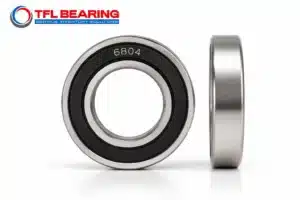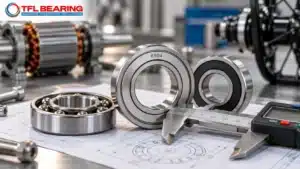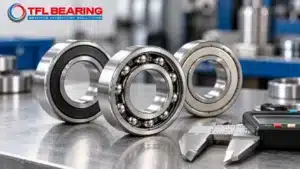







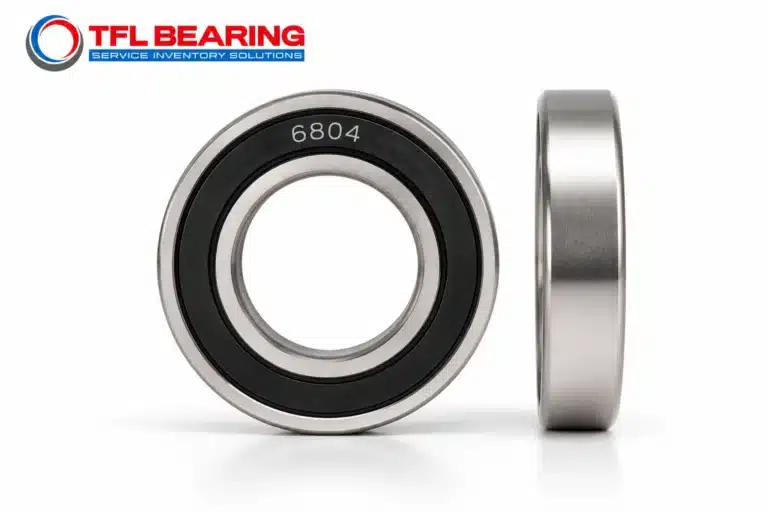
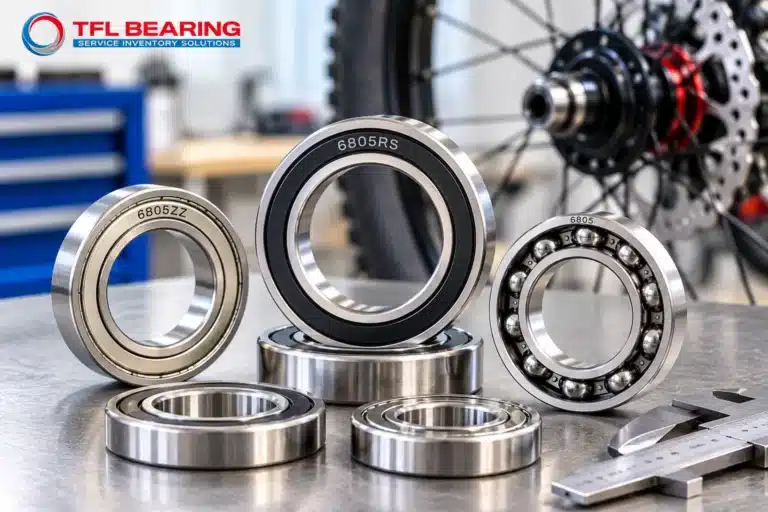
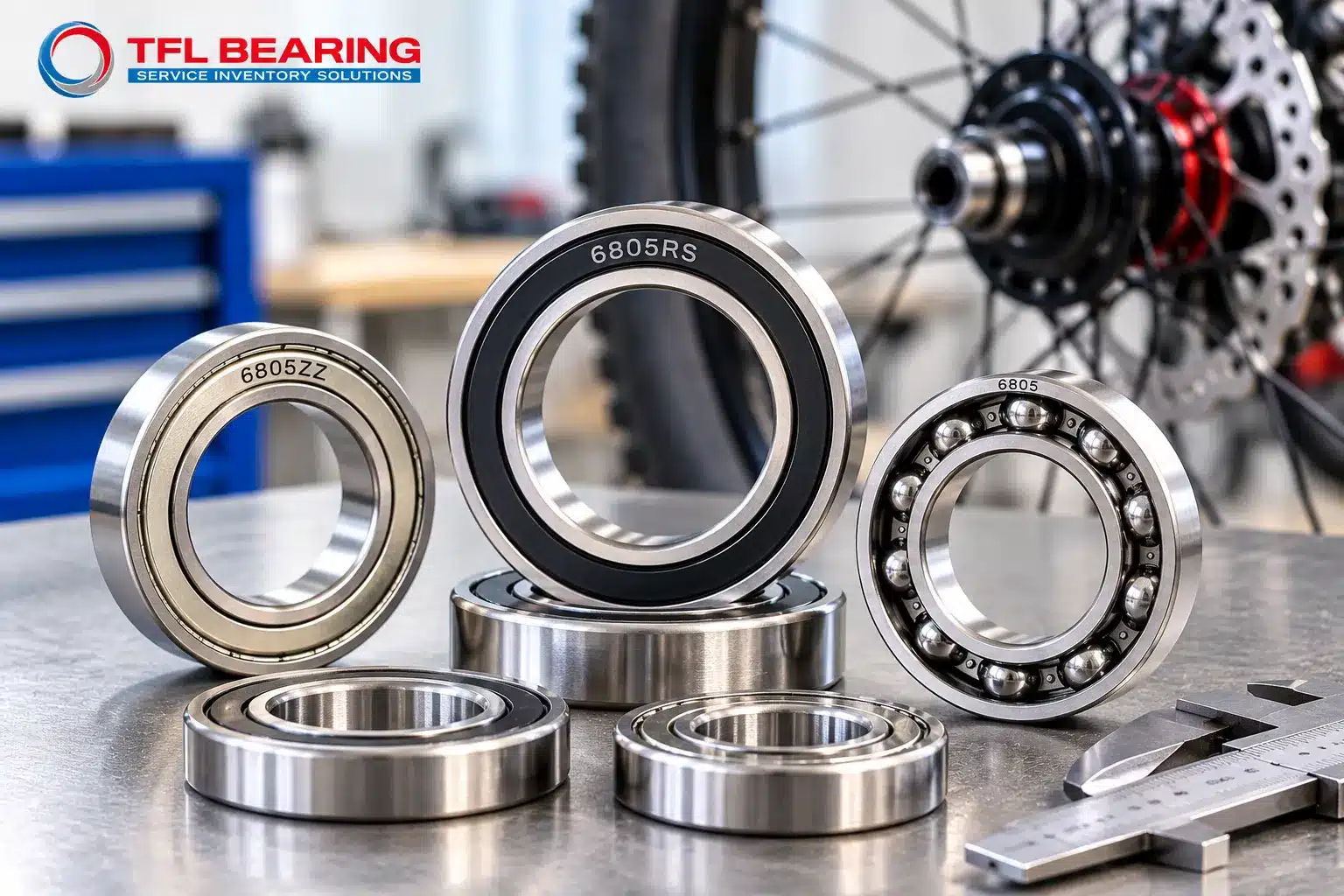
A 6805 bearing is a thin, single row deep groove ball bearing that measures 25 mm bore, 37 mm outside diameter and 7 mm width. Most sellers write that as 25x37x7. You’ll find it in bike hubs, suspension pivots, ebike motors, robots and compact machines.
SKF and FAG sell the same size as 61805. The letters after the number tell you the seal, and that choice matters more than most buyers think. This guide covers specs, seal codes, brand equivalents, bike fit, ceramic options and the mistakes that lead to a second order.
What are the 6805 bearing dimensions and size?
The 6805 bearing has a 25 mm bore, a 37 mm outer diameter and a 7 mm width. It weighs about 22 grams. The size follows the ISO metric plan, so a 6805 bearing from SKF, NSK, NTN, FAG or Koyo fits the same shaft and housing. Only the closure, clearance and precision grade change.
Here’s a handy picture. A 6205 also has a 25 mm bore, but it’s 52 mm across and 15 mm wide. The 6805 bearing shares that bore yet is far slimmer, like a saucer next to a soup bowl. That slim shape puts it in the 6800 thin series.
Key specs
| Spec | Value |
|---|---|
| Bore (d) | 25 mm |
| Outer diameter (D) | 37 mm |
| Width (B) | 7 mm |
| Weight | About 22 g |
| Basic dynamic load rating (C) | 4.30 to 4.36 kN |
| Basic static load rating (C0) | 2.6 to 2.94 kN |
| Limiting speed, open | 24,000 to 28,000 rpm |
| Limiting speed, 2RS sealed | About 11,000 rpm |
| Minimum shaft shoulder | 27 mm |
| Maximum housing shoulder | 35 mm |
| Maximum fillet radius | 0.3 mm |
These ratings come from SKF 61805 and Schaeffler FAG 61805 product data published by authorized distributors (2026). Each brand rates a little differently, so check the maker’s catalog for your exact part.
What do 2RS, ZZ, 2RZ and LLB mean on a 6805 bearing?
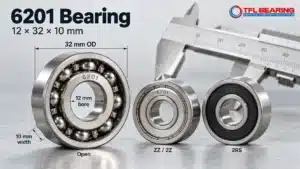
These codes name the closure on each side. 2RS means rubber seals that touch the inner ring. ZZ means metal shields with a tiny gap. 2RZ (SKF) and LLB (NTN) are rubber seals that don’t touch, so they spin more freely. An open bearing has no closure. The size stays 25x37x7 for all of them.

Think of a contact seal like a squeegee on a window. It wipes away dirt well but adds drag. A non contact seal is more like a door with a thin gap: less drag, a bit less protection.
| Type | Closure | Water and dirt protection | Relative speed | Good fit |
|---|---|---|---|---|
| Open | None | Low | Highest | Oil bath gearboxes, sealed housings |
| ZZ | Two metal shields | Dust only | High | Clean, dry motors and fans |
| 2RS (SKF 2RS1, NSK DDU, NTN LLU) | Contact rubber seals | Best | Lowest | Bike hubs, pivots, outdoor gear |
| 2RZ, LLB, NSK VV | Non contact rubber seals | Good | High | Ebike motors, robots, conveyors |
| Hybrid ceramic | Usually sealed | Depends on seal | High | Race wheels, inverter motors |
The 6805 ZZ bearing dimensions match the 2RS exactly. Only protection and drag change. SKF data shows why that matters: the open 61805 is rated to 24,000 rpm, the 2RZ to 19,000 rpm and the 2RS1 to about 11,000 rpm.
TFL’s deep groove ball bearings range covers open, shielded and sealed designs, so you can compare closure options in one place.
Which brands make the 6805 bearing, and are they interchangeable?
Yes, they’re interchangeable on size. SKF and FAG label it 61805, while NSK, NTN and Koyo label it 6805. All share 25x37x7. Seal codes differ, so match the closure type, internal clearance and precision grade. Don’t just copy letters from the old part. An SKF 61805 2RS1 and an NSK 6805 DDU are both contact sealed.
| Brand | Part number | Contact seal | Non contact seal | Shields |
|---|---|---|---|---|
| SKF | 61805 | 2RS1 | 2RZ | 2Z |
| NSK | 6805 | DDU | VV | ZZ |
| NTN | 6805 | LLU | LLB | ZZ |
A search for an SKF 6805 bearing usually lands on a 61805 page, so don’t worry when the number looks different. LLB seals are popular in bike hubs. Enduro Bearings, a cycling brand, lists its 6805 LLB with 52100 steel races and ABEC 3 precision for hub use (2026).
Stainless versions trade load for rust resistance. SKF rates its W61805 2RS1 at 3.38 kN dynamic. That’s about a fifth lower than chrome steel.
When the old part number is worn off or from an unfamiliar maker, a bearing cross reference check against dimensions, load and seal type saves guesswork.
Can you use a 6805 bearing in a bike bottom bracket or hub?
In hubs, often yes. In bottom brackets, check first. BB30 and PF30 shells use the 6806 (30x42x7) for 30 mm spindles. Many 24 mm spindle brackets, like BB86 and BB92, use a 24x37x7 bearing. It looks like a 6805 bearing but has a 1 mm smaller bore, so a true 6805 won’t fit that spindle.
Bike shops also list the 6805 2RS for suspension pivots, linkages and ebike motors. In a hub, replace both bearings as a pair. Press only on the outer ring when fitting it into the hub shell. Pressing on the inner ring pushes force through the balls and can dent the races.
Is a 6805 ceramic bearing worth it?
Sometimes. Most ceramic 6805s are hybrids: steel rings with silicon nitride balls. They’re lighter, harder and don’t conduct electricity, which helps in motors driven by inverters. They cost much more, though. They won’t fix a bad seal, a dirty setting or a poor fit. For daily riding, a quality steel 2RS is usually the smarter buy.
If stray current is your real problem, compare hybrids with other electrically insulated bearings before you decide.
What are the limits of a 6805 bearing?
Thin rings mean modest load capacity, around 4.3 kN dynamic. The 6805 bearing handles only light axial load and very little misalignment. Heavy shock, strong thrust or a bent shaft will shorten its life fast. For those jobs, a 6005 (25x47x12) or 6205 (25x52x15) carries far more.
The upside is space. When a design needs a large bore in a tiny cross section, thin section ball bearings like the 6800 family are the natural pick.
Common mistakes to avoid
- Mixing up sizes. People confuse the 6805 with 24x37x7 or with the 6806. Measure bore, outer diameter and width with calipers.
- Using a 2RS in a fast motor. Contact seals heat up at high rpm. A 2RZ, LLB or ZZ may suit better.
- Ignoring clearance. C3 means extra internal play for hot running or tight fits. Copy the old suffix.
- Choosing ABEC 5 for a muddy trail bike. Precision won’t beat a good seal in dirt.
- Reusing a pressed out bearing. Removal often damages it, so fit a new one.
- Cleaning sealed bearings with solvent. Solvent can wash grease out past the seal.
Conclusion
The 6805 bearing is simple once you can read its code: 25x37x7, then a seal suffix, then clearance and grade. Measure first, match the seal to the job and confirm the brand equivalent. Need a fast match? Send your old part number or drawing to TFL Bearing for a cross check and quote. That’s the easiest way to get the right 6805 bearing the first time.
FAQs
Can I swap a 6805 2RS for a ZZ?
Yes. Both are 25x37x7. The ZZ spins with less drag but lets water in, so keep it for dry, clean spots.
How do I identify a 6805 bearing with no markings?
Use calipers. A 25 mm bore, 37 mm outer diameter and 7 mm width confirms the size. Then check whether the seal touches the inner ring.
What ABEC grade should I choose?
ABEC 3 suits most bikes and general machines. ABEC 5 or higher suits fast, precise spindles. A higher grade means tighter tolerances, not longer life in dirt.
What other bearings have a 25 mm bore?
The common ones are the 6705 (25x32x4), 6805 (25x37x7), 16005 (25x47x8), 6005 (25x47x12) and 6205 (25x52x15). Each step up adds load capacity but takes more space.
Can TFL Bearing supply 6805 bearings for bulk or mixed orders?
TFL Bearing is a China based B2B sourcing partner. It handles mixed model orders, brand cross reference and pre shipment inspection. The minimum order depends on type and spec, so send your requirements for an exact quote.