







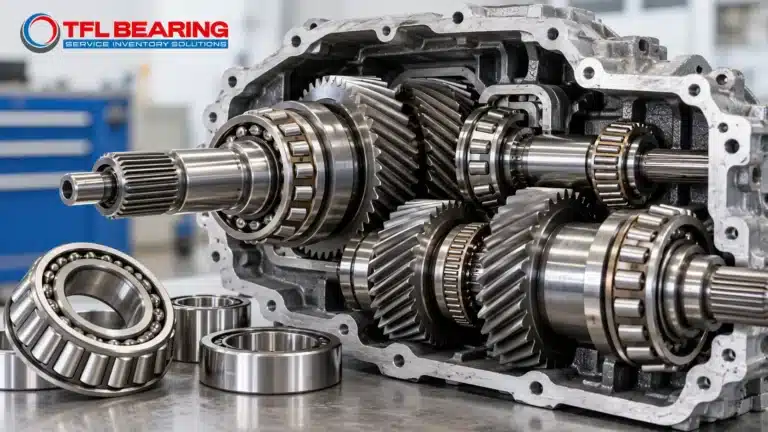
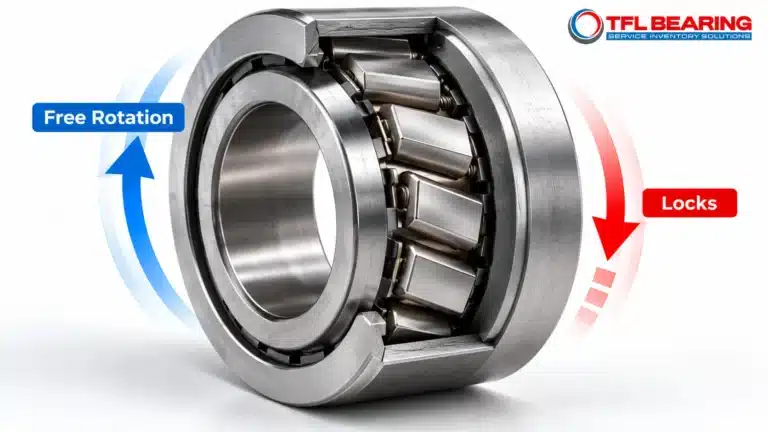
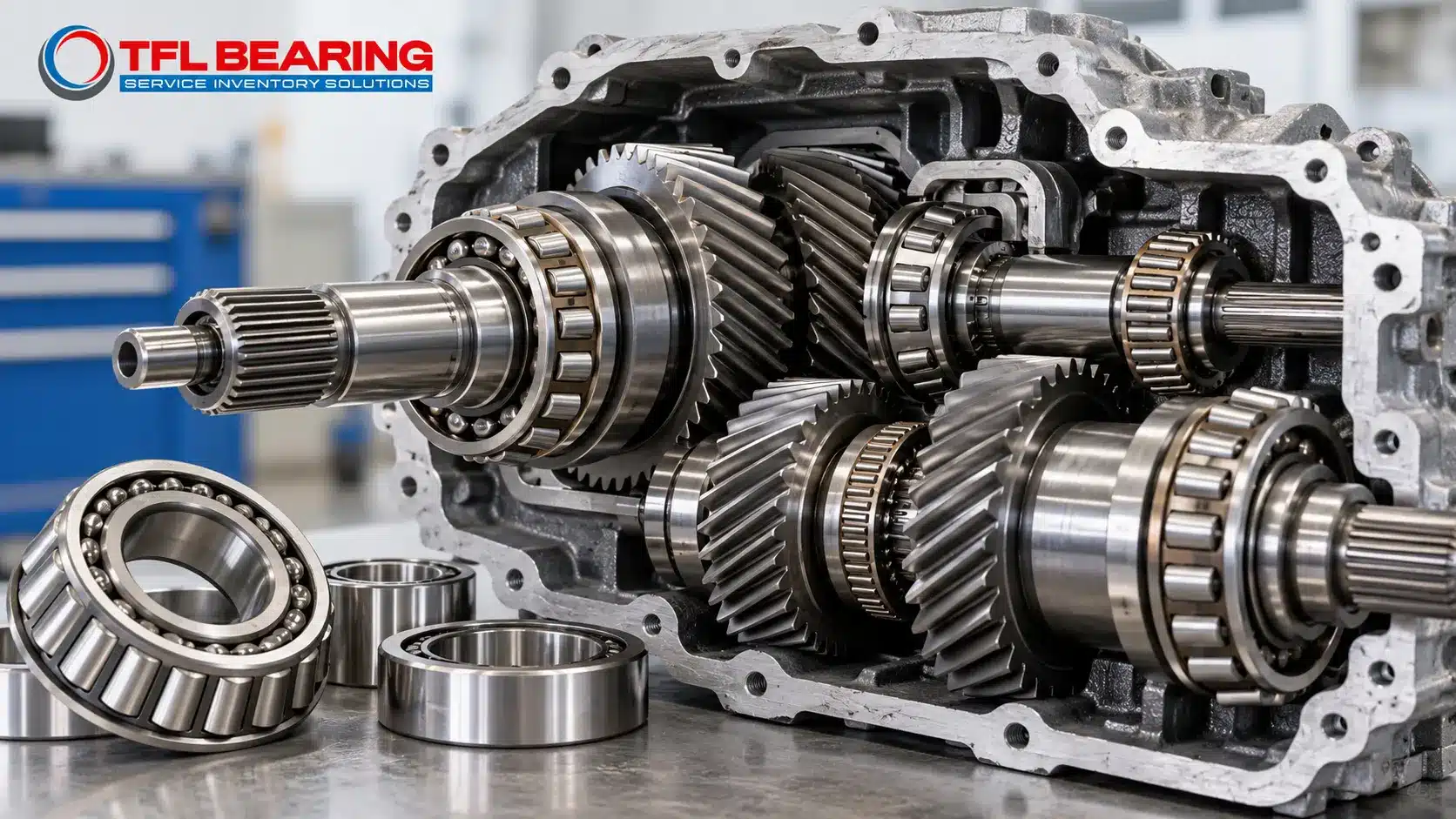
A gearbox bearing is the part that holds each shaft inside a gearbox and lets it spin with very little friction. It carries the force from the meshing gears, so the teeth stay lined up, quiet and cool. When one wears out, the noise, heat and damage spread fast.
Below, you’ll learn about the bearings in gearbox designs for cars and industrial machines, where each one sits, why they fail, and how to pick the right replacement.
What does a gearbox bearing do?
Every gearbox bearing supports a rotating shaft and holds it in the exact spot the gears need. It carries radial load, which pushes across the shaft, and axial load, which pushes along it. Get that support right and the gears mesh cleanly, with low noise, low heat and long life.
Picture a door hinge. Radial load is the door’s weight hanging on it. Axial load is someone pushing the door up along the pin.
Spur gears create mostly radial loads. Helical gears, with their angled teeth, also push the shaft along its length, a bit like a screw. That’s why a gearbox thrust bearing or a tapered roller design shows up so often in helical boxes.
Where are the bearings in a gearbox?
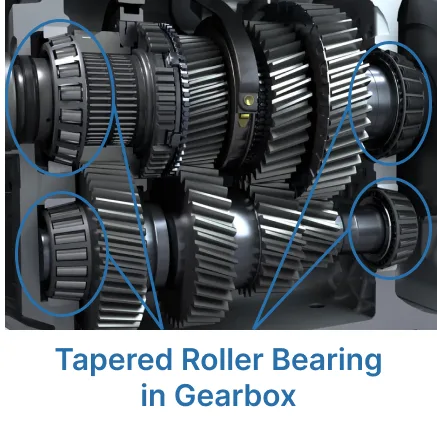
A typical manual car gearbox has four main bearing positions: the input shaft, the output shaft, the countershaft and the differential. Industrial gearboxes add more, such as planet gear bearings in planetary units and thrust bearings on worm and bevel pinion shafts.
- Input shaft: The gearbox input shaft bearing takes power from the engine through the clutch. It spins whenever the clutch is engaged, so it’s often the first one you hear.
- Output shaft: This output shaft bearing sends power to the wheels or the driven machine.
- Countershaft (layshaft): It supports the shaft that carries power between input and output.
- Differential: This bearing lets the wheels turn at different speeds in corners. Tapered rollers are common here. Our pinion vs carrier bearing guide covers the differential in more detail.
Most shafts use a fixed and floating setup. One bearing locates the shaft so it can’t slide. The other floats, so the shaft can grow as it warms up without jamming. NSK’s guide, Rolling Bearings for Industrial Gearboxes, explains these arrangements in detail.
What are the main gearbox bearing types?
The types of bearings used in gearboxes are mainly deep groove ball, angular contact ball, tapered roller, cylindrical roller, spherical roller, needle roller and thrust bearings. Light gearboxes lean on ball and needle bearings. Big, heavily loaded gearboxes favor roller bearings, because rollers touch the raceway along a line instead of a single point.
| Bearing type | Main load | Speed | Handles tilt? | Typical gearbox position |
|---|---|---|---|---|
| Deep groove ball | Radial, light axial | High | Little | Input and output shafts in light gearboxes |
| Angular contact ball | Radial plus one way axial | High | Little | High speed shafts, often in pairs |
| Tapered roller | Heavy radial plus axial | Medium | Little | Differentials, countershafts, helical pinions |
| Cylindrical roller | Very high radial | High | Little | Floating end of heavy shafts |
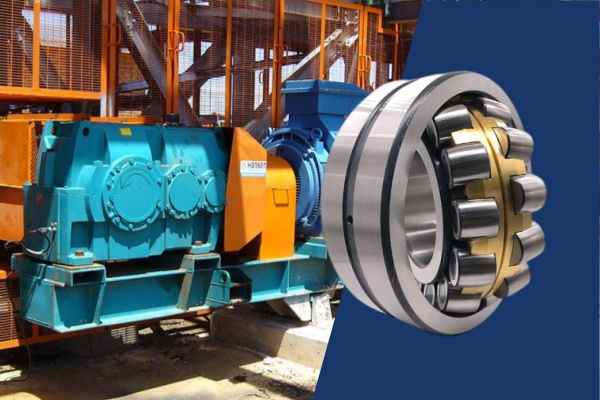
| Spherical roller | Heavy radial, some axial | Medium | Yes | Large industrial and wind gearboxes |
| Needle roller | High radial in tiny space | Medium | Little | Under free spinning gears, planet gears |
| Thrust bearing | Axial | Low to medium | Some designs | Worm shafts, extruder gearboxes |

Schaeffler notes that larger gearboxes rely on spherical, cylindrical and tapered roller bearings for load capacity, while lightweight units prefer ball and needle bearings. Many shafts mix types. Lubrizol points out that ball bearings often pair with tapered rollers on the same shaft.
On a heavy shaft, cylindrical roller bearings usually take the floating position, because their rings can shift slightly as the shaft expands. When axial force is high, as in extruders or big worm units, designers add a gearbox thrust bearing. Spherical roller thrust bearings are a common choice when the shaft may also tilt slightly. See our thrust bearing types guide for how each design works.
Here’s a real example. SKF’s transmission bearing kit for some VAG 5 and 6 speed manual gearboxes uses two grooved ball bearings in a pressed steel carrier. The carrier holds both at the exact spacing and clearance, which cuts noise and friction.
How do gearbox bearings differ in planetary, worm and bevel gearboxes?
Not every gearbox bearing does the same job. The gear type changes the load, so it changes the bearing.
Planetary gearboxes
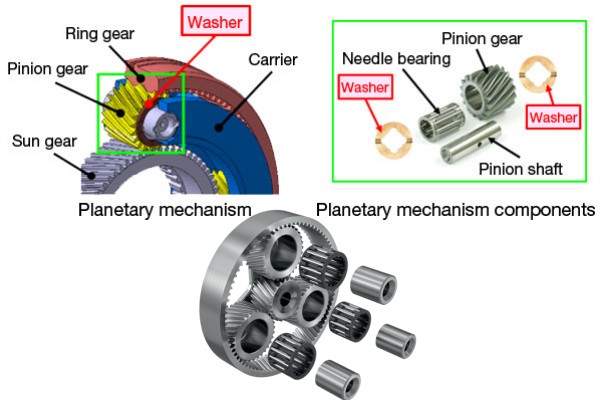
In a planetary unit, small planet gears circle a central sun gear. Each planet spins on its own pin, so the planet gearbox bearing has to fit inside the gear itself. That’s why needle roller and cylindrical roller bearings are common here. They carry high radial load in a thin cross section. Big planetary units, such as wind turbine gearboxes, also use large bearings to hold the planet carrier.
Worm gearboxes
A worm pushes hard along its own shaft every time it drives the wheel. So the worm shaft gearbox bearing must handle strong axial load in one or both directions. Tapered roller bearings mounted in pairs are the usual answer, with angular contact ball bearings on smaller units. Worm boxes also run hotter than other designs, because the teeth slide more than they roll, so internal clearance and oil choice matter even more.
Bevel and hypoid gearboxes
Bevel gears turn power through a corner. The pinion tries to push itself out of mesh, so its bearings must hold it firmly in place. Designers often fit two tapered roller bearings with a set preload. If that preload drops, the tooth contact pattern shifts and the gears start to whine.
What causes gearbox bearing failure?
Most gearbox bearing failure starts with lubrication: too little oil, dirty oil, the wrong viscosity or oil that’s simply worn out. Next come contamination, misalignment, overload, poor fits and careless installation. Fatigue is the natural end of a bearing’s life, but in a healthy gearbox it should arrive late, not early.
Contamination is easy to picture. A grain of grit in the oil acts like sand in your shoe. Every turn presses it into the raceway and leaves a dent that grows.
Even big, well designed units suffer. A 2024 study in Heliyon looked at failed bearings from a wind turbine gearbox. It reported that these bearings often fail at just 5% to 20% of their design life by flaking, where small pieces of steel peel off the raceway like old paint. The authors recommended better oil filtration.
What does gearbox bearing damage look like?
When you open a gearbox, the bearing surfaces tell you what went wrong. ISO 15243 groups bearing damage into families such as fatigue, wear, corrosion, electrical erosion, plastic deformation and fracture. Here’s how the common ones look on a gearbox bearing.
- Flaking or spalling: Flakes of metal lift from the raceway. It’s classic fatigue, often sped up by dirty oil or overload.
- Dents: Small pits all over the raceway point to hard particles in the oil. Evenly spaced dents at the roller spacing usually mean impact or a bad press fit.
- Smearing: Dull, torn patches show that rollers skidded instead of rolling, often under very light load at high speed.
- Rust and etching: Brown marks or dark stains mean water got into the oil.
- Blue or brown color: The bearing ran too hot, usually from low oil, too much preload or too little clearance.
- Washboard marks: Fine grey lines across the raceway can come from electric current passing through the bearing, a growing issue in gearboxes driven by inverter fed motors.
Keep the failed gearbox bearing and photograph it before cleaning. The damage pattern is your best clue to the real cause.
How can you tell if a bearing inside a gearbox is worn?
Watch for whining, humming, rattling or grinding that changes with speed, plus rising oil temperature, new vibration and metal particles on the magnetic drain plug. In a manual car, a noise at idle in neutral that stops when you press the clutch often points to the gearbox input shaft bearing.
Here’s why. Pressing the clutch stops the input shaft, so its bearing goes quiet. A worn clutch release bearing usually does the opposite and gets louder with the pedal down.
In factories, teams track the same signs with vibration analysis and oil analysis, often weeks before anything breaks.
How should a gearbox bearing be lubricated?
Most gearbox bearings share the gear oil. Turning gears throw oil around the case, and it runs down into the bearings. That’s called splash lubrication. In some boxes, the lower bearings simply sit in an oil bath. Large industrial units often pump oil through filters and coolers, then spray it right where each gearbox bearing needs it.
A few bearings sit above the oil line or behind seals. These are often sealed, grease filled types, so check the old part before you order.
- Change oil on time. Old oil loses its additives and carries more wear metal.
- Keep water out. Even a little water in the oil can cut bearing fatigue life sharply. Milky oil is a warning sign.
- Use the right viscosity. Too thin and the oil film breaks. Too thick and the bearing runs hot and churns.
- Filter it. On circulating systems, a fine filter is cheap insurance for every gearbox bearing in the box.
Oil analysis helps here. A lab report shows wear metals, water and particle counts, so you can spot trouble before you hear it.
How do you choose a gearbox roller bearing or ball bearing?
Match the bearing to load direction, load size, speed, space, alignment and lubrication. Then copy the original’s exact size, internal clearance, cage, seals and precision class. Schaeffler lists load, speed, required life, lubrication and shaft arrangement as the factors that matter most for gearbox applications.
Here’s a quick rule of thumb. Pick a ball bearing when speed is high and load is light to moderate, such as on a small input shaft. Pick a roller bearing when load is heavy, shocks are common or the shaft carries large gears. Rollers spread the force along a line, so they carry more load in the same space. Ball bearings run with less friction, so they suit fast, light duty shafts. When axial force is part of the job, look at angular contact ball or tapered roller designs first, and check how the original gearbox bearing was arranged before you change anything.
- Read the full part number. A suffix like C3 means extra internal clearance, like buying shoes half a size up so your feet can swell. Gearboxes run warm, so it matters.
- Set preload exactly. Tapered roller pairs need the preload in the service manual.
- Use the right oil. Follow the maker’s grade and fill level.
- Check equivalents. If you’re switching brands, use a bearing cross reference guide to match dimensions and load ratings first.
How do you replace a gearbox bearing?
The exact steps depend on the gearbox, so follow the service manual. Here’s the general process a technician uses to replace a gearbox bearing.
- Drain the oil and check it. Look at the drain plug and the oil for metal, water or a burnt smell.
- Mark and remove parts in order. Take photos as you go, so shims and spacers go back in the same place.
- Pull the old bearing. Use a puller or press. Don’t hammer the shaft.
- Inspect the shaft and housing. Worn or scored seats will ruin a new gearbox bearing fast.
- Fit the new bearing. Press only on the ring with the tight fit, or warm the bearing with an induction heater. Bearing makers generally advise keeping it below about 120 °C.
- Set end play or preload. Use the shims and measurements in the manual.
- Refill and test. Add the right oil, run the gearbox, then check noise, temperature and leaks.
What should you send a gearbox bearing supplier?
A quick, complete request gets you the right gearbox bearing the first time. Before you ask for a quote, gather these details:
- The full part number and brand from the old bearing, including every suffix.
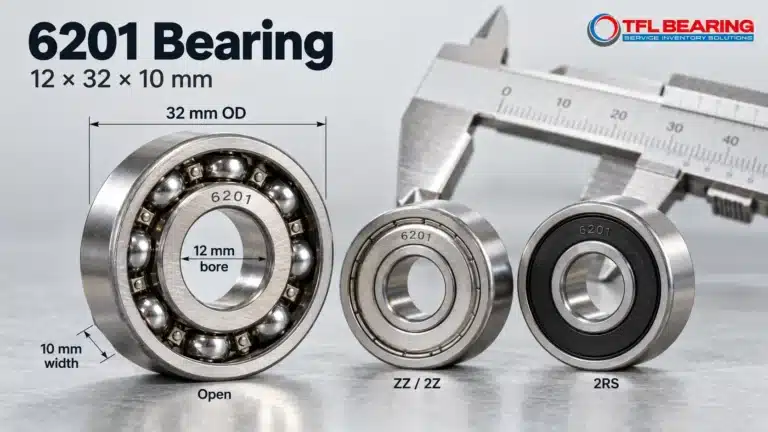
- Bore, outside diameter and width, measured with calipers if the markings are worn.
- The gearbox make, model and the shaft position.
- Speed, load type and running temperature, if you know them.
- Clear photos of the old part, its seals and any markings.
- The quantity you need now and per year.
With that list, a supplier can check equivalents, confirm clearance and match the gearbox bearing to your application.
What mistakes shorten bearing life?
- Replacing a bearing without finding why it failed. The new one often fails the same way.
- Pressing a bearing on through the wrong ring, which dents the raceways.
- Running the gearbox low on oil, or overfilled.
- Swapping a C3 bearing for a normal clearance one.
- Blaming the clutch release bearing when it’s really the input shaft bearing.
What can’t noise alone tell you?
Sound is a clue, not proof. A wheel bearing can mimic a gearbox one. If the noise follows road speed rather than engine speed, check the wheels first.
A mechanic’s stethoscope or a simple vibration pen can help you narrow it down. Touch it to the case near each shaft and listen for the loudest spot. That still isn’t proof, but it tells you where to look first.
Some worn input bearings stay noisy for years, while others break their cage suddenly. And most fixes mean opening the gearbox, which takes presses, pullers and experience.
The bottom line
A gearbox bearing is small, but it decides how long the whole gearbox lives. Know which type sits on each shaft, keep the oil clean, and act early on new noise or heat. Your next step: note the part number on your old bearing and match it exactly before you buy.
FAQs
How long do gearbox bearings last?
It depends on load, speed, oil quality and maintenance. With good care, they can last many years, and sometimes the full life of the machine.
Can I keep driving with a noisy input shaft bearing?
Often for a short time, but the noise usually grows. A failing bearing can also damage the input seal and leak oil onto the clutch, so get it checked soon.
Is a transmission bearing the same thing?
Yes, in most cases. Transmission and gearbox mean the same thing here, so the bearings are the same parts.
Can I replace the bearings in a gearbox myself?
Only with the right tools and skill. You’ll need a press, pullers and the service manual for preload. Poor fitting can cause more damage.
What is the most common gearbox bearing type?
In car gearboxes, deep groove ball, tapered roller and needle roller bearings are the most common. Large industrial gearboxes rely more on cylindrical, tapered and spherical roller bearings.
Should I replace every gearbox bearing at once?
If the gearbox is already open and the bearings have high hours, many shops replace them all. Metal from one failed gearbox bearing can damage the others, so inspect every one carefully.
Does TFL Bearing supply bearings for gearboxes?
Yes. TFL sources ball and roller bearings for gearboxes, with cross reference checks and inspection before shipment. Minimum order depends on the model, so send your list for a quote.