







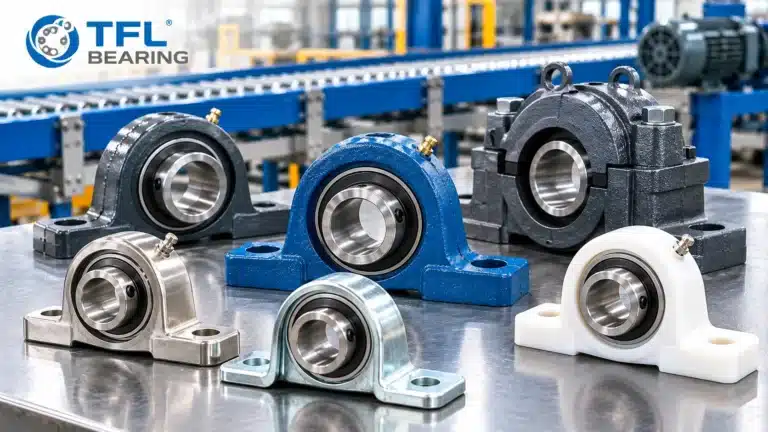
A flange bearing is a bearing with a flat, extended rim (the flange) that lets you bolt it to a surface or seat it in a housing, so the shaft stays exactly where it should. The term actually covers three different parts: bolt on mounted units, flanged ball bearings and flanged sleeve bearings. This guide shows you how to tell them apart and pick the right one.
Most guides cover only one family. That’s why buyers so often order the wrong part. Let’s fix that.

What Is a Flange Bearing?
A flange bearing is any bearing with a protruding rim used to mount or locate it. On a mounted unit, the flange is part of a housing you bolt to a flat surface. On a flanged ball or sleeve bearing, the flange is a lip on the outer ring that stops the bearing sliding through its bore.
Think of a coat hook versus a shirt button. Both hold things in place, but you’d never swap one for the other. Flanged bearings work the same way.
GGB explains that the flange also acts as a thrust surface, so these bearings take radial loads plus light axial loads. Radial load pushes across the shaft, like a belt pulling sideways. Axial load pushes along it, like closing a drawer.
What Are the Main Flange Bearing Types?
There are three main flange bearing types. Flange mounted bearing units bolt onto machine frames. Flanged ball bearings drop into a drilled hole in small precision assemblies. Flanged sleeve bearings are simple bushings, usually bronze or plastic, for slower or oscillating motion. Each solves a different problem.
Flange mounted bearings
These flange mount bearings pair a bearing insert with a cast iron, stainless or stamped steel flange bearing housing. You bolt the bearing flange to a wall that sits at right angles to the shaft. You’ll see them on conveyors, fans and farm machinery.

Timken’s UCF series data (2026 online catalog) says these units use a wide inner ring insert with a spherical outer surface that compensates for shaft misalignment. They ship prelubricated with a grease fitting for relubrication.
Flanged ball bearings
Flanged ball bearings are usually deep groove ball bearings with a flange on one side of the outer ring. They’re common in small motors, printers and automation equipment. Our range of flanged ball bearings covers these.

The real benefit is machining. A supplier listing on IPROS (2026) explains that you don’t need a shoulder inside the housing bore, so you can bore straight through. The catch? The housing face becomes your reference, so it must be machined square.
Flanged sleeve bearings
A flanged sleeve bearing is a plain bushing with a collar. McMaster Carr (2026 catalog) describes it as a sleeve and thrust bearing in one: the flange takes thrust and stops the bearing being pushed out.

Bronze flanged sleeve bearings are often SAE 841 sintered bronze, which is oil impregnated and self lubricating. Plastic flange bearings run dry with no added oil. igus (2026 catalog) rates its igubal plastic flange bearings from minus 40°C to 200°C and says they stay corrosion free in wet areas.
Flange bearing types compared
| Type | Typical parts | Best for | Load and speed | Watch out for |
|---|---|---|---|---|
| Flange mounted bearing unit | UCF, UCFL, piloted cartridges | Conveyors, fans, farm machines | Moderate to heavy loads, medium speeds | Flat surface, right locking method |
| Flanged ball bearing | F608ZZ, miniature F series | Small motors, printers, robotics | Light loads, high speeds | Square housing face |
| Bronze flange bearings | SAE 841 sleeves | Slow or oscillating, hard to reach spots | Moderate loads, slower speeds | Solvents strip the oil |
| Plastic flange bearings | Polymer sleeves | Food, washdown, wet areas | Light loads, low speeds | Heat and friction limits |
What’s the Difference Between a 2 Bolt and 4 Bolt Flange Bearing?
A 4 bolt flange bearing carries the most load and resists vibration best. A 2 bolt flange bearing suits lighter loads and tighter spaces. Motion Industries (2026 product guide) ranks them clearly: four bolt units support the highest loads, three bolt units moderate loads, and two bolt diamond units the least.
Four bolt units come with a square body or a round, piloted body, often called a flange cartridge. The pilot is a raised ring that drops into a matching hole, centering the bearing like a lid on a jar.
USA Roller Chain (2026) notes that stamped steel housings cost less and suit light duty jobs. Cast iron is the everyday workhorse. Stainless and thermoplastic housings handle washdown areas, while a steel flange bearing unit gives the most strength.
How Do You Read a Flange Bearing Part Number?
Most mounted unit codes follow one pattern. A UCF204 is a UC insert with set screws in a square 4 bolt F housing for a 20 mm shaft. A UCFL205 uses a 2 bolt FL housing for a 25 mm shaft. An F608ZZ is a flanged 608 ball bearing with two metal shields.
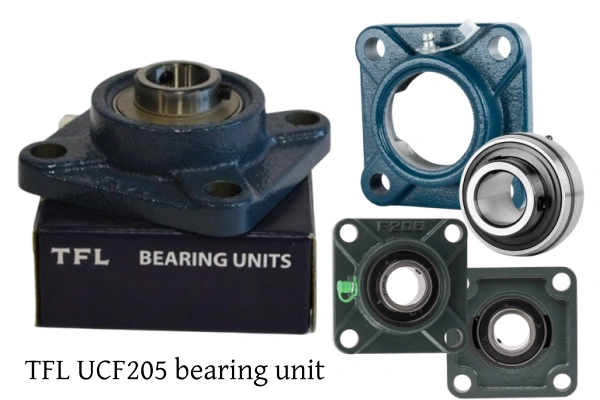
For sizes 04 and up, multiply the last two digits by five to get the bore in millimeters. So 204 means 4 × 5 = 20 mm. Inch sizes add a suffix in sixteenths of an inch, so a 16 suffix means a 1 inch shaft.
For tiny shafts, browse metric miniature flanged ball bearings. Always check flange diameter and thickness on the drawing, because they vary by maker.
How Do You Choose the Right Flange Bearing?
Start with the shaft and the mounting surface, then work out to load, speed and environment. Get these six facts right and you’ll solve most selection problems before you request a quote.
- Shaft size: Metric or inch? Measure, don’t guess.
- Mounting surface: Is it at right angles to the shaft? If it’s parallel, you need a pillow block. Our pillow block bearings guide explains the difference.
- Load and vibration: Shock or heavy loads call for four bolts.
- Speed: High speed favors ball bearings. Slow, back and forth motion suits a flange sleeve bearing.
- Environment: Water, dust or heat point to stainless, thermoplastic or better seals.
- Locking method: USA Roller Chain lists set screws, eccentric collars and concentric collars.
five numbers: inner diameter, outer diameter, overall length, flange outer diameter and flange thickness.
What Mistakes Should You Avoid?
The most common mistake is ordering the wrong family. Searching for “flange bearing” and buying a bolt on unit when you needed a small flanged ball bearing wastes days. Confirm the family first, then the size.
Other mistakes we see often:
- Bolting to an uneven surface. It twists the housing and loads the bearing unevenly.
- Locking set screws before aligning the shaft and both bearings.
- Choosing two bolts for a heavy, vibrating load.
- Over greasing. Extra grease adds heat and can push past seals.
- Washing oil impregnated bronze in solvent, which strips its stored oil.
- Expecting a small flange to carry heavy thrust. It locates; it doesn’t replace a thrust bearing.
What Are the Limitations of Flange Bearings?
Flange bearings are simple, but not perfect. Self aligning inserts correct small mounting misalignment, not a bent shaft. Set screw locking may loosen under frequent reversing or shock loads. Sleeve types create more friction than ball bearings and have lower speed limits. Plastic softens as heat rises.
Know these limits upfront and you’ll choose a design that lasts.
Conclusion
Pick the family first, then the bolt pattern, material and size. Do that and you’ll get a flange bearing that fits the first time and runs longer.
Your next step: if you’re replacing a branded part, run its number through our bearing cross reference, then send your shaft size, bolt pattern and load to our team for a quote.
FAQs
How long does a flange bearing last?
It depends on load, speed, lubrication and contamination. Rolling bearing life is calculated using the method in ISO 281. Clean, aligned and correctly greased units last far longer than dirty or misaligned ones.
Can I replace just the insert in a flange unit?
Usually, yes. Timken notes its UCF housings are designed for easy bearing replacement. Match the insert series and bore, and check the housing for cracks first.
Are flange units interchangeable between brands?
Often. Timken states its UCF bolt hole spacing and shaft center height match competitive units. Still, compare drawings before you swap.
Do sealed flange units need grease?
Some are greased for life. Others come prelubricated with a grease fitting for topping up. Follow the maker’s interval and never overfill.
Does TFL Bearing supply flange bearing replacements?
Yes. TFL supplies flanged ball bearings, including inch and metric miniature sizes, and checks cross references for branded part numbers. For a flange bearing unit or sleeve type, send your specs and the team will confirm availability.