








A common bearing sourcing question is simple:
Are Chinese bearings good enough, or is it worth paying more for SKF, NSK, Timken, FAG, or another premium bearing brand?
The question often comes up when two quotes show the same bearing number but very different prices.
Take a common 6205 deep groove ball bearing. The bore, outside diameter, and width may be the same. The designation may look almost identical. Yet one bearing can cost several times more than another.
Does the higher price mean five times the bearing life?
Not necessarily.
Does the same bearing number mean the two products will perform exactly the same?
Also no.
Some Chinese bearings are suitable for standard industrial motors, pumps, fans, conveyors, and general machinery. The bigger issue is not simply “China versus Europe or Japan.” It is the manufacturer’s process control, bearing specification, batch consistency, application data, and whether the bearing is being used within its real capability.
This guide compares Chinese bearings with established brands such as SKF, NSK, Timken, NTN, and FAG/Schaeffler in four practical areas: precision, bearing steel, rating life, and application risk.
The goal is not to recommend one country or one brand.
The goal is to answer a more useful question:
When is a lower-cost bearing a reasonable choice, and when should you pay more for a premium bearing?
Are Chinese Bearings Good Enough for Industrial Use?
Yes, some Chinese bearings are good enough for industrial use. But “Chinese bearing” is far too broad to describe one quality level.
China has large established bearing manufacturers, specialized precision-bearing producers, automotive suppliers, and thousands of smaller factories and trading companies.
Their capabilities are not the same.
The same is true when comparing international brands. A standard deep groove ball bearing, a matched P4 spindle bearing set, and a wind-turbine main bearing should not be judged by the same purchasing rule.
For a standard electric motor, fan, or pump, a bearing from a qualified Chinese supplier may be a practical option when the following are confirmed:
- complete bearing designation;
- bore, outside diameter, and width;
- seal or shield configuration;
- internal clearance;
- tolerance class;
- dynamic and static load ratings;
- speed capability;
- cage design;
- lubricant specification, where relevant.
For a high-speed spindle, safety-critical machine, or equipment where one failure can stop production for several days, the qualification process needs to be much stricter.
The first rule is therefore simple:
Compare the exact bearing and the exact application. Do not compare countries alone.
Do Bearing Brands Really Matter?
Yes, bearing brands can matter.
But the brand name is not a substitute for checking the bearing specification.
Established bearing companies such as SKF, NSK, NTN, Timken, and Schaeffler have long application histories, extensive technical catalogs, bearing-selection tools, and large amounts of field experience.
For an engineer or maintenance team, this reduces uncertainty.
If a machine requires a difficult bearing arrangement, the manufacturer may already have:
- speed data;
- preload guidance;
- internal-clearance recommendations;
- lubrication information;
- fit recommendations;
- application engineering experience.
This is one reason premium bearing brands are often selected for difficult or high-consequence applications.
However, a famous brand name does not mean that every bearing in the catalog is necessary for every machine.
A standard 6205 bearing in an accessible fan motor and a P4 matched angular contact bearing set in a CNC spindle have very different risk levels.
So the better question is not:
Which bearing brand is always best?
It is:
How much technical and reliability margin does this application require?
Chinese Bearings vs SKF, NSK and Timken: What Actually Changes?
When engineers compare Chinese bearings with SKF, NSK, Timken, NTN, or FAG, the discussion normally comes down to four areas:
- precision and running accuracy;
- bearing steel and manufacturing control;
- bearing life and batch consistency;
- application data and technical support.
1. Precision and Running Accuracy
Bearing precision covers dimensional accuracy and running accuracy.
In practical terms, engineers may look at:
- bore deviation;
- outside-diameter deviation;
- width deviation;
- inner-ring radial runout;
- outer-ring radial runout;
- axial runout.
ISO 492 defines geometrical and tolerance requirements for radial rolling bearings.
In Chinese procurement, you will commonly see tolerance classes described as Normal or P0, P6, P5, P4, and P2.
ABEC classes may also appear in international discussions.
Do not assume that an ABEC and ISO tolerance class are perfectly interchangeable for every tolerance characteristic. For critical applications, compare the actual manufacturer’s tolerance table.
For many general industrial machines, Normal/P0 or P6 precision may be sufficient.
The risk increases when the application moves into:
- high-speed spindle systems;
- precision grinding;
- low-runout rotating systems;
- matched bearing sets;
- controlled preload arrangements.
At P5, P4, and higher precision levels, a grade printed on the box is not enough.
Ask for the actual tolerance data.
For example:
| What to Check | Why It Matters |
|---|---|
| Bore deviation | Shaft fit and preload or clearance |
| Radial runout | Shaft rotation accuracy |
| Axial runout | Face accuracy and spindle performance |
| Width variation | Matched arrangements and axial position |
| Inspection method | Determines whether reported data can be trusted |
| Actual lot report | Shows batch performance, not only catalog claims |
A practical purchasing rule is:
If a supplier claims P4 or P5 capability, ask for a recent inspection report for the same bearing type or production grade.
The exact data is more useful than the words “high precision.”
2. Bearing Steel and Process Control
Another common question is whether Chinese bearings use different steel.
For many standard through-hardened rolling bearings, the steel grades are from the same broad high-carbon chromium bearing-steel family.
You may see names such as:
- 100Cr6;
- SAE/AISI 52100;
- GCr15.
Their chemical compositions are similar, with approximately 1% carbon and around 1.5% chromium being typical of this bearing-steel family.
However, the steel grade name does not tell the whole story.
Two bearings made from a similar high-carbon chromium steel family can still perform differently.
Important variables include:
- non-metallic inclusion control;
- steel cleanliness;
- carbide distribution;
- heat-treatment consistency;
- hardness and hardness variation;
- ring grinding;
- raceway surface finish;
- assembly cleanliness.
Non-metallic inclusions can act as stress concentration sites in highly stressed steel.
This is why clean bearing steel is important for rolling-contact fatigue performance.
The practical sourcing question is therefore not only:
Is this bearing made from GCr15?
A better question is:
What material and process controls support the finished bearing?
For a standard low-consequence application, a normal material certificate may be enough.
For a high-load or high-consequence bearing, buyers may ask for additional information such as:
- steel specification;
- hardness requirements;
- heat-treatment records;
- metallurgical cleanliness requirements;
- non-metallic inclusion evaluation;
- batch inspection data.
Do not judge Chinese bearing quality from the steel grade name alone.
Also do not assume that every European or Japanese bearing uses one identical material route.
The exact bearing series and application matter.
3. Bearing Life and Batch Consistency
Bearing basic rating life is commonly calculated using the ISO 281 framework.
For basic rating life:
L10 = (C / P)^p
where:
- L10 is the basic rating life;
- C is the basic dynamic load rating;
- P is the equivalent dynamic bearing load;
- p depends on the rolling-element type.
The basic rating life is associated with 90% reliability under the conditions defined by the standard.
SKF, NSK, Timken, and Chinese bearing manufacturers do not use separate national laws of bearing fatigue.
The rating-life framework is the same.
But this does not mean two bearings with the same dimensions will automatically have identical field life.
Actual bearing performance can be affected by:
- internal bearing design;
- dynamic load rating;
- steel and heat treatment;
- raceway finish;
- assembly cleanliness;
- internal clearance;
- lubrication;
- contamination;
- mounting fits;
- misalignment;
- operating temperature.
There is no credible universal percentage showing that Chinese bearings always last 70%, 80%, or 90% as long as SKF, NSK, or Timken bearings.
The Chinese bearing market is too diverse for one percentage.
Instead, compare the exact bearing.
A useful comparison table is:
| Comparison Point | What to Verify |
|---|---|
| Dynamic load rating C | Manufacturer’s current catalog |
| Static load rating C0 | Manufacturer’s current catalog |
| Internal clearance | CN, C3, C4, or application-specific requirement |
| Tolerance class | Actual published tolerances |
| Seal and grease | Configuration and lubricant specification |
| Lot inspection | Measurements from the supplied batch |
| Field history | Similar machine and operating conditions |
For critical machines, a controlled sample order or field validation can be more useful than a broad country-of-origin argument.
If the bearing can be tested in one non-critical machine before a large rollout, record:
- operating temperature;
- vibration;
- noise;
- grease leakage;
- running hours;
- failure condition.
Compare both products under the same conditions.
The closer the test is to your real machine, the more useful the result becomes.
4. Application Data and Technical Support
One difference between many established global bearing brands and smaller bearing factories is the amount of published application data.
For example, a premium bearing manufacturer may provide detailed information on:
- attainable speed;
- limiting speed;
- preload;
- grease quantity;
- mounting fits;
- internal clearance;
- matched arrangements;
- bearing-life calculation.
An established Chinese manufacturer may also provide strong technical data.
But the level of documentation varies more from supplier to supplier.
This matters because engineers cannot make a reliable selection from a bearing number alone.
If the supplier cannot provide the technical data needed for the application, the low price may not compensate for the additional uncertainty.
When Is a Lower-Cost Chinese Bearing a Reasonable Choice?
A lower-cost Chinese bearing can be a reasonable choice when the application is well understood and the bearing specification is easy to verify.
| Application | Chinese Bearing Option | What to Confirm |
|---|---|---|
| Standard electric motor | Often worth evaluating | Clearance, noise, seal, grease, speed |
| Fan | Often worth evaluating | Speed, temperature, balance |
| Water pump | Often worth evaluating | Seal arrangement, load, moisture |
| Conveyor | Depends on duty | Contamination, load, relubrication |
| General gearbox auxiliary position | Depends on load | Load, fit, lubrication |
| Easy-to-access non-critical equipment | Often suitable for a controlled trial | Replacement cost and field monitoring |
The important phrase is worth evaluating.
It does not mean:
Any cheap Chinese bearing will work.
It means a qualified product may provide a good cost-performance balance when:
- the machine operates within a known range;
- the bearing is easy to replace;
- downtime consequences are limited;
- the specification is clear;
- the supplier can provide reasonable inspection and traceability information.
When Should You Pay More for a Premium Bearing Brand?
There are applications where a conservative sourcing decision is easier to justify.
Examples include:
- high-speed precision spindles;
- matched angular contact bearing sets;
- safety-critical equipment;
- hard-to-access bearing positions;
- machines with very high downtime costs;
- extreme-temperature applications;
- qualified OEM bearing positions;
- applications requiring extensive engineering data.
For a CNC spindle, for example, precision class is only one requirement.
You may also need to check:
- contact angle;
- preload;
- matched arrangement;
- steel or ceramic rolling elements;
- cage;
- grease;
- attainable speed;
- shaft and housing fits.
A P4 marking alone does not prove that two spindle bearings are interchangeable.
What About Ndm or DN Value?
The speed factor n × dm can help compare bearing speed conditions.
The mean bearing diameter dm is commonly based on bore diameter and outside diameter.
However, there is no single universal Ndm value that changes every bearing from “normal speed” to “high speed.”
Attainable speed depends on:
- bearing type;
- internal design;
- rolling-element material;
- load;
- preload or clearance;
- lubricant;
- lubrication method;
- operating temperature.
Use the bearing manufacturer’s speed data for the exact bearing series.
Do not select a high-speed bearing from precision class alone.
Cheap vs Expensive Bearings: Compare Total Cost, Not Unit Price
When buyers compare cheap vs expensive bearings, unit price is the easiest number to see.
It is not always the most important number.
Consider two situations.
Situation A: Accessible Fan Motor
The bearing is easy to replace.
The machine is not connected to a critical production line.
Maintenance staff can complete the repair quickly.
In this case, evaluating a qualified lower-cost bearing may make sense.
Situation B: Critical Production Gearbox
A bearing failure can stop the line.
Replacement requires disassembly and crane work.
The lost production value is much higher than the bearing purchase price.
Here, a conservative bearing selection may be justified even when the premium bearing costs several times more.
A simple cost review should consider:
- bearing purchase price;
- installation labor;
- replacement frequency;
- spare-parts availability;
- inspection cost;
- expected downtime impact.
The more expensive the failure is, the less important the bearing’s unit price becomes.
This is why there is no correct answer to:
Are expensive bearings worth it?
The correct answer depends on the cost of being wrong.
How to Check Chinese Bearing Quality Before You Buy
If you are considering a Chinese bearing supplier, do not start by asking:
Is your bearing high quality?
Every supplier will say yes.
Ask questions that produce data.
1. Confirm the Complete Bearing Designation
A 6205 is not enough if the application requires:
- C3 clearance;
- 2RS seals;
- ZZ shields;
- special grease;
- brass cage;
- precision class.
Compare the complete designation and suffix.
2. Ask for the Current Technical Data
Check:
- dimensions;
- C rating;
- C0 rating;
- reference or limiting speed;
- internal clearance;
- tolerance class.
For a replacement project, compare this information with the existing bearing.
3. Ask for an Inspection Report
For precision or bulk orders, ask whether inspection data is available for:
- bore diameter;
- outside diameter;
- width;
- radial runout;
- axial runout, where relevant.
The data should match the tolerance class being offered.
4. Check Material and Heat-Treatment Documentation
The required level of documentation depends on the application.
For higher-risk bearings, ask what material, hardness, heat-treatment, and metallurgical records are available.
5. Confirm Seal, Grease, and Cage Details
Two bearings with the same basic number can behave differently when they use different:
- seals;
- grease;
- cage materials;
- internal clearance.
These details are especially important for motors and high-speed applications.
6. Start With a Sample or Controlled Batch
For a new supplier, avoid moving an entire critical machine population to a new bearing source based only on price.
Use a sample or small production batch.
Record the application and monitor the result.
7. Check Traceability
Ask how the supplier identifies:
- production lot;
- inspection lot;
- factory source;
- shipment records.
If a problem occurs, traceability makes root-cause investigation much easier.
Counterfeit and Source Risk: How Can You Verify a Bearing?
Visual inspection alone cannot prove that a bearing is genuine.
Packaging color, engraving depth, and font style can provide warning signs, but counterfeit products can copy visual details.
Hand rotation also cannot authenticate a bearing.
A rough or inconsistent feel may indicate damage or contamination, but a smooth bearing is not automatically genuine.
For premium-brand bearings, source traceability is more important.
For supported premium brands, the WBA Bearing Authenticator can also help check product codes against participating manufacturers’ authentication systems.
Check:
- supplier identity;
- invoice and purchase route;
- lot or serial information where applicable;
- manufacturer authentication options;
- packaging and designation consistency;
- available certificates.
Dimensional inspection can confirm whether a bearing meets measured tolerances.
It does not prove who manufactured the bearing.
For critical SKF, NSK, Timken, NTN, or Schaeffler purchases, a documented supply route is safer than relying on visual inspection after delivery.
How TFL Helps Buyers Compare Bearing Supply Options
TFL is an independent bearing supplier, not a bearing manufacturer.
Our role is to help buyers compare available bearing routes for the application.
Depending on the bearing, source, and order requirements, this may include:
- bearing designation and suffix review;
- cross-brand replacement comparison;
- Chinese-manufactured bearing options;
- global bearing brand sourcing;
- available inspection documentation;
- available source and batch information;
- pre-shipment dimensional inspection requirements.
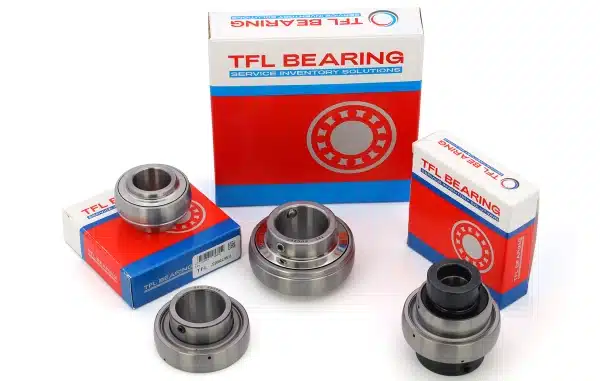
For a standard application, the goal may be to reduce sourcing cost without changing the required bearing specification.
For a high-speed, high-precision, or high-consequence application, the goal may be to reduce sourcing risk and verify the bearing route before quotation.
Send us the current bearing designation and the basic operating conditions:
- machine type;
- speed;
- load;
- operating temperature;
- current bearing model;
- main failure or sourcing problem.
We can review the available information and help compare suitable supply options.
SNot Sure Which Bearing Supply Route Fits Your Application?
Send us your current bearing designation, operating speed, temperature, load, and application details. TFL can help compare global-brand, cross-reference, and qualified Chinese bearing options before you request a quote.
Frequently Asked Questions
Are Chinese bearings good?
Some Chinese bearings are suitable for standard industrial applications, but quality and process control vary significantly between manufacturers and product lines. Check the exact bearing specification, tolerance, clearance, load rating, speed data, and supplier inspection capability rather than judging the bearing only by country of origin.
Are Chinese bearings as good as SKF?
There is no universal yes or no answer. A qualified Chinese bearing may perform well in a standard motor, fan, or pump application. SKF may be easier to justify for demanding applications that require extensive technical data, proven application history, or highly controlled precision. Compare the exact bearing and operating conditions.
Do bearing brands really matter?
Bearing brands can matter because established manufacturers often provide extensive technical data, process consistency, and application support. However, the correct bearing specification and application fit remain essential. A premium brand cannot correct an incorrect clearance, fit, lubrication route, or bearing type.
What is the difference between cheap and expensive bearings?
The difference may include precision consistency, steel cleanliness, heat treatment, raceway finish, assembly cleanliness, lubricant, seals, technical documentation, traceability, and batch control. The exact difference depends on the two products being compared.
When should I avoid a cheap bearing?
Be cautious with unknown low-cost bearings in high-speed spindles, safety-critical machines, difficult-to-access positions, matched bearing sets, and equipment where a bearing failure creates major downtime. In these applications, supplier qualification and application data are more important than unit price.
Does a P4 marking prove a bearing is high quality?
No. P4 is a tolerance-class designation. For precision applications, verify the manufacturer’s published tolerance data and, where appropriate, actual inspection results. Bearing performance can also depend on internal design, preload, material, cage, lubrication, and process consistency.
Can I use different bearing brands in the same machine?
Sometimes, but first check the bearing arrangement. For independent standard bearing positions, cross-brand replacement may be possible when the complete specifications match. For matched sets, precision spindle arrangements, or preload-controlled systems, mixing bearings from different sources is generally not a simple substitution.
How do I check a Chinese bearing supplier before ordering?
Confirm the complete designation, technical data, tolerance class, load ratings, internal clearance, seal and grease details, inspection capability, and traceability process. For a new supplier or critical application, start with a sample or controlled batch before a large rollout.
References
ISO 492:2023 — Rolling bearings — Radial bearings — Geometrical product specifications and tolerance values.
ISO 281:2007 — Rolling bearings — Dynamic load ratings and rating life.
ISO 683-17:2023 — Heat-treated steels, alloy steels and free-cutting steels — Part 17: Ball and roller bearing steels.
GB/T 307.1-2017 — Rolling bearings — Radial bearings — Geometrical product specifications and tolerance values.
GB/T 18254-2016 — High-carbon chromium bearing steels.
Disclaimer
This article is a general technical and sourcing discussion. It is not a quality rating of any specific bearing manufacturer, brand, product line, or production batch.
Bearing performance depends on the exact bearing design, manufacturing process, operating conditions, lubrication, mounting, contamination, and maintenance.
Brand names are used only for technical comparison and sourcing discussion. All trademarks belong to their respective owners.