








Stainless Steel Deep Groove Ball Bearings

TFL supplies stainless steel deep groove ball bearings for equipment exposed to moisture, washdown, humidity, and other corrosive operating conditions. The product list contains metric and inch-size single-row bearings with stainless steel rings, covering bore sizes from 1 mm to 55 mm and 0.04 to 0.75 inch. Buyers can compare open, shielded, sealed, grease-lubricated, and selected solid-oil configurations by dimensions, load rating, speed, clearance, and material. Common applications include food-processing equipment, packaging machinery, pumps, marine equipment, laboratory instruments, and outdoor machinery. TFL can source standard or customized specifications, inspect agreed order requirements before shipment, and support OEM or customized packaging.

Structural Characteristics of Deep Groove Ball Bearings
- Inner ring and outer ring: Both have continuous deep groove raceways to guide the rolling of the steel balls.
- Steel balls (rolling elements): Round steel balls for ball bearings roll in raceways, reducing friction and transmitting loads through point contact.
- Cage: Usually stamped steel sheets (small ball bearings) or brass solids (large ball bearings), used to evenly separate the steel balls.
Commonly Stainless Steel Models and Characteristics
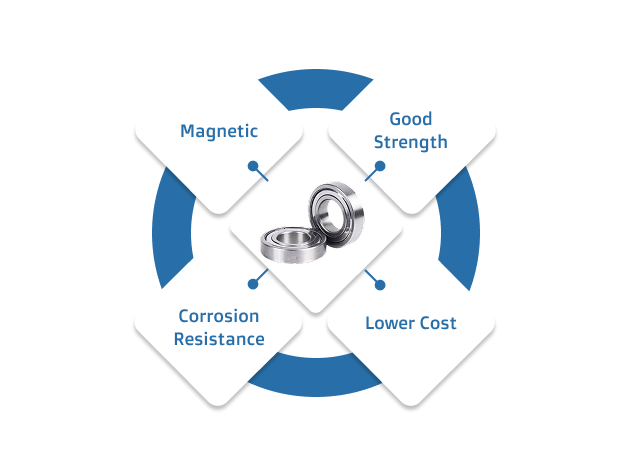
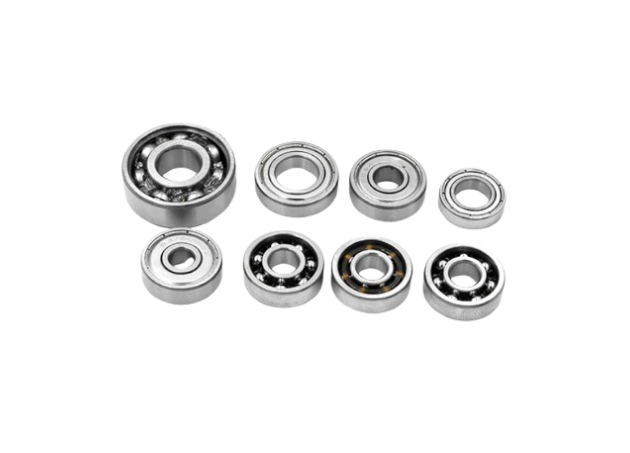
Application of Stainless Steel Deep Groove Ball Bearings
- Food processing: Stainless steel bearings are suitable for food processing machinery and can resist chemical corrosion and humid environments that may be encountered during food processing.
- Pharmaceutical machinery: In the pharmaceutical production process, stainless steel bearings can withstand the corrosion of various chemical reagents and ensure the stable operation of the equipment.
- Other corrosive environments: Stainless steel ball bearings perform well in environments such as seawater, salt water, acidic or alkaline solutions.
Stainless Steel Deep Groove Ball Bearing Selection Guide
This page provides high-quality, corrosion-resistant stainless steel single-row deep groove ball bearings for demanding environments. As an expert sourcing partner, we help you navigate our product list to compare metric or inch dimensions, open or closed configurations, cage materials, clearance, and maximum speeds. Always confirm the specific stainless steel grade (such as AISI 440C) and its compatibility with your operating environment before ordering.
What Makes These Stainless Deep Groove Ball Bearings Different?
The defining engineering feature of this category is its stainless steel ring and ball construction. Compared with general-purpose 52100 chrome steel bearings, stainless steel deep groove ball bearings provide vastly superior resistance to moisture, condensation, and many mildly corrosive environments, while retaining the compact, high-speed characteristics of a single-row design.
However, it is crucial to understand that stainless steel is “corrosion-resistant,” not “corrosion-proof.” Real-world performance heavily depends on the specific steel grade, surface passivation, chemical concentrations, chloride exposure, operating temperature, and your washdown regimes. Always share your exact operating medium with our team when requesting a quotation.
Product Range and Available Sourcing Options
Our comprehensive product list contains 612 single-row configurations, carefully sourced to meet diverse industrial needs, including 535 metric and 77 inch-size models. Metric bore sizes range from a miniature 1 mm up to 55 mm, while inch-size bores span from 0.04 to 0.75 inches.
| Selection Item | Options in This Product List | What to Confirm for Your Application |
|---|---|---|
| Measurement system | Metric and inch configurations | Bore diameter, outside diameter, width, and precise shaft/housing tolerance fits |
| Closure | Open, shielded (2Z/ZZ), or sealed (2RS) | Contamination levels, moisture exposure, seal friction limits, and relubrication needs |
| Ring material | Stainless steel (typically martensitic for load-bearing) | Required steel grade (e.g., 440C) and chemical compatibility with the operating medium |
| Ball material | Stainless steel or selected silicon nitride ceramic balls | Whether a conventional full-stainless or a hybrid ceramic configuration is required |
| Internal clearance | Primarily CN (Normal), with selected C2 and C3 models | Thermal expansion, operating speed, press fits, and required running clearance |
| Lubrication | Standard grease, unlubricated, or solid-oil options | Extreme temperatures, high-pressure washdown, chemical exposure, and NSF H1 food-grade needs |
| Precision | P0 or ABEC 1 / ISO P0 in the current list | Runout limits, noise restrictions, speed, and application-specific accuracy requirements |
Open, Shielded, or Sealed Stainless Bearings?
Open bearings offer the lowest friction and allow for continuous relubrication but provide zero protection against environmental contaminants. Metal-shielded designs (e.g., 2Z) help exclude larger particulates while maintaining relatively low friction for higher speeds. Rubber-sealed bearings (e.g., 2RS1) provide the best protection against moisture, fine dust, and grease wash-out, though the contact seal friction will reduce the maximum permissible speed.
Select your closure based on the actual contamination and cleaning protocols rather than just matching a part number. For high-pressure washdown equipment, you must also confirm seal material compatibility (like Nitrile or FKM/Viton), grease washout resistance, cleaning chemical pH, and direct spray exposure.
Available Stainless Steel Bearing Models
The range covers miniature inch bearings, metric miniature bearings, and common industrial W 60, W 61, W 62, and W 63 series configurations (the “W” prefix typically denotes stainless steel in European nomenclature). Representative equivalents include W 6004, W 6204-2RS1, W 6205-2Z, W 6008-2RS1, and W 6304-2RS1.
Suffixes identify critical internal construction differences. For example, 2Z indicates metal shields on both sides, while 2RS1 identifies rubber contact seals. Additional suffixes may indicate specific food-grade lubrication, internal clearance, or alternative cage materials. These must be rigorously retained during cross-reference checking.
How This Category Differs from Other Deep Groove Bearings
| Product Category | Main Selection Reason |
|---|---|
| Stainless steel deep groove ball bearings | Selected primarily for corrosion resistance in wet, cleanroom, or chemically exposed environments |
| Standard single-row deep groove ball bearings | General-purpose selection (chrome steel) where maximum load capacity is needed and rust is not a risk |
| Flanged deep groove ball bearings | Used when an integral outer ring flange is required for accurate axial location or simplified housing mounting |
| Deep groove ball bearings with filling slots | Selected for increased radial load capacity achieved through a higher ball complement |
| Snap ring groove ball bearings | Used when a snap ring (circlip) is required to securely locate the bearing axially within the housing |
| Double-row deep groove ball bearings | Selected when significantly greater load capacity and rigidity are required within a limited radial space |
Typical Corrosion-Resistant Bearing Applications
Stainless steel deep groove ball bearings are essential components for food and beverage (F&B) processing equipment, pharmaceutical machinery, automated packaging lines, chemical pumps, mixers, marine deck auxiliary equipment, laboratory instruments, and machinery operating in highly humid or frequently sanitized environments.
Note that deploying bearings in food, medical, or cleanroom applications requires more than just a stainless steel ring. You must independently confirm NSF/FDA lubricant approvals, specialized seal materials, stringent cleanliness standards, traceability, and any other industry-specific compliance requirements.
Application Engineering Warning: Corrosion Resistance Depends on the Complete Bearing
Never select a bearing solely because the outer rings are labeled “stainless steel.” You must verify that the balls, cages, rivets, and shields are also manufactured from compatible corrosion-resistant materials. Furthermore, be aware that standard bearing-grade stainless steel (like 440C) has roughly 80-85% of the dynamic load capacity of standard chrome steel. Always confirm if your environment contains severe saltwater, harsh acids, alkalis, chlorine-based cleaning agents, or sustained high temperatures before finalizing a design.


How to Choose from the Product List
Begin with the original bearing part number or your required physical dimensions (bore, OD, width). Next, systematically compare the measurement system, ring/ball metallurgy, closure type, internal radial clearance, tolerance class, specialized lubrication, dynamic/static load ratings, maximum speed limits, and the specific corrosive environment.
For a comprehensive technical review, provide our team with the bearing number, technical drawing or sample, operating medium, sanitation methods, operating temperatures, speeds, radial/axial loads, shaft/housing fits, target service life, and packaging requirements. Low-noise or high-precision requests must be stated explicitly, as standard stainless steel material alone does not inherently guarantee quiet running or elevated accuracy.
Why Source Stainless Steel Bearings from TFL?
TFL / SDTFL Bearing is an experienced independent bearing supplier and your dedicated global sourcing partner. Once you confirm the model, drawing, sample, material grades, or application requirements, we leverage our vetted network of qualified factory resources to supply the exact products you need.
Prior to shipment, our quality control team rigorously checks the agreed model, quantities, visual condition, robust packaging, and baseline quality metrics. Non-standard dimensions, special food-grade lubrication, OEM marking, neutral boxing, and custom packaging solutions can be fully tailored according to your order requirements.
For additional engineering insights, compare ceramic and stainless steel bearings for extreme environments or review our comprehensive guide on how to source stainless steel bearings from China safely. You can also browse our complete deep groove ball bearing range.
TFL / SDTFL Bearing is an independent bearing supplier and sourcing partner. Material descriptions and cross-reference numbers must be verified against your final technical specifications. While stainless steel significantly improves corrosion resistance, it does not guarantee immunity to every chemical, marine, high-pressure washdown, or high-temperature environment. Verify load capacities, as stainless steel ratings typically differ from standard chrome steel.
Need a Stainless Steel Bearing for a Corrosive Environment?
Send us your bearing number, precise dimensions, operating medium, temperature extremes, speed, load requirements, seal preference, lubrication needs, quantity, drawing, or sample. Our team will review and quote the most suitable stainless steel deep groove ball bearing options for your application.
FREQUENTLY ASKED QUESTIONS

What seal types are available for stainless steel deep groove ball bearings?
- Metal sheild: with the suffix ZZ or 2Z, for example: S6210ZZ.
- Contact rubber seals: with the suffix 2RS or RS, for example: S62082RS, 6202RS bearing