







Double Row Angular Contact Ball Bearings (General)

Double row angular contact ball bearings combine two angular contact bearing rows in one compact unit, allowing the bearing position to support radial load and axial load in both directions. This TFL product list covers metric 3200 and 3300 series models, plus selected large-size 305xxx double row angular contact bearings, with bore sizes from 10 mm to 280 mm. Buyers can compare open, shielded and sealed designs, A, ATN9, 2Z, 2RS1 and MT33-style suffixes, cage material, P6 tolerance, load rating, speed and pressure point distance. TFL helps customers source suitable standard or customized replacement bearings based on part number, drawings, samples or application requirements.
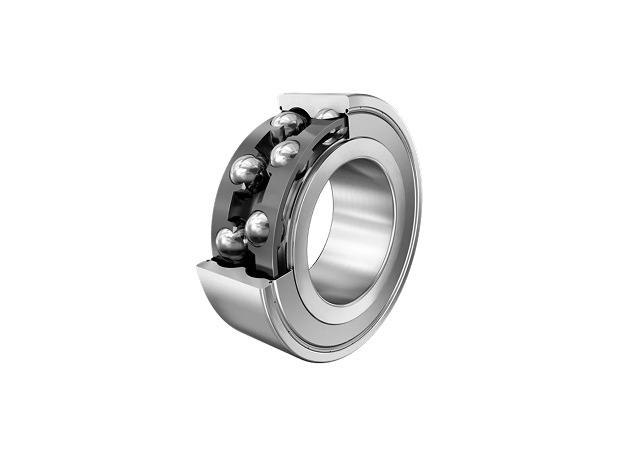
Bi-Directional Axial Load Capability
Compact Design Compared to Paired Singles
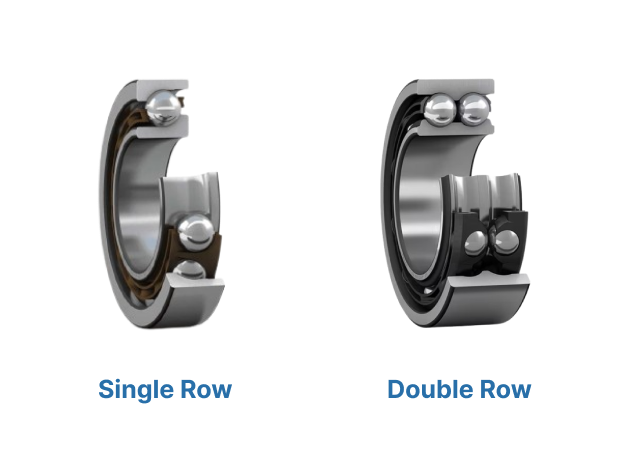
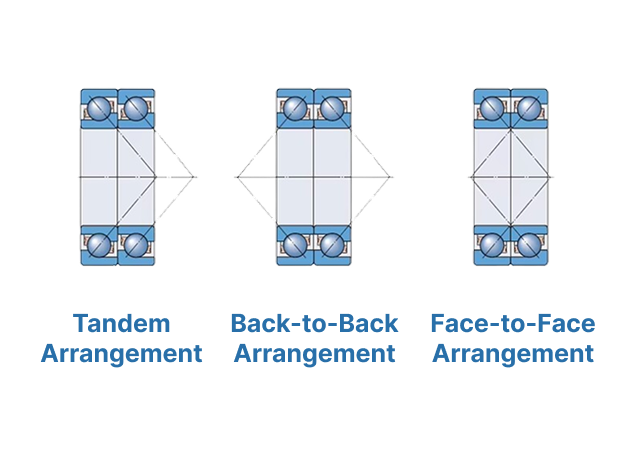
High Rigidity for Operational Stability
Double Row Angular Contact Bearing Selection Guide
Double row angular contact ball bearings are used when one bearing position needs radial load capacity and axial load support in both directions. They are often selected as a compact alternative to two matched single row angular contact bearings when installation space, rigidity, and simplified mounting are important.
How to Choose This Bearing Type
Choose this bearing type when the application has combined radial and axial loads, reversing thrust load, limited axial space, or a locating bearing position that needs higher rigidity than a standard deep groove bearing. Confirm shaft size, housing space, load direction, speed, lubrication, and whether the original bearing uses an open, shielded, or sealed design.
Common Series and Model Range
| Series / Model Range | Typical Role | Selection Notes |
|---|---|---|
| 3200 series | Compact double row angular contact bearings | Common for pumps, gearboxes, reducers, and compact industrial assemblies. |
| 3300 series | Wider section and higher load capacity | Useful when more rigidity and load rating are required in the same bore range. |
| Selected large-size series | Large-size double row angular contact options | Confirm drawing dimensions, contact geometry, and application load before replacement. |
Open vs 2Z vs 2RS Selection
Open bearings are suitable when the equipment has controlled lubrication or when higher speed is required. 2Z shielded bearings help keep out larger particles while maintaining relatively low friction. 2RS or 2RS1 sealed bearings provide better contamination protection, but the speed rating is usually lower than open or shielded options. For replacement, match the original sealing style whenever possible.
How to Read a Model Number: Example 3214 A-2Z/MT33
The search interest suggests that 3214 A-2Z/MT33 is a model worth highlighting on this page. In this style of number, “3214” identifies a double row angular contact bearing with a 70 mm bore, “A” refers to the internal design suffix, “2Z” means metal shields on both sides, and “MT33” is a grease suffix that should be confirmed against the original marking or drawing. In the current product list, 3214 A-2Z is listed as 70 × 125 × 39.7 mm with P6 tolerance and 4,500 rpm maximum speed.
| Code Element | Example | What to Confirm |
|---|---|---|
| 32 | 3214 | Double row angular contact dimensional series. |
| 14 | 3214 | Standard bore code; 14 × 5 = 70 mm bore. |
| A | 3214 A | Internal design suffix; do not ignore when checking interchange. |
| 2Z | 3214 A-2Z | Metal shields on both sides; compare with open or 2RS sealed versions. |
| MT33 | 3214 A-2Z/MT33 | Grease suffix; confirm lubricant specification before quotation. |
When to Choose Paired Angular Contact Bearings vs. Double Row
Choose paired single row angular contact ball bearings when the application needs more flexibility in contact angle selection, preload control, and stiffness tuning. A paired arrangement is often preferred when the load ratio, spindle behavior, or mounting direction needs to be customized for the application, or when you want to optimize axial support and rigidity step by step.
Choose double row angular contact ball bearings when the bearing position needs axial load support in both directions in a compact arrangement, and the priority is simpler mounting, shorter axial space, and a more integrated bearing solution. This type is often a better fit when the design calls for a compact locating bearing position with bidirectional axial support and no need for a separately tuned paired arrangement.
As a practical rule, use a paired arrangement when flexibility matters most, and use a double row bearing when compactness and simplified installation matter most. If the application has high rigidity requirements, unusual load balance, or a special preload target, review the complete shaft and housing arrangement before deciding.


Key Specifications to Confirm Before Quotation
Before requesting a quote, confirm the bearing number, bore diameter, outer diameter, width, sealing type, cage material, tolerance class, contact geometry, dynamic and static load rating, maximum speed, lubrication requirement, and operating temperature. If the original number is unclear, send bearing photos, drawings, or shaft and housing dimensions for cross reference support.
SKF / FAG / NSK Replacement Notes
Many buyers search by SKF-style, FAG-style, or NSK-style double row angular contact bearing numbers. TFL can help compare dimensions, suffixes, sealing type, cage material, and application requirements before recommending a replacement or alternative. We do not imply original-brand supply or authorized distribution.
Common Applications
Double row angular contact ball bearings are commonly used in pumps, gearboxes, compressors, reducers, industrial fans, conveyors, agricultural machinery, material handling equipment, and rotating assemblies where bidirectional axial support and compact bearing width are required.
Popular Models / High-Demand Models
Common models in this range include 3200 A-2RS1TN9/MT33, 3205 A-2Z, 3207 A, 3208 ATN9, 3308 A-2Z, 3310 A, 3313 A, and 3214 A-2Z. For a new priority model page, 3214 A-2Z/MT33 is a strong candidate because it already has specific search exposure.
Engineering Note
Do not replace a double row angular contact bearing only by bore, OD, and width. The sealing style, suffix, cage, speed rating, and contact geometry can affect fit, heat, rigidity, and service life.
Need Help Matching a Double Row Angular Contact Bearing?
Send us the bearing number, drawing, sample photos, or application conditions. TFL can help check dimensions, suffix interchange, sealing type, cage material, load rating, and available sourcing options before shipment coordination.
Request Bearing SupportTFL / SDTFL Bearing is a bearing supplier and sourcing partner. We help customers source suitable standard or customized bearing alternatives from qualified factory resources and inspect model, quantity, appearance, packaging, and basic quality requirements before shipment.
FREQUENTLY ASKED QUESTIONS

How does load capacity compare to two single row bearings?
Can I adjust the preload on double row angular contact ball bearings?
Are double row bearings separable?
Do your bearings meet international quality standards?
Yes, we are an ISO-certified bearing manufacturer, and all our bearings strictly comply with international quality standards.