









Thrust Ball Bearing With Outside Band

Banded thrust ball bearings, also called thrust ball bearings with outside band, are designed for axial load applications where the shaft washer, housing washer and ball assembly need to stay together during handling and installation. This TFL product list covers inch-size outside band thrust bearings, including T-100, B and D series models with bore sizes from 0.3125 inch to 6.5 inch. Buyers can compare bore diameter, housing washer inner diameter, outer diameter, width, ball size, ball quantity, dynamic thrust load, speed-based load rating, static thrust load and lubrication requirements. These bearings are commonly used in industrial machinery, steering assemblies, gear mechanisms, pumps, conveyors and equipment requiring stable axial support with easier installation.
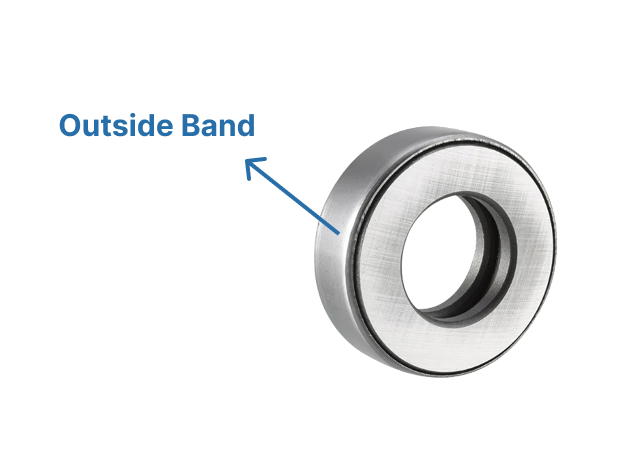
Special Metal Outside Band for Easier Handling
Simplified Installation Process
Specifically Engineered for Axial Loads
Banded Thrust Bearing Selection Guide
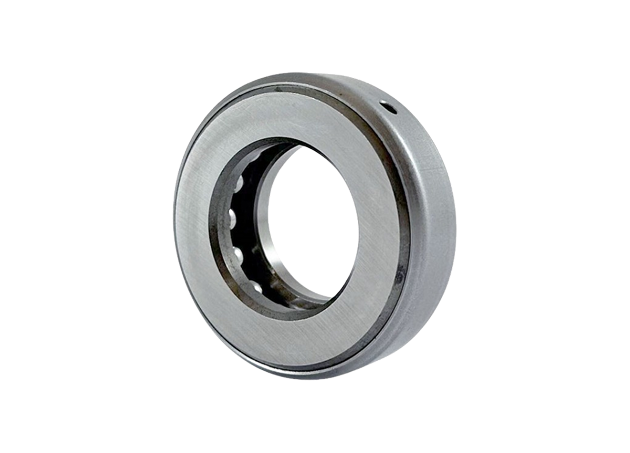
Banded thrust ball bearings are thrust bearings with an outside band that helps keep the washers and ball assembly together as one unit. The band improves handling, installation convenience, and component alignment during assembly, but it should not be treated as a sealing structure. These bearings are designed primarily for axial load support and are not intended for radial load applications.
How to Choose This Bearing Type
Choose a banded thrust bearing when the application needs axial load support and easier installation compared with a separable thrust ball bearing. The outside band keeps the bearing components together during handling, maintenance, and replacement, which can reduce installation errors caused by loose washers or ball assemblies.
Before selection, confirm the bore size, washer dimensions, available installation space, axial load, operating speed, lubrication method, and whether the application requires a banded design for easier assembly.
Common Model Range
| Model Family | Typical Range | Selection Notes |
|---|---|---|
| T-100 series | Common inch-size outside band thrust bearing models | Frequently selected by part number for industrial replacement applications. |
| B series | Medium to larger inch-size banded thrust bearings | Check bore, washer dimensions, and thrust load requirements. |
| D series | Compact inch-size outside band thrust bearing options | Useful where width, housing space, and axial load need to be balanced. |
How to Read a Model Number: Example T-100-13
T-100-13 is a representative outside band thrust ball bearing with a 1.25 inch bore, 2.1875 inch outside diameter, and 0.6875 inch width. It uses 52100 chrome steel rings and balls, 17 balls with 5/16 inch diameter, and requires lubrication during operation. This model is commonly referenced when checking T-100 series outside band thrust bearing replacements.
| Code / Parameter | Example in T-100-13 | Why It Matters |
|---|---|---|
| T-100 | T-100 model family | Identifies the inch-size outside band thrust ball bearing type. |
| 13 | Model position within the range | Confirm bore, outside diameter, width, and load rating from the product specification. |
| Housing washer and shaft dimensions | 1.25 inch bore / 1.28125 inch housing washer ID | Both dimensions should be checked before replacement. |
| Load rating | 4250 lbf dynamic thrust load / 14833 lbf static thrust load | Confirms whether the bearing matches the axial load requirement. |
Outside Band vs Standard Thrust Bearing
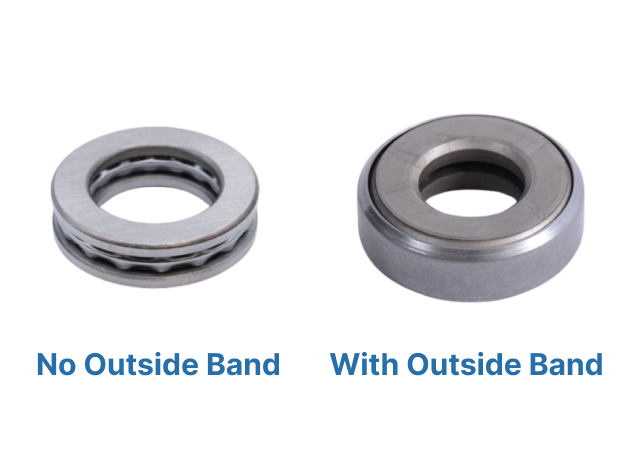
A standard thrust ball bearing is usually supplied as separate washers and ball assembly components, while a thrust ball bearing with outside band keeps the main components together for easier handling and installation. The outside band is mainly designed for assembly convenience and component retention; it is not a replacement for a sealing system.
For applications exposed to heavy dust, moisture, or washdown environments, confirm whether additional protection or a different bearing design is required.
Key Specifications to Confirm Before Quotation
Before requesting a quote, confirm the part number, bore diameter, housing washer inner diameter, outside diameter, width, ball diameter, ball quantity, dynamic thrust load rating, static thrust load rating, limiting speed, lubrication requirement, temperature range, and application environment. If the original number is unclear, send bearing photos, drawings, or measured dimensions.
Replacement and Cross Reference Notes
Many buyers search by part number when replacing a banded ball thrust bearing. TFL can help compare T-100, B series, D series, or customer-supplied part numbers by dimensions, load rating, and installation requirements before recommending an alternative.
Brand and part number references are used only for identification, replacement, and cross-reference purposes. TFL does not imply original-brand supply or authorized distribution unless specifically stated.
Common Applications
Banded thrust ball bearings are commonly used in industrial machinery, steering assemblies, gear mechanisms, pumps, conveyors, agricultural equipment, material handling systems, and maintenance replacement projects where axial load support and easier bearing handling are important.
Popular Models / High-Demand Models
Common models include T-100-3, T-100-13, T-100-20, D9, D15, D25, B25, and T-100-45. T-100-13 is a strong priority model because it has a dedicated product page and represents a common inch-size outside band thrust bearing application.
Engineering Note
Do not select a banded thrust ball bearing by bore size alone. The washer dimensions, outside band diameter, width, thrust load rating, speed, and installation conditions determine whether the bearing will fit and perform correctly.
Need Help Matching an Outside Band Thrust Bearing?
Send us the part number, drawing, sample photos, or application conditions. TFL can help check inch dimensions, outside band structure, thrust load rating, speed, and available sourcing options before shipment coordination.
Request Bearing SupportTFL / SDTFL Bearing is a bearing supplier and sourcing partner. We help customers source suitable standard or customized bearing alternatives from qualified factory resources and inspect model, quantity, appearance, packaging, and basic quality requirements before shipment.
FREQUENTLY ASKED QUESTIONS
