









What is the difference between a pinion bearing and a carrier bearing?
The pinion bearing supports the high-speed input shaft, managing extreme axial and radial loads simultaneously. In contrast, the carrier bearing secures the differential housing and ring gear, rotating at much lower wheel speeds but absorbing massive torque transfers.
Understanding the difference between a pinion bearing and a carrier bearing is essential when diagnosing differential noise, setting preload, or sourcing replacement axle bearings.
Rebuilding or diagnosing a differential is a high-stakes operation.
One incorrect preload setting or a misdiagnosed bearing whine can easily destroy a $3,000 drive axle.
In this technical breakdown, we will reveal exactly how these two components operate within heavy-duty automotive drivetrain systems.
You will discover:
- The unique load profiles each bearing must endure.
- Why exact inch-pound preload measurements are non-negotiable.
- How to properly identify failing components before catastrophic failure.
Pinion Bearing vs. Carrier Bearing Comparison
| Feature | Pinion Bearing | Carrier Bearing |
|---|---|---|
| Location | Supports the pinion gear shaft near the front of the differential housing | Supports both sides of the differential carrier and ring gear assembly |
| Speed | Higher driveline RPM | Lower wheel-speed rotation |
| Main Load | Combined radial and thrust loads from the pinion gear | Gear-separation forces and side loads from the ring gear |
| Common Failure Sound | High-pitched whine or howl during acceleration or deceleration | Lower rumble or growl that changes with vehicle speed or cornering |
| Service Sensitivity | Requires precise pinion preload and depth setting | Requires correct carrier preload and backlash adjustment |
Pinion vs. Carrier Bearing: Core Functions in the Axle
What Exactly is a Pinion Bearing?
The pinion bearing is the primary gateway for power entering the differential.
It is positioned at the front of the housing, directly supporting the pinion gear stem.
Because it connects to the driveshaft, this bearing spins at incredibly high RPMs.
The Role of the Carrier Bearing in the Housing
Moving deeper into the axle assembly, we find the carrier bearings.
These robust units are mounted on both sides of the differential carrier spool.
Their primary function is to hold the heavy ring gear perfectly rigid under extreme load.
While they rotate much slower than the pinion, they bear the immense physical weight and torque required to move the vehicle.

Load Analysis: The Brutal Environment of Pinion Bearings
Coping with High-Speed Rotations
The physics inside a differential are extreme.
The pinion gear is driven by the driveshaft, so its speed follows driveline RPM after the transmission and transfer case, rather than wheel speed.
For a commercial truck cruising on the highway, the pinion bearing can sustain over 2,500 RPM continuously, depending on axle ratio, tire size, and road speed.
This relentless speed generates immense frictional heat within the tight confines of the axle housing.
Without proper gear oil circulation and flawless micro-geometry on the bearing raceways, thermal breakdown occurs in minutes.
Managing Axial and Radial Loads Simultaneously
Speed is only one part of the bearing load problem.
Due to the hypoid gear design, when the pinion meshes with the ring gear under acceleration, it violently tries to push itself backward and outward.
This creates a massive axial load (thrust) combined with the heavy radial load of the spinning shaft itself.
Standard deep-groove ball bearings are generally unsuitable for this complex, multi-directional loading because they cannot carry heavy combined thrust and radial loads as effectively.
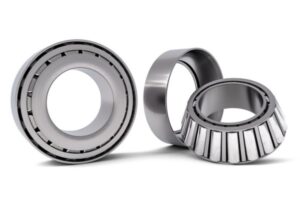
This is exactly why heavy-duty tapered roller bearings are mandatory for pinion and carrier applications.
The angled rollers and raceways are engineered specifically to absorb both radial and thrust forces simultaneously.
Expert Insight from Jessica Jia (TFL Bearing Technical Lead):
“In our teardown analyses of heavy-duty fleet vehicles, we see many premature pinion failures stem from severe shock loads during harsh acceleration. The tapered design is effective because its contact angle allows the bearing to carry radial and thrust loads at the same time. However, if you are inspecting a failed unit, always check the large end-face of the rollers for deep scoring; that is a strong sign of inadequate load distribution or insufficient lubrication.”
Structural Differences: How Carrier Bearings Support the Ring Gear
Ring Gear Support Mechanics
The differential carrier bearings have a different structural priority compared to the pinion.
They are responsible for keeping the ring gear in perfect alignment under massive side-loading.
When torque is applied, the ring gear naturally tries to deflect or “push away” from the pinion gear.
If the carrier bearings allow even a 0.005-inch deflection, the gear teeth will mesh incorrectly.
This results in immediate “gear howl” and localized tooth chipping.
Why Carrier Bearings Handle Lower Speeds but Higher Torque
Here is the technical reality of gear ratios:
Because the ring gear is much larger than the pinion, the carrier bearings rotate at wheel speed, which is significantly slower.
However, the torque load is multiplied by the gear ratio (e.g., 4.10:1).
This means the heavy-duty carrier bearings must control the much higher gear-separation forces and housing loads created after torque multiplication through the final drive ratio.
To handle this, carrier bearings usually feature a larger bore and more robust rollers to distribute the pressure across a wider surface area.
Installation Precision: The Critical Role of Preload
Calculating the Exact Crush Sleeve Preload
In the world of differential service, “tight enough” is a recipe for disaster.
Most modern axles use a crush sleeve to set the distance between the inner and outer pinion bearings.
As you tighten the pinion nut, you are literally crushing a steel spacer to achieve a specific Preload.
Preload is the measured “drag” or resistance to rotation, ensuring the rollers stay seated in the races even under load.
Many automotive axles specify a rotating torque in the range of 15–30 inch-pounds for new pinion bearings, but the final target must always follow the axle manufacturer’s service specification.
The Dangers of Incorrect Torquing
If the preload is too low, the pinion shaft will “walk” or move under load, leading to rapid gear wear.
If the preload is too high, the rollers will generate excessive heat, leading to thermal expansion and total seizure.
Expert Insight from Jessica Jia (TFL Bearing Technical Lead):
“One common mistake we see in the field is technicians using a foot-pound click-style wrench to check preload. You cannot do this. You MUST use a beam-style or dial-style inch-pound torque wrench to measure the constant rotating drag. Also, remember that ‘used’ bearings require significantly less preload (often 8-12 in-lbs) than brand new ones because the contact surfaces have already stabilized.”

Material & Precision: Engineering for Heavy-Duty Environments
GCr15 Chrome Steel Requirements for Axles
A bearing’s lifespan is entirely dictated by its metallurgical purity.
In high-torque differentials, standard carbon steel will deform almost immediately.
Premium manufacturers insist on using high-carbon GCr15 Chrome Steel (equivalent to SAE 52100) for all load-bearing components.
This specific alloy undergoes rigorous heat treatment to achieve a uniform hardness of 60-64 HRC.
This critical hardness level helps the rollers and raceways resist plastic deformation, contact fatigue, and surface damage under heavy shock loads.
For facilities managing large-scale drivetrain component sourcing, verifying these metallurgical standards is non-negotiable.
Surface Finish and Micro-Geometry Profile
But raw hardness is not enough; the surface must hold lubrication.
If a bearing surface is perfectly smooth, gear oil will simply slide off under extreme pressure.
Advanced grinding techniques create a specific micro-geometry profile on the raceways.
These microscopic “valleys” retain a razor-thin oil film, preventing metal-to-metal contact during peak acceleration.
Failure Diagnostics: The Domino Effect of a Dying Bearing
The Domino Effect of Metal Spalling
A failing bearing can quickly damage the rest of the axle assembly.
When the hardened surface of a roller or raceway begins to flake away under extreme pressure, we call this metal spalling.
These razor-sharp, microscopic metal flakes immediately mix with the gear oil.
This contaminated oil is then pumped directly into the tight mesh of the ring and pinion gears.
Within hours, these flakes act like liquid sandpaper, destroying the gear teeth and spreading the destruction to the carrier bearings.
Diagnosing the Whine: Pinion Noise vs. Carrier Noise
Before catastrophic failure occurs, the bearings will usually give you an auditory warning.
Identifying the exact source of the “gear whine” saves hours of diagnostic teardown time.
- Pinion Bearing Whine: Usually presents as a high-pitched howl. If it howls intensely during acceleration, the rear (inner) pinion bearing is suspect. If it howls during deceleration, the front (outer) pinion bearing is likely failing.
- Carrier Bearing Whine: This produces a lower-pitched rumble or growl. The pitch changes with vehicle speed, not engine RPM, and often becomes significantly louder when cornering.
Expert Insight from Jessica Jia (TFL Bearing Technical Lead):
“Never ignore a new vibration or whine. If you catch a failing pinion bearing early, you only replace the bearings and the crush sleeve. If you wait until the metal spalling process completes, you are replacing the ring gear, the pinion gear, and performing a complete axle rebuild. Sourcing our heavy-duty tapered options during the first sign of trouble is the smartest preventative maintenance you can perform.”
Frequently Asked Questions
Can you replace the pinion bearing without removing the carrier?
In some axle designs, the front (outer) pinion bearing can be accessed by removing the pinion seal and yoke without pulling the carrier assembly. However, preload must still be checked and reset correctly. Replacing the rear (inner) pinion bearing usually requires removing the carrier and pinion assembly.
Do carrier bearings and pinion bearings use the same oil?
Yes, both sets of bearings are lubricated by the same gear oil pooled in the bottom of the differential housing. This shared lubrication system is exactly why a failure in one bearing quickly contaminates and destroys the others.
How long should differential bearings last?
Under normal driving conditions with regular fluid maintenance, heavy-duty differential bearings should last over 150,000 miles. However, towing heavy loads, extreme off-roading, or running with low fluid levels can easily cut this lifespan in half.
Need Reliable Bearings for Your Axle Rebuilds?
- Exact-match tolerances for flawless preload setting.
- Robust global supply chain integration for bulk OEM and aftermarket sourcing.
- Direct technical support and guidance from our engineering team.
Stop risking your reputation and drivetrain integrity on sub-par components. TFL Bearing supplies premium, GCr15 heavy-duty tapered roller bearings engineered specifically for high-torque automotive and industrial applications.