







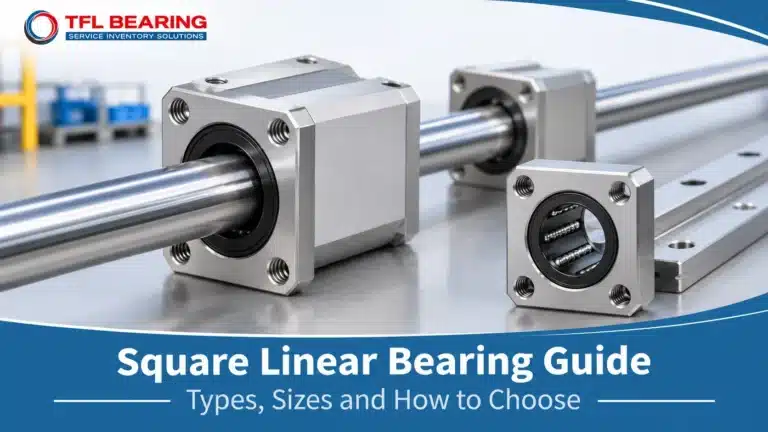

A square linear bearing is a linear motion bearing with a square bore, a square flange or a square housing, so it bolts flat to a machine and slides in a straight line. The name covers three different parts. Pick the wrong one and it simply won’t fit your shaft.
Here’s the quick answer. Need a slide that can’t spin on a single shaft? Choose a square bore plain bearing. Need easy bolting on a round shaft? Choose a square flange bearing or a square bearing block.
At a glance:
- There are three styles: square bore plain, square flange (LMK) and square block (SC or SCS).
- Ball types need a round hardened shaft.
- Plain types cope best with dust, chips and washdown.
- A profile rail carriage is a different part, even though it looks square.
What is a square linear bearing?
A square linear bearing is any linear bearing built around a square form. It can be a square bore bearing that slides on a square shaft, a round bore ball bushing with a square flange (LMK series), or a round bushing held in a square aluminum housing (SC or SCS series). All three give smooth, straight travel.
Think of a drawer slide. The drawer only moves in and out. A linear bearing does that same job inside a machine, from a desktop 3D printer to the pick and place systems on our robotics and automation bearings page.
Square bore plain bearing. PBC Linear’s Simplicity square bearings run on one square stainless steel shaft, with adjustable Frelon plugs to set the clearance. The shaft is square, so the carriage can’t rotate and you don’t need a second shaft.
Square flange linear ball bearing. The LMK series has a round bore and a square flange with four bolt holes. Misumi says its core height is lower than a round flange type, which helps in tight designs.
Square linear bearing block. An SCS8UU is an LM8UU ball bushing held in an aluminum housing by two circlips, with four threaded holes on top. You’ll also see it called a linear bushing block or linear motion bearing block.
How do you read square linear bearing codes?
Linear bearing codes follow a simple pattern. The letters give the style, the number gives the shaft size in millimeters, and the suffix gives the length and seals. An LMK8LUU, for example, is a square flange bearing for an 8 mm shaft, with a long body and seals on both ends.
| Code | What it means |
|---|---|
| LM | Standard round linear ball bearing |
| LMF | Round flange |
| LMK | Square flange |
| LMH | Flange cut flat on two sides |
| SC or SCS | Bearing block (bushing in a housing) |
| L | Long body for more stability |
| UU | Wiper seals on both ends |
| OP | Open type for supported shafts |
Here’s a real example. One LMK8LUU listing from 3D Printing Canada shows an 8 mm bore, 15 mm outside diameter, 45 mm length and a 34 by 34 mm flange.
Catalogs don’t always agree, though. Another supplier’s LMK LUU table lists a 25 mm square flange for the same LMK8LUU. Always check the drawing for your exact square linear bearing before you drill the mounting holes.
Common LMK long type sizes
The table below shows typical square linear bearing sizes from one supplier’s LMK LUU catalog. Treat it as a starting point and confirm every number with your own supplier.
| Model | Shaft (mm) | Outside diameter (mm) | Length (mm) | Square flange (mm) | Dynamic C (N) | Static C0 (N) |
|---|---|---|---|---|---|---|
| LMK6LUU | 6 | 12 | 35 | 22 | 323 | 529 |
| LMK8LUU | 8 | 15 | 45 | 25 | 431 | 784 |
| LMK10LUU | 10 | 19 | 55 | 30 | 588 | 1100 |
| LMK12LUU | 12 | 21 | 57 | 32 | 813 | 1570 |
| LMK13LUU | 13 | 23 | 61 | 34 | 813 | 1570 |
How does a square linear bearing work?
A square linear bearing works in one of two ways. Ball types use steel balls that roll and recirculate inside a cage, so friction stays very low. Plain types slide on a self lubricating liner, such as PTFE, with no rolling parts. Ball types feel smoother. Plain types handle dirt and washdown better.
Each ball touches the shaft at a tiny point. That’s why a linear ball bearing glides so freely, but it’s also why the shaft must be hardened.
A linear plain bearing works more like a sled on snow. PBC Linear warns about its “2:1 binding rule”: if the load sits too far out compared with the bearing’s length, the bearing can stick.
On a CNC router, the linear bearings carry the gantry while the spindle does the cutting. High speed machine tool spindles usually run on super precision angular contact ball bearings, and many designs add super precision cylindrical roller bearings for extra radial stiffness.
What is the difference between square and round linear bearings?
Round linear bearings ride on round shafts and let the carriage rotate, so you usually need two parallel shafts. Square designs stop rotation on their own and mount flat with bolts. Round systems run smoother and forgive small misalignment. Square profile rails carry more load and resist tipping.

| Type | Runs on | Stops rotation alone? | Best for |
|---|---|---|---|
| Square bore plain bearing | Square shaft | Yes | Dirty or wet areas, single shaft slides |
| Square flange ball bearing (LMK) | Round hardened shaft | No | 3D printers, light CNC |
| Square bearing block (SC, SCS) | Round hardened shaft | No | Gantries, packaging machines |
| Round linear ball bearing (LM) | Round hardened shaft | No | Smooth, low cost motion |
| Profiled rail guide block | Square profile rail | Yes | High load, high stiffness |
Machine Design rates round rail load capacity as medium and square rail as high. It says a square rail guide of similar size can carry about three times the load of a round ball bushing for the same travel life.
What are the different types of linear bearings?
The main linear bearing types are linear ball bearings, linear sleeve bearings, flanged linear bearings, mounted linear bearings in blocks or pillow blocks, profiled rail guides and crossed roller guides. Each one trades off friction, load, precision and cost. Most square designs are mounted versions of these core types.
Two standards are worth knowing. ISO 10285:2007 sets the dimensions for sleeve type linear ball bearings. ISO 12090 Part 1:2011 covers profiled rail guides.

When a precision stage also needs a rotary table, designers often add crossed roller bearings, such as the RB, RA and CRBH series. For slim robot joints next to a linear axis, constant section thin bearings save space and weight.
What materials is a square linear bearing made from?
A ball type square linear bearing usually pairs hardened bearing steel balls with a steel outer sleeve and a plastic or steel ball retainer. Many makers also offer stainless steel versions for damp rooms. Square blocks use an aluminum housing to keep weight down, while square flanges are normally steel. Plain types rely on a liner instead, such as PTFE, filled PTFE like Frelon, or an engineering plastic.
How do you choose the right square linear bearing?
Start with the shaft. A square shaft needs a square bore plain bearing. A round hardened shaft needs a ball bushing in a square flange or a block. Then check load, overhang, speed, dirt and the precision you need. Finally, confirm the bolt pattern and length.
- Measure the shaft. An 8 mm shaft needs an 8 mm bore.
- Check the dynamic (C) and static (C0) load ratings, and size for the real load plus shock.
- If the load hangs far out, use a long type or two bearings on each shaft.
- For dust or water, choose a mounted linear sleeve bearing or sealed UU types. On washdown food lines, the rotating parts nearby often use stainless steel deep groove ball bearings, as shown on our food and beverage machinery bearings page.
- Use flange mount linear ball bearings for panels, and blocks for flat plates.
How long will a square linear bearing last?
For a ball type square linear bearing, life comes from the dynamic load rating. A common formula is L = (C ÷ P)³ × 50 km, where C is the dynamic rating and P is the real load. Some makers rate C at 50 km of travel and others, following ISO 14728-1, at 100 km. Compare like with like.
Here’s a quick example. An LMK8LUU rated at 431 N with a steady 100 N load gives (4.31)³ × 50 km, or about 4,000 km of travel on a 50 km basis. Shock, misalignment, soft shafts and poor lubrication cut that number fast, so leave a safety margin.
Plain square bore bearings are rated differently. Their limit is pressure and speed together, often called the PV value. Check the liner maker’s PV limit for fast or heavily loaded axes.
Sizing example: a 3D printer bed and a small CNC gantry
Say a printer bed, glass plate and print weigh 2.5 kg together. That’s roughly 25 N of load. Spread over four SCS8UU blocks, each square linear bearing carries around 6 N, far below its ratings. Here the real risk isn’t load. It’s alignment and shaft quality.
Now take a small CNC router gantry at 15 kg, with cutting forces on top. Load per bearing climbs fast, and the spindle sits out in front of the shafts, so overhang matters more than raw weight. That’s where long LUU types, wider bearing spacing or a square profile rail start to make sense.
A simple rule works for both. Size each square linear bearing for the worst load at the worst position, then add a margin for shock. If the numbers are close, step up one shaft size.
Supported or unsupported shafts?
An unsupported shaft is held only at its ends, so it sags under load over long spans. A supported shaft sits on a rail along its full length. Supported shafts need open bearings, the OP types with a slot along one side, because the rail would hit a closed sleeve. If your square linear bearing setup has a long stroke or a heavy load, a supported rail keeps the shaft straight.
What are square linear bearings used for?
Square linear bearings are used in 3D printers, CNC routers, laser engravers, pick and place units, packaging lines, medical devices and sliding fixtures. Square bore plain bearings suit dirty or wet places like woodworking shops. Square flange and block styles suit compact machines with light to medium loads.
Take a small 3D printer as an example. The bed often slides on SCS8UU blocks over 8 mm shafts, while the belt idler pulleys spin on flanged miniature ball bearings. For lab analyzers and imaging systems, see our medical bearings page.
How do you install a square linear bearing?
Most early failures start at installation. A good square linear bearing on a twisted mount will bind on the first day. Follow these steps:
- Clean the shaft and the mounting faces. Remove burrs, chips and old grease.
- Check the shaft. Ball types need a hardened, ground shaft, typically around 60 HRC, and it must be straight.
- Slide the bearings onto the shaft first, then fit the bolts finger tight.
- Set the second shaft parallel. Run a dial indicator along both shafts, or slide the carriage end to end and feel for tight spots.
- Tighten the bolts in a cross pattern, then slide the carriage again. If it binds, loosen and repeat.
- Lubricate ball types as the maker says. On plain types, adjust the clearance until there’s no play and no drag.
How do you maintain a square linear bearing?
Keep the shaft clean, because dirt on the shaft ends up inside the square linear bearing. Wipe it down on a schedule that suits your shop, relubricate ball types at the maker’s interval, and replace worn wiper seals before they let chips in.
How often depends on the duty. A 3D printer that runs a few hours a day needs far less care than a packaging line running three shifts. Start with the maker’s interval, then adjust it based on what you find at each service.
Signs a square linear bearing is worn
- The carriage feels rough or notchy as it slides.
- You hear clicking or grinding at one spot in the stroke.
- The carriage rocks when you push it up and down.
- You see track marks, rust or red-brown dust on the shaft.
What is the difference between a linear bearing block and a linear guide block?
A linear bearing block is a ball bushing in a housing that rides on a round shaft. A linear guide block, also called a carriage, rides on a profiled rail with balls running in machined grooves. Guide blocks give higher load, stiffness and moment capacity. Bearing blocks cost less and forgive misalignment.

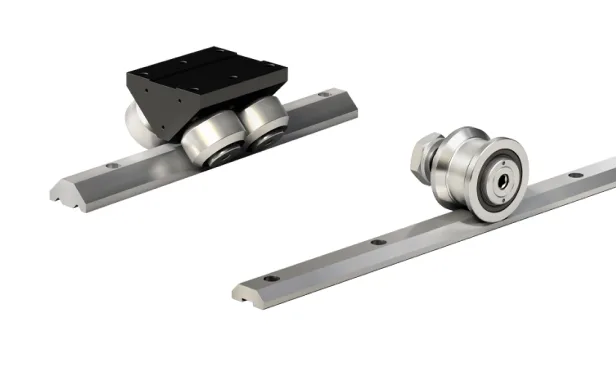
Some systems use guide wheels instead. The track rollers and cam followers inside them are often built on needle roller bearings.
Common mistakes and limitations
- Running ball bushings on soft shafts. The balls dent unhardened steel.
- Using parallel shafts that aren’t parallel. The blocks will bind.
- Ignoring overhang. A short square linear bearing under a long arm rocks and wears out early.
- Mixing up flanged linear bearings with rotary ones. Our guide to flange bearing types explains the rotary kind.
Every style has limits. Plain bearings have more friction and need their clearance adjusted. Square flanges need an accurate mounting bore. Long shafts with no support sag, so use a supported rail or a shorter span.
Conclusion
Measure your shaft, note your load and environment, and match them to the tables above. Then request a quote with your model code and quantity. The right square linear bearing comes down to three things: the shaft shape, the load and where the machine works.
FAQs
What does UU mean on a linear bearing?
It means rubber wiper seals on both ends. They keep dust out and grease in.
Do square linear bearings need lubrication?
Ball types need light oil or grease. Self lubricating plain liners are built to run without it, but follow the maker’s guidance.
Can a linear ball bearing run on a square shaft?
No. Ball bushings need a round hardened shaft. A square shaft needs a square bore plain bearing.
Which shaft sizes do LMK bearings fit?
LMK bearings start with small metric shafts such as 6 mm (LMK6UU) and 8 mm (LMK8UU), and larger sizes are made too.
Are SC8UU and SCS8UU the same?
Often, yes. Many sellers use both names for the same short 8 mm block that holds an LM8UU, while SCS8LUU is the long version. Sizes vary a little between makers, so compare drawings before you swap one for the other.
Can I replace an LMK8UU with an LMK8LUU?
Both fit an 8 mm shaft and share a 15 mm outside diameter. The long type is 45 mm long against 24 mm for the standard one, so check clearance at both ends of travel and confirm the flange size.
Is a square linear bearing better than a round one?
Neither wins in every case. A square linear bearing mounts flat and, in the square bore type, stops rotation on a single shaft. A round bearing in a round housing costs less and is easy to replace. Choose by mounting space, shaft shape and load.
Can TFL Bearings help with bearings for linear motion machines?
Yes. TFL supplies ball, roller, needle and crossed roller bearings. Send your drawing or model code and the team will check linear options.