







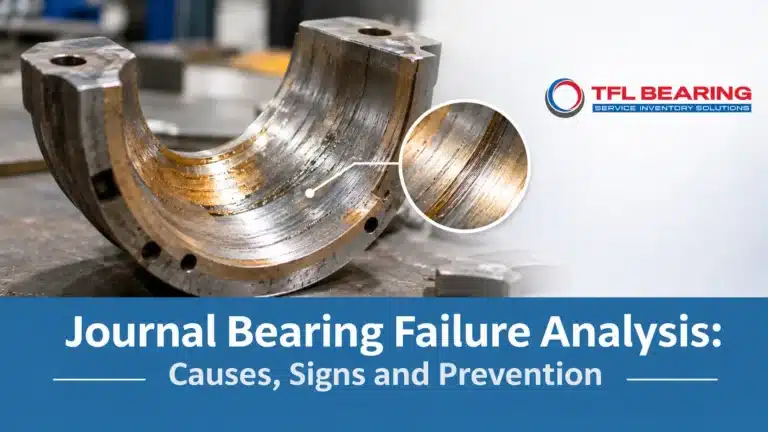

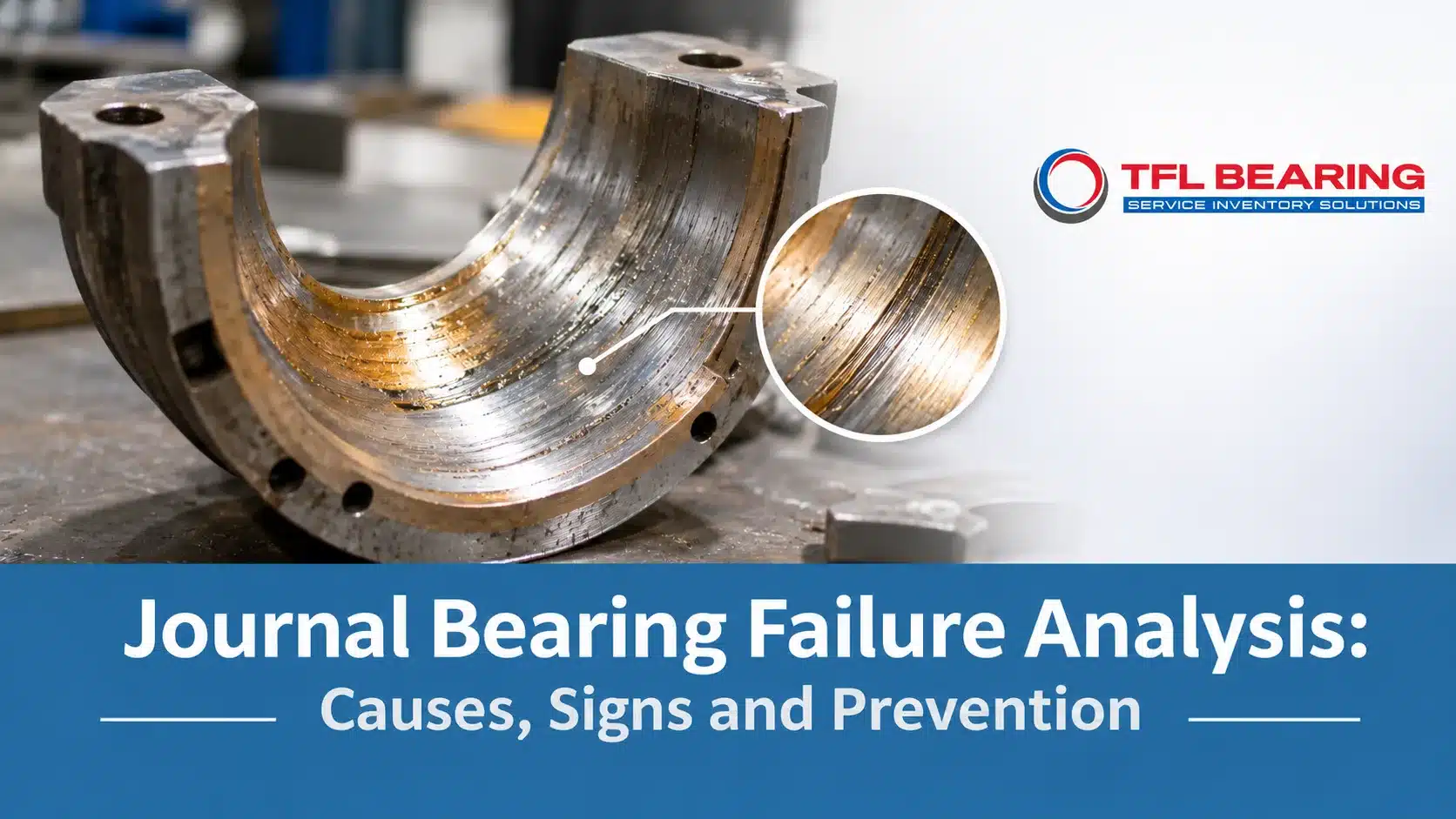
Journal bearing failure analysis is the process of finding out why a hydrodynamic bearing failed. You match the damage on the babbitt lining to a failure mode, confirm it against operating history, oil analysis, clearance and alignment, then correct the root cause. Done well, it stops the replacement bearing from failing the same way.
Most journal bearing failures start outside the bearing. Oil supply, dirt, alignment, load and stray current do the damage, and the soft babbitt records it. That’s why the lining is the best evidence you have, and why swapping the shell without reading it rarely solves anything.
What Causes Journal Bearing Failure?
A journal bearing has no balls or rollers. The rotating shaft pulls oil into a wedge-shaped gap and builds enough pressure to float on it. Machine Design puts that film at roughly 0.0004 to 0.004 in. thick, thinner than a sheet of paper.
This is the main difference from rolling element bearings, which carry load through steel contact. A journal bearing only survives while the film does. Five conditions break the film in most cases.
Oil starvation. Low pressure, a clogged supply hole, a failed pump or a sluggish oil ring on a cold start leaves too little oil to build pressure. The journal touches the babbitt within seconds.
Contamination. Particles larger than the film thickness cut grooves as they pass through the load zone. Water and salt are worse than they look: saltwater can grow a hard tin oxide layer on tin babbitt up to 100 µm thick, which later breaks off and acts as an abrasive.
Wrong clearance. A tight journal bearing restricts oil flow, so heat builds faster than the oil can carry it away. A loose bearing loses film stiffness and damping, and vibration climbs. Clearance also drifts open over the years as worn shells get scraped and refitted.
Misalignment. When the shaft sits at an angle, one edge of the shell carries most of the load. Some misalignment only appears hot, after the pedestal grows or tilts. Plain journal bearings tolerate very little of it, unlike spherical plain bearings, which are designed to let the shaft tilt.
Overload. Static overload, rotor unbalance and vibration all push peak film pressure past what the babbitt can carry. Start and stop are the riskiest moments, because the film hasn’t formed yet. Machine Design notes that radial loads of 400 psi or more are prone to wiping during starts and stops unless the machine has jacking oil to lift the shaft. Axial overload causes the same problems in the companion thrust bearings.
What Does Journal Bearing Damage Look Like?
Each cause leaves its own fingerprint on a journal bearing. Where the damage sits matters as much as what it looks like, so note its position across the width and around the circumference before you clean anything.
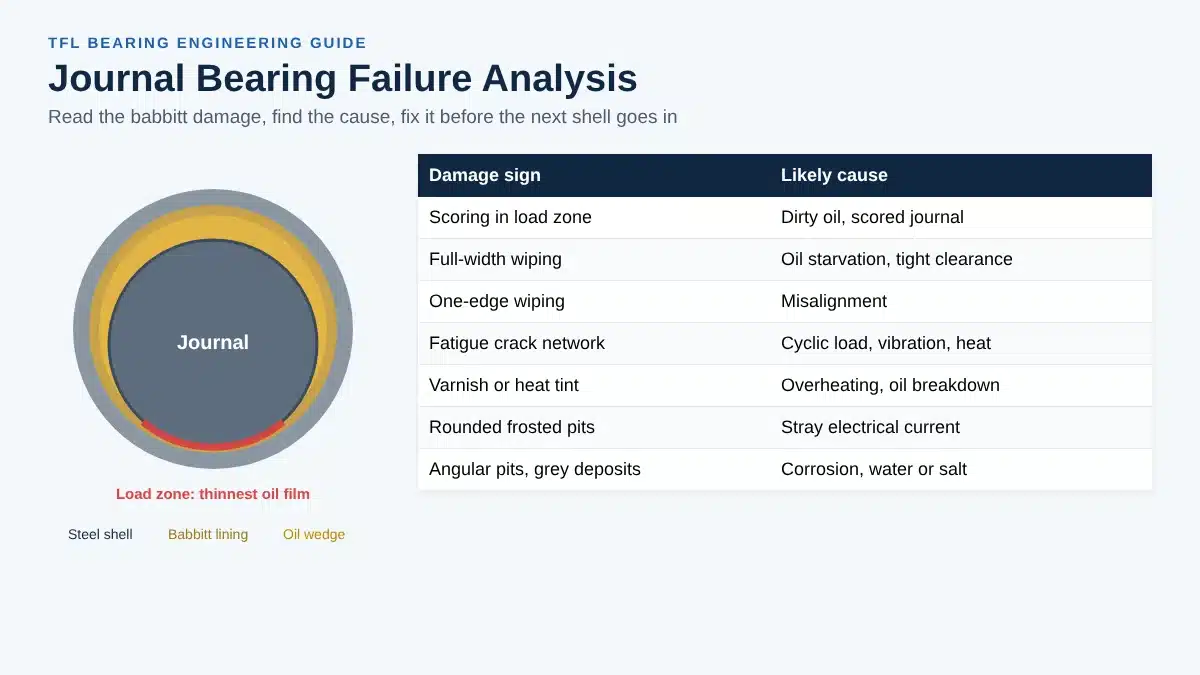
Scoring. Fine circumferential grooves, heaviest in the load zone at the bottom of the shell. Typical grooves run 0.001 to 0.040 in. wide and deep. Scoring points to hard particles in the oil, or a scored journal running against new babbitt.
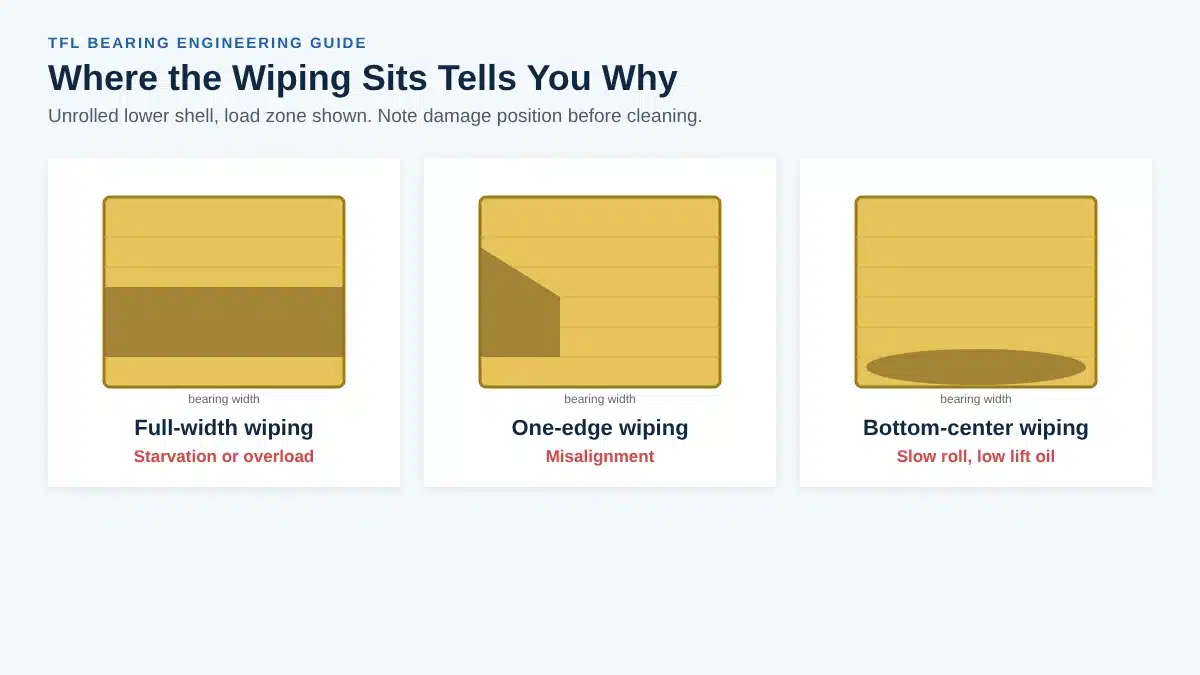
Wiping. Smeared, melted babbitt pushed from the contact point toward areas with more clearance. It means the film broke down and metal touched metal. Wiping across the full width suggests starvation or overload. Wiping on one edge points to misalignment. Wiping at the very bottom of a large bearing suggests long slow rolling on turning gear without enough lift oil.
Fatigue cracks. A crack network on the surface, sometimes with pieces of babbitt missing. Cracks start at the surface and grow toward the bond with the steel backing. Cyclic load from vibration or unbalance is the usual driver, and heat speeds it up because the babbitt loses fatigue strength as it gets hotter.
Discoloration. Dark, lacquer-like varnish in the hottest zones means the oil is breaking down from age or heat. Blue or straw heat tint on the steel journal means severe overheating, often just before seizure.
Corrosion and pitting. Small angular pits come from acids in aged oil attacking the alloy. Rounded pits with a frosted, matte look are electrical pitting, caused by stray current arcing through the thinnest part of the film. The two look similar at a glance, but the fix is completely different.
Journal Bearing Failure Analysis Chart
Use this chart as a starting point. Confirm every cause with at least one check before you act on it.
| Damage sign | Likely cause | What to check | Corrective action |
|---|---|---|---|
| Circumferential grooves in load zone (scoring) | Contaminated oil, scored journal | Particle count, filter condition, journal surface finish | Upgrade filtration, flush system, polish or replace journal |
| Smeared babbitt across full width (wiping) | Oil starvation, tight clearance, overload | Oil pressure and flow, measured clearance, start/stop records | Restore oil supply, correct clearance, add or repair jacking oil |
| Wiping or polishing on one edge | Misalignment | Cold and hot alignment, pedestal growth, soft foot | Realign for operating temperature |
| Crack network, missing babbitt (fatigue) | Cyclic load, vibration, high temperature | Vibration trend, rotor balance, babbitt temperature | Balance rotor, reduce vibration, review babbitt thickness |
| Varnish or heat tint | Overheating, oil breakdown | Oil inlet temperature, oil age, cooler performance | Change oil, restore cooling, recheck clearance |
| Rounded frosted pits | Stray electrical current | Shaft voltage, grounding brush, pedestal insulation | Repair shaft grounding, insulate the pedestal |
| Angular pits or hard grey deposits | Corrosion, water or salt in oil | Water content, acid number, seal condition | Stop water ingress, change oil |
| Fretting on shell back or joint faces | Loose housing fit, low crush | Housing bore, bearing crush, dowels | Restore correct fit and crush |
How Do You Diagnose a Failed Journal Bearing?
A good journal bearing failure analysis follows the same five steps every time. Skipping one is how teams end up blaming the bearing for a lube system problem.
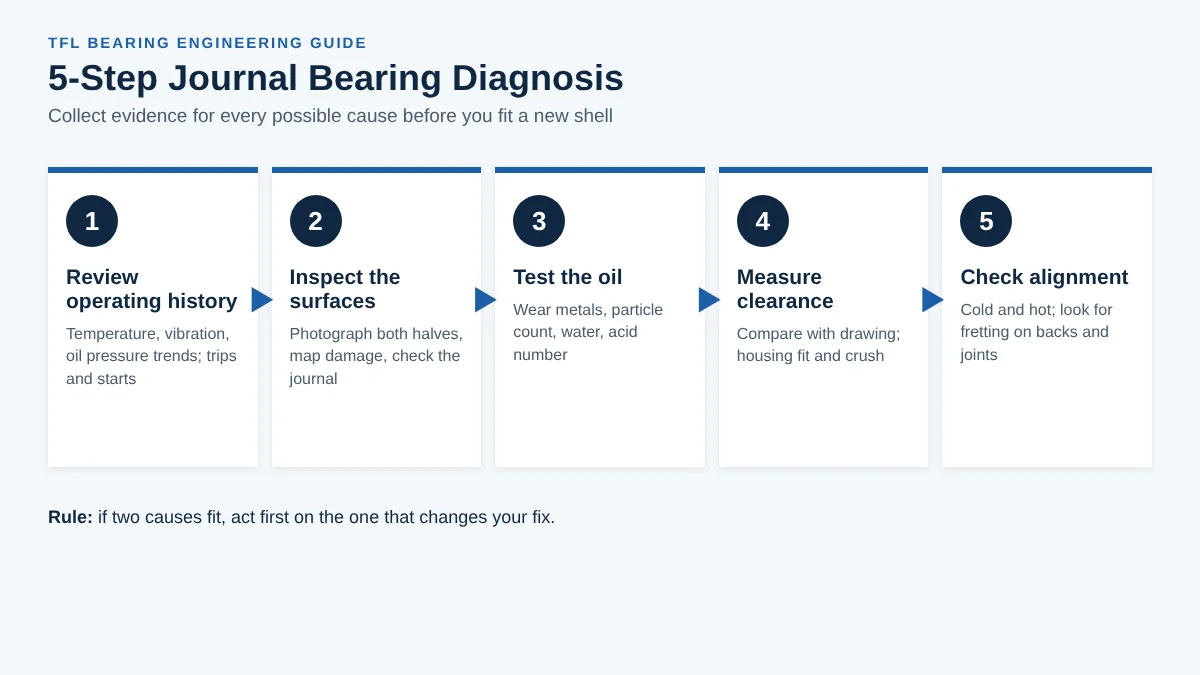
- Review operating history. Pull bearing temperature, vibration and oil pressure trends for the weeks before the failure, plus any trips, overspeeds or unusual starts. A sudden temperature spike is often the first sign of a wipe, even when it never crosses the alarm setpoint.
- Inspect the surfaces. Photograph both halves in place, then map the damage by position. Inspect the journal as well. A scored, tapered or out-of-round shaft reduces load capacity as much as a worn lining.
- Test the oil. Send a sample and the used filter element to a lab. For tin babbitt, rising tin, antimony and copper show the lining is wearing. Ask for particle count, water content and acid number too, because those point to the cause rather than the result.
- Measure clearance. Compare the measured clearance with the drawing. Check the housing fit and bearing crush at the same time.
- Check alignment. Measure cold and, where possible, at operating temperature. Look for fretting on the shell back, joint faces and dowels, which signals movement or distortion.
Write down the evidence for each possible cause. If two causes fit, act on the one that changes your fix first.
Should You Repair or Replace the Bearing?
Ask one question: will this journal bearing carry its full expected load, including starts and stops, if it goes back in?
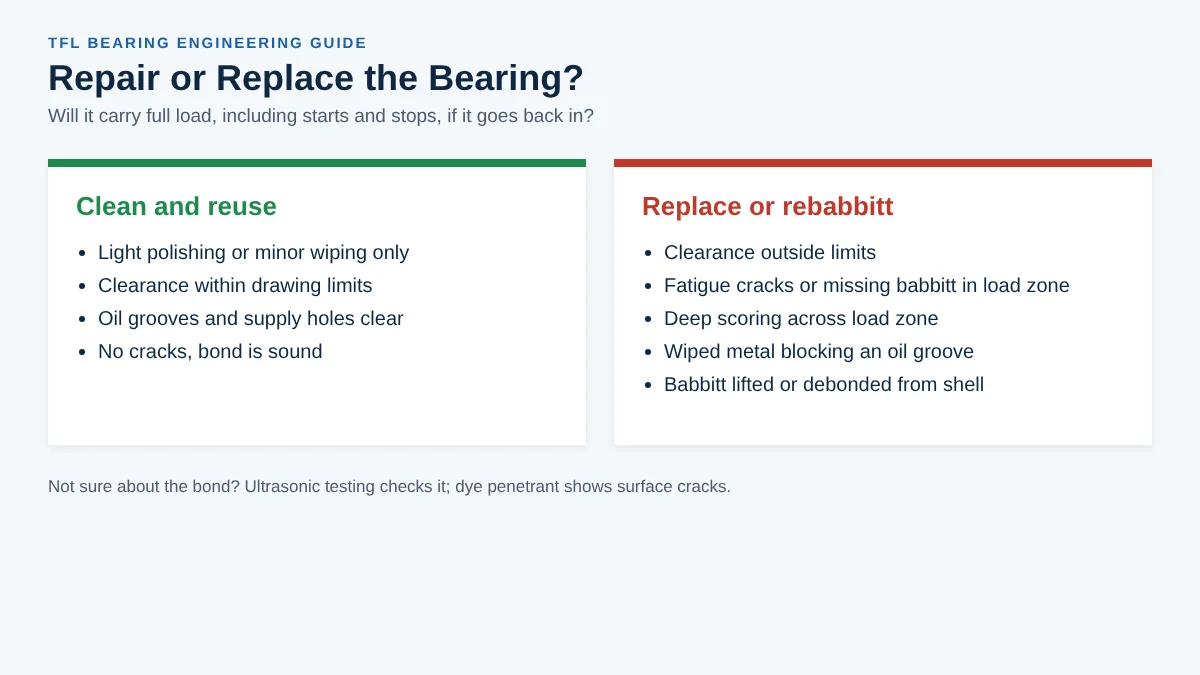
A journal bearing can usually be cleaned and reused when:
- Damage is limited to light polishing or minor wiping
- Clearance is within drawing limits
- Oil grooves and supply holes are clear
- There are no cracks and the bond is sound
Replace it, or send it for rebabbitting, when any of these apply:
- Clearance is outside limits
- Fatigue cracks or missing babbitt appear in the load zone
- Deep scoring crosses the load zone
- Wiped metal has blocked an oil groove
- The babbitt has lifted or debonded from the steel shell
Bond failure and fine cracks are often invisible. Ultrasonic testing checks the bond, and dye penetrant reveals surface cracks, both covered under ISO 4386. Bring in a bearing repair specialist when you lack that equipment, when damage sits close to the limits, or when the bearing supports a critical machine such as a steam or gas turbine in power generation. For pumps, fans and compressors in general industrial machinery, the same criteria apply, but in-house repair is often practical.
How Can You Prevent Repeat Failures?
Start with the root cause your journal bearing failure analysis found. Then lock in the basics so nothing else takes its place.
Correct lubrication. Use the specified oil grade and viscosity, keep inlet temperature stable and confirm pressure and flow at every bearing, not just at the pump. Change oil before it starts to varnish. On machines that see seawater or wash-down, such as marine equipment, check water content on every oil report.
Filtration. Choose filters that stop particles larger than the minimum film thickness. Flush any new or rebuilt system thoroughly, then drain and refill the oil after the first couple of weeks to remove leftover assembly debris.
Installation. Clean every part with the oil you’ll run on. Measure clearance, housing fit and crush. Align with thermal growth in mind. Never fit a new shell on a scored journal without polishing or replacing it.
Condition monitoring. Trend bearing metal temperature against the machine’s own baseline instead of a generic limit, and alarm on sudden rises as well as high levels. On larger machines, two proximity probes 90° apart track shaft position and orbit. A centerline drifting lower over months means wear. Vibration near half running speed suggests oil whirl.
Standard vibration analysis built for rolling bearings won’t catch most journal bearing faults, because there are no balls or rollers to create defect frequencies. Wind turbine gearboxes show the contrast well: gearbox bearing failure signs differ sharply between rolling and journal designs.
Electrical protection. Keep shaft grounding brushes in service and check pedestal insulation during outages. Where the motor or generator runs on rolling bearings instead, electrically insulated bearings block the same stray current path.
Frequently Asked Questions
What causes wiping in a journal bearing?
Wiping happens when the oil film collapses and the journal touches the babbitt, heating the surface until it smears. The usual triggers are oil starvation, tight clearance, misalignment, overload and heavy loads during starts and stops.
How does oil starvation damage bearings?
Without enough oil, the journal bearing can’t build film pressure, so the shaft rubs the lining. Friction heats the babbitt within seconds, causing wiping and then seizure if the supply isn’t restored. Displaced babbitt can also block oil grooves and make the starvation worse.
Can a damaged journal bearing be reused?
Sometimes. Light polishing or minor wiping can be cleaned and reused if clearance is within limits, oil grooves are clear and the bond is sound. A detailed survey of babbitted bearing damage in Lubricants explains that limited wiping often leaves a workable surface, while cracks, bond loss and deep scoring reduce load capacity.
Who can help with a journal bearing replacement or a switch to rolling bearings?
If you’re replacing bearings on a critical machine or reviewing whether a rolling bearing design suits your application, contact the TFL engineering team with your drawings, part numbers and operating conditions.