







Spherical bearings let a shaft or pin rotate and tilt at the same time. Inside, an inner ring with a convex outer surface sits in an outer ring with a matching concave bore, so the two can swivel against each other. Most spherical bearings you’ll buy are spherical plain bearings: two steel rings, no balls, no rollers.
That last point causes more ordering mistakes than anything else in this category. “Spherical bearing” can also mean a spherical roller bearing, which is a completely different part with rollers inside. Wikipedia’s definition of spherical bearings covers both, and so do supplier search results. So before you compare sizes, decide which one your machine actually uses.
Plain or roller: which spherical bearings do you have?
A spherical plain bearing is a sliding joint. The rings rub against each other, either on grease or on a low-friction liner. It shines at slow, back-and-forth movement under heavy load, the kind you get in a hydraulic cylinder eye or a loader linkage.
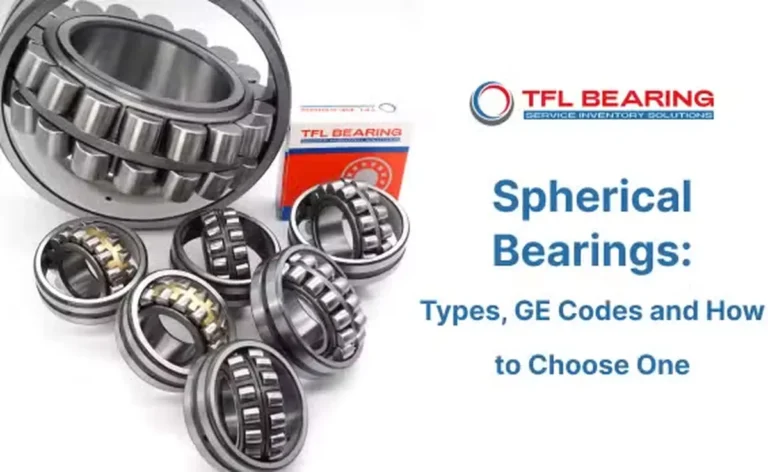
A spherical roller bearing has two rows of barrel-shaped rollers running on a sphered outer raceway. It’s built for continuous rotation of a shaft that might bend or sit slightly out of line, like a conveyor pulley or a vibrating screen. If that’s your part, TFL’s spherical roller bearing range and our guide to spherical roller bearing basics are the better place to start. For lighter loads with the same need to self-align, self-aligning ball bearings are another rolling option.

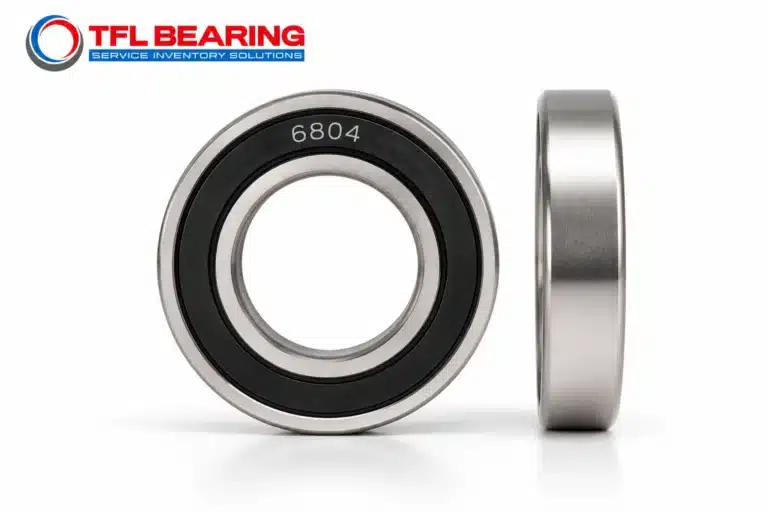
Quick check: look at the side of the old part. If you see rollers, it’s a roller bearing. If you see two solid rings and maybe a lube hole, it’s a plain bearing. The rest of this guide covers the plain type of spherical bearings.
Where spherical plain bearings earn their keep
Spherical bearings of the plain type exist for one job: carrying a big load through a joint that never lines up perfectly. Around 1840, engineer James Nasmyth used brass shells in hemispherical cups so long mill shafts could self-align, and the principle hasn’t changed much since.
Today you’ll find them in cranes, conveyors, forklifts, hydraulic and pneumatic cylinders, construction and farm equipment and industrial robots, according to an SKF product overview in Machine Design. Cars use them in suspension and steering parts too.
What makes spherical bearings good at this is load capacity. Take a common size, the GE20ES, which Kinex lists at 30 kN dynamic and 146 kN static.
That static figure is almost five times the dynamic one, and it tells you where the design is comfortable: heavy loads moving slowly through small angles. Spin one fast and continuously, and you’re asking a joint to do a wheel bearing’s work. It won’t thank you.
How to read a GE part number
Most metric radial spherical plain bearings follow ISO 12240-1, so a GE20 from one maker has the same boundary dimensions as a GE20 from another. The letters after the number are where brands drift apart, and where buyers get caught.
Here’s how the common codes break down, using published data from Kinex and SKF distributor listings:
| Code | What it means | Example |
|---|---|---|
| GE + number | Radial spherical plain bearing, number = bore in mm | GE20 = 20 mm bore |
| E | Phosphated steel/steel surfaces, dimension series E | GE20E |
| S | Lube groove and two lube holes in each ring | GE20ES |
| 2RS | Seals on both sides | GE20ES-2RS |
| C (SKF) | Maintenance-free, steel against PTFE sintered bronze | GE6C |
| GEH (SKF) | Wider inner ring and larger OD for more load and tilt | GEH10C |
A GE20ES-2RS measures 20 x 35 x 16 mm, with a 12 mm outer ring width. SKF’s version is a steel/steel bearing that needs relubrication, with an operating range of minus 30 to plus 130 °C, per a Motion listing.
Watch the tilt angle. Kinex gives 9° for the GE20ES, while another Motion listing for a GE20ES-2RS shows 6°. Seals and catalog methods change the figure, so take it from the datasheet for the exact part you’re buying, not from a generic size chart.
And read seller descriptions with care. At least one distributor page describes the GE20ES-2RS as a steel/PTFE maintenance-free bearing, while SKF’s own listing classifies it as steel/steel requiring maintenance. If a supplier gets that wrong, the grease schedule on your machine will be wrong too.
Steel/steel or maintenance-free?
This is the decision that matters most after size when you choose spherical bearings.
Steel/steel (E, ES types). These carry heavy and shock loads well, but they need grease. That’s what the S groove and holes are for. Skip relubrication and the sliding surfaces wear fast. They suit equipment that already has a grease routine, like earthmoving and farm machines.
Steel/PTFE (C, UK, TXE and similar). A PTFE liner does the lubricating, so there’s no greasing. SKF lists its GE..C series as maintenance-free but notes the sliding surfaces must be protected from contaminants from outside. They’re a good fit for places that are hard to reach, or where grease would contaminate a product.
A simple rule: if dirt and water are constant and someone greases the machine weekly anyway, steel/steel with seals is hard to beat. If nobody will ever touch the joint again, go PTFE and seal or shield it.
Size matters here too. SKF’s GE6C, a 6 x 14 x 6 mm maintenance-free bearing, is rated at only 3.6 kN dynamic, according to Acorn’s listing. Small spherical bearings leave very little margin, so check the rating against your peak load, not the average.
Rod ends, angular contact and thrust types
A rod end is a spherical plain bearing set in an eye-shaped housing with a threaded shank. Schaeffler’s catalog shows its rod ends built to ISO 12240-4, in both steel/steel and maintenance-free versions, with left-hand and right-hand threads.
For joints that also carry axial force, makers offer angular contact spherical plain bearings for combined loads and thrust spherical plain bearings for pure thrust. SKF notes both can work alongside a radial spherical plain bearing when the load case needs it. If the shaft turns continuously under heavy thrust instead, a spherical roller thrust bearing is the rolling-element choice.
5 mistakes that shorten the life of spherical bearings
- Ordering spherical bearings by bore alone. An E type and a C type of the same bore lubricate in completely different ways.
- Treating a steel/steel bearing as sealed for life.
- Using a plain bearing for continuous high-speed rotation.
- Forgetting the split outer ring. Many steel/steel types have an outer ring split at one point, and SKF’s steel/PTFE sintered bronze types use an intentionally fractured outer ring, so mount them with care.
- Copying the tilt angle from a size chart instead of the datasheet.
FAQs
Are spherical bearings the same as rod ends?
Not quite. A rod end contains a spherical plain bearing, but adds a housing and threaded shank so it can bolt onto a linkage.
Are spherical bearings interchangeable between brands?
On boundary dimensions, usually yes, because most metric sizes follow ISO 12240-1. Material and sealing still differ, so match the full suffix.
Do PTFE-lined spherical bearings need grease?
They’re designed to run without it. SKF’s GE..C series, for example, has no relubrication feature at all. Follow the maker’s note for your exact series.
If you’re replacing spherical bearings, start with the full code on the old ring, including every letter after the number. Then send it to TFL Bearing for a cross reference check, or request a quote with your quantity.