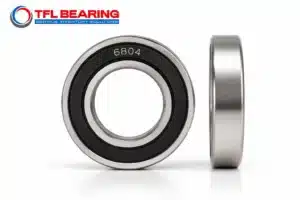






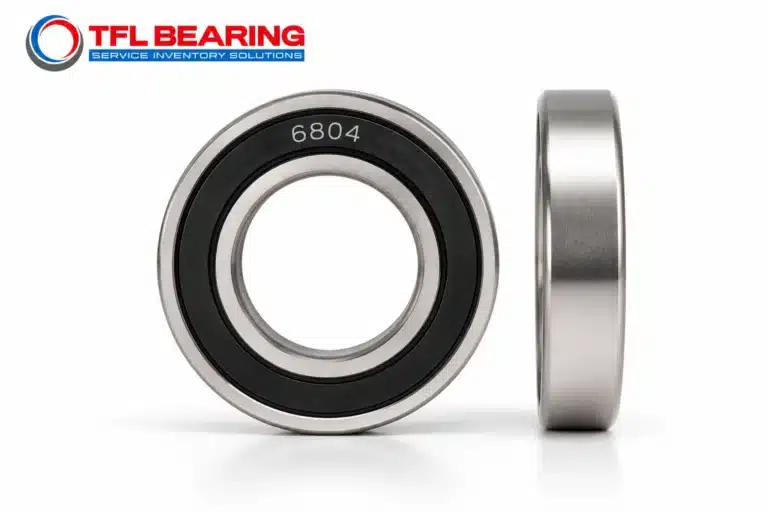
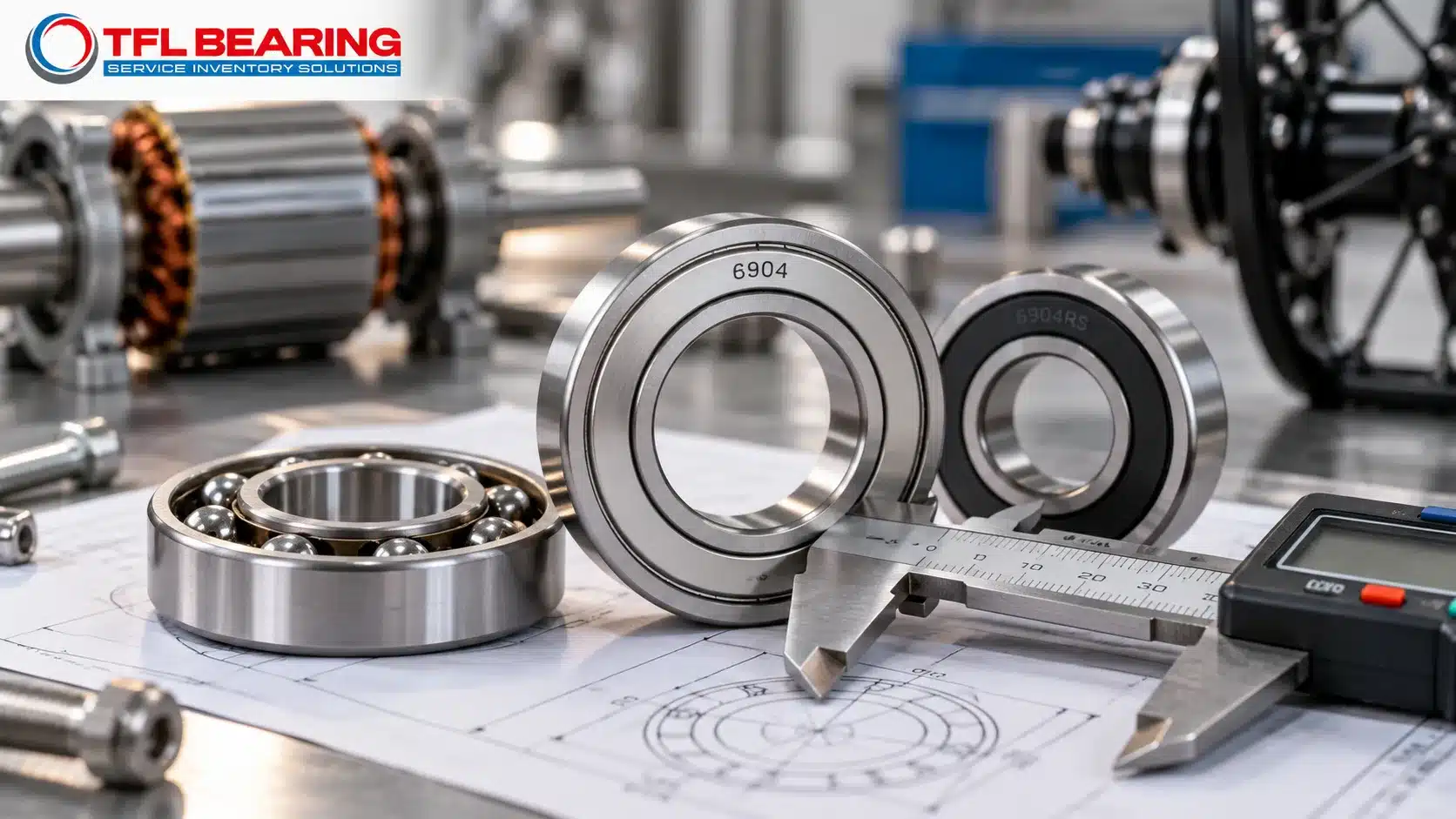
A 6904 bearing is a single row deep groove ball bearing with a 20 mm bore, a 37 mm outside diameter and a 9 mm width. It’s thin, light and built for radial loads at high speed. You’ll find it in bicycles, small electric motors, power tools and compact machines.
This guide gives you everything in one place: exact size, load and speed numbers, seal codes, brand equivalents and the buying mistakes that cost people time. All figures come from SKF, NSK and JTEKT Koyo catalog data checked in October 2026.
Quick Specs at a Glance
| Spec | Value |
|---|---|
| Type | Single row deep groove ball bearing |
| Size (d x D x B) | 20 x 37 x 9 mm |
| Dynamic load rating | 6.37 kN (SKF) / 7.0 kN (NSK) |
| Static load rating | 3.65 kN (SKF) / 3.7 kN (NSK) |
| Limiting speed, open | 26,000 rpm (SKF) |
| Limiting speed, sealed 2RS | About 10,000 to 12,000 rpm |
| Weight | About 0.036 to 0.037 kg |
| SKF and FAG name | 61904 |
What Are the 6904 Bearing Dimensions?
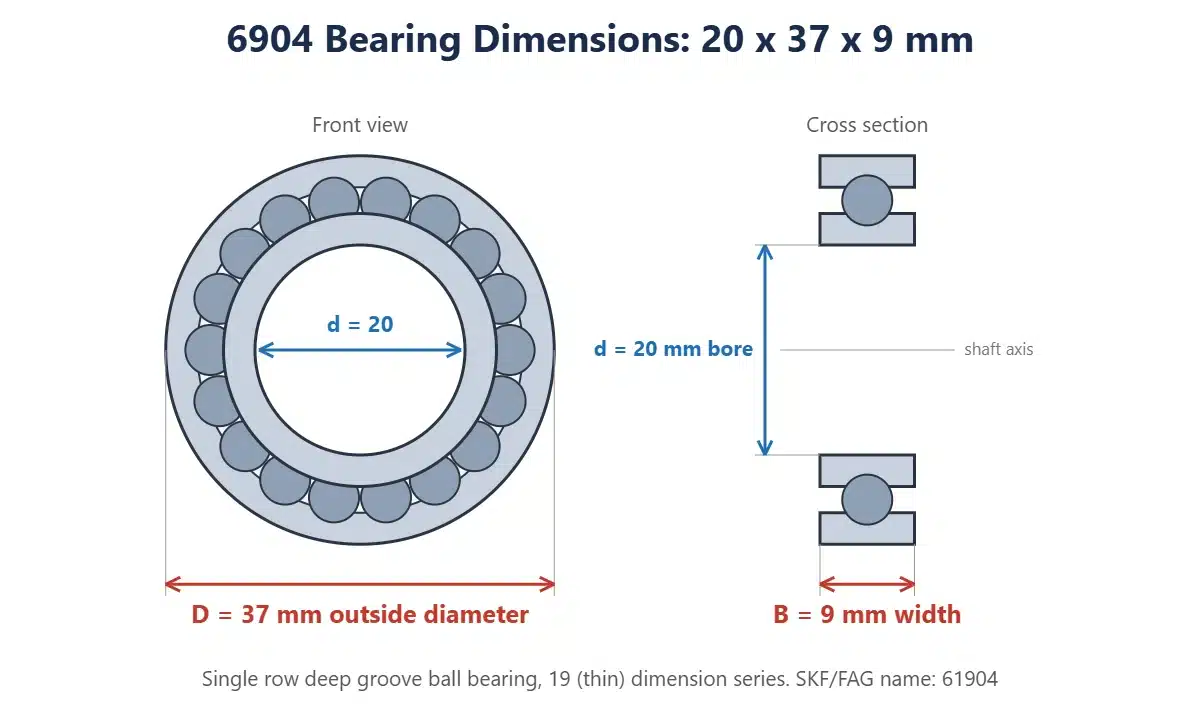
The 6904 bearing measures 20 x 37 x 9 mm. That’s a 20 mm bore (the hole the shaft goes through), a 37 mm outside diameter and a 9 mm width. The corner chamfer is at least 0.3 mm. These sizes follow the ISO boundary plan, so every brand’s 6904 bearing has the same outer size.
| Measurement | Metric | Inch |
|---|---|---|
| Bore (d) | 20 mm | 0.787 in |
| Outside diameter (D) | 37 mm | 1.457 in |
| Width (B) | 9 mm | 0.354 in |
| Chamfer (r min) | 0.3 mm | 0.012 in |
| Ball diameter | 4.762 mm | 0.187 in |
| Shaft shoulder (da min) | 22 mm | 0.866 in |
| Housing shoulder (Da max) | 35 mm | 1.378 in |
The shoulder figures come from the JTEKT Koyo catalog (2026). They tell you how tall the step on your shaft and housing should be, so the bearing seats are flat.
How Do You Read the 6904 Number?
Bearing numbers are a code, not a random label. Once you can read it, you’ll spot the wrong part fast.
- 6 means deep groove ball bearing.
- 9 means the very thin “19” dimension series.
- 04 times 5 gives the bore: 20 mm.
That last point is a handy shortcut. It works for any bore code from 04 upward.
Now see what happens when the series changes but the bore stays the same:
| Bearing | Size (mm) | Profile | Relative load capacity |
|---|---|---|---|
| 6904 | 20 x 37 x 9 | Thin section | Lowest |
| 6004 | 20 x 42 x 12 | Light | Higher |
| 6204 | 20 x 47 x 14 | Medium | Higher still |
| 6304 | 20 x 52 x 15 | Heavy | Highest |
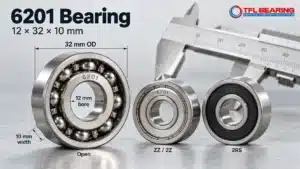
All four fit a 20 mm shaft, but none of them fits the others’ housings. Our 6201 bearing guide breaks down the same code system for a smaller size.
What Is the 6904 Bearing Load Rating?
SKF lists a dynamic load rating of 6.37 kN and a static rating of 3.65 kN. NSK lists 7.0 kN and 3.7 kN. These numbers are used to calculate life. They aren’t safe working loads, so your real load should sit well below them.
Here’s a simple way to picture it. Under ISO 281, the dynamic rating is the load at which a batch of bearings reaches a rated life of one million turns. So 6.37 kN, roughly 650 kg of force, is a calculation reference. It’s like the top speed printed on a car’s spec sheet. You don’t drive there every day.
The static rating is different. It’s the load a bearing can take while standing still before the balls start to dent the races. That matters for machines that sit loaded, like a jammed conveyor.
How Fast Can a 6904 Bearing Spin?
An open 6904 bearing is fast. SKF data lists a 43,000 rpm reference speed and a 26,000 rpm limiting speed. NSK lists 19,000 rpm with grease and 22,000 rpm with oil for its P6 grade. Sealed versions are much slower, usually around 10,000 to 12,000 rpm.
Why the big drop? Rubber seal lips rub on the inner ring. That rubbing makes heat, and heat limits speed.
Here’s something most listings miss. We’ve seen sealed 6904s sold online with the open bearing’s speed copied onto them. Always check the maker’s datasheet for the exact suffix you’re buying.
6904 2RS vs 6904 ZZ vs Open: Which Should You Pick?
Choose 2RS when dirt or water is around, like bike hubs. Choose ZZ for clean, faster jobs like small motors. Choose open when the machine has its own seals and oil bath. More sealing means better protection, but also more drag and a lower top speed.
| Type | Closure | Best for | Trade off |
|---|---|---|---|
| 6904 2RS | Rubber contact seals, both sides | Wet or dusty jobs, bikes | Lower speed, slight drag |
| 6904 ZZ | Metal shields, both sides | Clean, faster jobs | Weak against water |
| Open 6904 | None | Oil lubed gearboxes, top speed | Needs outside sealing |
You’ll also see a C3 suffix, like 6904 2RS C3. C3 means a little more internal room between the balls and rings. It helps when a motor runs warm or the shaft fit is tight, because metal grows with heat.
What Is the 6904 Bearing Cross Reference?
SKF and FAG call this size 61904. NSK, NTN, Koyo and Nachi call it 6904. MRC uses 1804S. They’re all the same 20 x 37 x 9 mm bearing. What changes is the seal code, so match the suffix, not just the number.
| Brand | Open | Sealed | Shielded |
|---|---|---|---|
| SKF | 61904 | 61904 2RS1 | 61904 2Z |
| FAG (Schaeffler) | 61904 HLC | 61904 2RSR HLC | 61904 2Z HLC |
| NSK | 6904 | 6904DDU | 6904ZZ |
| NTN | 6904 | 6904LLU | 6904ZZ |
| Koyo | 6904 | 6904 2RU | 6904ZZ |
| Nachi | 6904 | 6904 2NSE | 6904ZZ |
So “61904 vs 6904” isn’t a real choice. It’s one bearing with two naming styles. For any other part number, our bearing cross reference guide helps you find a match quickly.
What Is a 6904 Bearing Used For?
It’s chosen when space and weight are tight. Common uses include bicycle bottom brackets and hubs, small electric motors, power tools, pumps, automation parts and compact machinery. Its thin rings let a designer fit a 20 mm shaft into a small housing.
A few related options are worth knowing:
- Need an even slimmer ring for robotics or instruments? Look at thin section bearings.
- Need a lip that locates the bearing in the housing? The F6904 adds a 40 mm flange to the outer ring. You’ll find similar designs in our flanged ball bearings range.
- Running a motor on a variable frequency drive? Stray current can pit the races and cause a humming noise. Electrically insulated bearings stop that current from passing through.
- Ceramic and hybrid 6904 versions exist, mostly for cycling. Their load and speed numbers differ from steel, so use that maker’s own datasheet.
Common Mistakes When Buying a 6904 Bearing
- Mixing up look alike codes. NA 6904 is a needle roller bearing that’s 30 mm wide. RNA 6904 has a 25 mm inner diameter. Neither is a 20 x 37 x 9 ball bearing.
- Trusting the number alone. PFI’s 6904DW has an 18.75 mm bore, not 20 mm. Check the bore every time.
- Swapping a 6004 for a 6904 bearing. Same bore, but the 6004 won’t fit a 37 mm housing.
- Using open speed figures for a sealed part.
- Skipping C3 in hot motors or tight press fits.
Limitations and Fitting Tips
Thin rings are the 6904 bearing’s strength and its weak spot. It carries less load than a 6004 or 6204. It handles only light axial (side) load. It’s also sensitive to misalignment and to housings that aren’t perfectly round.
A few habits will save you trouble:
- Press only on the ring you’re fitting. Pushing the outer ring to fit the inner ring onto a shaft dents the races.
- Measure the old bearing with calipers before ordering.
- Read the full suffix: seal type, clearance and precision grade.
- Keep sealed bearings in their box until fitting, so dust stays out.
Conclusion
The 6904 bearing is a 20 x 37 x 9 mm thin deep groove ball bearing that trades some load capacity for compact size and high speed. Match the bore first, then the seal code and clearance, and always check the real speed rating on sealed parts.
Ready to source the right part? Browse our deep groove ball bearings or request a quote with your part numbers and quantities. Our team will confirm the correct 6904 bearing equivalent for your application.
FAQs
Can I replace a 6904 bearing with a 6004?
Not directly. Both have a 20 mm bore, but the 6004 is 42 mm across and 12 mm wide, so it won’t fit a 37 mm housing.
Is a 6904 2RS waterproof?
No. Rubber seals keep out splashes and dust, but they aren’t made for submersion or pressure washing.
Does a sealed 6904 bearing need regreasing?
No. Sealed and shielded versions are greased for life. Open versions get their lubrication from the machine.
What does ABEC mean on a 6904?
It’s a precision grade. A higher number means tighter tolerances, which helps in high speed and low noise jobs.
Can TFL Bearing supply mixed bearing models in one order?
Yes. TFL combines mixed model orders, checks interchange specs, inspects before shipment and handles export shipping in one process.