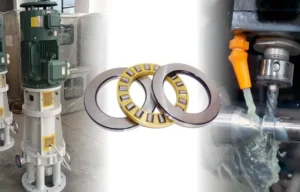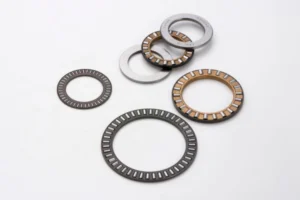








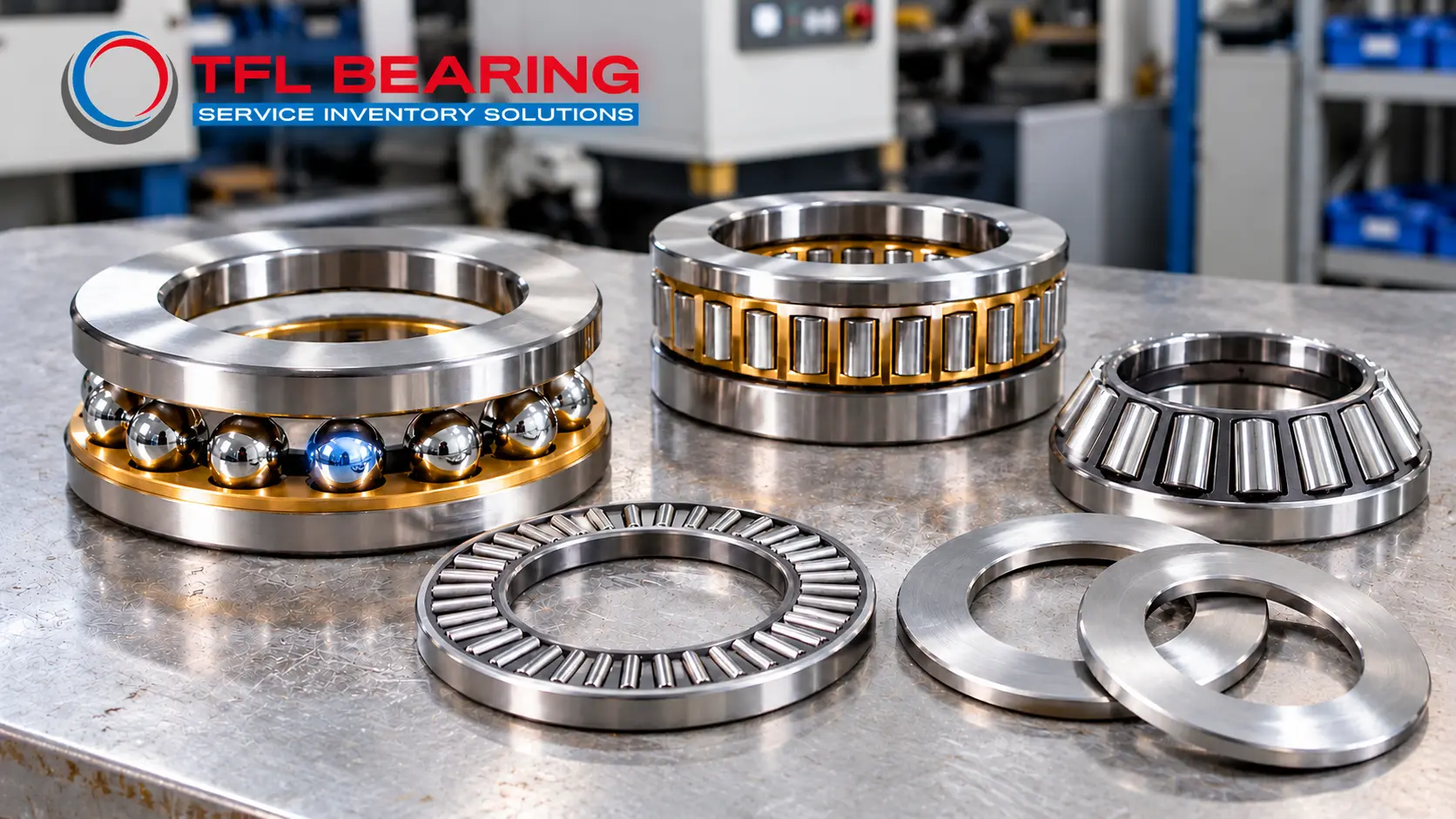
A thrust bearing is a bearing built to carry axial load, the push that runs along a shaft instead of across it. Picture a lazy Susan. Plates press down on it, yet it still turns. That’s the whole idea.
If the force runs across your shaft, you need a radial bearing. If it runs along the shaft, you need thrust support. Below, you’ll find every common thrust bearing type, how they compare, and the mistakes that cut bearing life short.
What is a thrust bearing?
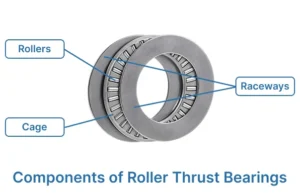
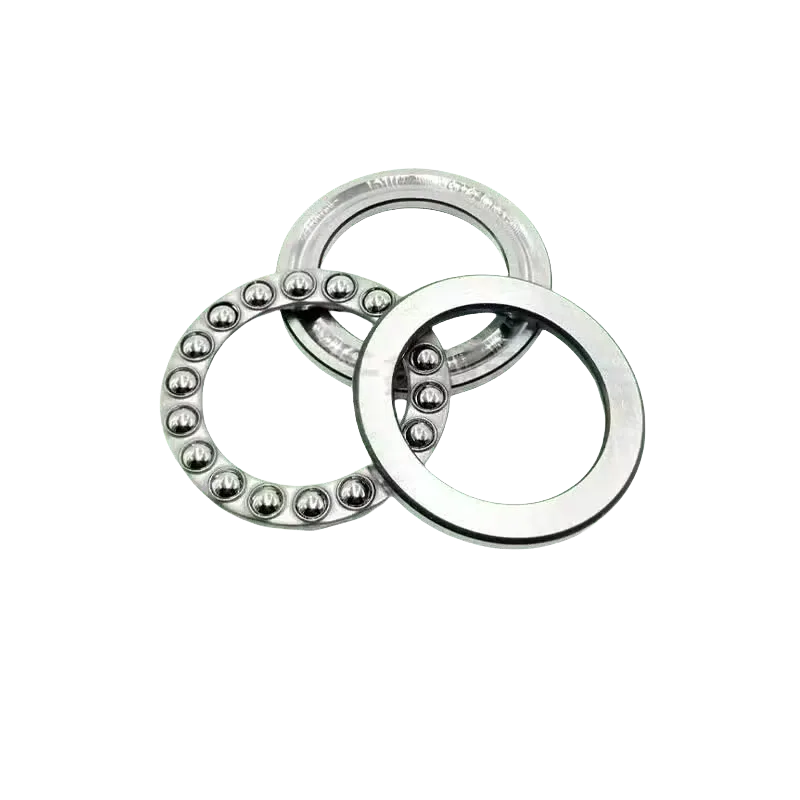
It’s a rotary bearing that supports force parallel to the shaft while the shaft turns. Most designs use two washers, which act as raceways, plus the rolling elements. The shaft washer fits the shaft. The housing washer sits in the machine body. Axial load and thrust load are simply two names for the same force.
A cage keeps the balls or rollers evenly spaced, like eggs in a carton.
Some big machines skip rolling parts altogether. Tilting pads form wedge shaped oil zones against a spinning disk, so metal never touches metal. Albert Kingsbury tested his first experimental version in 1904, and ASME lists it as an engineering landmark.
What are the main types of thrust bearings?
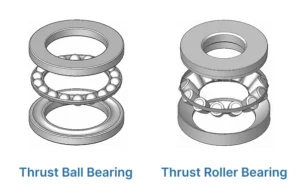
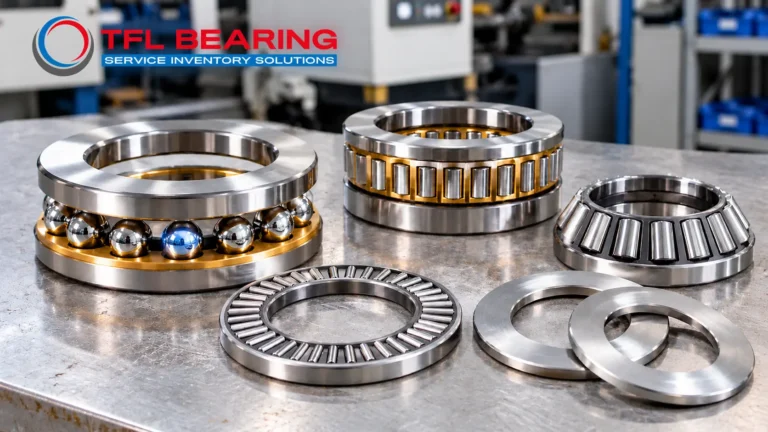
There are five main rolling designs: ball, cylindrical roller, needle roller, tapered roller and spherical roller. Plain thrust washers, fluid film and magnetic bearings cover special jobs. Balls suit lighter loads. Roller types carry more thrust because of their larger contact area.
Thrust ball bearings
A single direction design has a shaft washer, a housing washer and one ball cage, so it takes push from one side only. The double direction version uses three washers and two cages to take push from both sides. NSK lists uses such as ball screw supports, AGVs and fishing reels, and Nachi notes them in crane hooks.
Searching for a ball thrust bearing? It’s the same part. You can compare single direction, double direction and miniature sizes in our thrust ball bearings range.
Cylindrical roller thrust bearings
Short cylinders lie flat with their axes pointing to the center, like wheel spokes. This thrust roller bearing style handles heavy axial and impact loads. Fullbay notes it’s the lowest cost roller thrust type.

Needle roller thrust bearings
Needles are long, thin rollers, shaped like pins. SKF says this design gives high stiffness in very little axial space. When nearby machine faces act as raceways, it takes up no more room than a conventional thrust washer. Otherwise, you add separate washers.

Need radial support too? SKF suggests pairing it with a drawn cup or machined ring needle bearings. That’s where our needle roller bearings come in.
Tapered roller thrust bearings
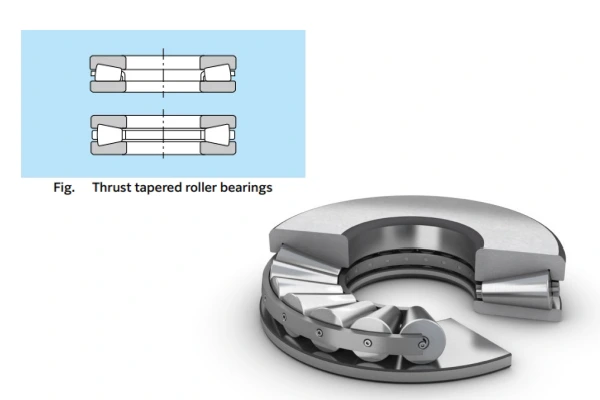
The rollers’ axes all meet at one point on the bearing’s axis, and the taper must be calculated carefully so each roller rolls without skidding. They take more thrust than ball types but cost more to make.
Spherical roller thrust bearings
They’re the only roller thrust design that takes radial load as well as axial load, and the only one that copes with misalignment and shaft deflection. SKF states radial load can reach 55% of the axial load. For heavy, flexing shafts, look at our spherical roller thrust bearings.
Thrust washers
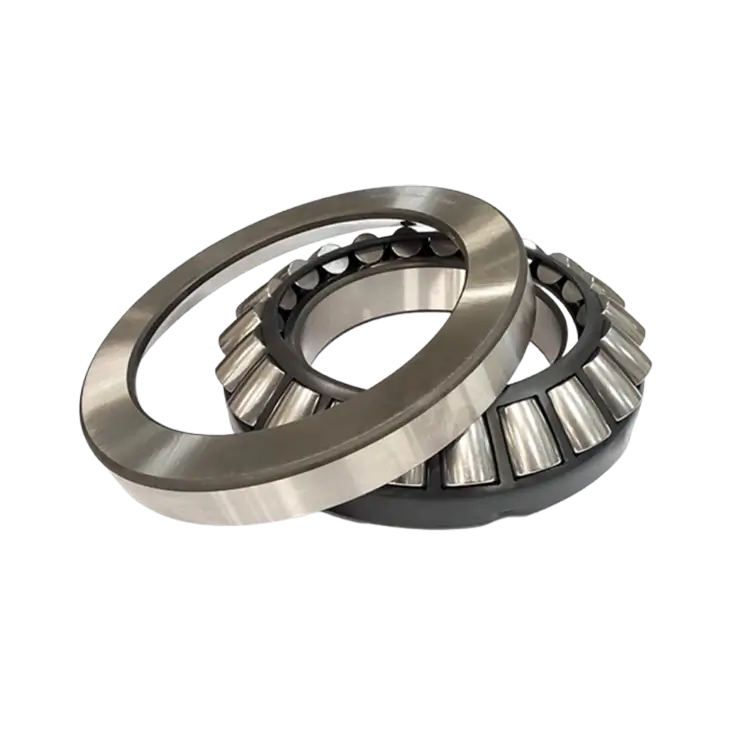
“Thrust washer” means two things. Inside a rolling bearing, it’s a raceway ring. On its own, a plain thrust washer is a flat ring that slides instead of rolls. It’s thin and simple, but friction is higher, so it suits slow or occasional movement.
How do thrust bearing types compare?
Pick by load direction, load size, radial load, speed and space. Ball designs suit lighter thrust. Needle designs save space. Cylindrical and tapered designs take heavier push. Spherical designs handle heavy combined loads and tilt. Ball, cylindrical and needle types carry no radial load at all.
| Type | Axial load | Radial load | Space needed | Typical use |
|---|---|---|---|---|
| Thrust ball | Light to moderate, one or both ways | None | Medium | Ball screw supports, crane hooks |
| Cylindrical roller thrust | Heavy, shock | None | Medium | Heavy, slow axial duty |
| Needle roller thrust | Heavy | None | Very thin | Tight assemblies |
| Tapered roller thrust | Heavy | None | Medium | Heavy axial duty |
| Spherical roller thrust | Very heavy | Yes, up to 55% of axial (SKF) | Tallest | Combined loads with misalignment |
| Plain thrust washer | Light to moderate | None | Thinnest | Slow, simple motion |
How do you choose the right thrust bearing?
Start with the load. Know its direction, its size, and whether it ever reverses. Then check speed, space, radial load and shaft alignment. Match the bore to the shaft and the outside diameter to the housing. Finally, confirm load ratings and limiting speed in the maker’s catalog.
Quick tips:
- Push from one side only? Use a single direction. Push both ways? Use double direction.
- Radial load too? Add a radial bearing, or choose spherical roller thrust.
- Shaft may tilt? Aligning seat washers help absorb mounting errors.
- Replacing a part? Thrust ball bearing boundary dimensions follow ISO 104, so match bore, outside diameter and height first.
What mistakes shorten thrust bearing life?
Most failures come from mounting and setup, not the bearing itself. Fitting washers backwards, expecting radial support, running too light or too fast, and rough handling cause most early damage. Each one is easy to avoid once you know it.
- Swapped washers: the shaft washer’s bore is slightly smaller. Fit it backwards and a washer can rub the spinning shaft.
- Too little load: at higher speeds, balls can slide on the raceways if axial load drops below a set minimum.
- Too much speed: Nachi warns centrifugal force throws lubricant out at high speed. Brands rate this differently, so trust the catalog’s limiting speed.
- Poor placement: Nachi advises mounting ball thrust units close to the radial bearing to limit shaft deflection.
- Rough handling: the separable rings and ball assembly damage easily.
What can’t a thrust bearing do?
Most designs can’t support radial load. Ball types need a minimum axial load and have speed limits. Plain washers wear faster because they slide. Even spherical designs only take radial load as a share of axial load. Every design needs correct lubrication to reach its rated life.
Conclusion
Choosing well comes down to load direction, load size, radial load, speed and space. Answer those five, and the right type usually picks itself.
Next step: write down your shaft size, load and speed, or your current part number. Then check our bearing cross reference guide or send the details to our team, and we’ll help you match the right thrust bearing.
FAQs
How do I read a thrust bearing number like 51205?
In standard metric codes, the last two digits give the bore. Multiply them by 5, so 05 means 25 mm. Codes 00 to 03 are exceptions: 10, 12, 15 and 17 mm.
Do thrust bearings need lubrication?
Yes. Open designs need grease or oil. At higher speeds, oil is often preferred because grease can be flung out of the bearing.
What is a clutch release bearing?
It’s a thrust unit in a car clutch, also called a throwout bearing. It presses on the clutch when you push the pedal.
How do ships handle propeller thrust?
They use a thrust block, a specialised thrust unit that resists the propeller shaft’s push and passes it to the hull.
Does TFL Bearing supply thrust bearings?
Yes. TFL lists miniature, single direction, double direction, outside band and self aligning thrust ball bearings, plus spherical roller thrust bearings. MOQ depends on the product and specification, so share your requirements for a quote.