







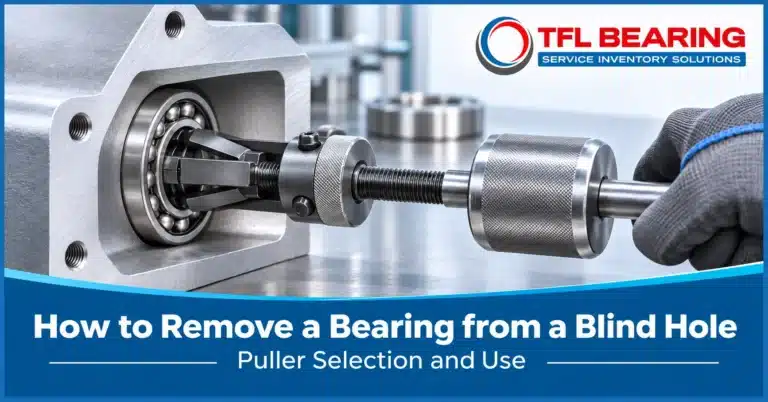
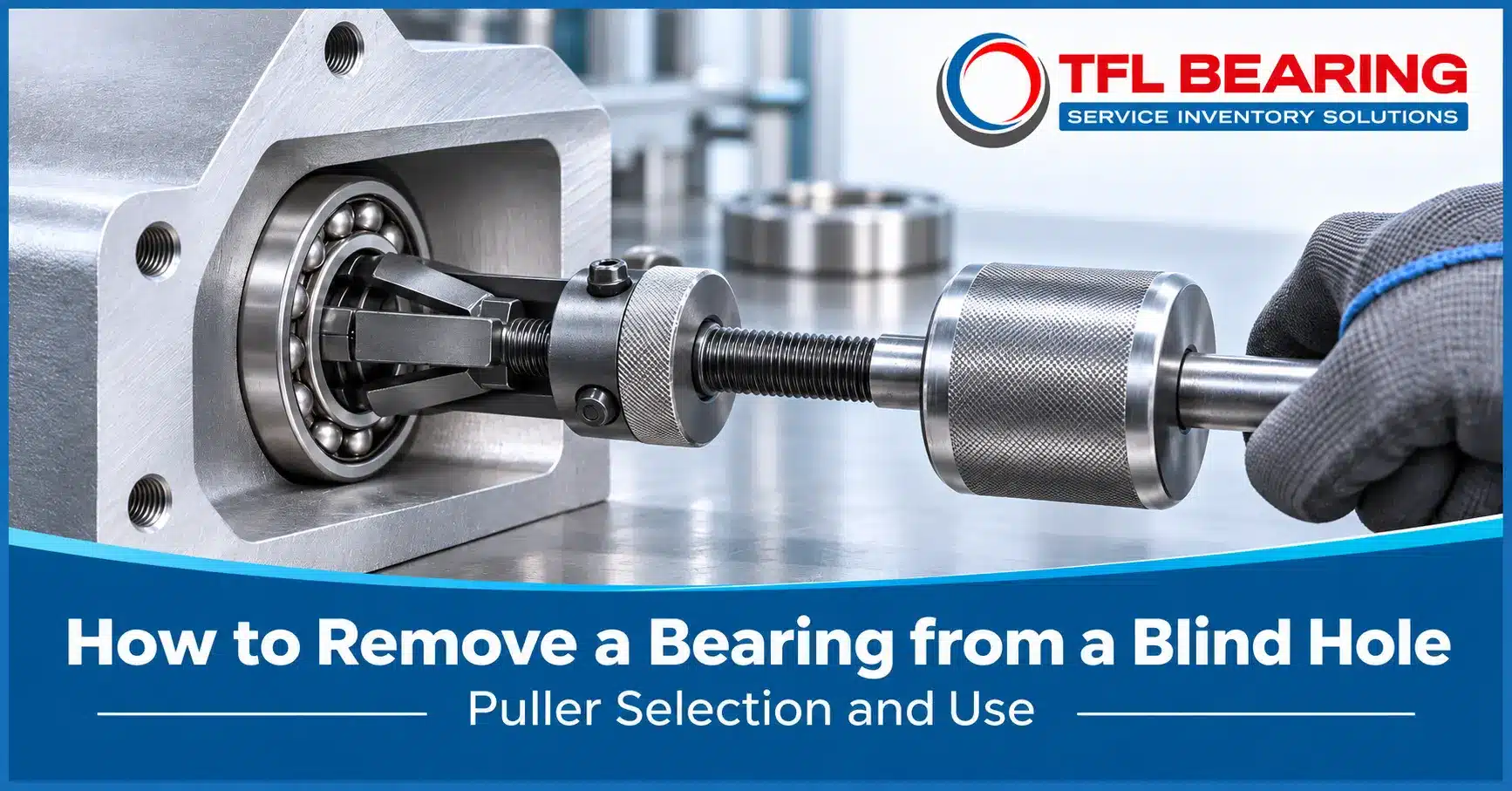
The shaft is out, the housing is on the bench, and the bearing sits at the bottom of a bore with nothing behind it to push on. That’s the whole problem with a blind hole. You can’t drive the bearing out from the back, so you have to pull it from the front, through the only face you can reach.
How to remove a bearing from a blind hole comes down to one question: which ring is tight? If the outer ring is the press fit, a blind hole bearing puller that grips behind the inner ring will do the job. If the shaft is still in place, you need a different tool. And if the bearing has already broken apart, the method changes again.
This guide walks through those cases, the tools that match each one, and the shop methods that work when the right puller isn’t on the shelf.
Before you pull: scrap or keep?
Decide this first, because it changes how gentle you need to be.
Koyo’s dismounting guidance is blunt about it. If the bearing is going in the bin, any simple method will do, even torch cutting. If you plan to reuse it or send it for failure analysis, take the same care you’d take when mounting it.
NSK gives the same advice and adds a detail that matters in a blind bore: dismounting must not damage the bearing seat. The housing is usually worth far more than the bearing, so protect the bore first and the bearing second. Our guide to bearing races and their damage signs covers what to look for on the seat once the old bearing is out.
One more rule from SNR’s fitting and removal manual: apply force to the ring you’re removing, and never through the rolling elements, because that dents the raceways. Almost every blind hole method breaks that rule to some degree, which is why a bearing pulled from a blind hole usually ends up as scrap.
Which blind hole bearing puller fits your job?
There are three main tool types, and the choice depends on what’s still inside the hole.
| Situation | Tool | How it grips | Example |
|---|---|---|---|
| Shaft removed, outer ring is the tight fit | Internal (expanding) puller with slide hammer | Claws or a collet behind the inner ring | SKF TMIP and TMIC kits |
| Shaft still fitted, no access behind | Blind housing puller | Adapters that reach in through the bearing | SKF TMBP 20E |
| Inner ring gone, only the outer ring left | Collet puller with slide hammer, or a hydraulic method | Collet lip behind the outer ring | Generic blind hole puller sets |

Internal pullers: the usual answer
SKF’s TMIP internal puller kits are made for bearings in housings where the fit is on the outer ring and the shaft has been removed. The claws grip behind the inner ring, and a sliding hammer supplies the pulling force.
The kits are sized by bearing bore. SKF sells them in three sets: 7 to 28 mm, 30 to 60 mm, and a combined 7 to 60 mm kit with two sliding hammers and spring-loaded extractors. If you don’t know the bore, the bearing designation tells you, and you can check it against our ball bearing range.
Reading the bore from the number is quick for most metric ball bearings. For bore codes 04 and up, multiply the last two digits by five: a 6204 has a 20 mm bore and a 6310 has a 50 mm bore. Codes 00, 01, 02 and 03 are the exceptions, at 10, 12, 15 and 17 mm. Small bearings with a single-digit bore code, such as a 608, carry the bore in millimeters directly, so a 608 has an 8 mm bore.
The detail people miss is space. SKF’s selection chart lists three limits for every extractor: maximum bearing width, space needed behind the bearing, and housing depth. A blind hole that’s only a millimeter or two deeper than the bearing may not leave room for the claws to open. Measure the gap before you buy.
Generic sets work the same way. Engineerfix describes the sequence: put the right collet into the bore, expand it by tightening the internal nut until its lip sits firmly behind the inner race, then attach the slide hammer to the collet shaft.
Blind housing pullers: when the shaft is still in
Sometimes you can’t remove the shaft first, for example in a pump or motor end where pulling the shaft means stripping the whole machine. That’s what a tool like SKF’s TMBP 20E is for.
SKF describes it as an adapter type puller for deep groove ball bearings in blind housings, where you can’t reach the bearing through the outer ring or through the bore. Its data sheet covers shafts from 30 to 160 mm, and extension rods give it up to 547 mm of reach. Retail listings rate its maximum pulling force at 55 kN.
Distributors list gearbox, pump and electric motor overhauls as typical jobs for it. It only works on deep groove ball bearings, so check the bearing type before you hire or buy one.
It’s a specialist tool, and priced like one. TestEquity listed it at $2,702.93 when we checked, so for a one-off job a local repair shop that owns one is often the cheaper route.
Collet pullers when the bearing has broken up
A failed bearing often leaves only a smooth outer ring in the bore, with the balls and inner ring gone. An inner-ring claw has nothing left to hook.
In that case the collet has to catch the back edge of the outer ring itself, which only works if there’s a little space behind it. Thin rings are the hard case: Industrial Monitor Direct warns that standard blind hole pullers often fail on angular contact races, because there’s too little surface to grip and the jaws slip or try to expand the race. If you’re replacing angular contact ball bearings in a blind bore, the grease method below is often the safer choice.
What you need on the bench
Gather everything before you start, because a half-pulled bearing from a blind hole is harder to grip than one that hasn’t moved at all.
- An internal puller or collet set that matches the bearing bore
- A slide hammer that fits the puller’s threaded rod
- Calipers or a depth gauge to measure the bore and the space behind the bearing
- A hot air gun, oven or induction heater for the housing
- Grease and a close-fitting piece of shaft, in case you need the hydraulic method
- Degreaser, clean rags and a light to inspect the bore
- The replacement bearing, so the housing isn’t left open and dirty
How to remove a bearing from a blind hole with a slide hammer
Here’s the sequence for the most common case, a ball bearing in a housing with the shaft out.
- Clean the bore and look at the bearing face. Note any chamfer on the inner ring, since the claw or collet lip seats there.
- Measure the bore of the bearing and the depth behind it. Pick the extractor or collet that matches the bore, and check that it fits the space behind.
- Insert the extractor through the bore and expand it until the lip sits squarely behind the inner ring. A lip that grabs on one side only will tip the bearing and score the housing.
- Fit the slide hammer and keep the shaft square to the bore.
- Use short, controlled blows. If the bearing hasn’t moved after several firm strikes, stop and add heat rather than hitting harder.
- Once it’s out, inspect the bore for scoring or fretting before fitting the new bearing.
Stacked bearings come out one at a time. Model Engineer forum members point out that expanding pullers can handle a blind hole with two bearings, because the puller’s small lip fits the large radius on the inner race bore.
The same applies to needle roller bearings, which sometimes sit stacked two deep in a blind bore. Pull each one separately and keep track of which came out first.
When it won’t move
Heat the housing, gently
Heating the housing makes the bore grow away from the outer ring. The effect is strongest in an aluminum casting, because aluminum expands roughly twice as much as steel for the same temperature rise. That’s basic thermal expansion, and it works in your favor here.
Keep the heat even and moderate. NSK warns against using open flames near bearings, and Schaeffler says heating a bearing ring with a direct flame can damage the parts. A hot air gun, an oven or an induction heater gives far more control than a torch.
The grease (hydraulic) trick
For a shallow blind hole, or a bearing that has nothing left to grip, grease can do the pushing. MRO Magazine describes the method:
- Pack grease into the hole so it fills the space behind the bearing.
- Push a piece of shaft into the bore, sized to fit it closely.
- Cover the shaft and grease with a rag.
- Strike the shaft with a hammer. The grease can’t escape, so it transmits the force and pushes the bearing out.
The fit of that shaft matters more than anything else. If it’s loose, the grease simply squirts past it (hence the rag). This is a makeshift method, and MRO Magazine itself names the slide hammer with collets as the proper tool.
It does suit small parts well. For miniature ball bearings in thin aluminum housings, such as hobby tools and RC parts, grease pressure is usually kinder to the casting than a heavy slide hammer.
Cold shrink for cups
For a tapered roller cup, a Hobby Machinist forum tip is to run a bead of weld around the inside of the cup. As the weld cools and contracts, the cup shrinks and can drop out. Use this on scrap parts only, and keep the arc away from the housing bore. Then order the replacement tapered roller bearing as a matched cone and cup set.
Common mistakes when pulling a bearing from a blind hole
Most damaged housings come from a handful of habits, not from the tool itself.
- Hitting harder instead of stopping. Heavy blows can deform the collet lip and crack a cast housing. If several firm strikes do nothing, change the method, not the force.
- Heating the bearing instead of the housing. If the heat reaches the outer ring first, the ring grows along with the bore and the fit stays just as tight.
- Levering against the bore. A screwdriver or chisel pried against the housing wall scores the seat, and a scored seat can let the new outer ring creep.
- Missing a retaining feature. Check for a circlip, retaining ring, set screw or staked edge before you pull. A bearing that seems stuck may simply still be locked in.
- Using the wrong collet size. A collet that’s too small expands on one side only, which tips the bearing and digs into the bore.
Check the bore before the new bearing goes in
Getting the old bearing from a blind hole is only half the job. The new one will only last if the seat it goes into is still sound, so give the bore a few minutes before you refit anything.
- Look for scoring. Run a fingernail around the bore. Light marks from the puller lip can be dressed with fine emery cloth, but deep grooves mean the seat needs repair.
- Look for fretting. Reddish-brown or dull patches on the seat show the outer ring was moving in service. A loose fit that caused the failure will cause the next one too.
- Measure it. Check the bore diameter at two or three depths and at two positions 90 degrees apart. Compare the readings with the housing drawing to catch wear or an oval bore.
- Clean the bottom of the hole. Chips, old grease and fragments of a failed bearing collect in the blind end and can stop the new bearing from seating fully.
If the bore is worn beyond its tolerance, fix the housing first. Fitting a new bearing into a damaged seat only sends you back to the slide hammer sooner.
Design it so the next removal is easy
If you’re the one specifying the housing, you can avoid this problem altogether. NSK recommends machining push-out holes through the housing shoulder, so bolts can drive a tight outer ring out evenly. Those holes should be fitted with blank plugs when not in use.
For separable bearings such as tapered rollers, NSK also suggests several notches in the housing shoulder, so the outer ring can be pressed out with a tool or light tapping. A few minutes of machining at the design stage saves hours with a slide hammer later.
Which ring gets the tight fit also depends on the bearing arrangement on the shaft. Our shaft bearing guide covers arrangements and fits in more detail.
Choosing the replacement bearing
Once the old bearing is out, match the replacement exactly: designation, seal type and clearance. If the marking has worn off, measure the bore, outside diameter and width, then use a bearing cross-reference guide to find equivalents.
Fit the new bearing with the same care. Press only on the ring that carries the tight fit, and keep it square to the bore as it goes in.

Quick answers
Can I remove a bearing from a blind hole without a puller?
Yes, for small or shallow bearings. The grease method works if you have a shaft that fits the bore closely, and gentle heat on the housing helps.
Can I reuse the bearing afterward?
Rarely. Pulling through the inner ring or the balls loads the raceways, and SNR warns that force through the rolling elements dents them. Plan on a new bearing.
What size blind hole bearing puller do I need?
Size it by the bearing bore, then check the space behind the bearing and the housing depth against the puller’s chart.
Why won’t my puller grip the bearing?
Usually the lip is the wrong size for the bore, or there isn’t enough space behind the bearing for it to open fully. Try the next collet size, check the depth again, and clean out any grease or debris that stops the lip from seating.
Is a slide hammer always the right choice?
For small and medium bearings it’s the quickest option, and it’s portable. For a large or very tight bearing from a blind hole, impact alone may not be enough, so combine it with housing heat, use push-out holes if the housing has them, or bring in a specialist blind housing puller.
What to check first
Before you buy or borrow anything, measure three things: the bearing bore, the depth of free space behind the bearing, and whether the shaft has to stay in. Those numbers pick the tool for you.
If you need a replacement bearing in the same size, or help identifying one with no readable marking, send the dimensions to our team for a quote.