







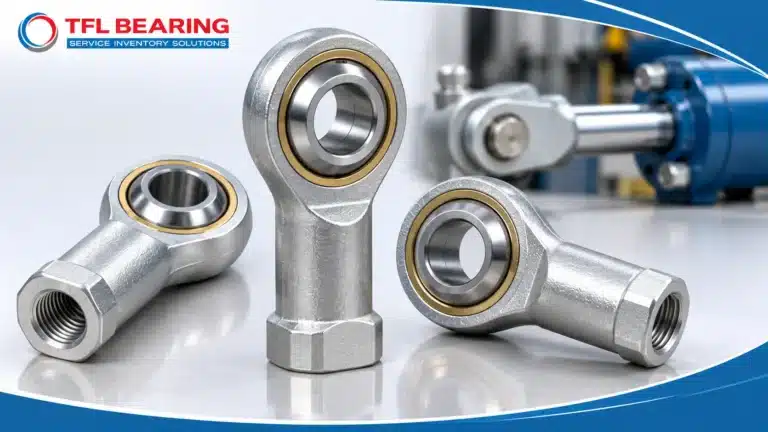

A female rod end bearing is a rod end with an internal thread in its shank, so it screws onto a threaded rod or cylinder piston rod instead of into a tapped hole. Inside the eye sits a spherical plain bearing: a ball with a bore that swivels in the housing, letting the linkage run out of line without binding. If the thread on your rod is on the outside, you need the female version.
That one detail causes more wrong orders than anything else on a female rod end bearing quote. The sections below cover what’s inside the housing, how the size chart works, which thread hand to pick, and what to check before you buy.
What is a female rod end bearing?
Rod ends fall under ISO 12240-4, first published in August 1998. The standard sets dimensions, tolerances and radial internal clearance for each dimension series. Within series E and G it also splits rod ends by shank design: external or internal thread, normal or strengthened form, or a welding end. Catalogs that follow it often call the internal thread version “type F” and the external one “type M”.
Three parts decide how the joint behaves:
- The rod end housing: the eye plus the internally threaded shank, usually galvanized steel or stainless.
- The inner ring (the ball): hardened, ground bearing steel carrying the bore for your bolt.
- The sliding layer between them: steel on steel, bronze, or a PTFE liner.
There are no balls or rollers in the load path. That separates a female spherical rod end bearing from the deep groove ball bearings in a motor or the needle roller bearings in a gearbox. A rod end gives up speed in exchange for tilting under load, and it’s built for oscillating, swiveling motion more than continuous spin.
Male vs female rod end bearings: match the thread, not the name
GlobalSpec’s spec guide sums up the difference in five words: a female housing has internal threads. A male rod end has a threaded stud sticking out of the eye instead.
So pick by what you are connecting to. An externally threaded tie rod, control rod or piston rod takes a female rod end bearing. A tapped hole, a threaded tube insert or a part with its own internal thread takes a male one.
A female rod end bearing shows up most on cylinders for a simple reason: the piston rod already carries an external thread. mbo Osswald, for example, sells K series female rod ends with a CETOP connection thread made for pneumatic cylinders.
Part numbers usually tell you the gender if you know where to look:
- INA uses “I” for internal: the GIR40-DO-2RS is listed as a rod end with internal thread, right hand, steel on steel. Its GAW series carries an external thread.
- SKF uses the SI prefix on female rod ends (SI 10 C, SI 25 ES, SIKB 6 F).
- An “L” in the code flags a left hand thread: SILKB 6 F, IKO’s PHS20LK, INA’s GIL series.
Learn those three habits and a mixed supplier quote stops looking like alphabet soup.
Right hand thread or left hand thread?
The right hand is the default thread on a female threaded rod end bearing. You only need a left hand thread when the rod has opposite threads at each end, which is how adjustable link rods work. Put a right hand female rod end on one end and a left hand one on the other, and spinning the rod lengthens or shortens the link without disconnecting anything.
Rod ends are often made with slightly longer threads for exactly this kind of adjustment after installation, with a jam nut locking the setting. If you skip the jam nut, vibration will make the adjustment for you, just not the one you wanted.
Where female rod end bearings get used
The rod end bearing entry on Wikipedia says the part started in aircraft and later spread into cars, trucks, race cars, motorcycles, boats, lawn tractors, go-karts, radio control helicopters and industrial machines. You’ll also hear it called a Heim joint in North America and a rose joint in the UK.
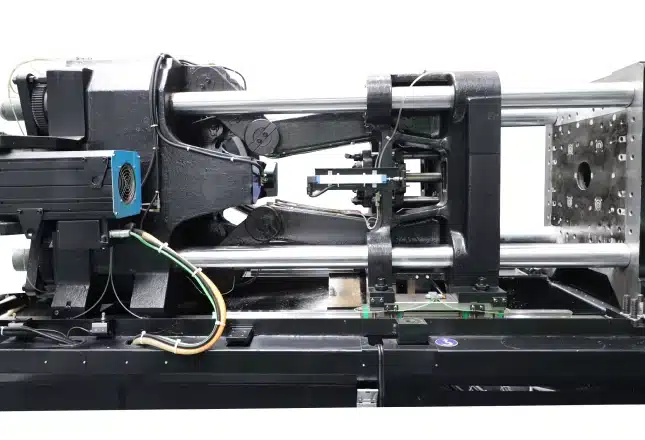
Typical female rod end bearing applications include:
- Hydraulic and pneumatic cylinder ends, where the rod end takes up misalignment between the cylinder mount and the load.
- Steering links, tie rods and control rods.
- Textile and agricultural machinery linkages.
- Food and beverage lines, where stainless, maintenance free versions survive frequent washdowns and harsh cleaning agents.
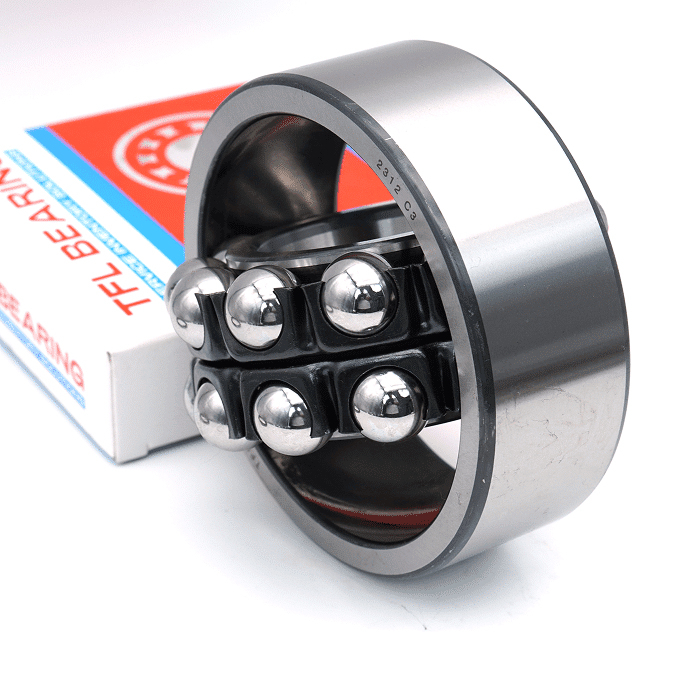
A rod end handles angular misalignment in a linkage. If your misalignment problem is on a rotating shaft instead, a rod end is the wrong tool. Look at self aligning ball bearings for light loads, or a spherical roller bearing when the shaft load is heavy.
Female rod end bearing sizes and dimensions
ISO 12240-4 defines two families you’ll meet constantly. Series K rod ends accept K series radial spherical plain bearings, in a cylindrical or sphered eye bore. Series E, sometimes called the small series, is the narrower design that accepts E series spherical plain bearings. Both come in female and male thread versions, so always check the series before comparing two quotes.
Here is a short female rod end bearing size chart using SKF’s maintenance free K series parts (SIKB F right hand and SILKB F left hand), taken from distributor listings:
| Bore (mm) | Thread | Inner ring width (mm) | Housing eye width (mm) |
|---|---|---|---|
| 6 | M6 | 9 | 7.5 |
| 8 | M8 | 12 | 9.5 |
| 10 | M10 x 1.5 | 14 | 11.5 |
| 12 | M12 x 1.25 (VZ019 fine pitch) | 16 | 12.5 |
| 14 | M14 | 19 | 14.5 |
| 20 | M20 x 1.5 | 25 | 18.5 |
Watch the pitch column. SKF’s VZ019 variants use fine threads (M12 x 1.25, M16 x 1.5), while the standard versions use the coarse metric pitch. A fine pitch rod end will start on a coarse rod for half a turn and then jam, which is a fun way to strip a thread on a Friday afternoon.
Female rod end bearing sizes also go well beyond this table. Small PHS style parts start at a 3 mm bore with an M3 x 0.5 thread. In builds that small, the nearby shaft hardware often comes from the same tiny range as miniature bearings, so plan the whole assembly at once. At the other end, SKF’s 40 mm steel on steel female rod ends take an M39 x 3 thread. In inch sizes, a part like Sealmaster’s TFL10 pairs a 5/8 in bore with a 5/8-18 left hand thread.
How do you measure a female rod end bearing?
Take five measurements, in this order:
- Bore diameter of the ball (d). A caliper on the inner ring bore is enough.
- Thread diameter, pitch and hand. Use a thread gauge on the rod, then check which way it tightens.
- Inner ring width and housing eye width. These decide whether it fits your clevis.
- Length from the bore center to the end of the shank, which sets your linkage geometry.
- Tilt angle. Read it from the catalog instead of measuring, since a worn part will give you a flattering number.
If two parts match on bore and thread but differ in eye width, they’re from different dimension series. They won’t swap cleanly.
How to choose female rod end bearings
Start with load, since that’s where most female rod end bearing failures begin.
Radial load capacity
Rod ends carry radial forces in tension or compression. Read both ratings: SKF’s SILKB 6 F lists a 4.25 kN dynamic and 6.8 kN static rating, and the 14 mm size rises to 17 kN dynamic and 27.5 kN static. Size for the dynamic number if the joint moves under load.
Axial load
One French supplier’s catalog puts the axial static load at 0.2 times the radial static load for its female rod ends. That’s one maker’s figure, and other designs differ, but it shows the scale: side loads eat capacity fast. If the linkage pushes hard along the bolt axis, rethink the layout or add a separate part such as one of the thrust ball bearings to take it. Combined radial and axial loads on a turning shaft belong with angular contact ball bearings, not a rod end.
Sliding material
This is the choice that sets your maintenance schedule:
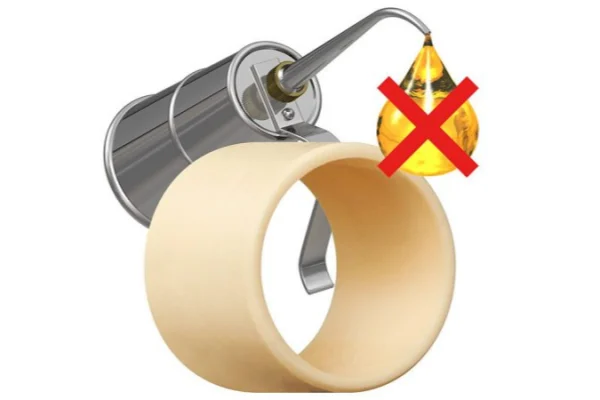
- PTFE liner: SKF says its SIKB F parts have an injection molded PTFE FRP layer between housing and inner ring, which needs no relubrication.
- Steel/PTFE sintered bronze: SKF says this suits heavy, constant direction loads.
- Steel on steel bearing: SKF lists these female rod ends as requiring maintenance, so plan on regular greasing.
Misalignment
Tilt angle grows with size in the same family. SKF lists 13° for the 6 mm SILKB and 16° for the 14 mm version, while the narrower SIL 12 C manages only 10°. Check the angle at full stroke, not at the midpoint.
Environment
Stainless housings with PTFE or bronze liners suit washdown areas. If nearby shafts need the same protection, stainless steel deep groove ball bearings keep corrosion resistance the same across the machine.

Speed
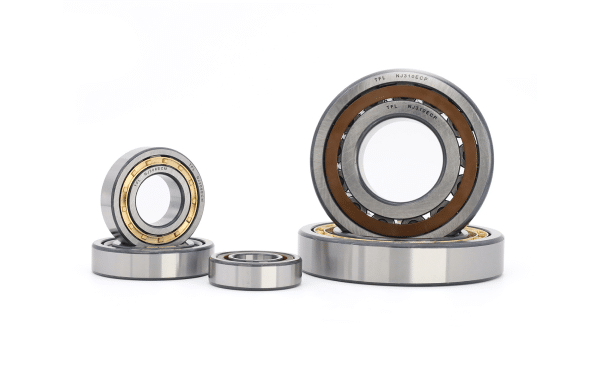
If the joint rotates continuously instead of swinging back and forth, a plain bearing will wear quickly. That’s a job for rolling elements, and for heavy radial loads at speed, cylindrical roller bearings are the usual swap.
How to install female rod end bearings
- Clean the rod thread and confirm thread hand and pitch before anything touches.
- Spin the jam nut onto the rod first, then thread the rod end on by hand.
- Set the length, keeping plenty of thread engaged inside the shank.
- Align the eye so the load runs through the bore center, in the plane of the eye. Bending loads on the shank are what snap rod ends.
- Move the linkage through its full travel and confirm it never hits the tilt limit.
- Grease relubricatable versions before first use. mbo Osswald’s product page says lubrication must be done during initial operation.
- Tighten the jam nut against the housing face.
Where you can, mount the eye in a clevis so the bolt works in double shear. A female rod end bearing hanging on a single cantilevered bolt puts a bending moment into both the bolt and the ball.
Female rod end bearing FAQs
Do female rod end bearings need lubrication?
It depends on the sliding layer. PTFE lined and self lubricating bronze types are sold as maintenance free, while steel on steel types need periodic grease through a lube hole or grease nipple.
What is the difference between male and female rod end bearings?
A female rod end has an internal thread and screws onto a rod. A male rod end has an external threaded stud and screws into a tapped part.
Are female rod end bearings interchangeable between brands?
Usually yes, if both follow the same ISO 12240-4 dimension series and thread. Mixing E and K series parts is where swaps fail.
What is a Heim joint?
It’s the North American name for a rod end bearing. In the UK the same part is called a rose joint.