







One SKF plummer block datasheet lists a breaking load of 210 kN when the load pushes straight down into the base. Swing that same load to 150 degrees, so it pulls toward the cap, and the figure falls to 120 kN. Same cast iron bearing housing, same bolts, roughly 43% less strength.
That gap explains most of what you need to know about choosing one. A cast iron bearing housing is the metal body that holds a rolling bearing, fixes it to a machine frame and keeps grease in and dirt out. Cast iron is the default because it’s stiff and cheap to cast, and it soaks up vibration well. It’s also brittle under tension, which is why the direction of your load matters as much as its size.
What a cast iron bearing housing does for the bearing
A bearing on its own can’t bolt to anything. The housing gives it a machined seat and a mounting base, plus somewhere to put seals and grease. Industry reference site GlobalSpec calls cast iron the most common material for pillow block housings, and a quick scroll through any distributor catalog backs that up.
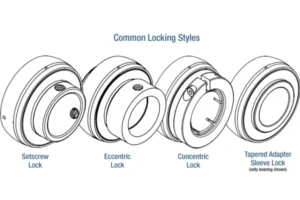
The bearing inside does the rotating work. In a split plummer block that’s usually one of the spherical roller bearings or a self-aligning ball bearing on an adapter sleeve. In a one-piece pillow block it’s a bearing insert with a spherical outer ring.
Cast iron bearing housing types you’ll find in catalogs
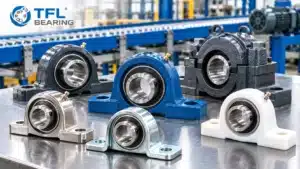
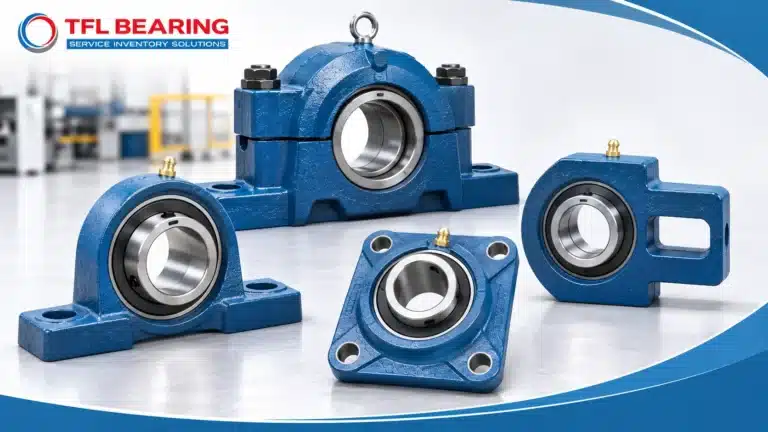
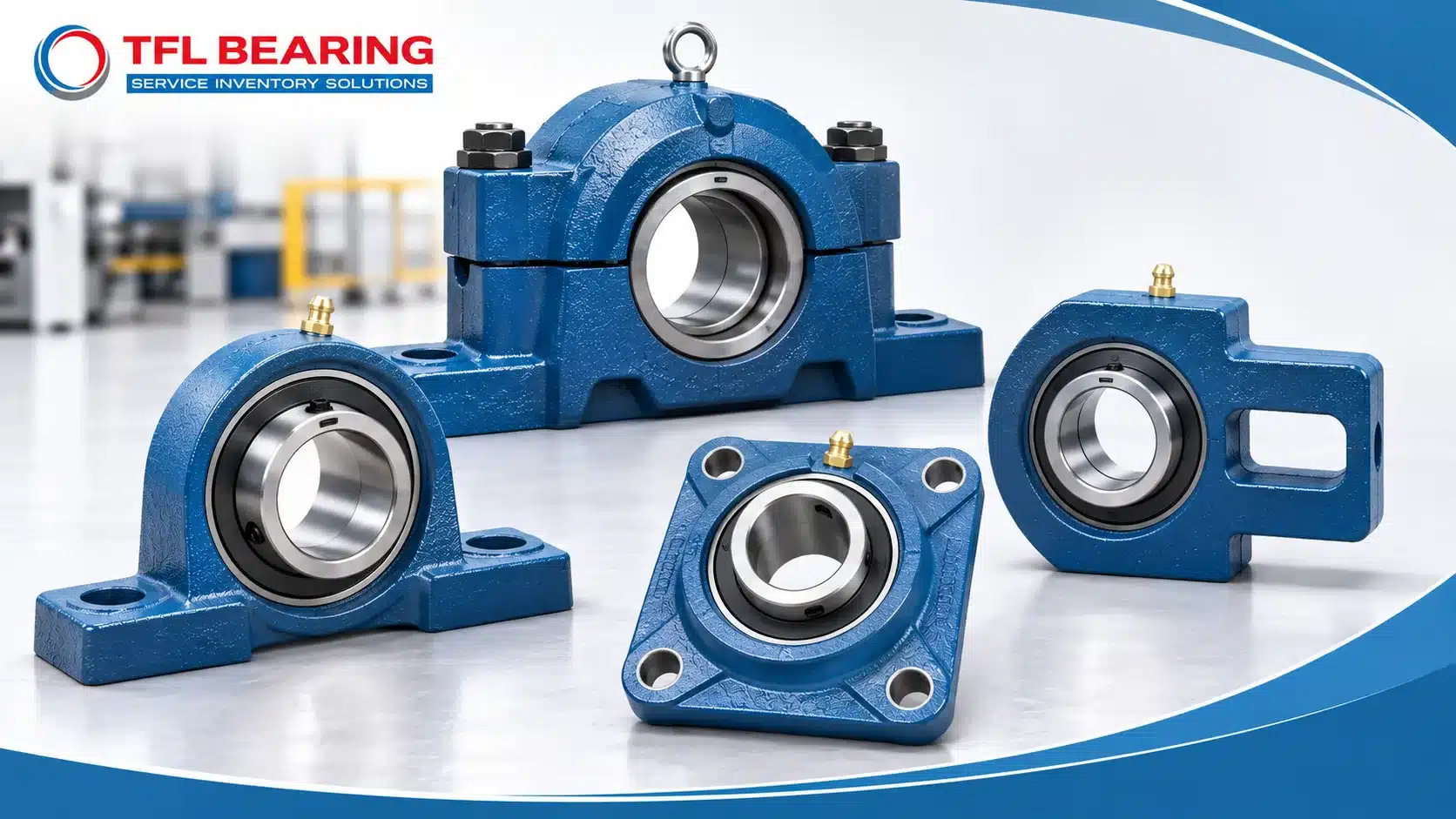
Most cast iron bearing housings fall into four groups. The names overlap depending on who’s selling, so it helps to know what each one physically looks like.
One-piece pillow block housings
A solid cast iron pillow block housing takes an insert bearing and bolts to a flat surface through two slots. SKF describes its SY cast iron housings as strong, stiff and cost effective, suited to most applications. A typical unit such as the UKP212 pairs a 55 mm insert on an adapter sleeve with a cast iron housing weighing 4.25 kg, rated for minus 20 to plus 100 °C.

Split plummer block housings
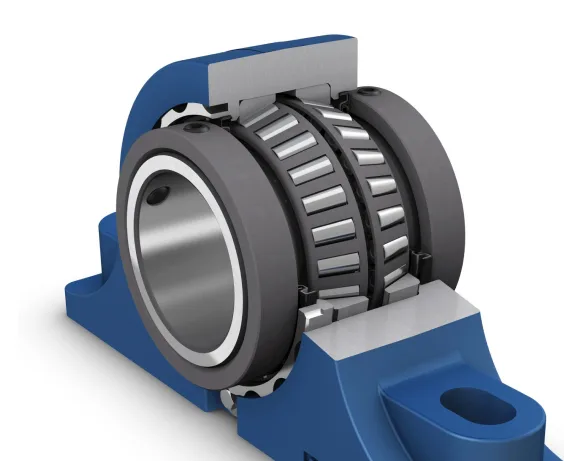
A split cast iron bearing housing, usually called a plummer block, comes in two halves, a cap and a base, so you can drop the bearing in without pulling the shaft. Large SKF SNL housings in the 30, 31 and 32 series are split designs with four bolt holes cast into the base, built mainly for spherical roller bearings and CARB toroidal bearings.
Smaller sizes carry double row spherical roller bearings or self-aligning ball bearings, both of which forgive a little shaft misalignment.
Flange bearing housings
These flange-mounted cast iron bearing housings bolt to a wall or bulkhead with the shaft passing straight through. The SKF FYTF oval flanges, for example, are grey cast iron and fix to a frame with two bolts.
Take-up housings
A take-up cast iron bearing housing slides in a frame so you can tension a conveyor belt. One mounted bearing catalog lists wide slot and top angle take-up housings in cast iron right next to its 2-bolt and 4-bolt pillow blocks.
People also say “cast iron bearing block” for either of the first two. It isn’t a separate category.
Bearing housing materials: grey cast iron or ductile iron?
This is the real material decision for any cast iron bearing housing, and it comes down to graphite shape.
Grey cast iron holds its carbon as flakes. Those flakes damp vibration nicely and machine easily, but each flake tip is a place where a crack can start.
Ductile iron, also called nodular or spheroidal graphite (SG) iron, grows the graphite as round nodules instead. According to the Wikipedia entry on ductile iron, those nodules inhibit cracking, which gives the metal much better impact and fatigue resistance than most cast irons. Magnesium is the usual additive that forms them.
You can see this split in SKF’s own grading. Large SNL plummer blocks come as standard in grey cast iron EN-GJL-250. Where extra strength is needed, SKF supplies them in spheroidal graphite iron EN-GJS-400 and adds a D to the name (SNLD). Its heavier SED series skips grey iron entirely and uses SG iron as standard. So if you’re shopping for a heavy duty cast iron bearing housing, ductile iron is usually what that label should mean.
Our rule of thumb: grey iron for steady loads that push into the base, ductile iron for shock loads, cold sites or any load that pulls up on the cap. The price step is usually smaller than the cost of one cracked housing and a day of downtime.
Why load direction changes everything
Spec sheets love the phrase “high radial load capacity” and rarely say which way that load is allowed to point.
Cast iron is strong in compression and much weaker in tension. When the load pushes into the base, the base and the support surface carry it. When it pulls toward the cap, the cap bolts and the thinner cap casting take the strain. The SKF datasheet quoted at the top shows the pattern clearly:
- 0° (straight into the base): 210 kN breaking load
- 55°: 300 kN
- 90° (sideways): 180 kN
- 120°: 130 kN
- 150°: 120 kN
Notice that 55° is actually the strongest angle, since the load spreads across the base and its flanks. Past 90° the numbers drop fast. SKF datasheets also publish separate yield points for the cap bolts at 120°, 150° and 180°, which tells you where the designers expect failure to start.
On a real machine, a belt drive pulling a pulley upward, a fan mounted on a wall or an overhead conveyor can put a cast iron bearing housing in its weak zone. The usual fixes are turning the housing so the load points into the base, or stepping up to ductile iron with dowel pins in the base. If your bearing also takes thrust, add that axial figure too; the same datasheet lists a separate axial breaking load.
Cast iron bearing housing vs steel
Steel comes in two forms, pressed or stamped sheet and cast steel. They solve different problems.
| Grey cast iron | Ductile (SG) iron | Pressed steel | Cast steel | |
|---|---|---|---|---|
| Stiffness | High | High | Low | High |
| Vibration damping | Best | Good | Poor | Fair |
| Shock and tension | Weak | Good | Fair | Best |
| Weight | Heavy | Heavy | About 60% lighter (per LDK) | Heavy |
| Typical use | General industry | Mining, shock loads | Light duty, HVAC | Extreme loads |
One bearing manufacturer’s catalog lists its cast steel pillow block option at 70,000 psi tensile strength, against 65,000 psi for its standard housing. That’s a small jump on paper. You pay for cast steel when the risk is fracture, not when you just want more capacity.
Pressed steel housings cost less and suit lower loads, according to GlobalSpec. LDK argues that stamped steel is often the smarter choice for light OEM work and that cast iron gets picked out of habit. Fair point for a lawn mower deck. On a crusher, habit is right.
Cast iron bearing housing dimensions and sizes
Plummer block sizes follow a shared standard. ISO 113 sets boundary dimensions for two-bolt housings meant for bearings in diameter series 0, 1, 2 and 3, and for four-bolt housings in series 0, 1 and 2. The current edition is ISO 113:2010, which ISO lists as reviewed and confirmed in 2026.
Because SNL housings follow ISO 113, a housing from one brand will often drop onto bolt holes drilled for another. Check the drawing before you assume it.
Here are three real cast iron bearing housing sizes from the SNL range so you can see how the numbers scale:
| Housing | Bearing seat | Centre height | Length | Bolt centres | Mass |
|---|---|---|---|---|---|
| SNL 518-615 | 160 mm | not listed | 345 mm | not listed | not listed |
| SNL 526 K7 | 230 mm | 150 mm | 445 mm | 380 mm | 33 kg |
| SNL 532 K7 | 290 mm | 170 mm | 550 mm | 470 mm | 55 kg |
The SNL 532 also specifies 30 mm attachment bolts. Fit smaller housing mounting bolts than the drawing calls for and you’ve turned a 55 kg casting into a loose one.
How to choose cast iron bearing housing for your shaft
Pick the bearing first, then the cast iron bearing housing. Doing it in the other order is how people end up with a nice housing and a bearing that can’t carry the load.
- Size the bearing for the load and speed. Heavy radial loads with misalignment point to spherical roller bearings. Moderate loads and higher speeds suit deep groove ball bearings in insert form. Pure radial load on a stiff shaft may justify cylindrical roller bearings in a cylindrical seat housing.
- Match the housing to the bearing’s outside diameter and the shaft fitting (adapter sleeve or cylindrical seat).
- Work out the load angle and compare it with the housing’s breaking load table. Add a safety factor that suits your site.
- Choose grey or ductile iron based on that angle and on shock.
- Pick a seal for the environment, then confirm the centre height fits your frame.
Combined heavy radial and axial loads sometimes call for tapered roller bearings in a matched housing instead of a standard plummer block. And if the shaft belongs to a motor on a variable frequency drive, consider electrically insulated bearings inside the housing, since cast iron conducts stray current straight through.
Lubrication and mounting habits that shorten housing life
A lot of housing trouble starts on the workbench, long after the foundry did its job.
SKF marks each cap and base as a pair so they don’t get mixed up. They’re machined together, so swapping a cap from the next housing over can pinch the bearing seat out of round. Keep pairs together on the bench.
For bearing housing lubrication, SNL housings have a grease guiding system that feeds grease to the side of the bearing, and SKF offers felt, V-ring, four-lip, labyrinth and heavy-duty taconite seals. Oil-lubricated sites use a separate series (SONL) designed for oil. Overgreasing a sealed housing pushes grease past the seals and invites dirt back in, so follow the bearing maker’s interval, not a fixed weekly squirt.
Corrosion is the other quiet issue. Cast iron bearing housings need a coating to resist the environment, and SKF paints its SNL range to ISO 12944-2 corrosivity category C2, which suits indoor and mild sites. Washdown and coastal plants need more than that.
FAQS
What is a cast iron bearing housing?
It’s a cast metal mount that holds a rolling bearing and bolts it to a machine frame. Most are grey cast iron, and the stronger grades use ductile iron.
What are cast iron bearing housings used for?
They support rotating shafts in conveyors, fans, pumps and crushers. Dodge lists air handling, food, forest products and paper among the typical uses for its cast iron pillow blocks.
What is the difference between cast iron and steel bearing housings?
Cast iron is stiffer and damps vibration better. Steel copes better with shock and tension, and pressed steel is lighter and cheaper for light loads.
How do you choose a cast iron bearing housing size?
Start from the bearing’s outside diameter and the shaft size. Then check the centre height, the bolt centres and the load rating at your actual load angle.
Before you send a quote request
Write down five things: shaft diameter, bearing type, load in kN and its direction, speed, and the environment. With those, any supplier can tell you in one reply whether grey iron will do or whether you need ductile. If you’re not sure which bearing belongs inside the housing, send us your shaft and load details and we’ll match it.