







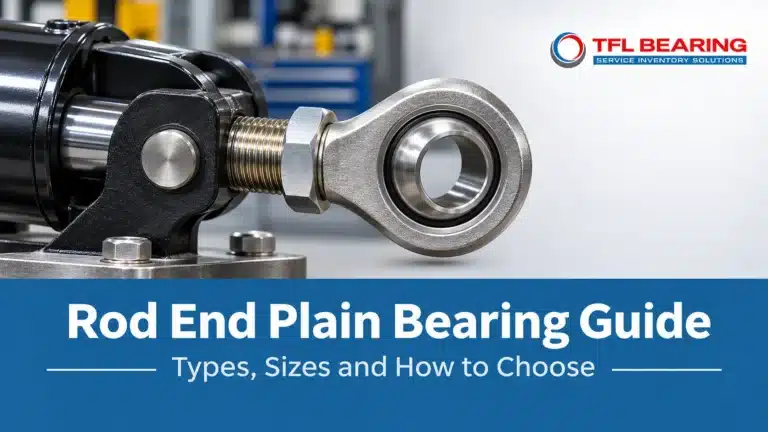

A hydraulic cylinder pushes a linkage through an arc, and the two mounting points never stay perfectly in line. That’s the job a rod end plain bearing exists for. It’s a housing with a threaded shank and a spherical plain bearing pressed into its eye, so it carries radial load in tension or compression while the ball swivels to absorb misalignment.
“Plain” means there are no balls or rollers inside. Where a deep groove ball bearing rolls, a rod end slides: an inner ring with a spherical outer surface moves against a matching curved race. That sliding contact is what lets it take heavy, slow, oscillating loads in a small package.
What is a rod end plain bearing, exactly?
A rod end plain bearing has two parts. The spherical plain bearing does the moving, and the rod end housing (the eye plus its shank) connects it to the machine. Distributor catalogs describe the typical use the same way: on the end of hydraulic or pneumatic cylinders, or linking two shafts, carrying radial forces in a tensile or compressive direction.
So a rod end spherical plain bearing (often sold as a spherical rod end bearing) is really one component inside another. You can buy the spherical plain bearing on its own and press it into your own housing, or buy the complete rod end with the bearing already fitted. The second option saves machining and gives you a standard thread to work with.
One thing they’re poor at is full rotation. Rod ends handle swivelling and tilting, not a shaft spinning at speed. For a pivot that also needs to rotate continuously under misalignment, a rolling design such as a spherical roller bearing is the better fit.
Rod end bearing types: the sliding surface decides everything
Most rod end plain bearing types differ mainly in what slides against what. This choice controls lubrication, load direction and service life, so it’s worth getting right before you look at sizes.
| Sliding contact | Lubrication | Best load type | Typical use |
|---|---|---|---|
| Steel on steel | Regular greasing required | Heavy and alternating loads | Construction and agricultural linkages |
| Steel on bronze | Greasable | High loads, higher heat | Heavy machinery pivots |
| Steel on PTFE liner | Maintenance free | Constant, one-direction loads | Pneumatic cylinders, hard-to-reach joints |
A steel on steel bearing has the highest load capacity of the three, but it needs grease at intervals. Henderson Bearings’ product notes say steel on steel rod ends suit alternating radial loads in particular.
PTFE liner designs swap grease for a self-lubricating sliding layer. These are the maintenance free rod end bearings most catalogs push for light duty. Schaeffler’s technical guidance says its maintenance-free rod ends suit slow movements, small to moderate swivel angles and loads acting in one direction. It also says they have no relubrication point and must not be greased.
That rule surprises maintenance crews who grease everything on a schedule. Extra grease on a PTFE liner adds nothing and can pull dirt into the contact.
Male vs female rod end bearings
The shank on a threaded rod end is either male (external thread) or female (internal thread). Female versions screw onto a threaded rod or cylinder piston rod. Male versions screw into a tapped hole, clevis or connector.
Neither is stronger by default. Pick the one that matches what you’re bolting to, and check the shank’s own load rating, because the thread is often the weak point.
Both come in right-hand and left-hand threads. Fitting one of each on the same link rod gives you a turnbuckle: turn the rod and the length changes without disconnecting either end. Fine-pitch threads give finer adjustment and better resistance to vibration, according to MBO Osswald’s rod end guide.
Angular misalignment and load: where rod ends fail
A rod end plain bearing’s tilt angle tells you how far the housing can swing off-axis before it binds. SKF’s SALKB maintenance-free series lists tilt angles between 13° and 16° depending on size. Go past that and the housing edge hits the ball, which turns a swivel into a lever.
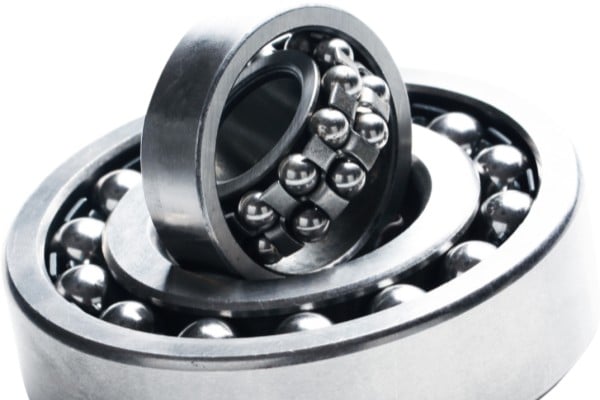
If the misalignment comes from a rotating shaft rather than a swinging linkage, the job belongs to a rolling bearing. Self aligning ball bearings handle shaft deflection at speed, which a plain rod end can’t.
Axial load is the other limit. A rod end plain bearing carries radial load well and side load poorly. DURBAL’s design notes cap the axial share at 20% of the radial load for its heavy duty range, and MBO Osswald gives the same 0.2 factor for maintenance-free K series parts. A pivot that also takes real thrust needs a separate solution, such as a thrust ball bearing on a rotating axis.
Load type matters as much as size. Schaeffler applies a load factor of 1 for a one-direction load but between 2.25 and 3 for pulsating loads on several series. In plain terms, a rod end plain bearing that flexes back and forth needs a lot more housing strength than one that only pulls.
Rod end plain bearing applications
The rod end plain bearing started in aircraft and now turns up in cars, trucks, motorcycles and boats. It goes by other names too: heim joint in North America and rose joint in the UK, after the two companies that dominated early production. Some suppliers also sell it as a ball joint bearing.
Industrial uses cluster around anything that pushes, pulls or steers:
- Hydraulic and pneumatic cylinder ends
- Steering links, tie rods and control rods
- Agricultural and construction machinery linkages
- Packaging machine levers and gate actuators
Forklifts show how plain and rolling bearings split the work in one machine. The cylinders that tilt the mast need a swivelling pivot at each end, while the mast channels ride on mast guide bearings that roll up and down the uprights.

Rod end plain bearing dimensions and sizes
ISO 12240-4 is the international standard for spherical plain bearing rod ends. It sets dimensions, tolerances and radial internal clearances for several dimension series, so parts from different makers interchange. The 1998 edition is still current; ISO lists it as reviewed and confirmed in 2026. Older drawings often cite DIN 648, the German standard it absorbed.
The two series you’ll meet most are E (the narrower “small series”) and K (a wider design with a larger range of load and thread options). E series parts are slim enough for the sphere to sit inside a clevis opening.
To give a feel for real rod end plain bearing sizes, here’s part of SKF’s maintenance-free male thread SALKB series:
| Bore (mm) | Thread | Tilt angle | Dynamic load (kN) | Static load (kN) |
|---|---|---|---|---|
| 6 | M6 | 13° | 4.25 | 6.8 |
| 12 | M12 | 13° | 13.2 | 15 |
| 14 | M14 | 16° | 17 | 25.5 |
| 16 | M16 | 15° | 21.4 | 34.5 |
| 20 | M20x1.5 | 14° | 31 | 50 |
Those numbers apply to that series only. Other makers and other sliding materials rate differently even at the same bore, so always check the catalog for the exact part.
How to choose rod end bearings in five checks
- Start with load direction. One-direction loads suit a PTFE liner; alternating or shock loads point to steel on steel with grease.
- Size on the housing, not just the ball. Schaeffler says the permissible static load of the housing and shank must always be checked, because the eye or thread often fails before the bearing.
- Confirm the tilt angle covers your worst-case misalignment with some margin.
- Check temperature. DURBAL rates its steel on PTFE parts from minus 40 °C to plus 200 °C, but only up to 120 °C once lip seals are fitted.
- Match thread type, hand and pitch to the mating part.
Corrosion is the extra check for washdown or outdoor duty. Stainless and zinc-plated housings exist for both series. If the shafts nearby rotate, the same rule applies there, and stainless steel deep groove ball bearings are a common match.
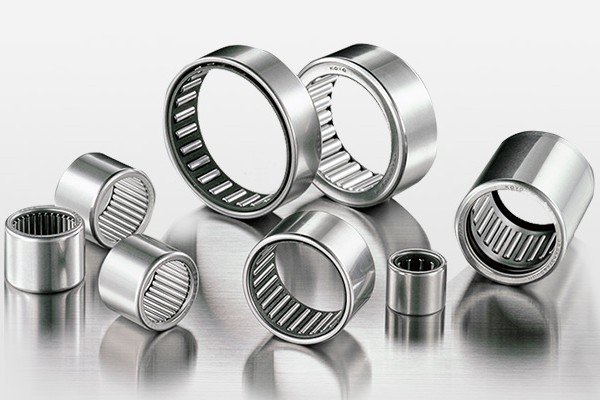
For a compact oscillating pivot that needs lower friction than sliding allows, needle roller bearings are the rolling alternative.
For a new design with a steady one-way load and no easy grease access, start with a maintenance-free E series rod end plain bearing with a PTFE liner, then size it from the housing’s static rating with the load factor applied.
How to install a rod end plain bearing correctly
Most early failures come from the fitting, not the part. Get these steps right and a rod end plain bearing will usually outlast the pins and bushings around it.
- Clean the mating thread and check its pitch and hand before you start. A left-hand rod end will often start on a right-hand thread for a turn, then strip.
- Screw the shank in to its full engagement length. A shank held by only two or three threads puts the whole load on the first thread root.
- Lock it with a jam nut against the housing face rather than relying on thread adhesive alone. The nut stops the shank from backing off under vibration and still lets you adjust the length later.
- Align the eye so the ball swings in the plane of motion. If the linkage moves sideways to the eye, the housing will hit the ball long before the rated tilt angle.
- Clamp the inner ring, not the housing. The bolt through the ball should pinch the inner ring between washers or spacers, so the sliding happens at the sphere and not between the bolt and the bore.
- Cycle the linkage by hand through its full stroke before you power it up, and watch for binding at both ends.
On greasable designs, pump grease in after fitting until fresh grease shows at the edge of the ball or the seal. On PTFE-lined parts, skip this step completely.
Signs a rod end plain bearing is worn out
A rod end plain bearing rarely fails without warning. Check it at every service, with the load taken off the link so you can feel what the bearing is doing.
- Axial or radial play you can feel by hand. Any knock between the ball and the race means the sliding layer or the race has worn.
- Clicking or clunking when the cylinder changes direction. That’s the same play showing up under load reversal.
- A ball that feels stiff, rough or gritty when you rotate it. Usually dirt has got past the seal or the grease has dried out.
- Rust or pitting on the exposed part of the ball, which will damage a PTFE liner quickly.
- Cracks, bending or fretting marks on the eye or shank, especially near the first engaged thread.
- Liner material squeezed out around the ball on maintenance-free types.
Play is the sign to watch most closely. A little play turns every load reversal into an impact, and impact loads wear the race far faster than steady ones. Replace the part at the first sign of knocking rather than waiting for it to get worse.
When you replace one rod end on a link, check the one at the other end as well. Both see the same number of cycles, so they usually wear at a similar rate.
Rod end plain bearing vs ball joint vs clevis
These three parts often compete for the same mounting point, but they aren’t interchangeable. The right one depends on how the two ends of the link move relative to each other.
| Part | Movement allowed | Load strength | Typical use |
|---|---|---|---|
| Rod end plain bearing | Swivel plus tilt within its tilt angle | Good radial, limited axial | Cylinder ends, control rods, linkages |
| Ball joint (automotive type) | Wide tilt and rotation | Built for one vehicle load path | Steering and suspension |
| Clevis with pin | Rotation about one axis only | High in its plane, no misalignment | Fixed-plane pivots, cylinder mounts |
A clevis is the simplest and strongest choice when both mounting points always stay in one plane. Once there’s any twist or offset, the pin binds and starts to wear the bores oval. That’s where a rod end plain bearing earns its place, because the ball takes up the misalignment instead of the pin.
Automotive ball joints are designed around steering and suspension geometry and are usually tied to a specific vehicle, so they’re rarely the right pick for general machinery.
Lubrication intervals for greasable rod ends
Steel on steel and steel on bronze parts need fresh grease to flush out wear particles as well as to cut friction. How often depends on load, swivel angle and dirt, so always start from the maker’s interval for your series.
As a rule of thumb, rod ends on dusty, wet or high-cycle equipment need grease far more often than those on clean, slow machines. If the old grease comes out dark or gritty, shorten the interval. If the grease point is hard to reach in normal service, that’s a strong reason to switch to a maintenance-free rod end plain bearing with a PTFE liner.
Use the grease the maker specifies. Mixing incompatible greases can change the consistency of both and leave the contact running dry.
What to send when ordering a replacement
Most ordering mistakes come from describing a rod end by its bore alone. Two parts with the same bore can differ in thread, series and sliding material, and only one of them will fit and last. Before you ask for a quote, collect these details from the old part or its drawing:
- Bore diameter and ball width
- Thread size, pitch and hand (right or left)
- Male or female shank, and the shank length
- Dimension series, such as E or K
- Sliding material: steel on steel, steel on bronze or PTFE liner
- Seals, grease nipple and housing finish, such as zinc-plated or stainless
- The full part number printed on the housing, if it is still readable
With that list, a supplier can match the part exactly instead of guessing from a photo, and you avoid a second round of shipping.
FAQ
What is the difference between rod ends and spherical plain bearings?
A spherical plain bearing is just the inner and outer ring. A rod end is that bearing already fitted into a housing with a threaded shank, ready to bolt onto a rod or cylinder.
Does a rod end plain bearing need lubrication?
Steel on steel and steel on bronze rod ends need regular greasing. Maintenance-free PTFE liner versions have no grease point and should not be lubricated, though SKF notes they still need inspection.
How do you choose the correct rod end plain bearing size?
Work out the peak radial load, multiply by the load factor for its type (one-direction, pulsating or alternating), and pick a rod end whose static rating for the housing and shank exceeds that figure. Then confirm the tilt angle and thread.
Can a rod end plain bearing take axial load?
Only a small share. Several makers cap it at around 20% of the radial load, so add a separate thrust bearing if the axial force is significant.
Is a heim joint the same as a rod end plain bearing?
Yes, in practice. Heim joint is the common North American name and rose joint is the UK name. Rod end plain bearing describes the same part by how it works.
Why does my rod end plain bearing knock?
Knocking almost always means internal play from a worn race or liner. Check that the jam nut and the bolt through the ball are tight first, then replace the rod end if the play is in the bearing itself.