







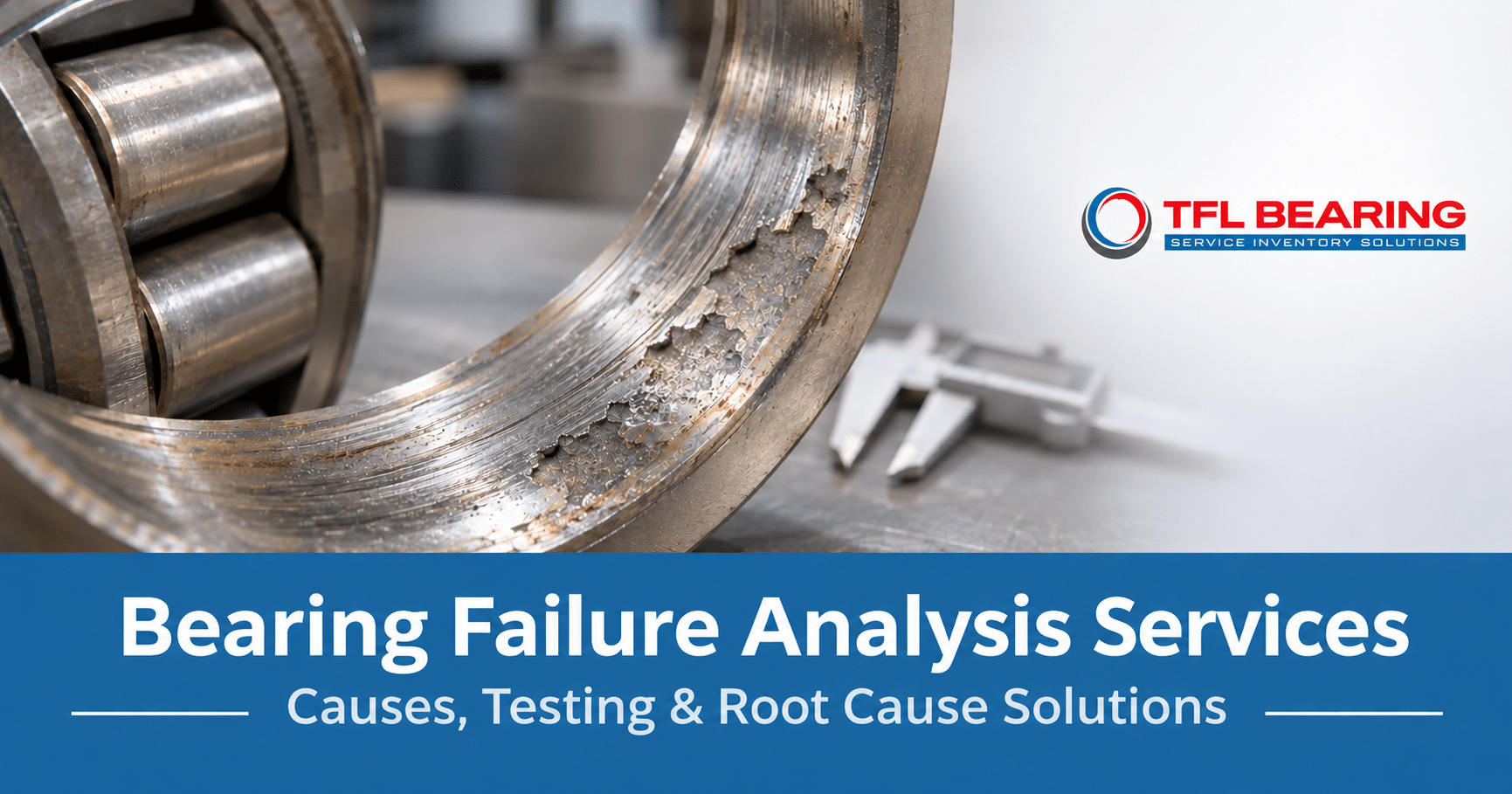
Bearing failure analysis services examine a failed bearing, classify the damage, and trace it back to the condition that caused it, so the next bearing in that position lasts longer. A good investigation looks at the bearing plus the shaft, housing, seals, lubricant and operating history. A typical job ends with a written report that names the failure mode (often using ISO 15243 terms), the likely root cause, and the changes to make.
That last part decides whether the money was well spent. Whether the part is a small deep groove ball bearing in a fan motor or a large roller bearing in a gearbox, a report that says “fatigue” and stops there tells you almost nothing. A report that says “subsurface spalling in a 90-degree arc on the outer ring, consistent with excess belt tension, reduces tension and moves to a higher load rating” gives you something to act on.

Why bearings fail early (and why the numbers disagree)
Most bearings never fail at all. SKF’s damage analysis training says about 90% of bearings outlive the machine they’re fitted to. The ones that fail early tend to fall into the same few buckets.
In its bearing failure training, SKF splits premature failures like this: lubrication 36%, fatigue 34%, mounting and handling 16%, contamination 14%. That mounting share covers mistakes like hammering a ring onto its seat or setting the wrong preload on tapered roller bearings, which carry their load through an adjusted pair.
You’ll also see claims that lubrication failure causes up to 80% of bearing problems. Both figures circulate, and they aren’t measuring the same thing. Reliamag’s review of these statistics points out that the 36% covers premature failures only, while the 60% to 80% figures also count contaminated lubricant, wrong grease selection and lubricant breakdown.
The split also shifts by industry. SKF notes that in pulp and paper, contamination and poor lubrication drive most damage, not fatigue. So treat any headline percentage as a starting point for your own plant, never as a diagnosis.
The six damage modes in ISO 15243
ISO 15243:2017 is the international standard for rolling bearing damage terms. It covers any rolling-element bearing made from standard bearing steels, classifies failure modes by what the damage looks like, and lists likely causes for each. It does not assign percentages. The standard is under revision (a working draft closed its comment period in April 2026), but the 2017 edition is the one labs cite today.
| ISO 15243 mode | What you see | Usual root causes |
|---|---|---|
| Rolling contact fatigue | Pits and craters (bearing spalling) in the load zone, or frosty surface peeling | Overload, thin oil film, dirt or material defects |
| Wear | Dull raceways and scoring (abrasive) or torn, smeared metal (adhesive) | Hard particles in lubricant; rollers skidding under too little load |
| Corrosion | Rust, reddish oxide on the bore or OD, or dents at rolling element spacing | Water ingress, loose fit, vibration while stationary |
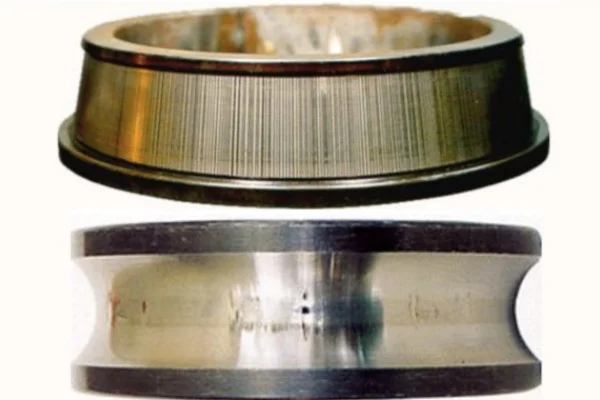
| Electrical erosion | Grey frosted bands or evenly spaced “washboard” flutes | Current passing through the bearing, often from a VFD |
| Plastic deformation | Clean, shiny dents at rolling element spacing | Shock load or static overload, poor mounting |
| Cracking and fracture | Cracked rings, broken cages | Usually secondary: fretting, bearing misalignment, overspeed |
Reliability Solutions’ guide to the ISO modes notes that only rolling contact fatigue (classic bearing fatigue) is inherent to bearing operation. The other five are preventable in principle.
Adhesive wear deserves a note because it surprises people. It often shows up on lightly loaded cylindrical roller bearings, which have minimum load requirements. Below that load the rollers skid instead of rolling, and the metal smears. Upsizing makes it worse.
Two other look-alikes trip people up: true and false brinelling. True brinelling dents are clean and shiny with no debris. False brinelling dents sit at the same spacing but carry reddish-brown debris, because they come from vibration on a bearing that wasn’t turning. One means a shock load; the other usually means the machine sat next to something that vibrates, or shipped without transit locks.
How is bearing failure analysis performed?
If you want to know how to identify bearing failure causes yourself, follow the same order a lab uses. The bearing failure root cause analysis process looks similar everywhere, from GGB’s published method to the bearing makers’ own field teams.
- Collect everything, not just the bearing. That means the housing, mating shaft, seals, a grease or oil sample, wear debris and the operating record. Damage on the bearing often makes sense only next to a worn shaft seat or a milky grease sample.
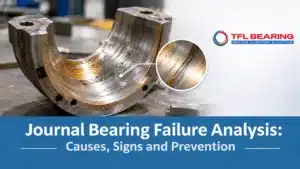
- Visual and dimensional inspection. The analyst photographs the damage, measures fits and clearances, and maps the wear path. This wear pattern analysis matters because location tells a story: spalling across the full raceway width suggests misalignment, while damage confined to one arc of a stationary outer ring suggests a fixed point load such as belt pull.
- Lubricant review. Grease color alone narrows things down. Brown points to heat or oxidation, milky to water, grey or black with metallic particles to electrical damage, and dry, crusty grease to starvation or bearing overheating.
- Advanced bearing failure testing, if needed. When visual evidence isn’t conclusive, labs move to destructive methods such as cross sections, metallurgical testing under optical and electron microscopes, and chemical or spectrographic analysis. Applied Technical Services, for example, lists SEM, metallography, hardness testing and chemical analysis, and follows ASTM E2332 for component failure investigation.
- The report. A basic report covers background, visual findings and conclusions. A full one adds lab data and specific corrective actions.
If step 2 points to misalignment that the machine itself causes (long shafts, frames that flex), the fix may be a bearing that tolerates it. A spherical roller bearing accepts a few degrees of misalignment under heavy radial loads.
Vibration analysis sits slightly apart from all this. It’s a condition monitoring tool used while the machine runs, and it’s the main way to spot problems like fluting before teardown. Good bearing root cause analysis combines both: the vibration trend shows when the damage started, and the teardown shows what it was.
What to do in the first hour after a failure
A bearing failure investigation often loses its best evidence before the part reaches a lab. A few habits protect it:
- Don’t wash the bearing or wipe off the grease. Bag a grease sample separately.
- Photograph the bearing in place, with its orientation marked (load zone, drive end or non-drive end).
- Record the mounting arrangement. For paired angular contact ball bearings, note whether they were set back to back or face to face, because a reversed pair fails fast.
- Keep the shaft and housing measurements, or the parts themselves.
- Write down the run hours, the last relubrication date and anything that changed recently, like a new belt or a VFD retrofit.
GMN’s bearing service team makes the same point: remove the bearing right after the damage appears, because running it longer smears the original marks into secondary damage.
Bearing failure analysis cost
There’s no standard price list, so get a written quote with the scope stated. Cost mostly depends on how deep the work goes:
- Basic visual inspection. Some distributors that offer bearing inspection services include a bearing damage inspection free when you buy the replacement from them. Bearing Service Company, for example, says its inspection reports are always free.
- Independent root cause report. Independent firms often charge a fixed fee per bearing for a written RCA report, with a higher fee for a full investigation.
- Full metallurgical lab work. Sectioning, SEM and chemistry cost the most and are quoted per job.
Weigh that against what a failure costs you. Tractian’s cost breakdown describes an unplanned failure that cost hundreds of times the price of the bearing once downtime and collateral damage were counted. The part is rarely the expensive bit.
A practical rule: a free visual inspection is fine for a one-off failure on a non-critical machine. If the same position has failed twice, or the machine stops a production line, pay for a full investigation.
Choosing industrial bearing failure analysis services
Ask these before you send anything:
- Will the report use ISO 15243 bearing damage classification terms, so another engineer can check it?
- Do they examine the shaft, housing and lubricant, or only the bearing?
- Can they do metallurgical testing in-house, or do they subcontract it?
- Is the analysis independent of whoever sold you the bearing? If the supplier is also the judge, ask who reviews the findings.
- What turnaround do they commit to, and what do you get at each scope level?
Turning the report into a better bearing
The report is only half the fix. The other half is usually a change in what you install, and this is where many plants stall.
Electrical erosion on VFD motors is the clearest case. Grounding and cabling come first, but IEC TS 60034-25 also recommends an insulated bearing at the non-drive end of larger inverter-fed motors. Electrically insulated bearings use a ceramic coating on the inner or outer ring, or ceramic rolling elements, to break the current path while keeping standard dimensions. Changing grease alone won’t stop fluting.

Light loads and misalignment show up together on fans, conveyors and agricultural shafts. There, self aligning ball bearings can absorb shaft deflection that would load the edge of a rigid bearing.
If you already have a failure report, send it to the TFL team with the old part number. TFL provides engineering support for bearing failure analysis and cross-reference checks, so we can suggest a replacement that addresses the cause, not just the dimensions.
FAQ
What is bearing failure analysis?
It’s the examination of a failed or damaged bearing and its surrounding parts to identify the damage mode and the root cause. The goal is to stop the same failure from happening again.
What tests are used in bearing failure analysis?
Visual and dimensional inspection come first, then lubricant analysis. Labs add metallography, SEM, hardness testing and chemical analysis when the visual evidence isn’t conclusive. Vibration analysis helps before removal.
How can bearing failure be prevented?
Most prevention comes down to correct lubrication, clean handling, careful mounting and alignment, plus picking a bearing that suits the real load, speed and electrical conditions. On VFD motors, add shaft grounding or electrically insulated deep groove ball bearings.