







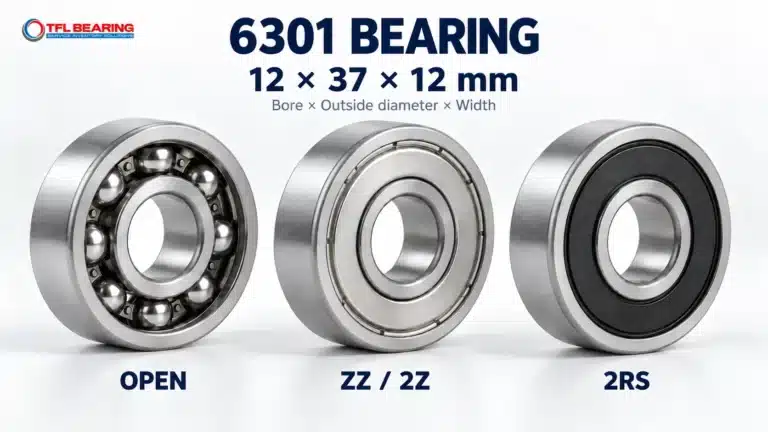
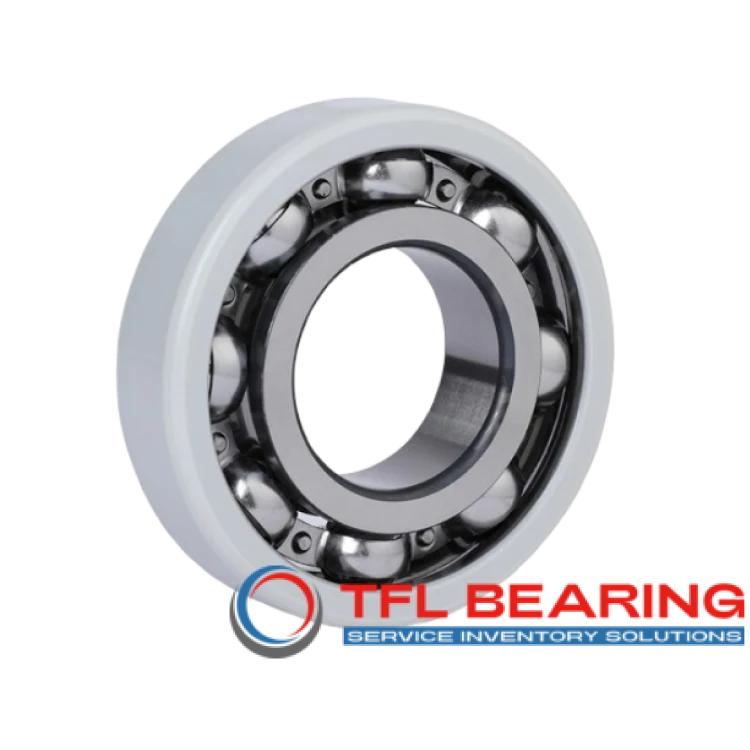
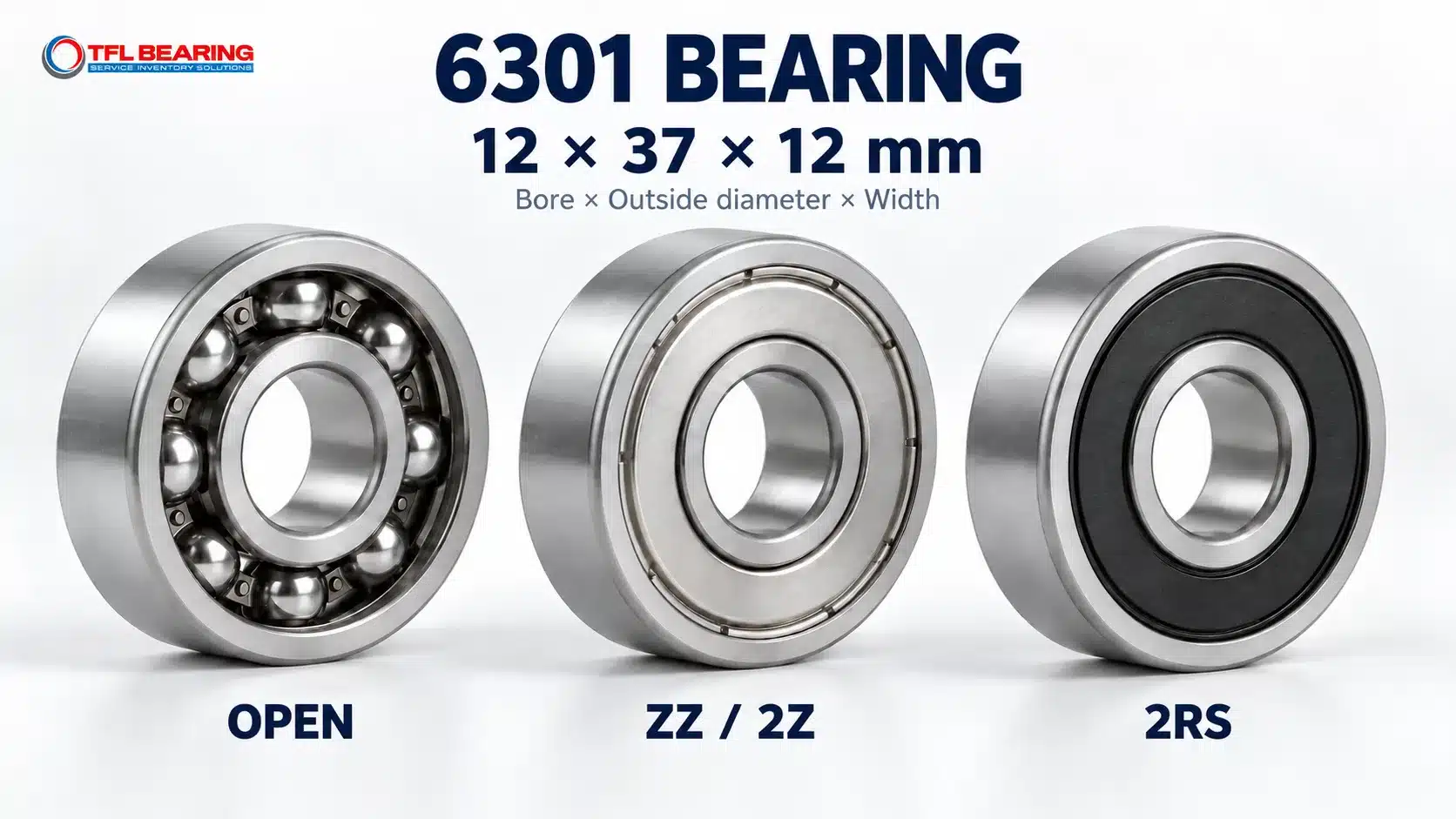
A 6301 is a single row deep groove ball bearing with a 12 mm bore, a 37 mm outside diameter and a 12 mm width. It’s a medium series part, so it carries more load than the smaller 6201 on the same 12 mm shaft. You’ll find it in electric motors, pumps, fans and car belt pulleys.
The specs below come from published NSK, Schaeffler (FAG), SKF and Timken data, checked in October 2026. That way you can order the right part the first time.
What Does the Number 6301 Mean?
The number is a code. “6” means deep groove ball bearing. “3” means the medium dimension series. “01” means a 12 mm bore. Bore codes 00 to 03 break the usual “multiply by 5” rule: 00 is 10 mm, 01 is 12 mm, 02 is 15 mm and 03 is 17 mm.
Letters after the number add detail. Think of them like trim badges on a car. They tell you about seals, internal clearance and precision.
What Are the 6301 Bearing Dimensions and Specifications?
Every major brand makes this bearing size as 12 × 37 × 12 mm with a 1 mm minimum chamfer. These boundary dimensions follow ISO standards, so brands swap freely. Load ratings and speed limits differ a little by maker and seal type.
| Spec | NSK (open) | FAG 2RSR | SKF 2RSH | Timken 2RS |
|---|---|---|---|---|
| Inner diameter (bore) | 12 mm | 12 mm | 12 mm | 12 mm |
| Outer diameter | 37 mm | 37 mm | 37 mm | 37 mm |
| Width | 12 mm | 12 mm | 12 mm | 12 mm |
| Dynamic load (Cr) | 10,700 N | 10,300 N | 10,100 N | 9,700 N |
| Static load (C0r) | 4,200 N | 4,200 N | 4,150 N | 4,200 N |
| Speed | 24,000 rpm (grease) | 13,700 rpm (limiting) | 14,000 rpm (limiting) | 19,000 rpm (grease reference) |
| Weight | about 0.06 kg | 59.8 g | not listed | 0.06 kg |
Sources: NSK online catalogue (2026), Schaeffler product data (2026), RS Components listing for SKF (2026), Timken data sheet (2024).
NSK also lists six balls of 7.938 mm each. Its fitting data suggests a shaft shoulder of 17 to 18 mm and a housing shoulder of no more than 32 mm.
What’s a dynamic load rating? It’s a strength score used to estimate service life. It isn’t a load you should run all day. Notice how seals cut speed: NSK’s open version is rated at 24,000 rpm on grease, while its sealed 6301DDU is rated at 16,000 rpm.
What’s the Difference Between 6301 2RS, ZZ and Open?
They share the same size but use different covers. A 2RS bearing has rubber contact seals on both sides. It blocks dust and water but adds drag. A ZZ bearing has metal shields with a tiny gap, so it spins freer but protects less. An open bearing has no cover and relies on outside lubrication.
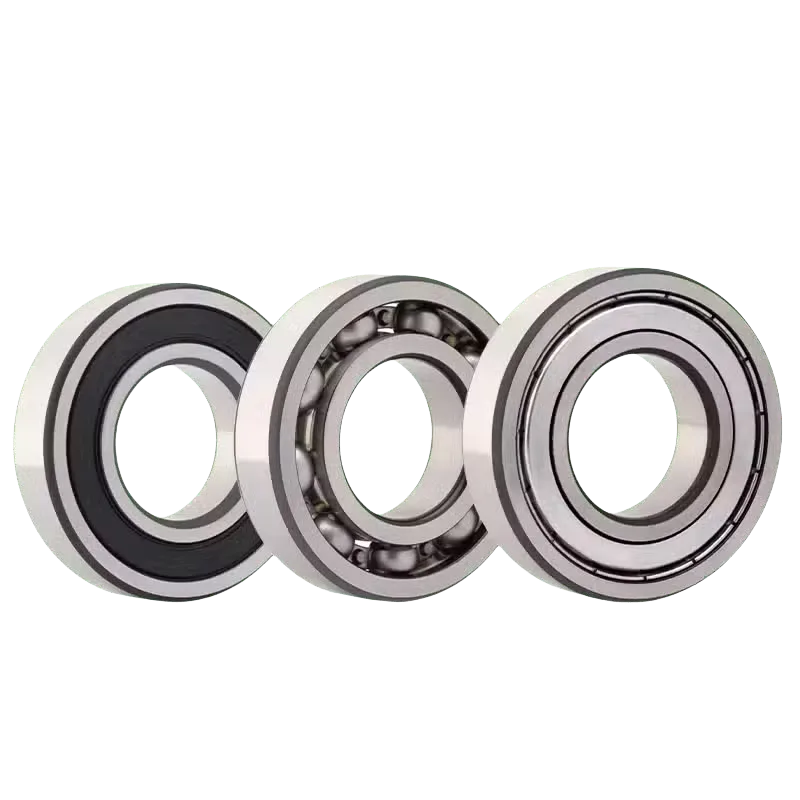
Each brand writes the same idea differently:
| Variant | SKF | FAG | NSK | NTN |
|---|---|---|---|---|
| Open | 6301 | 6301 | 6301 | 6301 |
| Metal shields both sides | 6301 2Z | 6301 2Z | 6301ZZ | 6301ZZ |
| Rubber seals both sides | 6301 2RS1 or 2RSH | 6301 2RSR | 6301DDU | 6301LLU |
Nachi uses 2NSL for a double sealed version. Watch the single seal codes too. NSK DU, NTN LU and Timken RS mean a seal on one side only.
What Is the 6301DULX Bearing?
This is an NSK marking found inside belt idler and tensioner pulleys on some Nissan models, including the Almera Tino and Primera 2.2 dCi. “DU” is NSK’s code for one rubber contact seal. We couldn’t find the “LX” suffix explained in NSK’s public catalogue pages, so treat it as an OEM specific code.
Car owners on Nissan forums report swapping it for an SKF 6301 2RSH or 2RS1 of the same 12 × 37 × 12 mm size. One owner said the new bearing made the same noise afterwards. That’s a useful reminder: check the belt and pulley before blaming the bearing. Another warned that the old bearing can get damaged when you press it out of the pulley cup.
Where Is the 6301 Bearing Used?
Typical applications include electric motors, pumps, fans and general industrial machinery, according to Timken and NSK product listings. In cars, it shows up in belt idler and tensioner pulleys. If you source parts for vehicles, our automotive bearings page covers other common positions.
Why pick it over a 6201? The 6201 measures 12 × 32 × 10 mm (NTN, 2026). The 6301 has thicker rings and bigger balls, so it takes heavier loads. But it needs a 37 mm housing, so the two aren’t interchangeable.
How Do You Choose the Right 6301 Bearing Replacement?
Start by measuring, then read every letter on the old part. Matching the numbers alone isn’t enough. Seals, clearance and precision grade all change how the bearing behaves in your machine.
- Measure the bore, OD and width with calipers. You should get 12, 37 and 12 mm.
- Check clearance. C3 means more internal play than normal. It’s common in motors, where heat expands the inner ring.
- Check precision. Codes like P6 and P5 mean tighter tolerances than standard.
- Match the environment. Pick 2RS for dirt and water, ZZ or open for clean, fast running.
- Check for snap ring suffixes. Our N vs NR snap ring guide explains how to read them.
- Convert brand codes with a bearing cross reference guide before you order.
Common Mistakes When Buying a 6301 Bearing
- Mixing up 6301 and 6201. Same bore, different OD and width.
- Typing “6301 RS” when you need full sealing. A single RS usually means one seal.
- Ignoring C3. A normal clearance part can run hot in a motor designed for C3.
- Trusting one listing. A UK distributor page for a Timken 6301 C3 shows an 11 mm width, while Timken’s own drawing for the 2RS shows 12 mm. Always check maker data.
- Running a sealed bearing at open speeds. Seal drag lowers the safe limit.
How Much Does a 6301 Bearing Cost?
Prices vary by brand, seal and quantity. In October 2026, RS Components listed an SKF 6301 2RSH at £6.78 before VAT. Rubix listed a Timken open bearing at £2.96 and a FAG version at £4.68 before VAT. US distributor Motion showed open bearings from SKF, NSK and NTN at roughly $29 to $39 each.
Bulk orders usually cost less per piece. Prices change often, so treat these as a snapshot.
What Are the Limitations of This Bearing?
It’s built mainly for radial loads. It takes some axial load in both directions, but not heavy thrust. It handles very little misalignment. Sealed versions have temperature limits too. Schaeffler rates the FAG 2RSR from 20 °C below zero up to 100 °C.
If your machine needs more than this, look at a larger series or a different bearing type.
Conclusion
The 6301 is a simple, sturdy bearing once you know its code: 12 × 37 × 12 mm, a medium series build, and suffixes that tell you seals and clearance. Measure first, read every letter, and match the seal to the job. When you’re ready to source one, browse our deep groove ball bearings or send us your full part number for a quote.
FAQs
What is the 6301 bearing size in inches?
About 0.472 in bore, 1.457 in OD and 0.472 in width. It’s a metric bearing, so always order it by its millimetre size.
Can this bearing take axial load?
Yes, a moderate amount in both directions. For heavy thrust, use a bearing designed for axial loads.
Can I replace a 6301 2RS with a ZZ?
The size matches, so it fits. But ZZ shields protect less against water and fine dust, so stick with 2RS in dirty or wet spots.
How long does this bearing last?
It depends on load, speed, lubrication and dirt. Engineers estimate life with the ISO 281 method, using the dynamic load rating.
Can TFL Bearing supply 6301 bearings and brand equivalents?
TFL supplies deep groove ball bearings and supports cross reference checks for major brands. Minimum order quantity varies by product, so send your exact part number and quantity for a quote.