







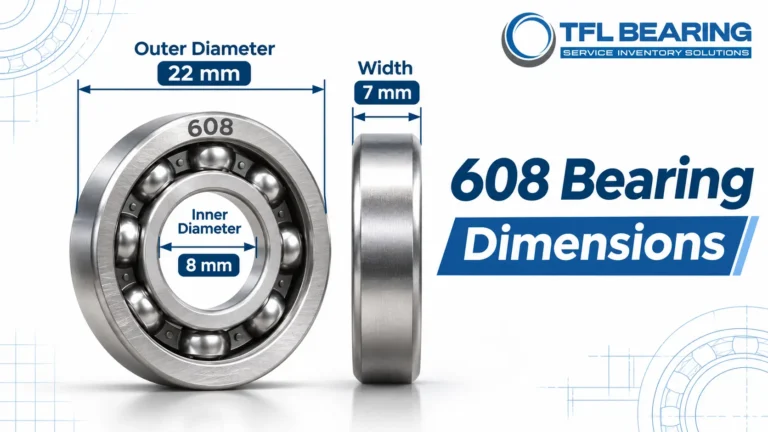
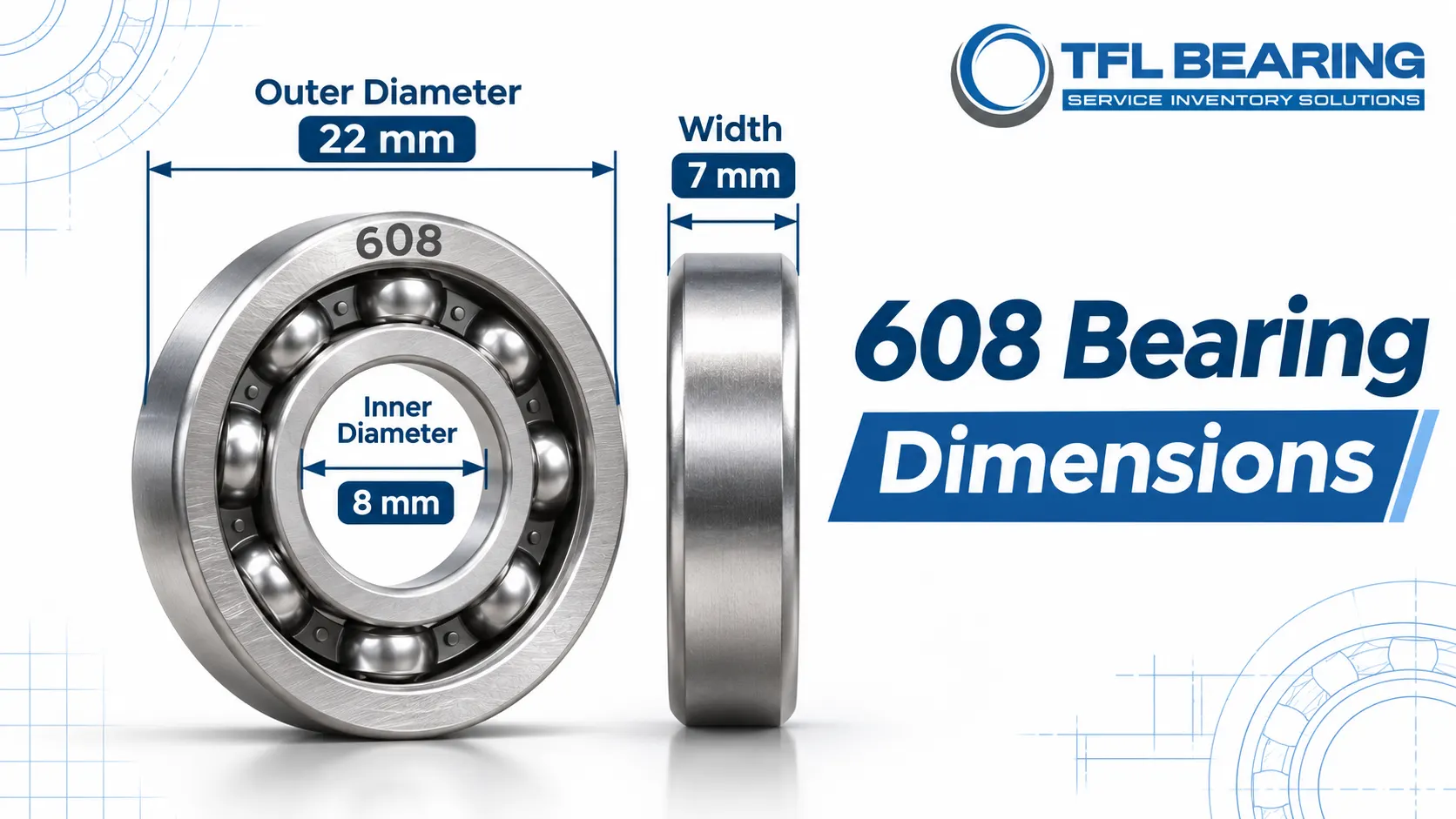
The standard 608 bearing dimensions are an 8 mm inner diameter, a 22 mm outer diameter and a 7 mm width, written as 8x22x7 mm. In inches, the 608 bearing size is about 0.315 x 0.866 x 0.276. These numbers stay the same whether the bearing is open, 608ZZ or 608 2RS.
The 608 is one of the most common small bearings in the world. It spins inside skateboards, 3D printers, fans and power tools. This guide covers the 608 bearing size chart, the specifications, the seal types and how to measure one yourself.
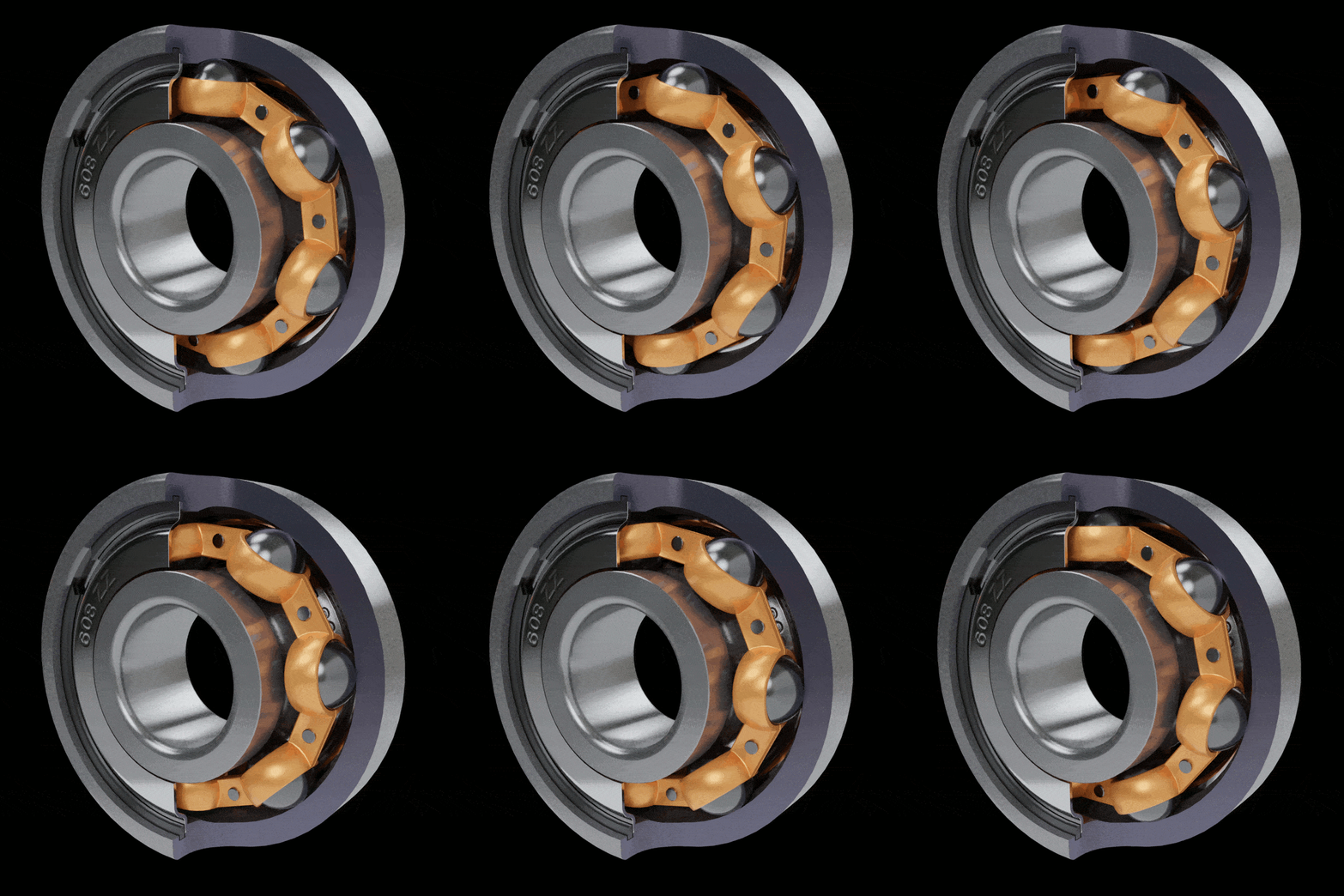
Key takeaways
- 608 bearing dimensions (ID x OD x width): 8 mm x 22 mm x 7 mm
- Type: single row deep groove ball bearing
- Versions: 608 (open), 608ZZ (metal shields), 608 2RS (rubber seals)
- Weight: about 12 g in chrome steel
What are the 608 bearing dimensions in mm and inches?
The 608 bearing inner diameter is 8 mm, the 608 bearing outer diameter is 22 mm and the 608 bearing width is 7 mm. In inches, that’s 0.3150 in, 0.8661 in and 0.2756 in. These sizes follow ISO 15:2017, so any brand’s 608 fits the same shaft and housing. The table below lists the full 608 bearing dimensions.
| Measurement | Symbol | mm | Inches |
|---|---|---|---|
| Inner diameter (bore) | d | 8 | 0.3150 |
| Outer diameter | D | 22 | 0.8661 |
| Width | B | 7 | 0.2756 |
| Minimum corner chamfer | r | 0.3 | 0.0118 |
Think of it like shoe sizes. The brand can change, but a size 9 is still a size 9.
What does the number 608 mean?
The “6” means it’s a deep groove ball bearing. The “0” puts it in the light 60 series, which sets the 22 mm OD and 7 mm width. For bores under 10 mm, the last digit is the bore in millimetres, so “8” means an 8 mm bore.
So the 608 deep groove ball bearing is a small member of the same family as the standard deep groove ball bearings used in motors, pumps and gearboxes. Letters after the number, like ZZ or 2RS, only describe the side covers. They never change the 608 bearing dimensions.
What are the 608 bearing specifications?
A typical chrome steel 608 has a dynamic load rating of about 3,650 N and a static load rating of about 1,370 N. It holds 7 balls, each 3.969 mm (5/32 in) across, and weighs about 12 g. The exact values change slightly by brand, but the 608 bearing dimensions don’t. Always check the datasheet for load data.
| Specification | Typical value |
|---|---|
| Dynamic load rating (Cr) | 3,650 N (about 820 lbf) |
| Static load rating (C0r) | 1,370 N (about 308 lbf) |
| Balls | 7 x 3.969 mm |
| Weight | About 12 g |
| Standard material | 52100 (GCr15) chrome steel |
The 608 bearing load rating isn’t a weight limit. It’s more like a stamina score. Under ISO 281:2007, it’s the load that 90% of bearings can carry for one million turns. You can compare it with other types in our full ball bearings catalog.
What is the difference between 608ZZ and 608 2RS bearings?
Both have the same 608 bearing dimensions: 8x22x7 mm. The 608ZZ bearing has two metal shields with a tiny gap, so it spins freely and runs faster. The 608 2RS bearing has two rubber seals that touch the inner ring. They block water and dust better, but they add friction and lower the top speed.
| Feature | 608 (open) | 608ZZ | 608 2RS |
|---|---|---|---|
| Side covers | None | 2 metal shields | 2 rubber seals |
| Touches inner ring | No | No | Yes |
| Water protection | None | Low | Good |
| Friction | Lowest | Low | Higher |
| Top speed | Highest | High | Lower |
| Best for | Clean, oiled setups | 3D printers, fans | Skates, outdoor tools |
Here’s a simple rule. Choose ZZ for speed in clean places. Choose 2RS for dirt, splashes and outdoor use. You’ll find these sizes in our metric size standard miniature ball bearings range.
How do you measure a 608 ball bearing?
Use a digital caliper. Measure the bore with the inside jaws, the OD with the outside jaws and the width across the flat ring faces. If the readings match the 608 bearing dimensions of 8.00, 22.00 and 7.00 mm, you have a true 608. If you get 7.94 mm (5/16 in) or 22.23 mm (7/8 in), you likely have an inch size bearing.
- Wipe off the grease and dirt.
- Measure the bore twice, a quarter turn apart.
- Measure the OD the same way.
- Check the width on both the inner and outer ring.
- Read the part number on the shield or seal.
These steps confirm the 608 bearing dimensions before you order. If your readings land on fractions of an inch, browse our inch size miniature ball bearings instead.
One tip: a worn bearing still measures the same. Wear shows up as wobble, noise or rough turning, not as smaller numbers.
608 bearing size chart: how does it compare to other 8 mm bore bearings?
Many bearings share an 8 mm bore. They differ in OD and width, so a matching bore doesn’t mean a matching bearing. The chart puts the 608 bearing dimensions next to its closest neighbours.
| Bearing | Bore (mm) | OD (mm) | Width (mm) |
|---|---|---|---|
| 688 | 8 | 16 | 5 |
| 698 | 8 | 19 | 6 |
| 608 | 8 | 22 | 7 |
| 628 | 8 | 24 | 8 |
| 638 | 8 | 28 | 9 |
| F608 (flanged) | 8 | 22 | 7 |
Need a smaller or larger size? Our miniature bearings section covers many bore and OD options.
The F608 keeps the same 608 bearing dimensions but adds a lip on the outer ring. It stops the bearing from sliding through a thin housing, like the head on a screw. See our metric size miniature flanged ball bearings for that style. For bigger sizes, check our flanged ball bearings.
Some designs need a small gap between the turning part and the housing. A wider inner ring creates that gap without an extra washer. That’s what our miniature ball bearings with extended inner ring do.
What tolerance and clearance does a 608 bearing use?
The 608 bearing dimensions above are nominal sizes. Most 608s are made to the ISO 492:2014 Normal class, which is close to ABEC 1. The bore can sit up to 0.008 mm under 8 mm, the OD up to 0.009 mm under 22 mm and the width up to 0.12 mm under 7 mm. Normal radial clearance (CN) is 2 to 13 µm.
To picture 0.008 mm, think of about a tenth of a human hair. That’s why the 608 bearing tolerance holds so tight in real life.
C3 clearance (8 to 23 µm, per ISO 5753 part 1, 2009) leaves a little more room inside. It suits motors that run warm, because the parts grow with heat. In inverter driven motors, stray current can also pit the raceways. Our electrically insulated deep groove ball bearings block that current.
What are 608 bearing applications and materials?
Skateboards are the classic use. Each wheel takes two bearings, so a full board uses eight. Inline skates, scooters, fidget spinners, 3D printer lead screws, small motors and power tools use them too. Because the 608 bearing dimensions are a global standard, a replacement from any good brand fits.
The 608 bearing material matters as much as the size. Chrome steel is the standard choice. Stainless steel (often marked S608) resists rust in wet places. Hybrid ceramic versions run cooler at high speed but cost more.
Common mistakes and limitations
- Treating ABEC as a speed rating. It measures how precisely the bearing is made, not how fast it spins.
- Pressing on the wrong ring. When you fit a bearing onto a shaft, press the inner ring. Force through the balls can dent the raceways.
- Using 2RS at very high speed. Seal drag builds heat.
- Mixing up sizes. Seals never change the 608 bearing dimensions, but a 688 or 628 looks similar. Always measure.
A 608 handles side loads (radial loads) best. It isn’t built for heavy pushing along the shaft (thrust loads) or for shock. If your design pushes hard along the shaft, pair it with our miniature thrust ball bearings.
Conclusion
The 608 bearing dimensions are easy to remember: an 8 mm bore, a 22 mm OD and a 7 mm width. Pick ZZ for clean, fast jobs and 2RS for dirt and water. Then match the clearance to how warm your machine runs. Ready to order? Send us the 608 bearing dimensions, closure type and quantity you need, and request a quote today.
FAQs
Is a skateboard bearing the same as a 608 bearing?
Yes. Almost all standard skateboard and inline skate wheels use the 608 bearing dimensions of 8x22x7 mm. The exception is “micro” bearing wheels, which use the smaller 688.
Can I replace a 608ZZ with a 608 2RS?
Yes. They share the same 608 bearing dimensions and swap directly. You’ll get a little more drag and better water protection.
How long does a 608 bearing last?
It depends on the load and speed. The basic rule is life = (C ÷ P)³ million turns, where C is the dynamic rating and P is your real load. If you halve the load, life goes up about eight times.
Is there an inch version of the 608?
No. The 608 is metric, and no inch bearing matches it exactly. Some inch bearings with a 7/8 in OD come close, but they don’t swap with a 608.
Does TFL Bearings supply 608 bearings?
Yes. TFL Bearings lists the 608ZZ among its popular metric miniature models, in chrome steel and stainless steel. The team is in Jinan, Shandong, and quotes on both small and bulk orders.