







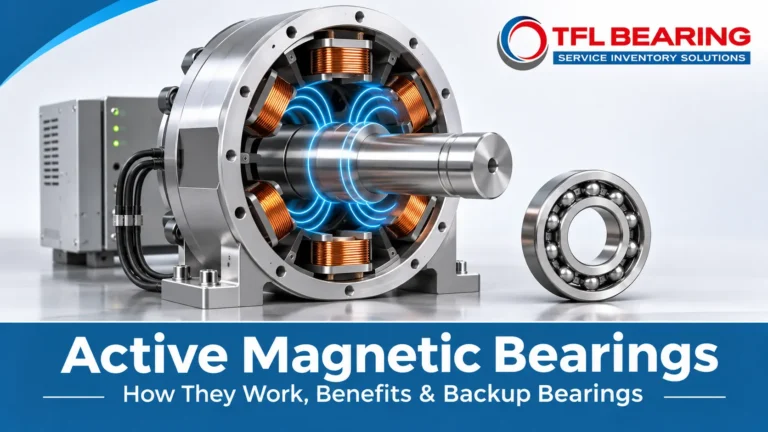

Active magnetic bearings (AMBs) hold a spinning shaft in the air with electromagnets. The shaft never touches the bearing. Sensors watch where the shaft is, and a small computer changes the magnet power to keep it in the center.
Because nothing touches, there is no oil, almost no friction and very little wear. That makes active magnetic bearings a strong choice for very fast, oil-free machines like large compressors and chillers.
But there is one thing many people miss. Every machine with magnetic bearings still needs normal ball bearings inside it. We’ll explain why, and what those bearings look like, further down.
Active magnetic bearings in 30 seconds
- Shaft floats on magnetic force, with no contact
- No oil or grease needed for the magnetic bearings
- Can run at very high speeds
- Needs electric power all the time
- Costs more and is bigger than oil bearings for the same load
- Always comes with backup ball bearings for safety
How do active magnetic bearings work?
Think of it like balancing a stick on your hand. Your eyes see the stick lean, your brain decides what to do, and your hand moves to fix it. Active magnetic bearings do the same thing, many times every second.
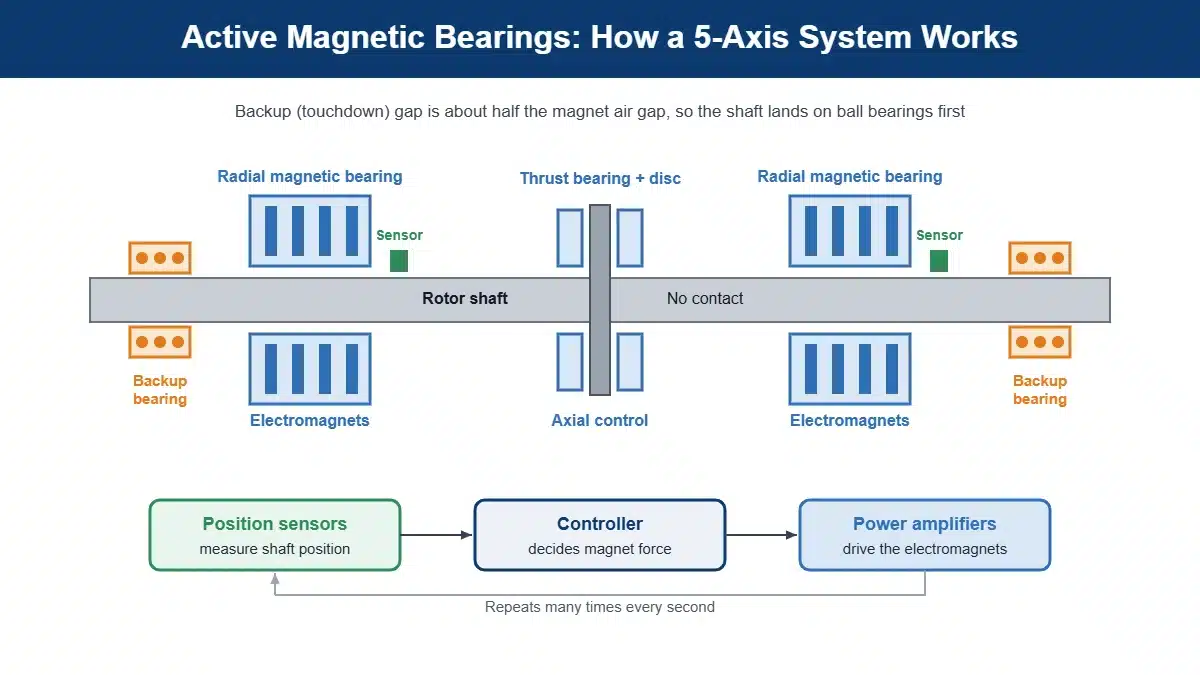
It has four parts:
- Electromagnets: pull on the shaft to hold it in place
- Sensors: measure where the shaft is
- Controller: decides how much pull each magnet needs
- Amplifiers: send the right power to each magnet
Around the shaft sit four electromagnets, two pulling up and down and two pulling side to side. If the shaft drifts left, the right magnet pulls a little harder. A separate thrust magnet does the same job along the length of the shaft, pulling on a steel disc from both sides.
Most machines use two radial magnetic bearings and one thrust bearing. Engineers call this a 5-axis system, because it controls the shaft in five directions.
The smart part is software. The controller can soften the bearing when the shaft passes a speed that would normally cause shaking, and it can cancel out small unbalance in the rotor. A normal bearing can’t change its behavior while running.
Why companies choose active magnetic bearings
No oil at all
An oil bearing needs pumps, filters, coolers and tanks. A magnetic bearing needs none of them. The machine gets smaller, simpler and cleaner, and there is no risk of oil leaking into the gas or refrigerant inside.
Very high speed
Ball bearings and oil bearings have a speed limit. Active magnetic bearings push that limit much higher. This lets a fast motor drive a compressor directly, without a gearbox in between.
Less energy lost
With no contact, there is very little friction. Big machines save energy every hour they run, which adds up over years.
Live machine data
The sensors always know where the shaft is. So the system can show vibration, balance and speed in real time without extra monitoring tools.
Little wear
Nothing rubs, so the magnetic bearing itself doesn’t wear out the way a ball bearing slowly does.
The downsides you should know
Active magnetic bearings are not the right answer for most machines. Here is why.
- They cost a lot more. You are buying magnets, sensors, a controller and power electronics, not just a bearing.
- They are bigger. A magnetic bearing carries less load per square centimeter than an oil bearing, so it must be roughly twice the size to carry the same weight.
- They can’t take sudden overloads well. A hard knock or a big pressure spike can push the shaft beyond what the magnets can hold.
- They need power every second. If power is lost, the magnets stop holding the shaft. That’s exactly why backup bearings exist.
If your machine runs on oil-lubricated sleeve bearings today and keeps failing, read our journal bearing failure analysis guide first. Often the fix is in the oil or the setup, not a whole new bearing system.
For a deeper look at all types of magnetic bearings, including simple permanent magnet designs, see the magnetic bearing page on Wikipedia.
Backup bearings: the hidden ball bearings in every AMB machine
For anyone who buys bearings, this is the most useful part of the topic.
Why backup bearings are needed
When the machine is off, the magnets are off too. The shaft has to rest on something. And if power fails while the shaft is spinning at full speed, the shaft falls. Without a safety bearing, it would crash into the magnets and wreck them.
So every AMB machine has backup bearings near each magnetic bearing. You may also hear them called touchdown, auxiliary or catcher bearings. They all mean the same thing.
How they work
A backup bearing sits around the shaft with a small gap. In normal running, the shaft never touches it. The gap is smaller than the magnet gap, usually about half. So if the shaft drops, it lands on the backup bearing first, and the magnets stay safe.
Industry standards treat these bearings as required, not optional. The compressor standard API 617 calls for them, and ISO 14839 has a full part written just for touchdown bearings.
What type of bearing is used
Most backup bearings are angular contact ball bearings with ceramic balls. Common setups include:
- Two angular contact bearings mounted as a matched pair
- One double row angular contact bearing
- A four-point contact ball bearing, which catches load from both directions
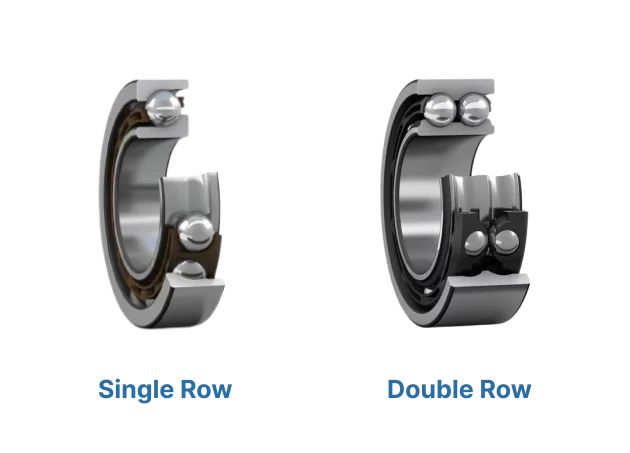
Many designs remove the cage and fill the bearing with balls instead. This stops the balls from skidding when a fast shaft suddenly lands on them.
Matched pairs of single row angular contact ball bearings are the most common choice, mounted face to face or back to back.
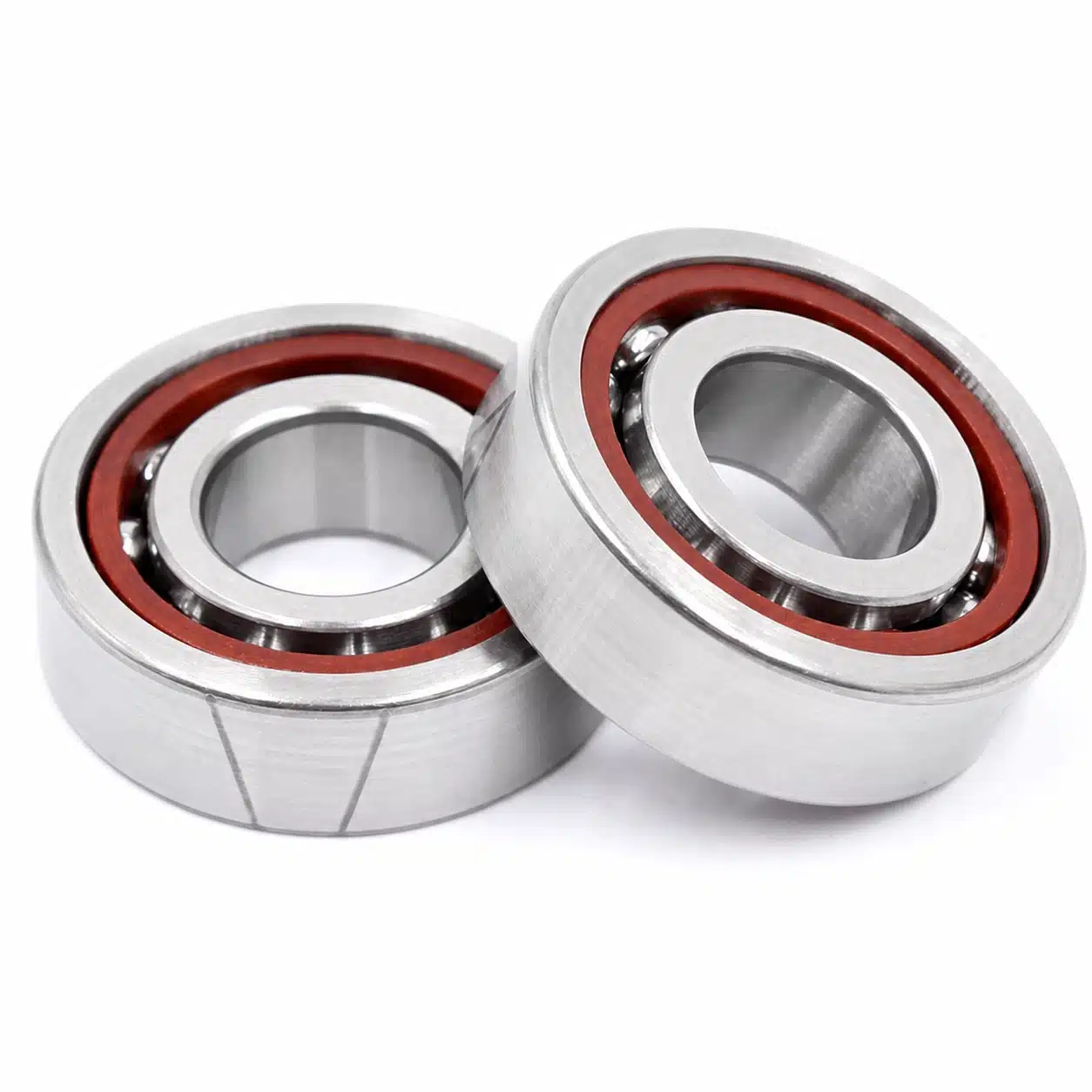
When space along the shaft is short, one double row angular contact ball bearing can replace a pair.
If the shaft needs to be caught in both axial directions with a single part, a four-point contact ball bearing is worth a look.
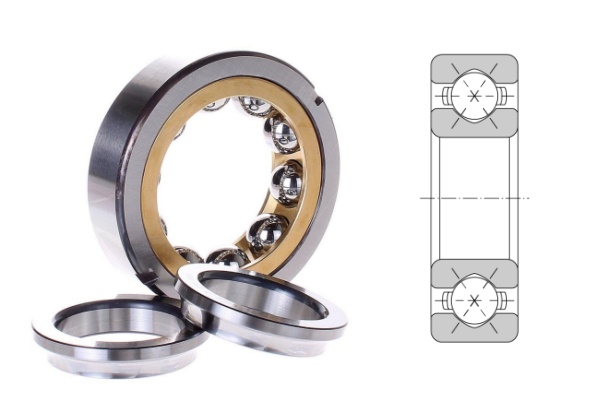
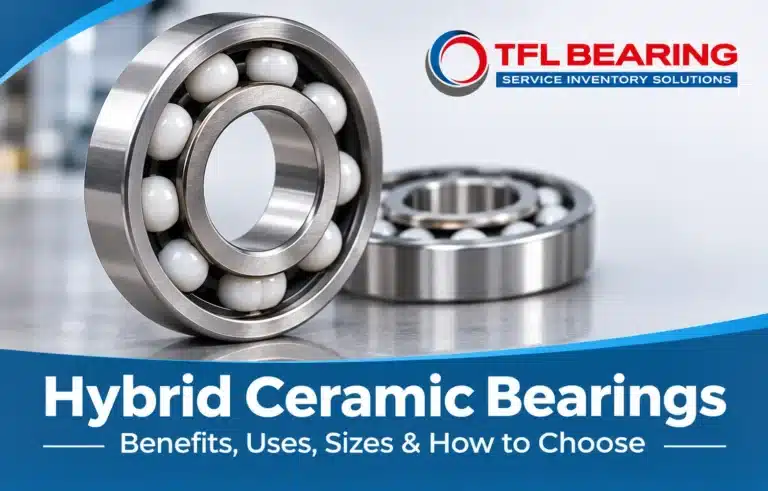
Ceramic balls are used because they are light, very hard and cope with little or no grease. We explain these benefits in detail in our guide to hybrid ceramic bearings.
What a backup bearing has to survive
A backup bearing does nothing for months, then suddenly gets hit by a shaft spinning at thousands of rpm. On a big flywheel, the shaft can keep spinning on the backup bearings for two to three hours before it stops.
That’s a hard job, so quality matters more than the catalog numbers. One small flaw from handling or assembly can make a backup bearing fail within minutes of a drop. Always inspect backup bearings after any drop event, and buy them from a supplier with a clear quality process.
Magnetic bearings vs ball bearings vs oil bearings
| Feature | Magnetic bearing | Ball or roller bearing | Oil (fluid film) bearing |
|---|---|---|---|
| Contact | None | Rolling contact | Thin oil film |
| Lubrication | None | Grease or oil | Oil system with pumps |
| Max speed | Highest | Medium | High |
| Load for its size | Lowest | High | Highest |
| Handles shock | Poorly | Well | Well |
| Needs power | Yes | No | No |
| Needs backup bearings | Yes | No | No |
| Cost | Highest | Lowest | Medium |
For most machines, ball and roller bearings are still the best value. They are cheap, need no power and take shocks well. Slow, heavy machines like conveyors and gearboxes run happily on tapered roller bearings and will for many years.
Active magnetic bearings make sense only when speed is extreme, oil is a problem and the machine is big enough to pay for the electronics.
Where active magnetic bearings are used
- Chillers: Large air conditioning chillers use oil-free compressors on magnetic bearings to save energy. Some chiller makers use ceramic ball bearings lubricated by refrigerant instead, so the two technologies compete here.
- Gas compressors: Pipeline and process compressors drop their oil systems and run the motor and compressor on one shaft. The same idea is being developed for subsea and offshore use, alongside other marine bearing needs.
- Turboexpanders: These machines cool gas in gas processing plants. Oil getting into the gas would be a problem, so magnetic bearings were adopted here early.
- Flywheels: Energy storage flywheels spin very fast inside a vacuum, where oil doesn’t work well.
- Special machines: Nuclear gas circulators, space blowers and high-speed test rigs also use them.
High-speed direct drive also removes the gearbox. If you are comparing that route with a geared design, our gearbox bearing guide shows which bearings a gearbox needs.
For everyday factory equipment, standard bearings for industrial machinery remain the simple and reliable choice.
Quick check: does your machine need magnetic bearings?
Answer yes or no to each:
- Is the shaft speed too high for ball or oil bearings?
- Would oil in the process cause real damage?
- Is the machine large and expensive to stop?
- Do you have steady power and a plan for power loss?
- Is oil system maintenance costing you a lot of time?
Four or five yes answers: active magnetic bearings are worth studying. One or two: a good quality ball or roller bearing is almost always the better buy. Our bearing selection guide can help you compare options.
FAQ
What is the difference between active and passive magnetic bearings?
Active magnetic bearings use sensors and a controller to adjust the magnets all the time. Passive magnetic bearings use permanent magnets only, with no control. Almost all industrial machines use the active type.
What happens if a magnetic bearing loses power?
The shaft drops onto the backup ball bearings, which carry it safely while it slows down and stops.
Do active magnetic bearings need maintenance?
The magnets don’t wear, but the electronics and sensors need checks. The backup bearings should be inspected after every drop.
Can I replace magnetic bearings with ball bearings?
Sometimes, but it means a redesign. You would need a lubrication system and a lower speed limit, so talk to the machine maker first.
Need backup bearings for a magnetic bearing machine?
TFL doesn’t make complete active magnetic bearing systems. We supply the ball bearings around them: angular contact pairs, double row and four-point contact bearings for backup duty, plus standard bearings for machines that don’t need magnetic bearings at all.
Send us the bearing number or drawing, shaft speed, rotor weight and lubrication type (grease, vacuum grease or dry) through our request a quote page. Our team will reply with matching options.