







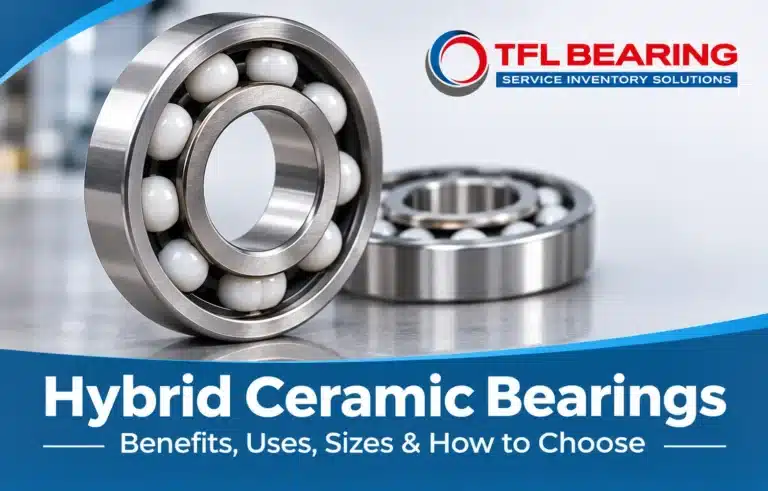
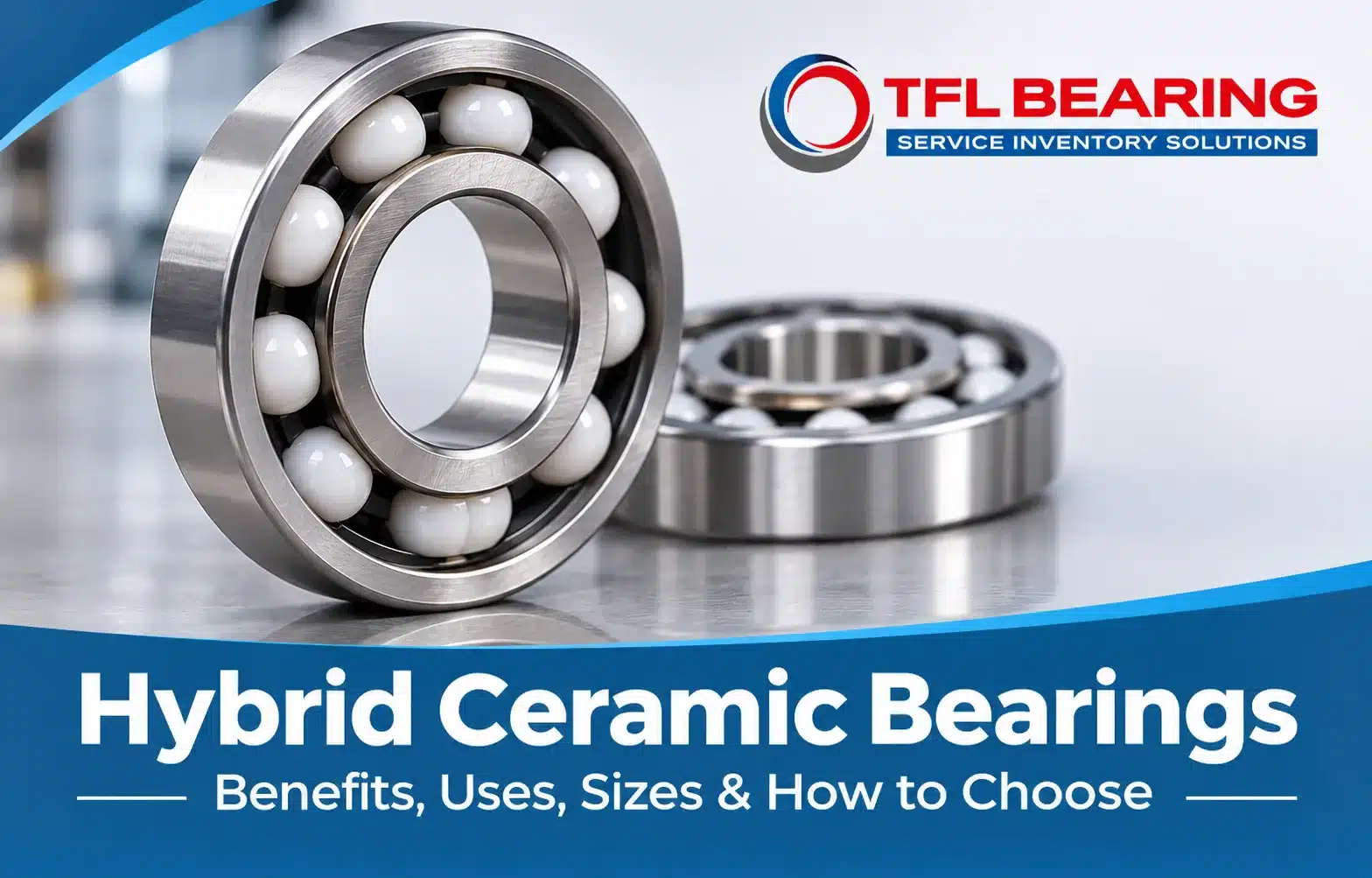
Hybrid ceramic bearings are rolling bearings with steel inner and outer rings and balls (or rollers) made of silicon nitride (Si3N4) ceramic. They spin faster, run cooler, last longer with poor lubrication and stop electric current from passing through the bearing. They cost more than steel bearings and carry less static load.
Use hybrid ceramic bearings in fast spindles, inverter-driven electric motors and machines where grease is hard to maintain. For slow shafts with heavy or shock loads, standard steel deep groove ball bearings are still the smarter buy.
Hybrid ceramic bearings at a glance
- Construction: steel rings, silicon nitride ceramic balls, standard cage and seals
- Ball weight: about 60% lighter than a steel ball of the same size
- Speed: up to 25% higher than all-steel bearings (SKF data)
- Friction: up to 50% lower (SKF data)
- Grease life: up to 8 times longer with certain lubricants (SKF data)
- Static load rating: about 30% lower than steel
- Electrical insulation: yes, the ceramic balls block current
- Fit: same ISO dimensions as the steel version, so no redesign needed
What are hybrid ceramic bearings?
A hybrid ceramic bearing replaces only the steel rolling elements with ceramic ones. The rings stay in bearing steel, usually 52100 chrome steel or stainless steel. SKF describes its hybrids as dimensionally interchangeable with other ISO bearings.
That means a hybrid drops into the same shaft and housing as the steel ball bearings you already use.

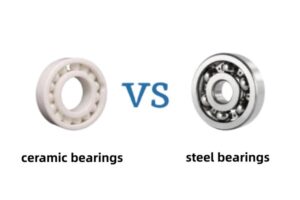
The name confuses many buyers. Most products sold as “ceramic bearings” are actually hybrids. A full ceramic bearing has ceramic rings too, and it behaves very differently (see the comparison below). If you are still weighing materials in general, our article on ceramic bearings vs steel bearings in extreme environments covers the basics.
Why keep steel rings at all? Steel can be ground to very tight roundness. Ceramic rings are harder to machine, so they vibrate more. SMB Bearings notes this is why professional cyclists choose hybrids over full ceramic.
How to spot hybrid ceramic bearings
Silicon nitride balls are usually dark grey or black, so on an open bearing you can often see the difference from shiny steel balls. A sealed bearing hides the balls, so the part number is the reliable check. Don’t rely on looks alone. Confirm the ball material on the maker’s data sheet or packaging.
5 hybrid ceramic bearing benefits, explained simply
Each benefit comes from one property of silicon nitride ceramic balls.

1. Higher speed
Silicon nitride has roughly 40% of the density of bearing steel. So a ceramic ball weighs about 60% less than a steel ball of the same diameter.
Lighter balls push less on the outer ring at high rpm. That is why SKF rates its hybrids up to 25% faster than steel equivalents. It is also why ceramic balls are common in super precision angular contact ball bearings for high speed spindles.
2. More stiffness and accuracy
A silicon nitride ball has about 50% higher elastic modulus than a steel ball, according to SKF. In simple terms, it squashes less under load. The shaft stays where it should, which helps accuracy in machine tool spindle bearings.
3. Better wear resistance
Silicon nitride is more than twice as hard as bearing steel. A hard, smooth ball rolls over small dirt particles instead of getting dented. That keeps hybrid ceramic bearings running longer in contaminated oil.
For full material data, the silicon nitride page on Wikipedia lists its density and hardness with references.
4. Lower friction and longer grease life
SKF says its hybrid ceramic bearings cut friction by up to 50% and can stretch grease life up to 8 times. Less friction also means less heat.
Treat these as best-case figures from a premium maker. A cheap hybrid with a rough raceway won’t reach them. SMB Bearings even warns that a low-grade hybrid can be matched on speed by a good precision steel bearing.
5. Electrical insulation
Silicon nitride does not conduct electricity. SKF measured an open hybrid bearing at several gigaohms of DC resistance. This is the main reason hybrid ceramic bearings are used in motors (more on that next).
One limit to know: hybrids are not rated for higher temperatures than steel bearings. The steel rings and the grease still set the temperature limit. The ceramic’s real thermal benefit is low expansion, so the bearing copes better when the shaft runs hotter than the housing.
Hybrid ceramic bearings for electric motors
Motors on a variable frequency drive (VFD) are the biggest use today, and a common question in high efficiency industrial motor bearings. Here is the problem in three steps:
- The VFD switches at high frequency.
- Some voltage builds up on the motor shaft.
- The current discharges through the bearing and burns tiny pits in the raceway.
ISO 15243 calls this electrical erosion. On a removed bearing, it looks like a frosted raceway or a washboard pattern called fluting.
Ceramic balls break the current path. SKF found a hybrid’s impedance stays above 1 kΩ even at 1 MHz, so it blocks high-frequency inverter current well. Hybrids are one of three common types of electrically insulated bearings, next to ceramic-coated rings and resin-coated rings.
Check these 3 things before you switch
First, confirm the damage is electrical. Fluting and lubrication failure can look alike. A bearing failure analysis of the old bearing gives you a clear answer.
Second, look at the whole current path. IBT, a US bearing distributor, warns that insulating one bearing can push the current into the other motor bearing, the coupling or the driven pump. Most fixes insulate both motor bearings, or use one insulated bearing plus a shaft grounding brush.
Third, check the size. SKF uses its INSOCOAT coated bearings for shafts of 55 mm and up. Schaeffler stocks hybrid deep groove ball bearings up to 120 mm outside diameter for smaller VFD motors. Large ceramic balls are costly to make, so bigger motors usually get a coated ring instead.
Our guide on ceramic bearings vs coated insulated bearings compares both options.
Hybrids in EVs and wind turbines
Researchers at Hyundai Transys studied Si3N4 hybrid bearings in EV reducers, where motor current damages steel balls and raceways. NSK has developed a plastic over-moulded bearing as a cheaper alternative for EV drivetrains. So the debate in cars is about price, not performance.
Wind turbine generators have used hybrid bearings for years, according to SKF, mainly to stop electrical erosion. They are a regular request in energy sector and power generation equipment.
Hybrid ceramic vs steel bearings vs full ceramic bearings
| Feature | All steel bearing | Hybrid ceramic bearing | Full ceramic bearing |
|---|---|---|---|
| Rings / balls | Steel / steel | Steel / silicon nitride | Ceramic / ceramic |
| Max speed | Baseline | Up to about 25% higher | About 20 to 25% of steel |
| Load capacity | Baseline | Static about 30% lower, dynamic similar | About 65 to 75% of steel |
| Electrical insulation | No | Yes | Yes |
| Needs lubrication | Yes | Yes | No, can run dry |
| Corrosion resistance | Low (unless stainless) | Limited by steel rings | Excellent |
| Shock loads | Good | Avoid | Avoid |
| Price | Lowest | Higher | Highest |

Hybrid ceramic vs steel bearings
Pick a hybrid when you need speed and insulation, or when lubrication is poor and you still want long life. Pick steel for heavy static loads, shock loads or a tight budget, because it carries more load for less money.
The shock load point matters. SMB Bearings explains that hard ceramic balls dent steel raceways under sudden impact, which causes fast wear. So crushers and hammer mills should stay on steel.
Hybrid ceramic vs full ceramic bearings
Full ceramic bearings are for corrosive, underwater, vacuum or non-magnetic jobs, and they can run without grease. But they are slow and brittle. If you need speed, choose hybrid ceramic bearings.
Speed also depends on more than ball material. Our guide to high precision vs high speed ball bearings shows how precision grade, cage design and lubrication change the limit.
Hybrid ceramic bearing applications
SKF lists these main uses since the 1990s: machine tools, wind turbine generators, railway and EV traction motors, aerospace, compressors, pumps and vacuum pumps.
Fast, precise machines get the biggest gain. Think grinding spindles, high speed compressors, or the joints used in robotics and automation.
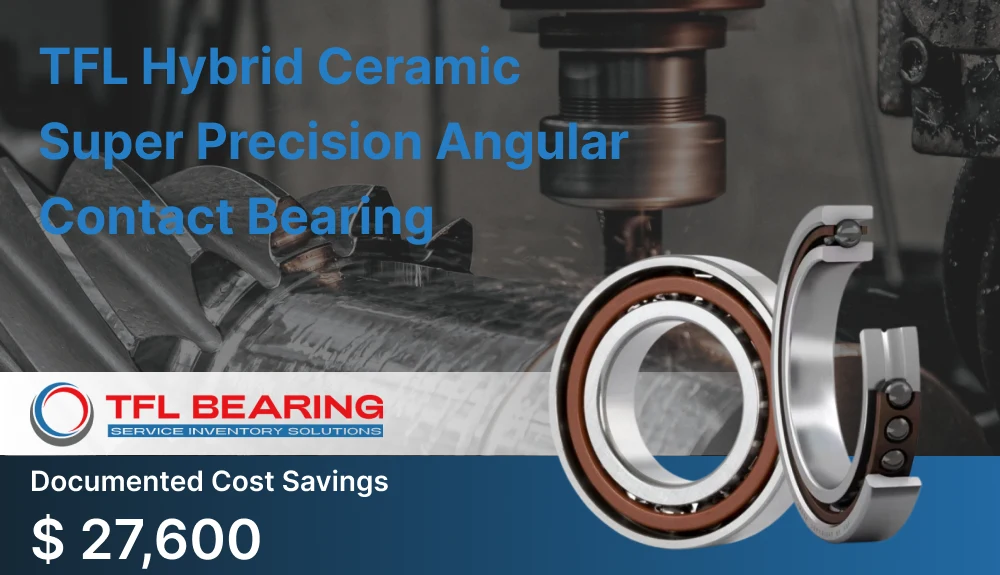
Traction motors use hybrids for insulation as much as speed. SKF makes hybrid cylindrical roller bearings too, so if your motor runs steel single row cylindrical roller bearings, ask if a hybrid version exists in the same series.
Small precision tools, such as dental handpieces, use ceramic balls in miniature ball bearings because speeds are extreme and loads are tiny.
Cyclists and skaters buy hybrid ceramic bearings for wheels and bottom brackets too. Our roundup of real user reviews of ceramic bearings for skating and cycling shows what riders actually notice.
When to skip hybrids: slow shafts with heavy loads, machines that take impacts, and washdown areas where steel rings would rust.
Signs your machine needs hybrid ceramic bearings
Most machines run fine on steel. These signs suggest a switch to hybrid ceramic bearings is worth testing:
- A motor on a VFD keeps failing, and the old bearings show fluting or a frosted raceway.
- A spindle runs close to its speed limit and gets hot at top rpm.
- The grease interval is short, or the bearing is hard to reach for relubrication.
- The oil film is thin, for example with low-viscosity oil in some compressors and pumps.
- The shaft starts and stops often, so lower ball inertia helps.
If none of these apply, stay with steel. A well-chosen steel bearing is cheaper and carries more static load. When you are unsure, test hybrid ceramic bearings in one machine first and compare bearing life before you change the whole fleet.
Hybrid ceramic bearing sizes and part numbers
Hybrid ceramic bearing sizes follow standard ISO series. SKF’s standard hybrid deep groove range covers bores from 5 to 110 mm, in open and sealed, greased-for-life versions.
A hybrid 6205 keeps the same 25 x 52 x 15 mm size as the steel part in our 6205 bearing dimensions guide. Only the ball material changes.

Part numbers differ by brand. Most use some kind of “HC” code for ceramic balls, but the position varies. Check any number in our bearing cross reference charts before you order a replacement.
Common myths about hybrid ceramic bearings
Myth 1: They don’t need grease. Only full ceramic bearings can run dry. Hybrid ceramic bearings still need grease or oil, because the raceways are steel.
Myth 2: They handle higher temperatures. The steel rings, cage, seals and grease set the limit, just like a steel bearing. A hybrid helps with thermal expansion, not with a higher maximum temperature.
Myth 3: Any ceramic ball makes a bearing faster. Raceway finish, precision class, cage and lubrication matter as much as the balls. A low-grade hybrid can lose to a good precision steel bearing.
Myth 4: A hybrid fixes every motor bearing failure. It only stops current from passing through the bearing. If the real cause is misalignment, overload or the wrong grease, a hybrid will fail too.
Installing and handling hybrid ceramic bearings
Mount a hybrid the same way as a steel bearing of the same size, with the same shaft and housing fits the maker recommends. A few habits protect the ceramic balls and the steel raceways:
- Press only on the ring you are fitting. Never push the force through the balls, and never hammer the bearing.
- Use an induction heater or a bearing oven for interference fits, and stay inside the maker’s temperature limit.
- Order the same internal clearance as the original part. Motor bearings often use C3.
- Keep the bearing in its packaging until fitting, and work with clean hands and tools.
Hard ceramic balls are sensitive to impact, so careless mounting can dent the raceways before the machine even starts.
Do hybrid ceramic bearings need lubrication?
Yes. Hybrids need grease or oil just like steel bearings. Only full ceramic bearings can run dry.
The good news is that hybrids keep their grease longer, so you relubricate less often. Use the grease the motor or machine maker specifies.
Lower friction means a cooler bearing, and cooler grease ages more slowly. That is one reason the relubrication interval gets longer. When you switch from steel, keep the same grease type unless the machine maker says otherwise, because mixing incompatible greases can shorten bearing life.
What affects the cost of hybrid ceramic bearings?
Hybrid ceramic bearings always cost more than the same steel size, but the gap varies. These factors drive it:
- Ball size: large silicon nitride balls are much harder to make than small ones.
- Precision class: super precision spindle bearings cost more than standard motor grades.
- Seals and grease: sealed, greased-for-life versions add cost over open ones.
- Brand and quantity: premium brands and small orders cost more per piece.
For large motors, compare the price against a coated insulated bearing of the same size before you decide.
When you compare quotes for hybrid ceramic bearings, check that each one lists the same size, precision class, internal clearance, cage, seals and grease. A much lower price often means a lower precision class or an unknown ball grade. Ask the supplier to state the ball material and grade on the data sheet, especially for a critical motor or spindle.
FAQ
Are hybrid ceramic bearings worth the extra cost?
They are worth it when a motor runs on a VFD and shows electrical damage, or when a spindle runs near its speed limit. For a normal motor with no bearing problems, steel is fine.
Can I replace a steel bearing with a hybrid directly?
Yes, the size is the same. Still check the static load, any shock loads and the full current path in the machine.
Are hybrid ceramic bearings non-magnetic?
The balls are, but the steel rings are magnetic. For non-magnetic jobs, such as near MRI scanners, you need full ceramic bearings.
How long do hybrid ceramic bearings last?
It depends on load, speed and lubrication. Under the same conditions, SKF reports longer grease life and better wear resistance than steel, especially with poor lubrication or contamination.
Are hybrid ceramic bearings good for bikes and skateboards?
They can lower friction and resist wear, but the gain depends on quality and riding speed. A well-made steel bearing with good seals is often enough for everyday riding.
What is the difference between Si3N4 and ZrO2 ceramic balls?
Silicon nitride (Si3N4) is the standard ball material in hybrid ceramic bearings. It is light, very hard and tough. Zirconia (ZrO2) is denser and softer, so it is used mainly in full ceramic bearings for corrosive jobs, not for high speed.
Can hybrid ceramic bearings run in water?
Not for long with chrome steel rings, because the rings will rust. For wet or washdown areas, choose stainless steel rings or a full ceramic bearing instead.
How to order the right hybrid ceramic bearing
Gather four details before you ask for a quote:
- Bearing number or bore, outside diameter and width
- Shaft speed (rpm) and load type
- Drive type: VFD or direct-on-line
- Photos of the old bearing’s raceways, if it failed
Send them to our engineers through the request quote page. We’ll tell you whether a hybrid, a coated insulated bearing or a plain steel bearing fits your job.