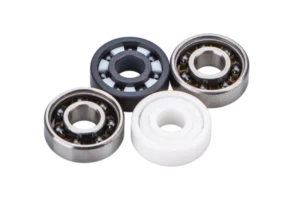









Quick Comparison: Ceramic bearings (silicon nitride) are superior to steel bearings in high-speed, high-temperature, and corrosive environments. They are 40% lighter, electrically insulating, and can run with little to no lubrication. However, steel bearings are tougher, handle heavy shock loads better, and are significantly more cost-effective for general industrial use.
⚖️ Engineering Critical Points
- The “Hybrid” Sweet Spot: For most high-performance motors (like EV motors), hybrid bearings (ceramic balls + steel races) offer the best balance of speed, insulation, and cost.
- Electrical Insulation: Ceramic is naturally non-conductive, making it the #1 choice for preventing electrical arcing (fluting) in VFD-controlled motors.
- Brittleness Risk: Full ceramic bearings are brittle. They can shatter under heavy impact or shock loads, whereas steel will plastically deform.
- Thermal Expansion: Ceramic expands 70% less than steel, requiring careful clearance calculation if used with steel housings at high temperatures.
Bearings are critical components in mechanical systems, directly influencing efficiency, reliability, and service life. While traditional steel bearings have long been the industry standard, ceramic bearings are increasingly used in demanding applications where conventional materials reach their limits. Understanding the differences between ceramic bearings and steel bearings is essential for engineers and decision-makers, particularly when equipment must operate in extreme environments such as high temperatures, corrosive conditions, or high-speed systems.
Overview of Bearing Materials
Steel bearings are typically manufactured from high-carbon chromium steel or stainless steel, offering a balance of strength, toughness, and cost efficiency. Ceramic bearings, on the other hand, are usually made from advanced ceramic materials such as silicon nitride. These materials exhibit fundamentally different mechanical and chemical properties, leading to distinct performance characteristics.
The choice between ceramic and steel bearings is not simply a matter of preference but depends heavily on operating conditions, load requirements, and environmental factors.
Material Properties and Structural Differences
Steel bearings are valued for their high toughness and ability to absorb shock loads. Their ductility allows them to withstand impact and vibration without catastrophic failure. However, steel is susceptible to corrosion and loses hardness at elevated temperatures.
Ceramic bearings offer significantly higher hardness and lower density compared to steel. Silicon nitride ceramic, in particular, is lightweight, non-magnetic, and electrically insulating. These properties make ceramic bearings attractive for specialized applications but also introduce differences in fracture behavior and load handling.

Performance Under High Temperatures
Temperature resistance is a key factor when comparing ceramic bearings vs steel bearings. Steel bearings experience a reduction in hardness and fatigue strength as operating temperatures increase. Lubricant degradation at high temperatures further accelerates wear and failure.
Ceramic bearings maintain structural stability at much higher temperatures. Their thermal resistance allows them to operate reliably in environments where steel bearings would require special cooling or frequent replacement. This makes ceramic bearings well suited for high-temperature machinery, aerospace systems, and certain industrial processing equipment.

Corrosion and Chemical Resistance
Steel bearings, including stainless steel variants, can suffer from corrosion when exposed to moisture, chemicals, or aggressive cleaning agents. Corrosion damages raceways and rolling elements, leading to noise, vibration, and premature failure.
Ceramic bearings are inherently resistant to corrosion and most chemicals. This advantage is particularly important in food processing, medical equipment, chemical handling, and marine applications. In these environments, ceramic bearings often deliver longer service life with reduced maintenance requirements.
Load Capacity and Mechanical Strength
Load capacity is a critical consideration in bearing selection. Steel bearings generally offer higher toughness and are better suited for applications involving heavy loads or shock forces. Their ability to deform slightly under stress helps distribute loads and prevent brittle failure.
Ceramic bearings, while extremely hard, are less tolerant of impact and sudden overloads. They perform best under controlled loading conditions where forces are predictable and evenly distributed. As a result, ceramic bearings are commonly used in high-speed, low-to-moderate load applications rather than heavy-duty machinery.
Speed Capability and Friction Behavior
One of the most significant advantages of ceramic bearings is their superior speed capability. The lower density of ceramic rolling elements reduces centrifugal forces at high rotational speeds. Combined with smoother surface finishes, this results in lower friction and reduced heat generation.
Steel bearings can operate at high speeds, but friction and heat buildup become limiting factors. In applications such as high-speed spindles, electric motors, and precision instruments, ceramic bearings often outperform steel bearings by maintaining stable operation at higher speeds.
Electrical and Magnetic Properties
Steel bearings conduct electricity and can be affected by stray electrical currents in applications such as electric motors or generators. Electrical discharge through steel bearings can cause pitting and fluting damage, reducing service life.
Ceramic bearings are electrically insulating and non-magnetic. This property prevents electrical current passage and eliminates related damage mechanisms. As a result, ceramic bearings are commonly used in applications where electrical insulation is required.
Lubrication Requirements and Maintenance
Steel bearings typically rely on lubrication to prevent wear, reduce friction, and manage heat. In harsh environments, lubricant contamination or breakdown can significantly reduce bearing life.
Ceramic bearings can operate with reduced lubrication or, in some cases, without lubrication altogether. Their low friction and resistance to wear allow for extended maintenance intervals. This advantage is particularly valuable in cleanroom environments or applications where lubricant use is restricted.
Noise and Vibration Characteristics
Noise and vibration performance are important in precision equipment. Ceramic bearings often generate less vibration due to their high stiffness and smooth rolling surfaces. This contributes to improved accuracy and quieter operation.
Steel bearings may produce higher noise levels, especially as wear progresses. However, their damping characteristics can be advantageous in applications where vibration absorption is important.
Cost Considerations and Economic Trade-Offs
Cost is one of the most noticeable differences between ceramic and steel bearings. Ceramic bearings are significantly more expensive due to material costs and specialized manufacturing processes. Steel bearings remain the most cost-effective solution for general-purpose applications.
When evaluating cost, it is important to consider total cost of ownership rather than initial purchase price. In extreme environments where steel bearings require frequent replacement, ceramic bearings may offer better long-term value despite higher upfront cost.
Typical Applications for Steel Bearings
Steel bearings remain the preferred choice in many industrial applications, including heavy machinery, automotive systems, construction equipment, and general manufacturing. Their robustness and cost efficiency make them suitable for environments with moderate temperatures, controlled corrosion exposure, and high mechanical loads.
Typical Applications for Ceramic Bearings
Ceramic bearings are commonly used in high-speed spindles, aerospace components, medical devices, semiconductor manufacturing equipment, and chemical processing systems. Their resistance to heat, corrosion, and electrical currents makes them ideal for specialized and extreme operating conditions.
Selection Criteria for Extreme Environments
Choosing between ceramic bearings and steel bearings requires careful evaluation of operating environment, load conditions, speed requirements, and maintenance expectations. Extreme environments often involve a combination of high temperature, corrosive media, electrical exposure, or stringent cleanliness requirements.
Technical resources that compare bearing materials and application suitability, such as guidance provided by SDTFL Bearing, help engineers understand where ceramic or steel bearings deliver the greatest performance advantages.
Hybrid Bearing Solutions
In some applications, hybrid bearings combine ceramic rolling elements with steel raceways. This approach balances the benefits of ceramic materials with the toughness of steel, offering improved speed capability and electrical insulation while maintaining higher load tolerance.
Hybrid bearings are often used in electric motors and precision equipment where both durability and performance are required.

Long-Term Reliability and Lifecycle Performance
Reliability over time is a key consideration in bearing selection. Steel bearings provide proven performance in a wide range of applications, but their limitations become apparent in extreme environments. Ceramic bearings excel in maintaining performance where steel bearings degrade rapidly.
Understanding lifecycle performance helps organizations make informed decisions that align with operational goals and maintenance strategies.
Conclusion
The comparison of ceramic bearings vs steel bearings highlights fundamental differences in material behavior, performance, and application suitability. Steel bearings remain a reliable and economical choice for many industrial applications, offering toughness and versatility. Ceramic bearings, while more expensive, deliver superior performance in extreme environments characterized by high temperatures, corrosion, high speeds, or electrical exposure.
Selecting the right bearing material requires a clear understanding of operating conditions and performance priorities. By evaluating factors such as load, speed, environment, and maintenance requirements, engineers can choose the bearing solution that provides optimal reliability and long-term value.
Optimize Your Machinery with SDTFL Bearings
At SDTFL Bearings, we understand that selecting the right component—whether it’s a robust steel bearing for heavy loads or a high-performance ceramic bearing for extreme environments—is crucial for your operational success. Don’t let heat, corrosion, or high speeds compromise your equipment’s reliability.
We are ready to assist you in analyzing your specific requirements and providing the ideal bearing solution to maximize your efficiency and service life.
Ready to upgrade your performance?
- Contact Us today for a personalized consultation.
- Request a Quote via email: [email protected]
- Call Us directly: +86 15806631151
FAQ: Ceramic vs. Steel Bearings
Do ceramic bearings need lubrication?
Full ceramic bearings can run completely dry (without lubrication) in many applications, which is ideal for vacuum or cleanroom environments. However, hybrid bearings (steel races) still require grease or oil to protect the steel parts from wear and corrosion.
Are ceramic bearings stronger than steel?
Ceramic is much harder than steel (Rockwell C 75 vs. 60) and wears less over time. However, it is not “stronger” in terms of toughness; ceramic is brittle and can crack under sudden heavy impact, whereas steel is more ductile.
Why are ceramic bearings used in bicycles and skating?
Primarily for reduced rolling resistance and weight. The perfectly smooth, hard surface of ceramic balls creates less friction, allowing wheels or cranks to spin more freely with less effort compared to standard steel bearings.
What is a hybrid ceramic bearing?
A hybrid bearing combines ceramic rolling elements (balls) with standard steel inner and outer rings. This design provides most benefits of ceramic (speed, insulation) at a lower cost than full ceramic bearings, making it popular for electric motors.