










A linear guide rail is a hardened steel track that carries a sliding block in a straight line. Balls or rollers recirculate inside the block, so the load rolls instead of dragging. HIWIN’s technical manual puts the friction of a linear guideway at about 1/50th of a traditional sliding guide. That single number explains why these rails sit inside almost every CNC machine, gantry robot and desktop 3D printer built today.
The rail on its own does very little, though. What you really buy is a linear guide rail and block set, sized and preloaded for a load you have to work out first. This guide covers how the system works, which type suits which job, and how to pick a size without guessing.
At a glance:
- Ball type rails suit most automation and CNC router axes.
- Roller type rails suit heavy cutting, where stiffness matters more than speed.
- Miniature rails (up to about 15 mm wide) suit 3D printers, lab and medical devices.
- Size a linear guide rail from load per block and L10 life, not from a similar machine.
How a linear guide rail works
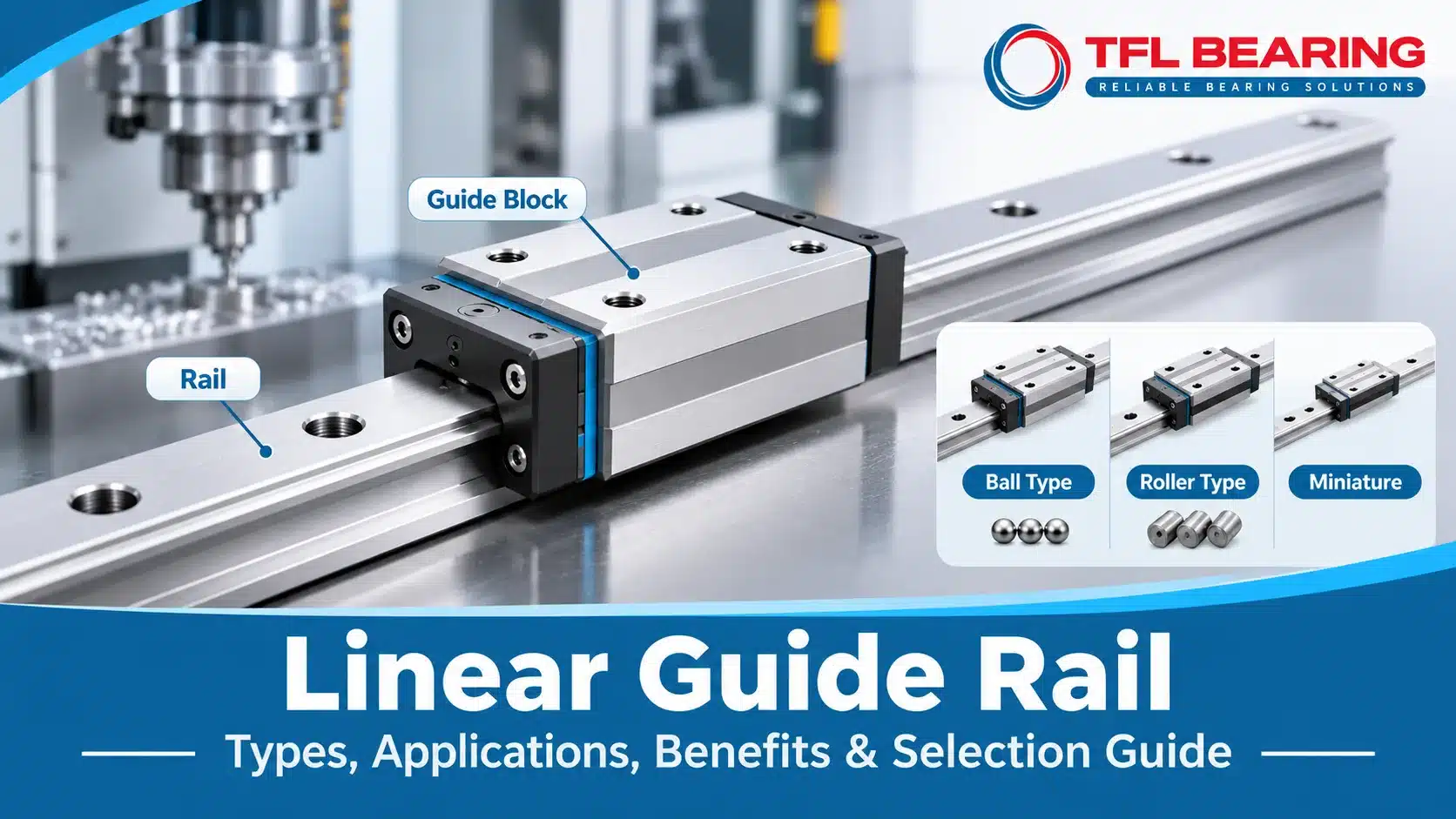
A linear guide rail system has two main parts. The rail bolts to the machine base and gives a precise raceway. The block (also called a carriage or slider) rides on that rail and carries whatever you mount on top.
Inside the block, steel balls or cylindrical rollers run between grooves in the block and grooves ground into the rail. When a ball reaches the end of the loaded zone, plastic return caps steer it back through a return channel to the start. End seals keep chips and dust out, and a grease nipple feeds lubricant to the raceways.
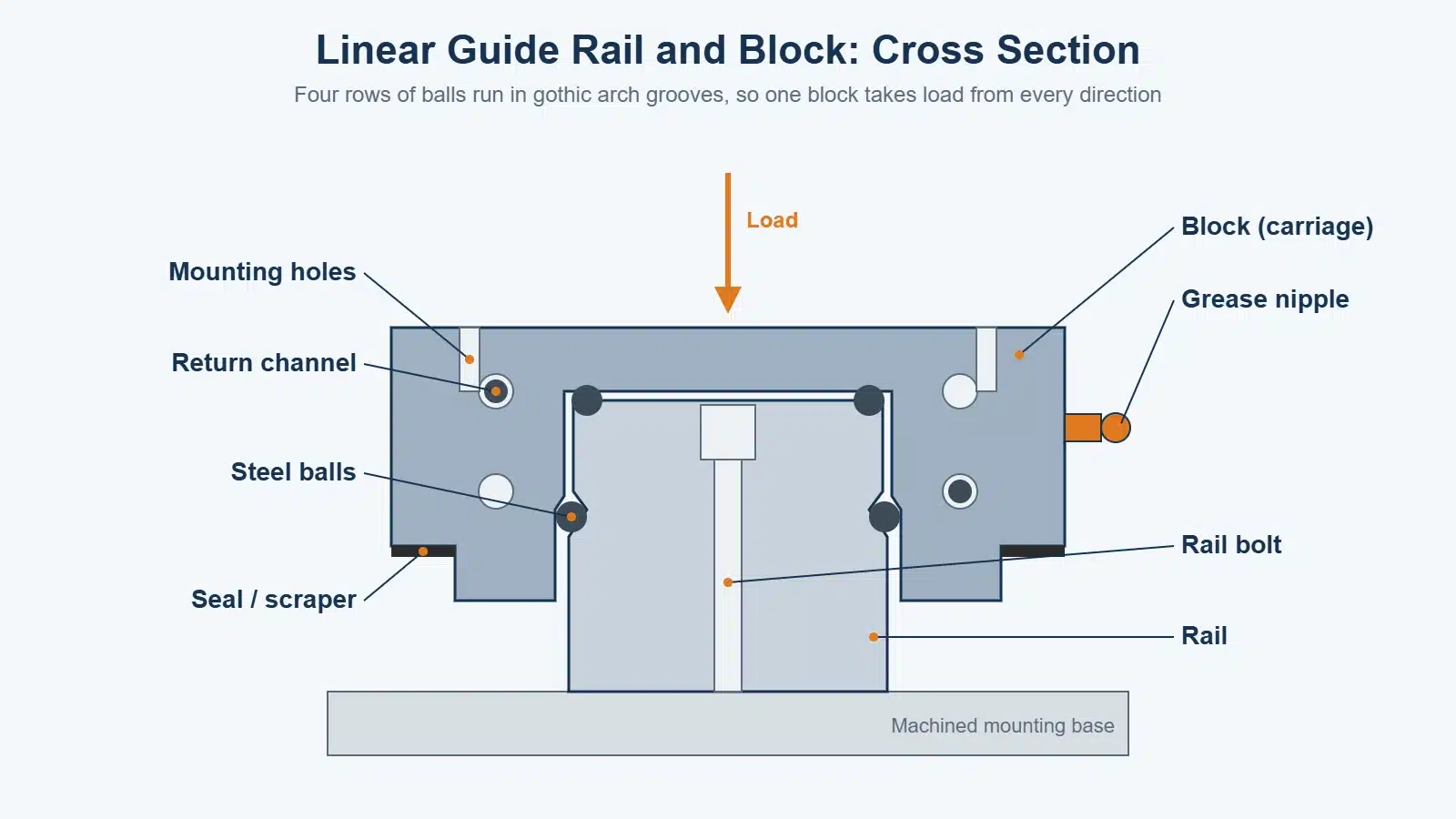
Most profiled rail guides use a gothic arch groove, so each ball touches the raceway at two points. That geometry lets one block handle downward load, lift off load, side load and moment load (pitch, roll and yaw) at the same time.
Types of linear guide rails
Ball type linear guides
This is the default choice for most machines. Steel balls give low friction and high speed, and they forgive small mounting errors. Bosch Rexroth states that ball rail systems reach higher speeds than roller rail systems and handle minor geometric defects better. Use them for automation axes, packaging lines and general machine slides.
Roller type linear guides
Cylindrical rollers touch the raceway along a line rather than at a point. That raises stiffness and load carrying capacity for the same rail width, which is why heavy machining centers and grinders use them. The catch: roller guides need a flatter, stiffer mounting base and cost more. On a light pick and place arm, that money is wasted.
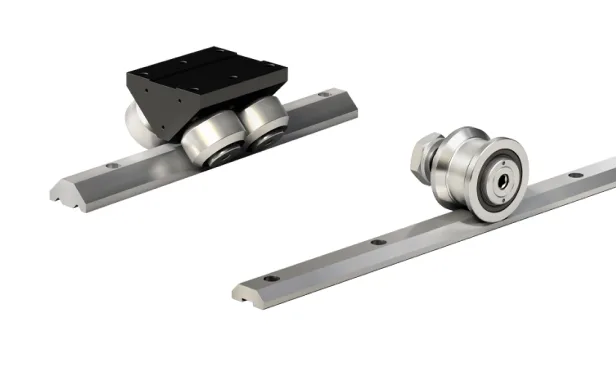
Simpler roller tracks skip the recirculating block and run cam followers on a flat rail. Those designs often rely on needle roller bearings to carry the load in a very small envelope.
Miniature linear guides
Miniature rails start at widths of a few millimeters and go up to around 15 mm. You’ll find them in medical devices, lab automation and 3D printers. HIWIN makes its MG miniature series in stainless steel, which is typical for this class.
Block style matters as well. Flange blocks bolt from above or below and spread the load. Square blocks save width. Long blocks hold more rolling elements, which raises capacity without moving to a bigger rail.
| Type | Contact | Best for | Watch out for |
|---|---|---|---|
| Ball type | Point | Speed, general automation, CNC routers | Lower stiffness than rollers at the same size |
| Roller type | Line | Heavy cutting, high rigidity axes | Needs very flat mounting surfaces |
| Miniature | Point | Small, light, clean environments | Low moment capacity per block |
Linear guide rail vs linear bearing vs round shaft
People mix these terms up all the time. A classic linear bearing (ball bushing) slides on a round shaft that’s often supported only at its ends. It’s cheap and forgiving of misalignment. But the shaft sags under load and can’t resist much twisting. Wikipedia’s entry on linear motion bearings lays out the wider family, from plain bushings to recirculating designs.
A profile linear guide rail is bolted along its full length, so it doesn’t sag, and the block resists twisting in every direction. You pay more, and you need a machined mounting surface. Square housed units sit somewhere between the two. Our guide to the square linear bearing explains when they make sense.
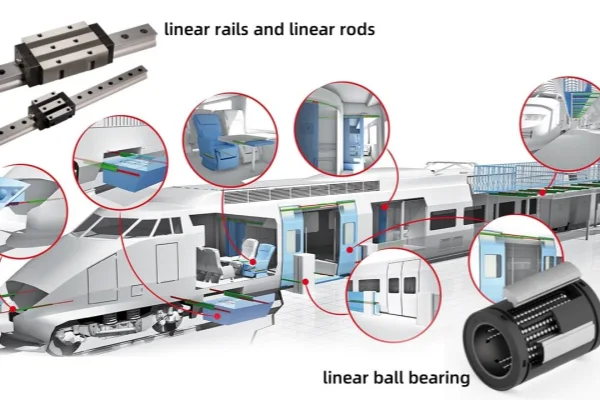
Where linear guide rails are used
CNC machines are the biggest market. Each axis usually pairs a linear guideway with a ball screw. The screw’s fixed end runs on super precision angular contact ball bearings, mounted in matched sets to take the axial thrust.
Industrial automation comes next: gantry robots, linear modules, palletizers and storage and retrieval systems. When a linear axis feeds a rotary table or robot wrist, the rotating joint often uses crossed roller bearings, because they take radial, axial and tilting loads in one slim ring.
In 3D printers and small CNC routers, miniature rails have largely replaced round rods on the better machines. The belt idlers around them still turn on miniature bearings, so it’s worth stocking spares of both.
You’ll also see linear motion guide rails in semiconductor handling, medical imaging tables and laser cutters. Robot arms in these cells often use thin section bearings at the joints to keep weight down.
Benefits of a linear guide rail system
- Low friction, so smaller motors can drive the axis and positioning stays repeatable.
- High linear positioning accuracy, with grades that control height, width and running parallelism.
- Rigidity in all directions, including moment loads, from one compact block.
- Easy replacement. HIWIN notes that a damaged linear guideway can be swapped out far more easily than a boxway or V groove slide.
The weak points are cost, sensitivity to dirt when seals wear, and the need for a properly machined base. Bolt a linear guide rail to an uneven welded frame and it will bind and wear early, however good the rail is.
How to choose a linear guide rail
This is where most buyers go wrong. They copy a rail size from a similar machine, then wonder why blocks fail after a year. Work through these steps instead.
1. Work out the load on each block
Add up the moving mass, the cutting or process force and the acceleration forces. Then split that load across the blocks, based on where the center of gravity sits. An offset load turns into a moment, and moments often decide the size more than raw weight does.
Here’s a simple case. A gantry carriage weighs 80 kg and runs on two rails with two blocks each. If the center of gravity sits in the middle, each block sees roughly a quarter of the weight, about 200 N. Push the center of gravity 100 mm toward one rail and the blocks on that side pick up a much bigger share. Add a 3 m/s² acceleration and you get another 240 N of force on the whole carriage during every start and stop. That is why the load per block, not the total weight, is the number to size against.
Mounting direction matters too. MISUMI points out that a recirculating ball guide keeps the same dynamic load rating on a wall or ceiling. But pitching, yawing and rolling moments change a lot when the guide runs vertically or upside down, so check the moment rating for your actual orientation.
2. Calculate the life
Linear guide rail load capacity ties directly to life. THK defines nominal life (L10) for ball guides as L = 50 × (C ÷ P)³ in kilometers. C is the basic dynamic load rating and P is the applied load. For roller guides, THK uses a 100 km reference and an exponent of 10/3.
A quick example: a block rated at C = 8,000 N carrying P = 2,000 N gives 50 × 4³, or 3,200 km of rated travel. Halve the load and life rises eightfold. That cubic effect is why going up one rail size is often cheaper than replacing blocks twice.
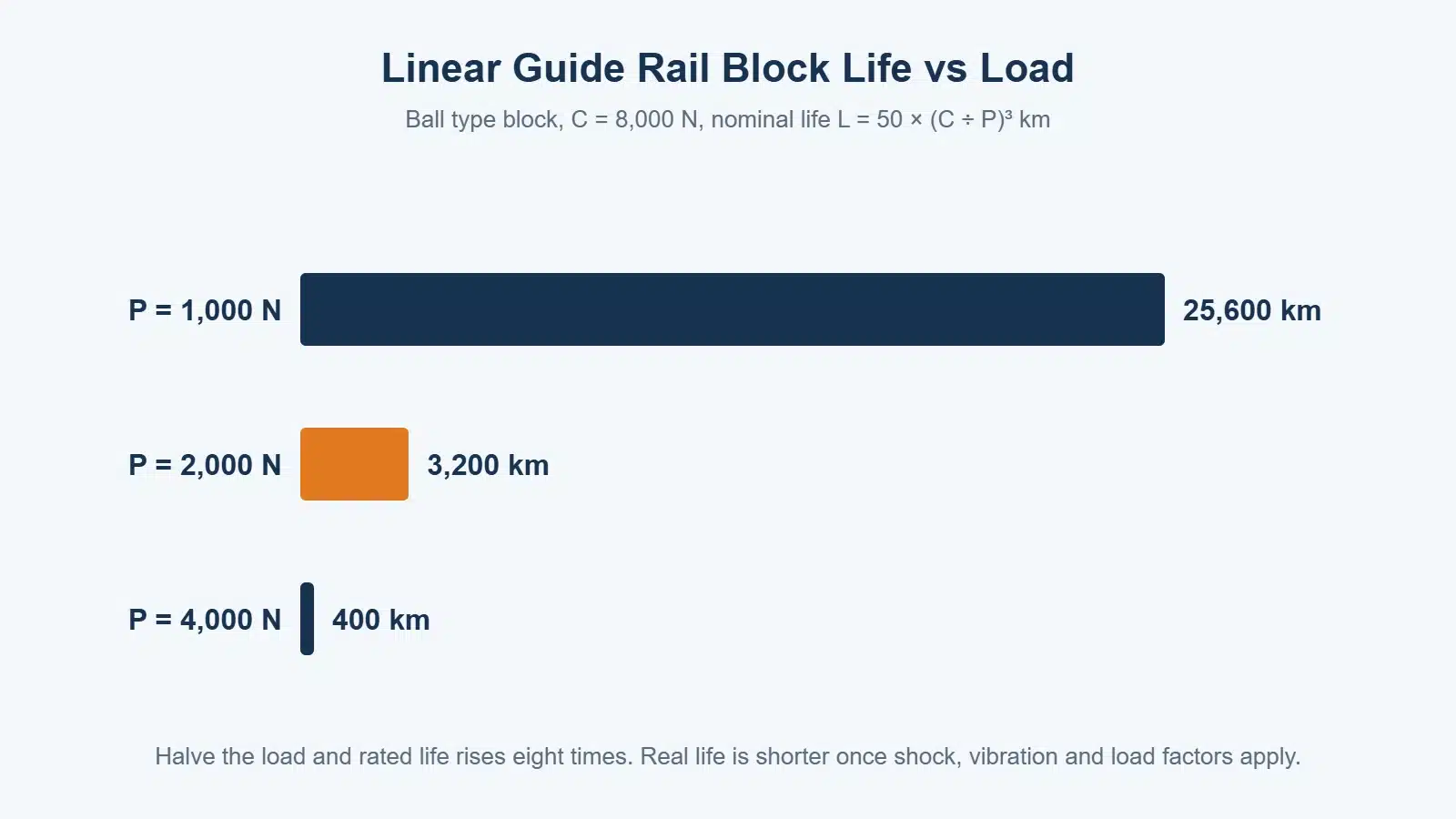
Two cautions apply. First, check whether a catalog rates C on a 50 km or 100 km basis. THK’s conversion for ball guides is C100 = C50 ÷ 1.26, so comparing brands without converting flatters one of them. Second, the formula assumes ideal conditions. Machine Design notes that vibration, shock and uneven load distribution all cut real life, which is why catalogs add load factors.
3. Pick the rail size
Linear guide rail sizes are named by rail width. Standard ball and roller series commonly run from 15 mm to 65 mm, with miniature series below that. Choose the smallest linear guide rail size that passes your life and moment checks with margin to spare.
4. Choose the accuracy grade
Accuracy grades control height tolerance, width tolerance and running parallelism. Names vary by maker. HIWIN and similar brands use N, H, P, SP and UP, while NSK’s preloaded assemblies use PN, P6 and P5. A router cutting plywood is fine with normal grade. A grinding machine or measuring table needs precision grade or better.
For high precision grades, HIWIN recommends ordering a matched, non interchangeable block and rail set. MISUMI adds that mixing blocks and rails across matched sets voids the precision guarantee.
5. Set the preload
Linear guide preload comes from fitting balls slightly larger than the gap between the raceways. This removes clearance and raises stiffness. Light preload suits smooth, low load axes, while medium or heavy preload suits cutting machines with vibration. More preload also means more friction, so don’t specify heavy preload on a light 3D printer axis.
6. Match the environment
Coolant, wood dust and clean rooms each need a different linear guide rail setup: seals, scrapers or bellows. Stainless rails help against moisture. Heat matters too: MISUMI’s technical data warns that above 100°C, raceway hardness drops, and so do allowable load and life.
Linear guide rail length, joints and interchangeable sets
Rails are sold in standard lengths and cut to order, with the bolt holes at a fixed pitch. The single piece limit depends on the maker and the rail size, so check the catalog before you design a long axis around one rail. For longer strokes, makers grind two or more rails as a set and mark the ends so they butt together in the right order.
On a pair of jointed rails, stagger the joints so the blocks never cross both joints at the same moment. Keep the end hole distance within the catalog limit too, because a rail end that overhangs its last bolt can lift under load.
Interchangeable rails and blocks can be mixed within the same series and grade, which makes spares simple. Non interchangeable sets are assembled and checked together at the factory. They hold tighter accuracy, but a worn block usually means replacing the whole linear guide rail set.
Installation and alignment basics
Installation decides whether the accuracy grade you paid for actually shows up on the machine. Clean and deburr the mounting surfaces. Push the reference rail against its locating shoulder and tighten the bolts in sequence. Then set the second rail parallel to the first with a dial indicator before final tightening.
Height differences between rails add preloads you never planned for. HIWIN also cautions that the bolted joint often limits load capacity more than the guide itself, so check screw strength on heavy axes. And never use the plastic shipping clip as an end stop. MISUMI warns this can let the block come off the rail.
Lubrication and maintenance tips
THK recommends greasing LM guides roughly every 100 km of travel, which works out to three to six months on a typical machine. NTN gives a similar default (six months or 100 km). It also says the interval shouldn’t go past two years or 500 km, even in clean, light duty use.
Use the grease type the guide shipped with, or confirm compatibility first, because MISUMI warns that mixing incompatible greases speeds up wear. On vertical axes, THK notes that lubricant may not reach the whole raceway, so plan extra grease points or shorter intervals.
Between services, wipe the rails, check the seals for tears and listen for changes in running noise. A block that starts to sound gritty is warning you weeks before it seizes.
Common linear guide rail problems
Most failures come from four causes: overload or shock that flakes the raceway, contamination past worn seals, poor lubrication, and misaligned rails that bind the blocks. Brinelling (dents in the raceway) usually comes from impact loads or from dropping a rail during installation.
When a block fails early, look at the raceway before ordering a replacement. Flaking along one edge points to misalignment, while fine scoring points to dirt or dry running. If the pattern isn’t clear, our article on bearing failure analysis services explains what to send and what a lab can tell you.
FAQs
How long do linear guide rails last?
There’s no fixed number of years. Life is rated in kilometers of travel using the L10 formula above, then adjusted for load, temperature and lubrication.
Can linear guide rails be used vertically?
Yes. The dynamic load rating stays the same, but check moment loads for that orientation, add a brake or counterweight for safety, and plan lubrication carefully.
What materials are linear guide rails made from?
Most rails and blocks use hardened bearing steel with ground raceways. Miniature and clean room series often use stainless steel, and some makers offer coated rails for corrosion resistance.
Can I cut a linear guide rail to length myself?
You can, but it’s risky. The rail is hardened, so it needs an abrasive cut with plenty of cooling, and the cut end must be deburred so it doesn’t damage the block seals. Ordering the rail cut to length from the supplier is safer and keeps the end hole spacing correct.
Is a linear guide rail the same as a ball screw?
No. The linear guide rail carries and guides the load, while the ball screw pushes it along the axis. Most CNC and automation axes use both together, and each one is sized separately.
What linear guide rail size suits a 3D printer?
Most hobby and small professional printers use 9 mm or 12 mm wide miniature rails, often sold as MGN9 and MGN12. The 12 mm size is the common pick for X and Y axes because it gives more moment capacity for a heavier print head. A light preload and a normal accuracy grade are usually enough.
What to prepare before you request a quote
Send your supplier six things: load per block (with offsets), stroke length, speed and acceleration, mounting orientation, accuracy grade and working environment. With that list, the quote comes back with the right size and preloads the first time, not after three rounds of emails.
TFL supplies the rotating side of the axis too, from ball screw support bearings to the deep groove ball bearings inside drive motors and conveyor rollers. Send your list to our team, and we’ll match bearings to the linear guide rail system you’re building.