








Look up the same 12 mm linear ball bushing in a few catalogs and you get three different load ratings: 410 N, 412 N and 510 N all appear for a 12 x 21 x 30 mm LM12UU. That spread matters. It can double or halve the life you calculate, as you’ll see below.
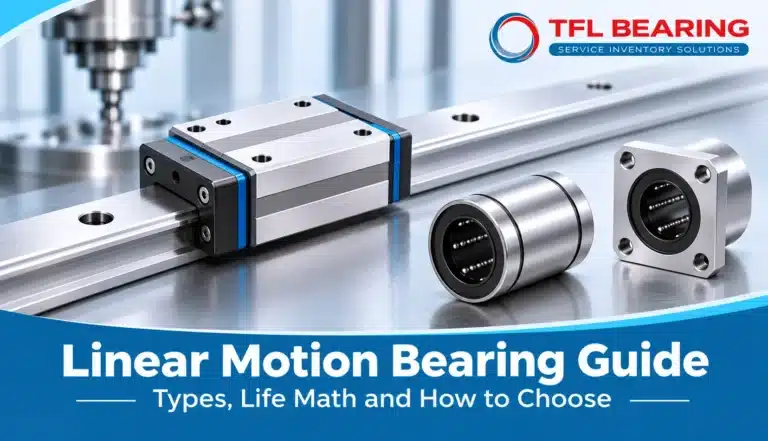
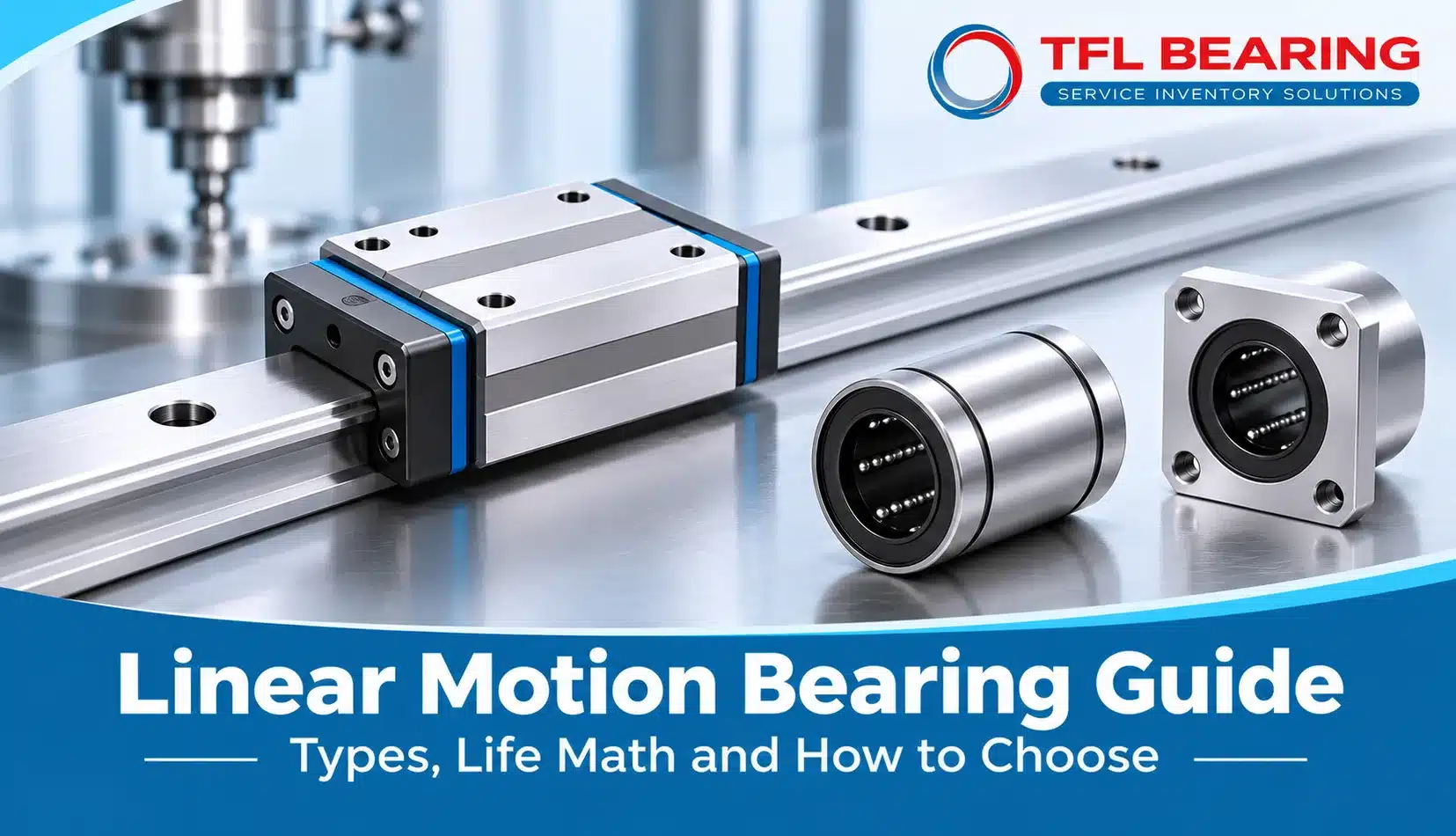
A linear motion bearing lets a part slide in a straight line with very little friction. The common types are ball bushings that ride on a round shaft, profiled rail guides with a carriage, and plain linear bearings with a polymer liner. This guide explains how each works, how to calculate life in kilometers, and which one to pick for your machine.
What a linear motion bearing does
A rotary bearing supports a turning shaft. A linear motion bearing does the opposite job: it guides a load along a straight path, either on a hardened shaft or on a rail. Wikipedia’s linear-motion bearing entry credits Thomson Industries with first producing what we now call the linear ball bushing.
Friction is the main reason people use them. MISUMI lists a friction coefficient of 0.002 to 0.003 for linear bushings, which is why a well-built axis moves under a light push. That’s the property that makes them common in robotics and automation equipment.
Linear motion bearing types compared
GlobalSpec lists more than a dozen linear bearing styles, from air bearings to crossed roller cages. In practice, most machines use one of four:
| Type | Runs on | Strength | Weak spot |
|---|---|---|---|
| Linear ball bushing (LM, LMK, LMF) | Round hardened shaft | Cheap, easy to fit, low friction | Lower load and stiffness than a rail |
| Profiled rail guide | Machined rail with carriage | High load and stiffness, carries moments | Needs a flat, aligned mounting surface |
| Plain linear bearing | Round shaft, polymer liner | Runs without grease, handles harsh conditions | Higher friction than rolling types |
| Ball spline | Grooved shaft | Slides and transmits torque at once | Needs a matching splined shaft |
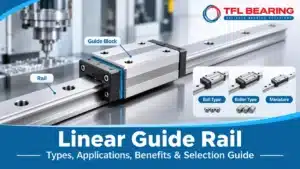
If you’re choosing between a round shaft and a rail, our linear guide rail guide covers rail sizing and preload in detail.
Rails follow an international standard. ISO 12090-1 sets the boundary dimensions and tolerances for profiled rail guides, which helps when you compare rail sizes between brands. Round-shaft bushing codes like LM12UU are shared by many makers, yet as the ratings above show, the parts behind them differ.
Plain linear bearings get overlooked. PBC Linear’s bonded-liner bearings run without oil and also allow rotation or oscillation on the shaft, which a ball bushing can’t do. For food plants that hose down equipment daily, that trade usually wins. Our food and beverage machinery page covers other bearings built for washdown.
How long will a linear motion bearing last?
Rotary bearings measure life in revolutions. Linear bearings measure it in distance traveled. THK defines the nominal life of its linear bushing on a 50 km basis and calculates it as:
L10 = (C / P)³ × 50 km
Here C is the basic dynamic load rating and P is the load on the bushing. Catalogs then apply four correction factors for shaft hardness, temperature, the number of bushings sharing a shaft, and shock or vibration.
A worked example with an LM12UU
Say a 12 mm bushing carries 100 N on a shaft with a 300 mm stroke, cycling 20 times a minute. To turn kilometers into hours, MISUMI’s formula divides the rated life by twice the stroke times the cycle rate.
| Catalog rating used | Rated life | Hours at 300 mm, 20 cpm |
|---|---|---|
| C = 412 N (THK LMK12UU) | 3,497 km | about 4,860 h |
| C = 510 N (other LM12UU listings) | 6,633 km | about 9,210 h |
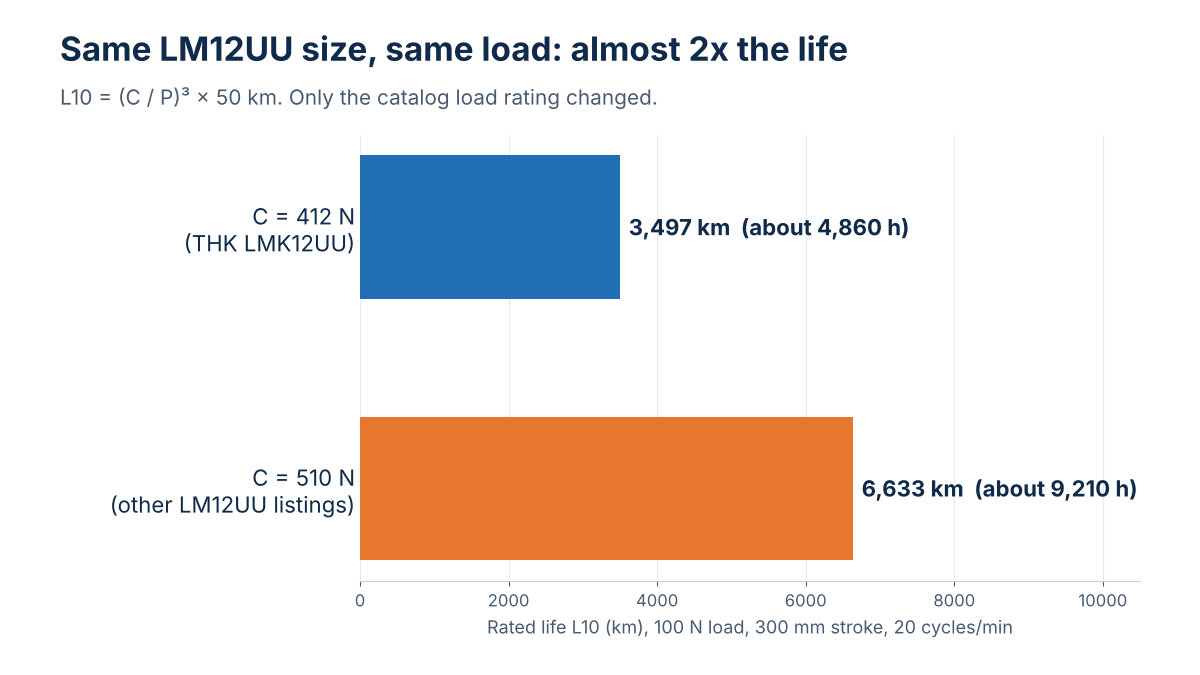
Same size bushing and same load, yet the second calculation promises almost twice the life. Nothing else changed. Only the catalog number did. That’s why we’d always take the load rating from the maker you’ll actually buy from, and check its rating basis.
The basis matters too. THK notes that some ratings use 50 km and others use 100 km, and gives a conversion: for ball-type systems, C100 equals C50 divided by 1.26. A rating quoted on the 100 km basis looks smaller, but it can describe the same bearing.
Factors that shorten life in real machines
Shaft hardness comes first. MISUMI states that ball contact shafts need sufficient hardness, and a soft shaft lowers the allowable load and shortens life. A cheap unhardened rod can throw away a large share of the rated life before the bushing is ever the problem.
Heat is next, and it’s easy to miss in an enclosed machine. Above 100 °C, the bushing and shaft lose hardness, so the allowable load drops. And THK points out that a bushing’s rated load changes with how its ball rows face the load, so mounting orientation affects real capacity.
If a linear axis is failing early, our bearing failure analysis services guide explains how to trace the cause before you buy replacements.
How to choose the right linear bearing
Work through these in order:
- Estimate the load per bearing, including the weight of the moving part and any process force.
- Decide whether the load includes a moment (an offset load that tries to tip the carriage). If it does, a rail guide usually beats round shafts.
- Set a life target in kilometers, then check it with the formula above.
- Check the environment: dust, washdown or no-grease rules point to plain bearings.
- Confirm the shaft or rail hardness and straightness with your supplier.
Square-flanged and block-style bushings follow the same rules. Our square linear bearing guide explains LMK and SCS codes if you’re mounting bushings in a housing.
When a different bearing does the job better
Linear motion bearings handle straight travel. Many machines also need a rotary axis right next to it, like a turntable or a robot joint. Compact crossed roller bearings carry radial plus tipping loads in one ring, which saves space in those positions.
For cam-driven slides, a cam follower running against a track can guide the motion where precision needs are modest.
Quick answers
What is the difference between a linear bearing and a linear guide?
A linear bearing usually means a bushing that rides on a round shaft. A linear guide uses a carriage on a profiled rail and carries higher loads and moments.
Do linear motion bearings need lubrication?
Ball bushings and rail guides need grease or oil. Plain linear bearings with self-lubricating liners can run dry.
What does LM12UU mean?
An LM series linear ball bushing for a 12 mm shaft, with seals on both ends (UU). Outer size is 21 mm by 30 mm long.
Can I get linear bearings and related parts from TFL?
Send your shaft size and load, plus the stroke, through our contact page, and our team will suggest options and confirm MOQ and lead time.