







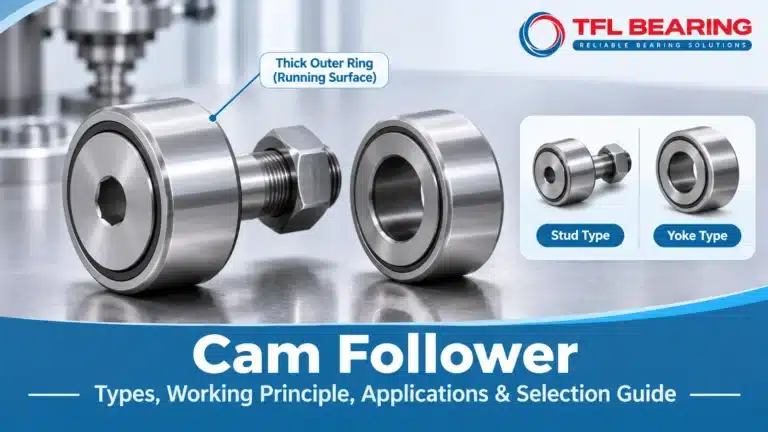



A cam follower is a roller bearing with a thick outer ring that rolls directly on a cam, track or rail. Most use needle rollers inside, and many have a threaded stud in place of an inner ring, so you mount one with a single hole and a nut.
That thick outer ring is what makes a cam follower different. A normal bearing gets support from its housing all the way around. A cam follower bearing carries the whole load on one small contact patch, often with shock, so its outer ring has to work as the wheel itself.
This guide covers how cam followers work, the main types and how to read part numbers. It also explains how to choose, install and maintain one, so it lasts as long as the machine around it.

How does a cam follower work?
The stud bolts into a machine frame, or the roller sits on a pin inside a yoke. The outer ring touches the cam profile or track. As the cam turns or the carriage moves, the outer ring rolls along that surface, and the rollers inside turn sliding friction into rolling contact motion.
In a cam and follower mechanism, the cam profile controls the motion. The follower picks up every rise, dwell and fall of that profile and passes it to an arm, slide or pushrod. Change the cam shape and you change the motion, with no motor or software involved.
Inside, most standard designs use needle rollers, because they pack a lot of load capacity into a slim section. If you’ve handled heavy duty machined needle roller bearings, the inside will look familiar. The difference is the much heavier outer ring and the stud.
Types of cam followers
Stud type cam follower
This is the most common type. The stud acts like a cantilevered shaft, so mounting is fast and needs little space. The weak point is the stud. On stud types, stud bending strength and deflection often limit the usable load before the rollers do.
Yoke type cam follower
A yoke type is the roller only, with no stud. It mounts on a separate pin inside a yoke or clevis that supports it on both sides. That makes it the better choice for heavy loads and for setups where deflection has to stay small.
Some yoke rollers include an inner ring, and some run straight on a hardened pin. If your pin isn’t hardened, matching needle roller bearing inner rings give the rollers a proper raceway and keep the pin from wearing.
Eccentric cam followers
An eccentric stud has an offset collar or bushing. Turn it during setup and the roller moves slightly toward or away from the track. This removes play, and it lets several rollers share one load evenly when your mounting holes aren’t perfect. You can also readjust it later as the track wears.
Caged vs full complement
Full complement followers fill the space with rollers for maximum load at low speed. Caged followers run faster and hold more grease, so they need relubrication less often. The cage works like the one in standard needle roller and cage assemblies, keeping the rollers spaced and guided.
For the heaviest duty, makers swap needles for one or two rows of cylindrical rollers. These give higher radial load capacity and better shock resistance, the same strengths behind standard cylindrical roller bearings.
| Type | Mounting | Best for | Main limit |
|---|---|---|---|
| Stud type | One hole and a nut | Compact machines, conveyors, guide rails | Stud bending |
| Yoke type | Pin supported both sides | Heavy loads, low deflection | Pin shear |
| Eccentric stud | Stud with adjustable offset | Removing play, sharing loads | Needs careful setup |
| Cylindrical roller type | Stud or yoke | Shock and very high radial loads | Larger size and cost |
Crowned vs cylindrical outer ring
Buyers often get this choice wrong. A crowned outer ring has a slightly curved running surface. It tolerates misalignment and avoids high edge stress when the roller tilts against the track.
A cylindrical (flat) outer ring touches the track across its full width. That contact area gives much higher track capacity, often more than double that of the crowned version of the same size. It also does better on softer tracks.
So the rule is simple. If you can machine the track flat and keep it aligned, choose cylindrical. If you can’t control alignment, choose crowned and accept the lower track capacity. Wikipedia’s cam follower entry has a short overview of the different shapes and mounting styles.
How to read cam follower part numbers
Part numbers look confusing, but most follow the same pattern: a series code, a size, then suffixes. Common suffixes in many catalogs:
- R usually means a crowned outer ring. No R usually means cylindrical.
- UU or PP means sealed on both sides.
- B or a hex mark means a hex socket in the stud head for easier tightening.
- E or “eccentric” in the series name means an eccentric stud.
The number usually shows the stud diameter or the roller outer diameter, depending on the brand. Always confirm four measurements before cross referencing: roller OD, roller width, stud diameter and stud thread. Getting these right avoids most ordering mistakes.
Cam follower vs track roller vs roller follower
People use these terms almost interchangeably. In everyday use, “cam follower” usually means the stud type, “track roller” usually means the yoke type, and “roller follower” is the term cam designers use for the moving part of the mechanism.
The name matters less than whether the part is built to run on its outer ring. A standard ball bearing used as a makeshift track roller has a thin outer ring that can crack under point loads.
Where cam follower bearings are used
Packaging, printing and labeling machines use cam followers to turn cam rotation into precisely timed motion. Indexing tables, conveyors, sorting systems and automotive assembly lines use them as guide and support rollers along tracks and rails.
Lifting equipment is a classic heavy duty case. Forklift masts run on rollers that take high radial load plus side thrust, which is why purpose-built forklift mast guide bearings exist instead of standard track rollers.
Cam mechanisms also need linkages. Where a follower arm connects to a rocker or pushrod, a rod end usually forms the pivot. Our rod end plain bearing guide explains how to size that part of the system.
How to choose the right cam follower bearing
1. Check every load limit
A cam follower’s real capacity is the lowest of four limits:
- the roller rating
- outer ring strength
- track capacity
- stud bending (or pin shear for yoke types)
A high catalog rating means little if the stud bends first. On heavy or shock-loaded axes, check all four, or move to a yoke type.
2. Match the track hardness
Catalog track capacity assumes a hardened steel track, usually around 40 HRC. A soft mild steel track lowers the usable load a lot. You’ll usually see the damage as a grooved, flattened track long before the bearing itself fails.
3. Plan for axial load
Cam followers are made mainly for radial load. They handle light side thrust through the stud flange and thrust washers. If your machine creates steady, heavy axial load, add a dedicated thrust bearing such as thrust needle roller cage assemblies with thrust washers.
4. Pick sealing and temperature limits
Sealed cam followers suit dusty, wet or washdown areas. Shielded or open designs run cooler at higher speeds. Check the cage material too, because plastic cages have lower temperature limits than steel ones.
5. Quick selection checklist
- Load per roller, radial and axial
- Speed and duty cycle
- Track material and hardness
- Stud or yoke mounting, concentric or eccentric
- Crowned or cylindrical outer ring
- Sealing, temperature and environment
Cam follower installation and alignment
Mount each follower with its axis square to the direction of travel and the outer ring sitting flat against the track. Even a small skew makes the roller try to steer, which wears the flange and track quickly.
Respect the tightening torque in the catalog. The stud already carries bending and tension from the load, and overtightening can snap the thread. Always use the nut. Screwing the stud straight into a tapped hole without a nut lets it loosen, and the thread then breaks under load.
Check the lube hole position as well. Most brands mark the stud head to show where the oil hole is, and it should face away from the loaded zone.
Cam follower lubrication and maintenance
Most stud type cam followers come prepacked with grease, and many can be regreased through a fitting in the stud. Grease suits most slow and medium speed cam and track work.
There’s no single correct interval. Regrease more often for continuous rotation, shock loads or dirty environments. Sealed units in clean, slow service can go much longer. Keep a light film on the track too, because a dry track wears the outer ring and the track together.
At each inspection, spin every roller by hand. Roughness, flat spots, a wobbling outer ring or a shiny groove worn into the track mean it’s time to replace it.
Common cam follower problems and causes
Four causes account for most cam follower bearing failures:
- a bent or snapped stud from overload or overtightening
- a cracked or flattened outer ring from shock
- track wear from soft or misaligned tracks
- seized rollers from lost grease
Skidding is a quieter problem. If the load is too light for the speed, the outer ring slides instead of rolling and wears flat spots.
Sometimes the fix is a different part. If your roller sits inside a bore and never touches a track, you don’t need a cam follower. A compact drawn cup needle roller bearing pressed into the housing is lighter and usually cheaper.
FAQ
What is a cam follower bearing?
It’s a needle or cylindrical roller bearing with a thick outer ring, made to roll directly on a cam or track. It comes with a stud for quick mounting, or as a yoke roller that sits on a pin.
What is the difference between stud type and yoke type cam followers?
A stud type mounts on its own built-in stud from one side. A yoke type sits on a pin supported on both sides, so it carries heavier loads with less deflection.
Can cam followers handle axial loads?
Only light ones. For heavy steady thrust, add a separate thrust bearing.
How long do cam follower bearings last?
It depends more on alignment, track hardness and lubrication than on the roller rating. Well-aligned followers on a hardened, greased track last far longer than the same part on a soft, dry one.
What materials are cam followers made from?
Most use high carbon bearing steel for the outer ring and rollers. Stainless steel versions suit wet, food or corrosive areas.
Get the right cam follower the first time
Send us six details: load per roller, speed, track material and hardness, stud or yoke mounting, sealing needs and operating temperature. Add your current part number if you have one. With that, we can match the size, outer ring profile and stud type quickly.
TFL supplies cam follower bearings in stud and yoke types, with or without a cage, sealed or open, from leading brands or in custom sizes. Contact the TFL team today for a fast quote.