








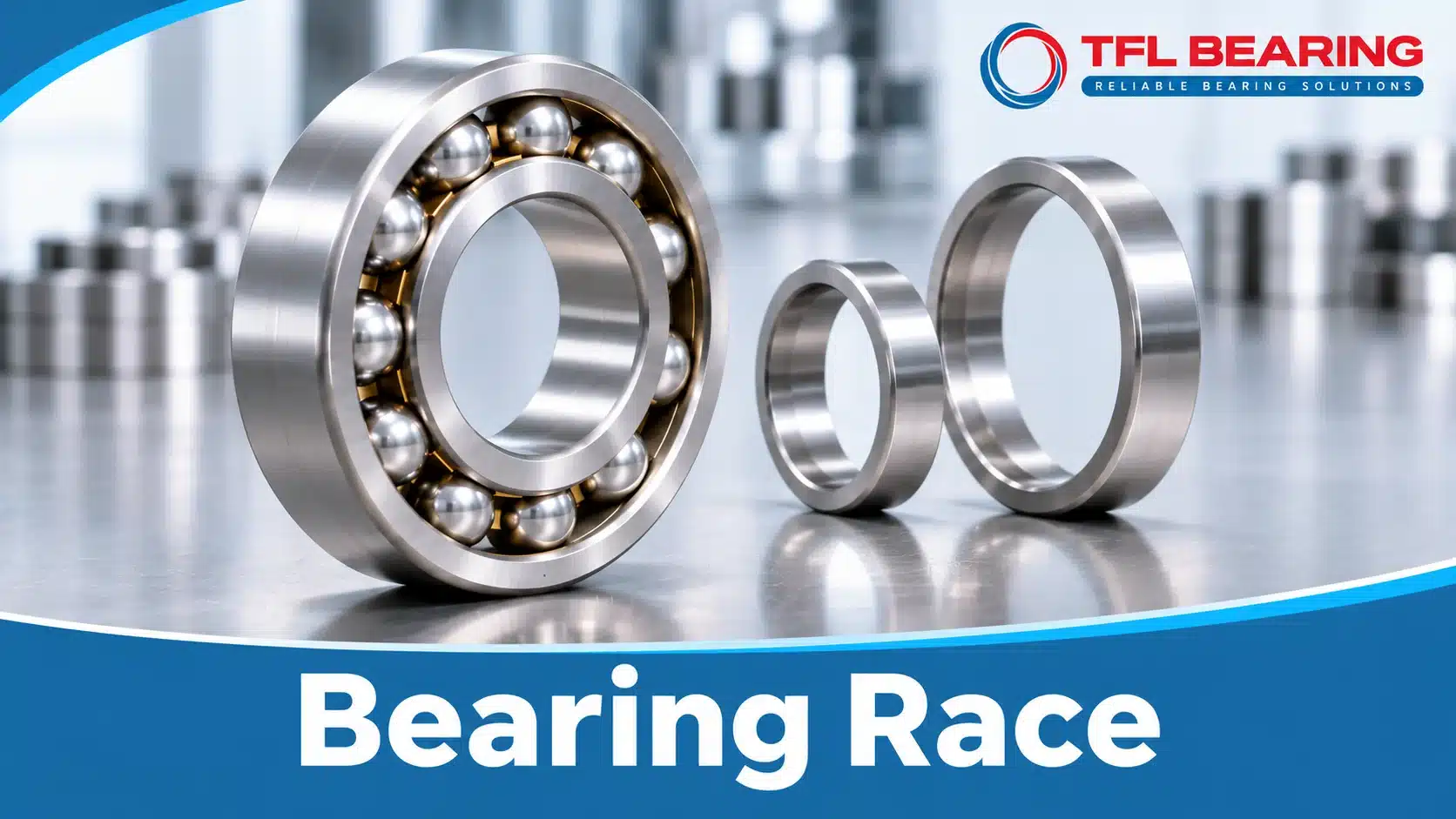
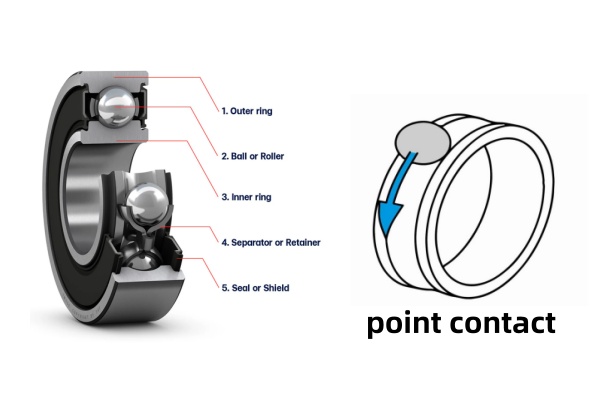
A bearing race is the hardened steel ring that the balls or rollers in a rolling bearing run on. Most bearings have two: an inner race that fits on the shaft and an outer race that sits in the housing. The ground track on each ring, where the rolling elements actually make contact, is called the raceway.
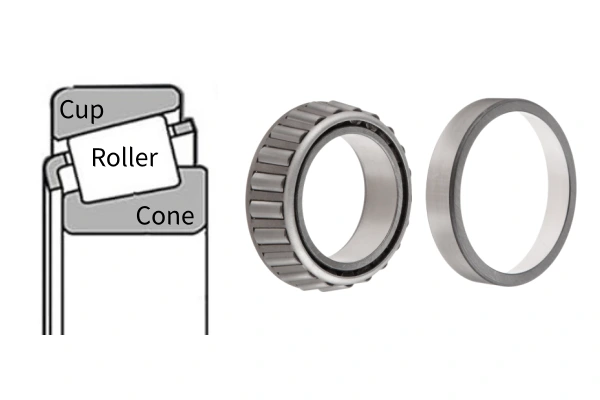
“Race” and “ring” mean the same part, and both are correct. Tapered roller bearings have their own names: the inner race is the cone and the outer race is the cup. This bearing race guide covers how the two races differ, what they’re made of, how race shape changes between bearing types, and how to read the damage on a worn race.
Inner race vs outer race
The inner race is the smaller ring. It usually turns with the shaft and is mounted with a press fit, which means the shaft is slightly larger than the ring’s bore. Its raceway is on the outside surface.
The outer race is the larger ring. It’s normally held still in a housing bore, and its raceway is on the inside surface. Some machines swap the roles. In wheel hubs and idler pulleys, for example, the outer ring turns and the inner ring stays still. Whichever bearing race rotates is the one that gets the tighter fit.
A standard ball bearing has four parts: the inner race, the outer race, the balls, and a cage that keeps the balls evenly spaced. In a deep groove ball bearing, both races have a deep, continuous groove. That lets the bearing carry radial load plus a fair amount of axial load in either direction.
How bearing race shape changes by bearing type
The shape of the raceway decides what loads a bearing can carry. Wikipedia’s page on the bearing race explains that the rings go through raceway grinding and superfinishing before final assembly. Buyers often overlook raceway shape, yet it’s usually why two bearings with the same bore and outside diameter behave so differently.
Ball bearing races
Ball raceways are curved grooves. Engineers describe them by curvature, which is the ratio of the groove radius to the ball diameter. A tighter groove gives more contact area and more load capacity. A looser groove gives less friction and handles misalignment better.
In angular contact ball bearings, one shoulder of each bearing race is higher than the other. That offset tilts the line of contact to an angle, so the bearing can carry heavy axial load in one direction. It’s also why engineers usually mount these bearings in pairs.
Roller bearing races
Cylindrical roller races are flat tracks, often with ribs (raised shoulders) on one ring to guide the rollers. In many designs the rings come apart. An NU type bearing has ribs only on the outer ring, so the inner ring slides out. You can see this layout in our NU205 bearing dimensions guide.
Tapered roller races are cone shaped, which is where the names cup and cone come from. A spherical roller bearing has an outer raceway ground as part of a sphere. That lets the inner ring and rollers tilt to follow a bent or misaligned shaft. Self aligning ball bearings use the same spherical outer race with two rows of balls.
When the shaft is the inner race
Some bearings have no inner ring at all. Drawn cup needle roller bearings often run directly on a hardened and ground shaft, so the shaft itself becomes the inner race. That saves radial space, but the shaft then needs bearing-grade hardness and finish. A soft shaft wears a groove very quickly.
What bearing races are made of
The most common bearing race material is AISI 52100 (also known as 100Cr6 or GCr15). It’s a high carbon chromium steel with about 1% carbon and 1.3 to 1.6% chromium. It’s a through hardening steel, meaning heat treatment hardens the whole ring to the core, typically to about 60 to 64 HRC.
The other main option is case hardening, also called carburizing. This gives the ring a hard outer layer more than 0.015 in deep over a softer, tougher core. Ball bearings mostly use through hardened steel, while roller bearings, especially tapered ones, mostly use case hardened steel.
The main advantage of carburizing is shock resistance. A fully hardened ring is brittle and can crack under impact, while a soft core absorbs the blow.
Some tapered bearing makers claim around 40% longer life for case hardened rings. That figure comes from the manufacturers themselves, though. An engineering reference notes there was no data directly comparing the dynamic capacity of the two methods. So the safe conclusion is this: carburized races clearly win on shock and fracture resistance, and whether they last longer depends on the application.
For thin, light rings, such as thin section bearings, even hardness through a small cross section matters as much as the steel grade. Our quality process explains how we inspect bearings before they ship.
How to read damage on a bearing race
The raceway keeps a record of what went wrong, and the standard ISO 15243 gives a common language for reading it. It groups rolling bearing damage into six main modes: fatigue, wear, corrosion, electrical erosion, plastic deformation, and fracture and cracking. Each mode has sub-types.
These are the marks you’ll see most often on a bearing race:
- Spalling (fatigue): flakes of metal breaking out of the raceway. Cracks grow under the surface until a piece breaks away. Heavy loads, misalignment and stress concentrations speed it up.
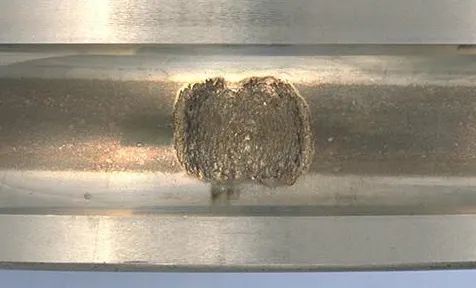
- True brinelling: dents spaced the same distance apart as the rolling elements. They come from an impact or a static overload that pushed the steel past its elastic limit. Dropping a bearing or hammering it into place does this.
- False brinelling: marks at the same spacing that look almost identical. They come from vibration while the bearing stands still, which is a form of fretting corrosion. They’re common in machines shipped or stored next to running equipment.
- Electrical fluting: evenly spaced ridges across the raceway, like a washboard, caused by electric current passing through the bearing.
- Wear and indentations: a dull, wide track or many small dents, from dirt or poor lubrication.
True vs false brinelling
People mix these two up more than any others, because both leave dents spaced at the ball or roller pitch. The way to tell them apart is the bottom of the mark. In true brinelling, the original grinding (hone) marks usually survive inside the dent, because the load pressed the steel down without wearing it away. In false brinelling the surface has worn away. You’ll often see rust or a reddish stain and no hone marks.
The fix is completely different for each. True brinelling points to handling, mounting or shock loads, so check installation tools and impact events. False brinelling points to vibration while the machine stands still or is being transported. Check storage, transport locking, and whether standby equipment gets turned over now and then.
Can you replace just one bearing race?
Suppliers often sell tapered roller cups and cones separately, but you should replace them together. Once they’ve run, both races wear in their own pattern. Pairing a new cone with a used cup (or the other way around) can cause edge stresses and early failure. Timken also recommends using a cup and cone from the same manufacturer.
For most other bearings this question doesn’t come up. The races, rolling elements and cage are built as one unit with a set internal clearance, so you replace a damaged ball bearing or spherical roller bearing as a whole.
A quick inspection trick used in field service is to run a fingernail across the cup raceway. If it catches on a nick or edge, the bearing race needs replacing. To check a cone raceway for pitting, shine a light through the bearing or probe it gently with a thin wire.
Bearing race FAQs
What is the difference between a bearing race and a raceway?
The bearing race is the whole ring. The raceway is the precision-ground track on that ring where the balls or rollers roll.
Why do bearing races fail?
Most races fail from fatigue spalling at the end of their normal life. Early failures come from dirt, poor lubrication, wrong fits, misalignment, overload or electric current. The damage pattern on the raceway usually tells you which one.
Is a bearing race the same as a bearing ring?
The two terms mean the same part. Tapered roller bearings also call the inner race the cone and the outer race the cup.
A recommendation for maintenance buyers
If you keep spare bearings for critical machines, store them flat in their original packaging and away from vibrating equipment. Keep matched tapered cups and cones boxed together. That one habit prevents most false brinelling, and almost all mixed-race problems, before anyone fits the bearing.
Need help matching a bearing race size, ring type or hardness spec to your machine? Send your part number or dimensions to the TFL Bearing team.