










A babbitt bearing is a plain bearing whose sliding surface is lined with babbitt metal, a soft white metal alloy based on tin or lead. During normal running the shaft journal doesn’t touch that metal at all. It floats on a thin film of oil, and the babbitt lining is there to protect the shaft in the moments when that film breaks down.
That single idea explains most of what you need to know about babbitt bearings. It’s why the metal is soft, why the lining is thin, and why oil cleanliness matters so much. It’s also why a damaged bearing is usually cheaper news than a damaged shaft. This guide covers how they work, the main babbitt bearing material grades, the common babbitt bearing types, their pros and cons, and how to inspect, repair or replace them.
How a babbitt bearing works
A babbitt bearing has no balls or rollers. That’s the basic difference between it and rolling bearings such as cylindrical roller bearings, where hardened rollers carry the load between two steel rings. In a babbitt bearing, oil carries the load.
When the shaft is still, it rests on the bottom of the bearing bore. As it starts turning, it drags oil into the narrow wedge between the journal and the lining. Pressure builds in that wedge until the shaft lifts and floats. Engineers call this hydrodynamic lubrication, which is why the part is often called a hydrodynamic journal bearing or sliding contact bearing.
Contact between shaft and babbitt only happens at start up, at shutdown, during an oil supply fault, or when dirt gets into the gap. That’s when the soft lining earns its place. Wikipedia’s entry on babbitt metal describes the alloy as small hard crystals held in a softer metal, so it behaves like a metal matrix composite and resists galling.
Bearing clearance has a big effect on all of this. A common turbomachinery rule is about 0.0015 in of clearance per inch of shaft diameter, and 0.003 in per inch is considered excessive in most cases. If the clearance is too tight, the oil film runs hot. If it’s too loose, the shaft moves around and loads the babbitt unevenly.
Babbitt bearing material: tin based vs lead based
Isaac Babbitt, a goldsmith from Taunton, Massachusetts, patented his soft metal lined axle boxes in 1839. Today most grades are specified under ASTM B23, which divides white metal bearing alloys into two families.
| ASTM B23 grade | Base | Nominal composition | Typical use |
|---|---|---|---|
| Grade 1 | Tin | 91% Sn, 4.5% Sb, 4.5% Cu | High speed, heavy load |
| Grade 2 | Tin | 89% Sn, 7.5% Sb, 3.5% Cu | General industrial, lead free |
| Grade 3 | Tin | 84% Sn, 8% Sb, 8% Cu | Heavier duty engines, compressors |
| Grade 7 | Lead | about 75% Pb, 15% Sb, 10% Sn | Lower cost, steady loads |
| Grade 8 | Lead | about 80% Pb, 15% Sb, 5% Sn | Lower cost, steady loads |
Tin based babbitt alloy is the default for anything with cyclic or shock loading. Lead based babbitt alloy costs less, but it tends to work harden and crack under pulsing loads. That makes it a better fit for machines that turn steadily, like line shafts and some saw arbors. Adding copper or antimony makes the alloy harder and stronger but less ductile, and that’s the trade engineers balance when they pick a grade.
Melting points are lower than most people expect. Grade 1 begins to melt at about 433°F (223°C) and Grade 2 at about 466°F (241°C). Babbitt loses strength well before it melts, so real operating limits sit far below these figures.
Babbitt bearing types you’ll meet in industry
Solid cast (poured) bearings
This is the traditional style. Babbitt is poured straight into a cast iron pillow block or housing and keyed in place with drilled holes or dovetail grooves. You still find these on older pumps and farm machinery.
Babbitt lined shells
These have a steel or bronze backing with a thin bonded layer of babbitt. Most modern babbitt lined bearings use this design, because the backing carries the load and the babbitt only provides the sliding surface.
Babbitt journal bearings and sleeve bearings
A babbitt journal bearing carries radial load. Designs range from a plain cylindrical bore to lemon bore, pressure dam and tilting pad versions for high speed rotors. A babbitt sleeve bearing works the same way in a one piece or split sleeve, and you’ll often find it in large electric motors.
Babbitt thrust bearings
These carry axial load on babbitted pads or shoes that run against a shaft collar. Tilting pad thrust bearings in turbines and large pumps are the best known examples. On smaller equipment, the same axial job often goes to rolling designs such as spherical roller thrust bearings, which handle heavy thrust and a little misalignment without an oil film system.
Many large machines use both kinds: two journal bearings to hold the rotor up, plus one thrust bearing to stop it moving along its axis.

Where babbitt bearing applications make sense
Babbitt bearings are still the standard in steam and gas turbines, centrifugal compressors, large motors and generators, marine propulsion shafts and big internal combustion engines. These machines share high speeds, large shafts, long continuous duty and a pressurized or ring oiled lube system that can keep the film in place. You can see how bearing needs change across sectors on our industries page.
They make less sense on small, slow, frequently started machines with no proper oil supply. Every start means a moment of metal contact. A bearing that starts and stops a hundred times a day spends far more of its life in that risky zone than a turbine that runs for months.
At the high speed end, some turbomachinery is now moving away from oil film bearings entirely. Our guide to active magnetic bearings explains when that switch pays off. For large, fast rotors that run around the clock, though, a well designed babbitt bearing is still very hard to beat.
Advantages and disadvantages of babbitt bearings
The strengths come from the soft lining and the oil film:
- They protect the shaft. Babbitt is far softer than a steel journal, so damage lands on the cheap part.
- They embed dirt. Small particles sink into the lining instead of scoring the shaft.
- They conform. The lining wears in around minor misalignment and surface flaws.
- They can be rebuilt. A worn shell can be rebabbitted instead of scrapped.
- They run quietly and damp vibration well, which is why high speed rotors rely on them.
The weaknesses are just as real:
- Low fatigue strength, especially at higher temperatures.
- They depend completely on a continuous, clean oil supply.
- Strength drops at high temperature, so they need temperature monitoring.
- Start and stop duty wears them faster than steady running.
- They’re vulnerable to shaft currents, covered in the inspection section below.
Babbitt vs bronze bearings
Bronze is the other classic plain bearing material, and the two get compared constantly. The real difference is hardness. Babbitt usually measures about 20 to 30 HB, while a common bearing bronze like C93200 sits around 65 to 75 HB.
That gap drives everything else:
- Babbitt embeds particles up to about 0.002 in without scoring the shaft. Bronze accepts very little contamination, so dirty oil hurts both the bearing and the journal.
- Babbitt wears in around small misalignment. Bronze needs better alignment and usually a hardened shaft.
- Bronze carries higher static loads, shock and slow oscillating motion much better, and some tin bronzes resist seawater corrosion well.
So the choice depends on the machine. If the shaft is expensive and the oil film is reliable, babbitt protects the shaft. If loads are heavy, speeds are low and lubrication is patchy, bronze survives where babbitt would smear.
Why thinner babbitt usually lasts longer
Many buyers get this point backwards. A thicker layer of babbitt seems like more material to wear, and so more life. In reality babbitt has low fatigue strength, and research shows that the thicker the layer, the more likely it is to develop fatigue cracks.
One widely shared turbomachinery guideline says thin babbitt under 0.015 in can have more than ten times the fatigue resistance of thick babbitt around 0.060 in. Cracks start on the surface, run down toward the bond line, then turn and spread sideways until pieces of lining break out. A thin layer keeps the strong steel backing close to the surface and gives cracks less room to grow.
Thin linings have a cost, though. They tolerate less wear and less embedded dirt before the backing shows through, so they need cleaner oil and better alignment. If a supplier sells a thick lining as a feature for a high speed, dynamically loaded machine, ask them why.
How to choose a babbitt bearing
Start with the load pattern. Steady loads can use lead based grades, while cyclic or shock loads call for tin based babbitt. Then confirm the following:
- Speed and starts per day. Frequent starts favor rolling bearings or a tougher material.
- The lube system. Ring oiled, bath or pressure fed, and how well it’s filtered.
- Lining thickness and backing. Thin linings on steel suit dynamic loads.
- Clearance. It should match the shaft size and the OEM’s design.
- A bond test report and a temperature sensor location for the new shell.
Babbitt bearing maintenance and inspection
Babbitt is a good witness. Because it’s softer than the journal, damage usually shows on the lining first, and the pattern points to the cause.
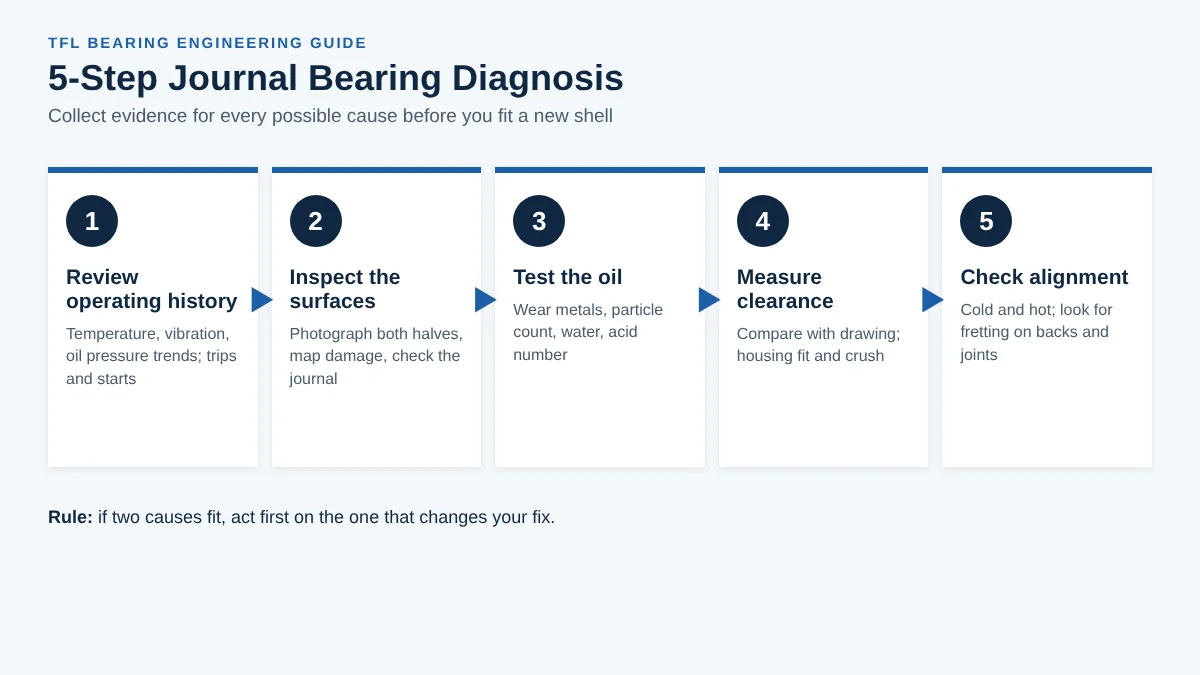
Watch temperature and vibration while it runs
Most bearings have an RTD or thermocouple set just under the babbitt, near the expected hot spot. For motor sleeve bearings, generic guidance often lists about 80°C as high normal, 90°C as alarm and 100°C as trip. Turbomachinery tilting pads often run hotter by design, so the OEM’s limits always win over a generic figure.
A slow climb matters more than a single high reading. If temperature and radial vibration rise together, the oil film is usually thinning and the clearance is opening up.
Read the lining when it’s opened
Failure guides group babbitt lining failure into a few recognizable modes:
- Wiping: babbitt smeared from one area to another, caused by oil starvation, overload or slow speed rubbing.
- Scoring: parallel grooves around the bore, almost always from dirt in the oil.
- Fatigue: a network of hairline cracks, often with missing pieces, caused by vibration or edge loading.
- Bond failure: the lining lifting off its backing. This is most common on copper alloy backings.
- Electrical pitting (frosting): fine frosted or blackened pits from shaft currents arcing through the oil film. On thrust shoes it usually starts at the trailing edge, where the film is thinnest.
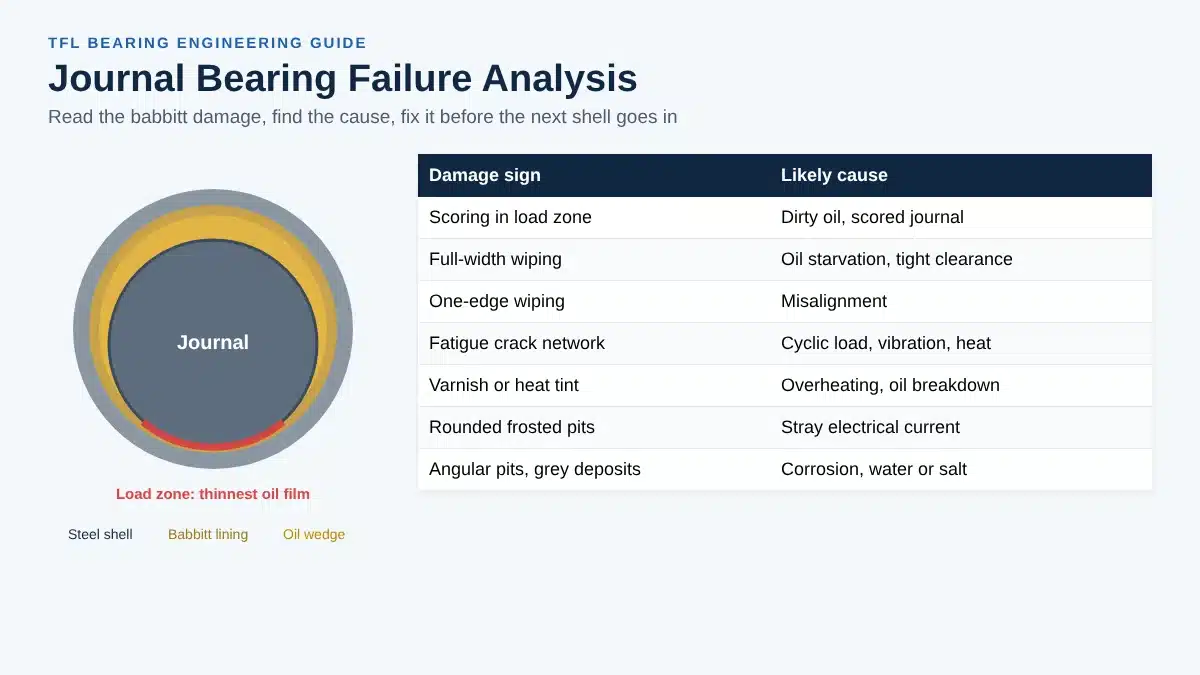
Electrical pitting catches many plants out on motors and generators run by variable frequency drives. The usual fix is to break the current path with insulated housings or shaft grounding. Where the same machine also has rolling bearings, electrically insulated bearings or hybrid ceramic bearings stop current from passing through those bearings as well.
Check the bond
You can’t judge bearing metal bonding by eye. ISO 4386-1:2019 sets out an ultrasonic test for the bond between lead or tin based bearing metal and steel or copper backings, for linings 0.5 mm thick or more. Ask for this report on any new or refurbished shell.
Can babbitt bearings be repaired?
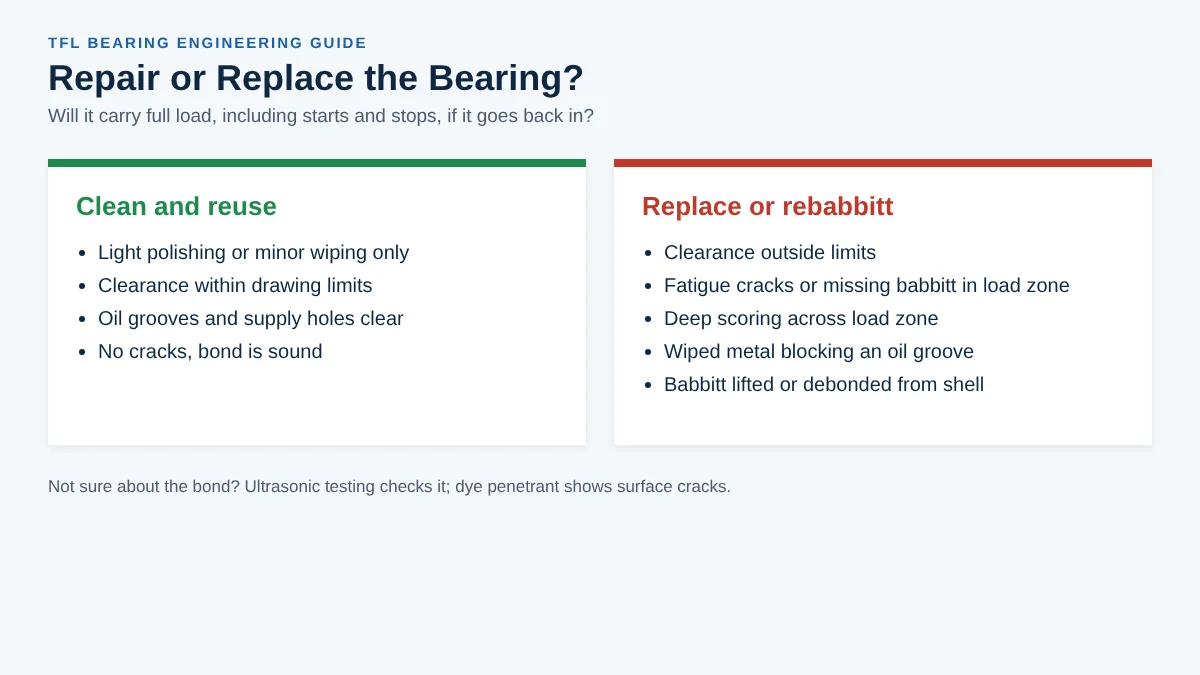
Yes, and that’s one of their biggest advantages. Rebabbitting means stripping the old metal, machining the bond surface and heating the shell. The bore is then tinned so the new metal will bond, and fresh babbitt is poured while the shell spins (centrifugal casting). Finally, the bearing is machined back to its final bore and clearance.
Bearing refurbishment makes sense when the backing is sound and the root cause is understood. If a bearing failed from misalignment or shaft currents and neither problem gets fixed, rebabbitting just buys you a second identical failure.
When a rolling bearing is the better choice
Plenty of machines that once ran on babbitt now use rolling bearings. This is especially true of smaller pumps, fans, gearboxes and motors, where starts are frequent and a full oil system isn’t worth the cost. Rolling bearings tolerate stop and start duty, run on grease, and come with catalog load ratings and predicted fatigue life.
Where an old babbitted bearing carried both radial and axial load, tapered roller bearings are a common replacement. If you’re weighing a conversion, our bearing selection guide walks through load, speed and mounting checks before you commit to a design change.
Babbitt bearing FAQs
What is the operating temperature of a babbitt bearing?
Motor sleeve bearings commonly alarm around 90°C and trip around 100°C, measured in the babbitt. Turbomachinery pads may run higher. Follow the OEM’s limits, because the sensor never sits exactly at the hottest spot.
How long does a babbitt bearing last?
There’s no catalog life like the fatigue rating used for rolling bearings. With clean oil, correct clearance, good alignment and no shaft currents, a babbitt bearing can run for many years. Dirty oil and frequent starts shorten that sharply.
How do you lubricate a babbitt bearing?
It needs a continuous oil supply from an oil ring, a bath or a pressure fed system with filtration. Grease isn’t suitable for hydrodynamic operation. Oil viscosity and supply temperature should follow the machine maker’s spec, because both set the oil film thickness.
Why is babbitt also called white metal?
White metal is the common British and European name for the same tin and lead based alloys. Some engineers prefer “babbitt” because “white metal” can also mean zinc die casting alloys.
Is a babbitt bearing the same as a journal bearing?
Not exactly. A journal bearing is any plain bearing that supports a turning shaft on a film of lubricant. A babbitt bearing is a journal or thrust bearing whose sliding surface is lined with babbitt metal. Many journal bearings are babbitted, but others use bronze, polymer or other linings. So every babbitt journal bearing is a journal bearing, but not every journal bearing uses babbitt.
What usually causes a babbitt bearing to fail?
Most failures trace back to the oil film. Dirty oil scores the lining, oil starvation or overload wipes it, and vibration or edge loading cracks it through fatigue. A poor bond lets the lining lift off its backing, and stray shaft currents pit the surface. Because the damage pattern points to the cause, inspect the old shell before you fit a new babbitt bearing, or the same failure is likely to come back.
What to check first
If you run machines with babbitt bearings, pull the last six months of bearing temperature and vibration data before your next shutdown. Look for slow upward trends, not just alarm events. At the shutdown, ask for an ultrasonic bond report on any spare or refurbished shell before it goes in.
If you’re replacing babbitt bearings with rolling bearings on smaller machines, send your shaft size, load, speed and duty cycle to the TFL Bearing team. We’ll suggest options that fit your housing.