







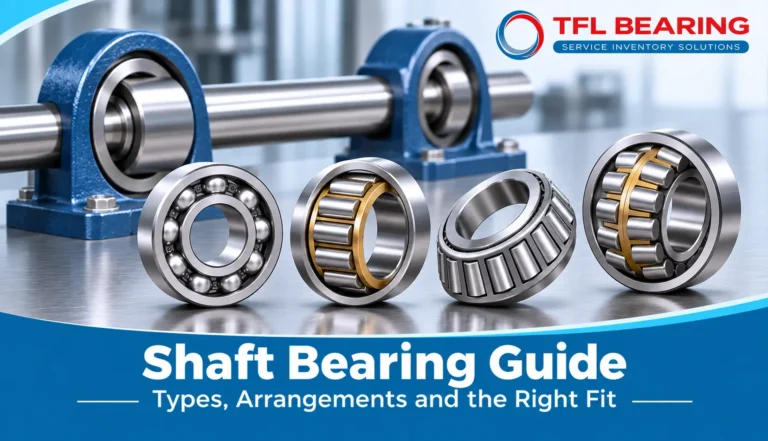

You have a rotating shaft, two bearing seats and a drawing that says “k5.” That’s the usual starting point for anyone looking up shaft bearings. A shaft bearing is any bearing that supports a turning shaft and keeps it in place, either a plain bearing (the shaft runs in a lined hole) or a rolling bearing (balls or rollers between two rings).
Picking the bearing type is only the first decision. Two more matter just as much: how the pair of bearings is arranged on the shaft, and how tightly each one fits its seat. This guide covers all three, with numbers you can check against your own drawing.
Plain or Rolling: The Two Families of Shaft Bearing
The simplest form of bearing is a plain bearing, which is just a shaft rotating in a hole with lubricant between them. Journal bearings and sleeve bearings both belong to this family.
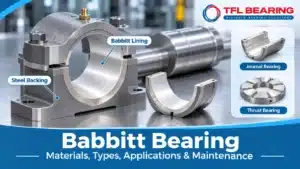
Some heavy machines run plain bearings with a soft metal lining. Our babbitt bearing guide explains how that lining works and when it’s used.
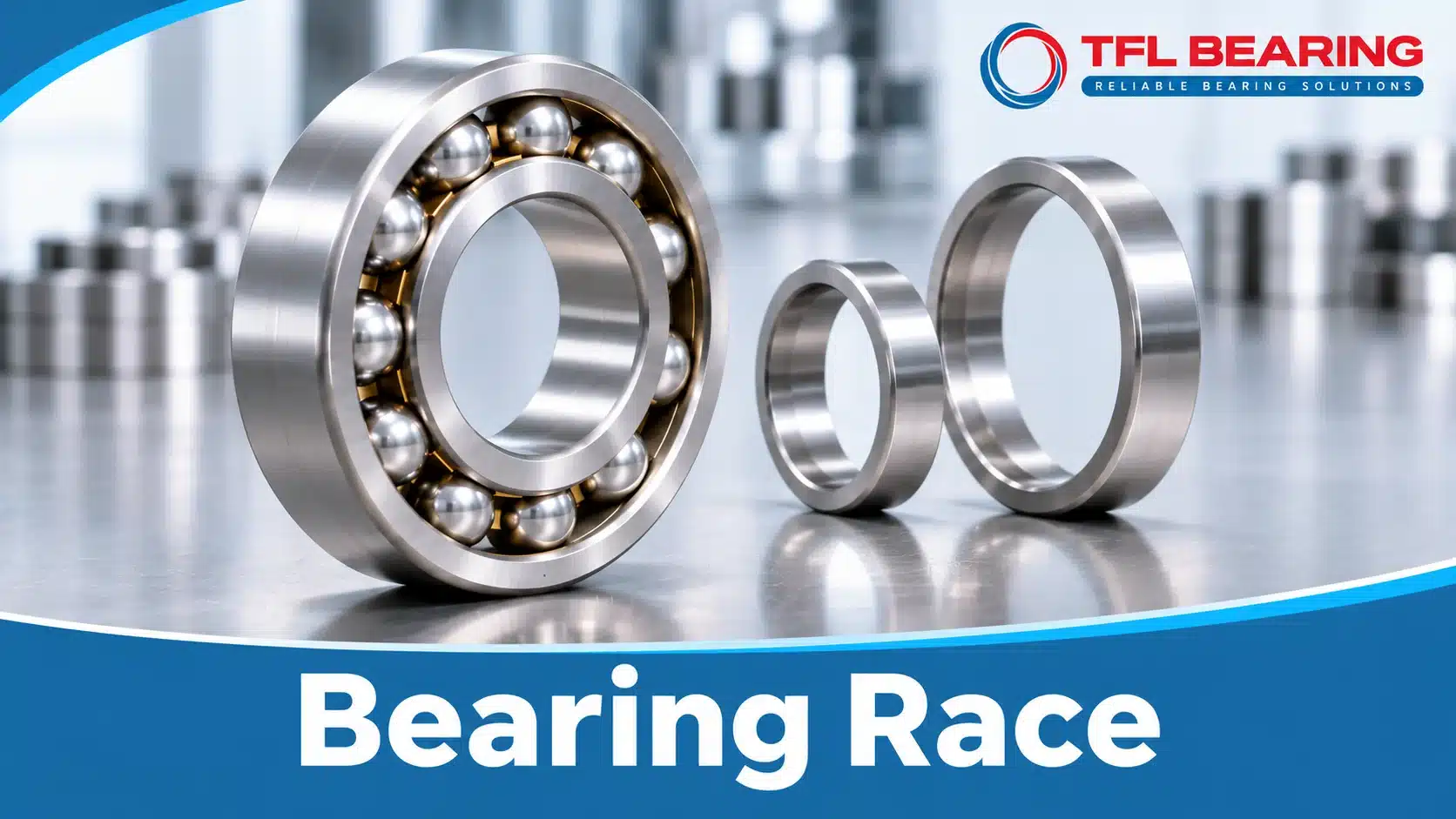
Rolling bearings put balls or rollers between an inner and outer ring. They start with less friction and tolerate tighter tolerances, which is why most motors and pumps use them. Within that family, the shaft’s load decides the type:
| Shaft Condition | Usual Bearing Type | Why |
|---|---|---|
| Moderate radial load, high speed | Deep groove ball bearing | Low friction, takes some thrust both ways |
| Heavy radial load | Cylindrical roller bearing | Line contact carries more load |
| Radial plus one-way thrust | Tapered roller bearing | Angled raceways carry both |
| Heavy load with shaft deflection | Spherical roller bearing | Self-aligns to the bent shaft |
For a typical motor shaft, start with our deep groove ball bearings.
Heavy shafts that bend under load, like fan and conveyor shafts, are a better match for spherical roller bearings.
One more meaning is worth knowing. On boats, “shaft bearing” usually means the cutless bearing around the propeller shaft, a plain bearing lubricated by nothing but seawater. Different world, same principle.
Locating and Non-Locating: Why One Bearing Must Be Free
A shaft usually sits on two bearings, and they can’t both grip it axially. SKF’s design guidance splits the job: the locating bearing positions the shaft and carries any thrust, while the non-locating bearing carries radial load only and lets the shaft slide as it grows with heat.
How much does a shaft grow? An SKF article on shaft expansion gives about 6 microinches per °F, per inch of shaft, for gray cast iron. Take a shaft with 1 m (39.4 in) between bearings that warms up by 90 °F, and it grows by about 0.021 inch, or roughly 0.5 mm. Steel expands at a different rate, but the order of magnitude is the same.
Half a millimeter doesn’t sound like much. Lock both bearings and that growth turns into a thrust load nobody designed for. SKF warns that if the non-locating ring can’t move for any reason, both bearings become axially preloaded.
There are two common ways to give the shaft room:
- Fit the non-locating bearing with a loose outer ring so it can slide in the housing. SKF describes self-aligning ball and spherical roller bearings working this way.
- Use a bearing that lets the shaft move inside it, such as a cylindrical roller bearing with one flangeless ring (NU or N type), so both outer rings can stay fixed.
The first method has a catch. SKF notes that fretting corrosion on the seat can stop a loose ring from sliding, which brings the axial load right back. A cast iron bearing housing with a clean, correctly sized bore makes a real difference here.
The Fit: How Tight Is Tight Enough?
Fits decide whether a ring stays put or creeps. The rule from NTN’s catalog is simple: the ring that rotates relative to the load gets a tight fit, and the stationary one can have a loose fit.
For most machines, the inner ring turns with the shaft while the load points one way, so the shaft needs an interference fit. NTN’s shaft fit table for radial ball bearings lists j5 for light loads up to 18 mm, k5 from 18 to 100 mm and m5 from 100 to 160 mm.
A Worked k5 Example on a 40 mm Shaft
SKF’s catalog works through exactly this case. A bearing with a 40 mm bore goes on a solid shaft machined to k5. The mean probable interference comes out at (22 + 5) / 2 = 13.5 µm.
Too little interference and the inner ring creeps on the shaft, polishing the seat until it fails. Too much and the ring expands enough to remove the bearing’s internal clearance, which NTN lists as a cause of seizure.
The same SKF example shows a hollow shaft needs more. For a hollow shaft of the same diameter with a large bore, the recommended seat moves up to m6, with a mean probable interference of about 23 µm, because a thin wall gives way under the press fit.
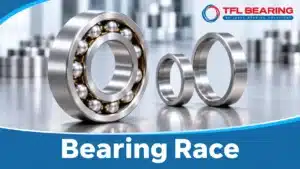
So check two things on the drawing: the tolerance letter, and whether the shaft is solid. Our guide to the bearing race explains how the rings and raceways behave once they’re pressed on.
Mounted Shaft Bearings for Simpler Machines
Not every shaft gets a machined seat. Conveyors and farm machines often use mounted units, where the bearing comes in its own housing and locks to the shaft with set screws, an eccentric collar or a clamp.
McMaster’s notes on these units point out that clamp-on shaft mounts are less likely to slip than set screws at high speed. If a set-screw unit keeps fretting a fast shaft, that’s one likely reason.
Signs a Shaft Bearing Has a Fit or Arrangement Problem
Fit and arrangement problems leave clear marks. Watch for these:
- Shiny or polished bands on the shaft seat: the inner ring is creeping.
- Brown fretting marks on the outer ring: the ring is moving in the housing.
- A bearing that runs hot only after the machine warms up: the shaft can’t expand freely.
- Heavy wear on one side of the raceway: unplanned axial load.
If you see any of these, our bearing failure analysis services guide explains what to send for a proper diagnosis.
Plain bearings fail differently. The journal bearing failure analysis article covers wiping and fatigue damage.
Quick Answers
What Is a Shaft Bearing?
Any bearing that supports a rotating shaft. It can be a plain bearing, where the shaft turns in a lined bore, or a rolling bearing with balls or rollers.
What Fit Should I Use for a Bearing on a Shaft?
For a rotating shaft under a steady load, an interference fit such as k5 for most ball bearings between 18 and 100 mm. Always confirm with the bearing maker’s table for your load and size.
Why Do Shaft Bearings Need a Non-Locating Side?
Shafts grow as they heat up. The non-locating bearing lets the shaft move so the two bearings don’t push against each other.
Where Can I Buy Shaft Bearings?
Send us the shaft diameter and load (plus the bearing number if you have one) through our contact page. We’ll suggest options and confirm MOQ and lead time.