








Introduction
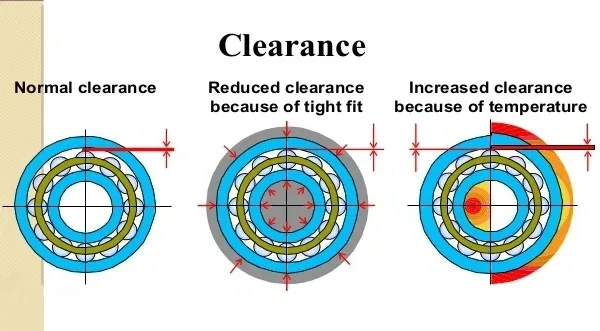
Ever wonder why certain roller bearings just don’t run and others run absolutely perfectly? It revolves mostly around something known as clearance. Clearance is that small bit of space between the rolling bits, inner ring, and outer ring within a bearing.
It’s important because too much or too little room can cause havoc. Should the clearance be overly tight, the bearing may overheat and fail. Should it be overly loose, your machine may vibrate and generate a lot of noise. How, therefore, can one find whether your bearing has the proper clearance? And how would one quantify it? Relax; we have you covered!
What Exactly is Roller Bearing Clearance?
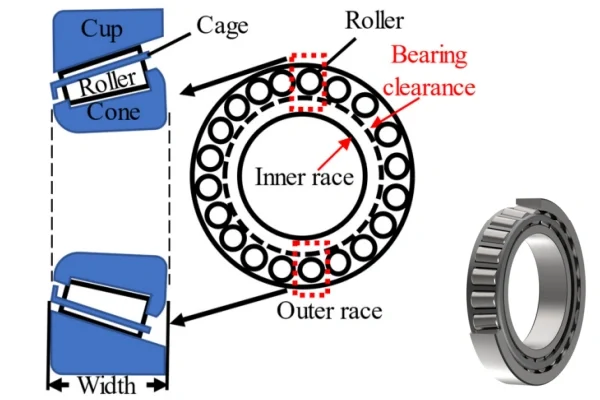
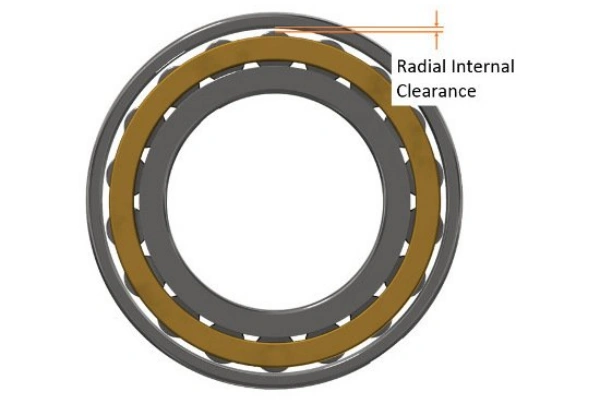
Clearance is the tiny gap between the rolling elements (like balls or rollers) and the inner & outer rings of the bearing. This gap affects how well the bearing handles heat, speed, and load.
When we talk about roller bearing clearance, we usually mean how much the inner or outer ring can move when the other ring is held still. We look at two types of movement:
Radial Clearance: This is how much the ring can move side-to-side.
Axial Clearance: This is how much the ring can move up and down.
When you’re checking your roller bearings, you might need to measure both of these!
Operational Clearance: The actual space when the bearing is in use, considering temperature and pressure changes.
Symbol for Internal Clearance
There are many different types of roller bearings, such as:
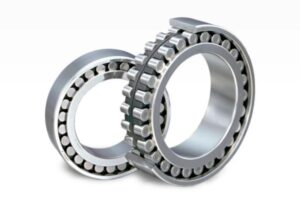
- Cylindrical roller bearings
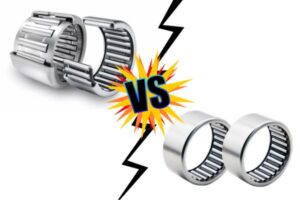
- Needle roller bearings
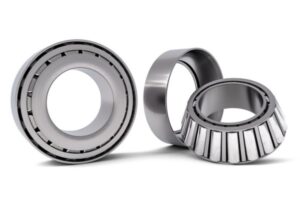
- Tapered roller bearings
- Spherical roller bearings (also known as self-aligning roller bearings)
- Thrust cylindrical roller bearings
- Thrust tapered roller bearings
- Thrust spherical roller bearings
Bearings come with different clearance levels, labeled with specific symbols:
- C1: This bearing has the smallest amount of clearance.
- C2: This bearing has a little more clearance than C1.
- CN: This means the bearing has a standard, or normal, amount of clearance. You might also just see an “N” instead of “CN.”
- C3: This bearing has more clearance than the standard CN.
- C4: This bearing has even more clearance than C3.
- C5: This bearing has the most clearance of all these symbols.
Types of Roller Bearings and Clearance
Popular Roller Bearing Sizes and Styles
Roller bearings abound; they range in shape from cylindrical to tapered, spherical to even split roller bearings. Every type comes in several roller bearing sizes; the clearance varies based on the work you are doing.
How Clearance Fits Each Type
Different bearings need different gaps. A needle roller bearing has a super tight clearance because it’s used in small spots. On the other hand, a double roller bearing needs a bit more room since it handles bigger jobs. Knowing your bearing type helps you figure out the right clearance.
Standard Roller Bearing Clearance Chart (C1-C5)
Selecting the correct radial internal clearance is critical for maximizing bearing life and ensuring operational stability. Below is the standard radial clearance classification chart to help you verify your feeler gauge measurements against industry specifications.
| Clearance Class | Internal Clearance | Typical Industrial Applications |
|---|---|---|
| C1 & C2 | Smaller than Normal | High-precision machine tool spindles, applications requiring minimal vibration. |
| CN (Normal) | Standard | General electric motors, standard gearboxes, conventional pumps. |
| C3 | Larger than Normal | Heavy interference fits, agricultural equipment (e.g., disc harrows), railway axles. |
| C4 & C5 | Extra Large | Extreme high-temperature environments, steel mill equipment, vibrating screens. |
Clearance Differences in Roller Bearings
Clearance standards and adjustment methods vary significantly depending on the specific type of roller bearing you are installing:
Expert Insight
When measuring clearance with a feeler gauge, remember that Spherical Roller Bearings require simultaneous radial clearance measurements across both rows of rollers to ensure the shaft remains perfectly aligned. Do not measure just one side.
Spherical Roller Bearings: Designed to accommodate heavy loads and misalignment. They are typically mounted on tapered journals with tight interference fits, which significantly reduces internal clearance during installation. Therefore, C3 or C4 clearance is often standard.
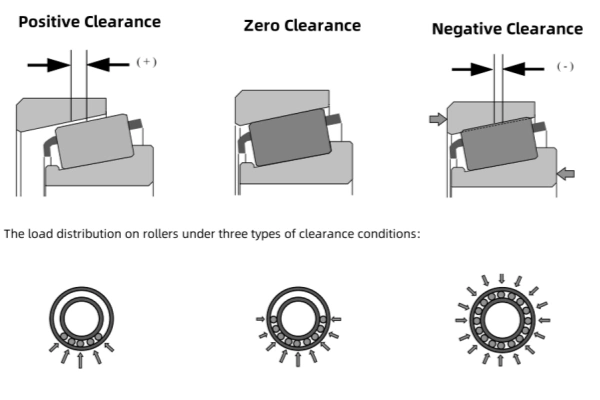
Tapered Roller Bearings: These usually do not have a predefined factory radial clearance (unless supplied as a matched set). Instead, axial end-play or preload is manually adjusted during installation by altering the distance between the cup and cone.
Cylindrical Roller Bearings: Highly sensitive to thermal expansion. In high-speed applications like large electric motors, C3 clearance is typically required to compensate for the rapid heat expansion of the inner ring.
Expert Insight: ISO Compliance
At TFL Bearing, all our radial internal clearance configurations are strictly manufactured and calibrated in accordance with the ISO 5753-1:2009 international standard. Referencing these official tolerances during your feeler gauge inspections ensures optimal load distribution and prevents premature bearing fatigue in heavy-duty applications.
How to Measure the Sideways Movement (Radial Clearance)
There are a few ways to measure how much your roller bearing can move side-to-side.
Using Special Tools
Special machines can check the clearance for some kinds of bearings, including deep groove ball bearings, self-aligning ball bearings, cylindrical roller bearings, needle roller bearings, and self-aligning roller bearings. These devices are quite good since they provide an exact measurement free of additional bearing stress. You just put the bearing in, and the machine tells you the average radial clearance.
Sometimes, you might use a machine that puts a little bit of pressure on the bearing while measuring. You hold the inner ring still and see how much the outer ring moves from one side to the other. The difference in the readings is the radial clearance. You usually do this a few times and take the average to get a good measurement.
The Simple Hand Method
If you don’t have a special machine, you can try a simpler way, especially if the bearing is bigger than what the machines can handle. You need to be a little careful with this method and not push too hard.
You hold the inner ring tightly and then try to wiggle the outer ring back and forth with your hand. The amount it moves is the radial clearance. To get a better idea, you can try this in a few different spots around the bearing and take an average.
Using Feeler Gauges
For bigger bearings like cylindrical roller bearings and self-aligning roller bearings, you can use something called a “feeler gauge.” These are thin pieces of metal that come in different thicknesses.
You can try sliding these thin pieces of metal between the rollers and the rings. Here’s how:
- Finding the Smallest Clearance: Turn the inner ring and the cage with the rollers around. Find the thickest feeler gauge that you can just barely slide in between three rollers that are next to each other and the outer ring.
- Finding the Largest Clearance: Keep turning the inner ring and the cage. Find the thinnest feeler gauge that you can’t quite slide in between three rollers next to each other and the outer ring.
The average of the thickness of the feeler gauge that just fits and the one that doesn’t is your radial clearance.
For self-aligning roller bearings, you do this for each row of rollers and then take the average of the two rows. If you have a cylindrical roller bearing with more than one row of rollers, you need to measure each row and make sure the clearance is pretty similar in all of them.

Struggling with precise clearance?
TFL Bearing offers pre-adjusted custom solutions. Don’t risk premature bearing failure due to manual measurement errors.
Request a QuoteHow to Measure the Up and Down Movement (Axial Clearance)
Most roller bearings (excluding tapered roller bearings) allow you to also monitor their movement up and down. The axial clearance comes from here.
Using a Special Tool
Just like with radial clearance, there are machines that can help you measure axial clearance. You hold the outer ring motionless then observe the movement of the inner ring up and down. The equipment will provide an axial movement reading.
The Simple Hand Method
You could also try a simple hand method. Make sure the heading is level on flat ground. Place a thin, sphere-shaped piece on top of the inner ring. Then, lift the inner ring up from the bottom with your finger and press down with your thumb on the round piece. The round piece moves in different ways based on the axial space. To do this again, turn the inner ring a few times and average each time.
Conclusion
So, there you go! Understanding and measuring clearance in roller bearings doesn’t have to be complicated. Whether you’re working with tapered roller bearings, cylindrical roller bearings, or any other type, getting the clearance right will keep your machines running smoothly. Too much or too little, and you’ve got problems—but measuring it is super easy with a few simple steps.
At TFL Bearings, we create all sorts of bearings—cylindrical roller bearings, split roller bearings, you name it—and we have quality back-off. Demand bearings that fit exactly right? Check what we have by swinging by our website. Let us maintain your machines running robust.
5 Common Questions About Roller Bearing Clearance
Is there a way I could find out whether my bearing has the correct clearance?
Yes. You must measure the radial internal clearance using a precision feeler gauge or dial indicator both prior to and after mounting. Always compare these readings against the manufacturer’s specifications (such as ISO 5753 C3 or C4 clearance charts) to ensure the residual clearance meets your specific operational requirements.
On a cylindrical roller bearing, can I change the clearance?
The initial unmounted factory clearance cannot be changed. However, the operational (residual) clearance is naturally reduced during installation based on the interference fit. A tighter fit will expand the inner ring or compress the outer ring, effectively reducing the internal radial clearance.
What happens if my tapered roller bearing exhibits excessive clearance?
Excessive end-play (axial clearance) drastically reduces the load zone within the bearing. This lack of proper support leads to roller skewing, edge loading, excessive vibration, and premature fatigue spalling, ultimately causing early bearing failure.
Do needle roller bearings have less clearance than other kinds?
Yes, needle roller bearings typically operate with a much tighter radial internal clearance compared to spherical or cylindrical types. This narrow clearance is engineered to maintain high rotational accuracy and ensure uniform load distribution across the full length of the needle rollers.
Why can split roller bearings be adjusted for clearance?
Split roller bearings are designed in halves, allowing them to be assembled directly around a shaft without dismantling adjacent heavy equipment. Because of this unique split design, their operational clearance can often be fine-tuned during assembly using specific clamping tolerances or housing shims, making them ideal for heavy industrial maintenance.