Looking for an SKF bearing alternative? You’re likely under pressure to find a reliable solution—fast. The right replacement needs to match your equipment, maintain performance, and meet quality standards you can trust. But with so many options available, making the wrong choice could lead to costly downtime or damage.
Before you decide, take a moment to understand exactly what your equipment needs. Consider critical factors like load, speed, and operating environment. This isn’t the time to rush—choosing the right bearing is about more than just compatibility; it’s about long-term reliability.
Key Takeaways
Always look at your old bearing’s specs and codes. This helps you find the right replacement that fits your machine well.
Think about your machine’s load, speed, and where it works. Pick a bearing that can do the job and last a long time.
Choose brands that people trust and have good certifications. This helps you stay away from fake or bad bearings.
Buy from suppliers you can trust, like TFL Bearings. They give fast delivery, good products, and strong warranty help.
Do not rush to buy cheap bearings. Focus on getting good quality and the right fit. This keeps your equipment working safely and smoothly.
When you start the bearing selection process, you need to look at the codes printed on your old bearing. These codes tell you the size, type, and special features. Each manufacturer uses a system, but most codes include numbers and letters. For example, you might see something like “6205-2RS.” The first part shows the bearing type and size. The last part tells you about seals or shields.
6205 bearing
Here’s a quick table to help you read common bearing codes:
You should also pay attention to bearing arrangement. Some machines use single bearings, while others need pairs or special setups. The bearing selection process gets easier when you know if you need a single, double, or custom bearing arrangement.
Why Specs Matter
Specs are the heart of the bearing selection process. If you skip this step, you risk picking a bearing that doesn’t fit or work right. Different bearing types handle loads and speeds in their own way. If you choose the wrong specs, your machine might run hot, make noise, or even break down.
6205-2RS bearing specs
Matching the original specifications is critical. When specs don’t match, you can get a poor fit because of tiny differences in size or shape. This can lead to failures, damage, and costly repairs. Mixing bearing types or brands without checking specs can also cause problems with bearing arrangement and durability.
Certifications
Certifications help you know if a bearing meets industry standards. When you see a certification, you know the bearing passed certain tests and checks. The most common one is ISO 9001. This shows the company follows strict rules for making and checking their products. Some bearings also have ISO 281, which covers dynamic load ratings for bearings made with modern materials and good manufacturing.
You might also see AS9100 for aerospace or IATF 16949 for automotive bearings. These show the bearing is safe for special jobs. Certifications mean the bearing went through extra steps to prove its quality.
Here’s a quick table of common certifications and what they mean:
Note: Always check for certification marks on the box or ask your supplier for proof. This helps you avoid fake bearings and keeps your machines safe.
Fit & Function
When you pick a new bearing, you want it to fit and work just like the original. Sometimes, a bearing looks right but does not match your machine’s needs. You might see the same size and shape, but hidden differences can cause big problems. For example, some cars switched ABS systems, and even though the bearing fit, the speed sensor did not match. This caused warning lights and error codes. You had to return the bearing and pay extra fees.
Low-quality or fake bearings often have hidden flaws. They might use poor materials or skip important steps in making the bearing. This can lead to noise, vibration, or even safety risks. You want to avoid these problems by choosing a trusted brand or supplier. Always check if the bearing matches your machine’s specs, not just the size. If you use a SKF bearing alternative from a reliable source, you lower the risk of these issues.
Fast Sourcing
When you need a bearing quickly, you want to know how fast you can get it. Most major suppliers respond to your requests in less than four hours. If you order a sample of a SKF bearing alternative, you usually wait about 7 to 15 days. Full production takes around 30 days, and custom orders might need up to 60 days. Suppliers in China, especially in Shandong Province, keep these lead times steady.
You can speed up your search by using smart sourcing strategies. Here are some ways to get the right bearing fast:
Check if the supplier can handle your order size without delays.
Look for suppliers who focus on quality and innovation.
Pick the right material, like steel alloys or advanced composites, for your job.
Order a sample first to make sure the bearing fits and works well.
Compare prices and warranties to get the best deal.
Ask other customers about their experience with the supplier.
Use sourcing platforms to find verified suppliers and read reviews.
Tip: Always have a backup supplier ready. If your first choice cannot deliver, you can switch quickly and avoid downtime.
Top Brands for Best SKF Bearing Alternatives
Here’s a table with top brands people often pick instead of SKF:
Brand
Country
Key Features
Typical Applications
FAG
Germany
Innovation, engineering excellence
Automotive, production machinery, railway, power transmission, industrial, aerospace
While these brands are trusted globally, they often come with high prices and longer lead times, which can be challenging for businesses that need quick and cost-effective solutions.
For comparison, we have chosen a very common bearing model: 6205-2RS (or its equivalent). This designation indicates a double-sealed bearing with an inner diameter of 25mm, an outer diameter of 52mm, and a width of 15mm.
Brand
Typical Model Number
Approximate Price Range (USD)
SKF
6205-2RSH
$6 – $20+
FAG
6205-2Z or 6205-2RSR
$10 – $25+
TIMKEN
6205-2RS
$5 – $20+
NSK
6205-DDU
$6 – $20+
NTN
6205LLU
$7 – $20+
This is where the Chinese bearing market offers a compelling alternative. In recent years, manufacturers in China have significantly improved in terms of quality, innovation, and production capacity, making them a smart choice for companies looking to balance performance and cost.
TFL is a top alternative to SKF bearings, offering reliable performance at a significantly more affordable price. Our bearings are priced well below major brand options—often at 30% to 70% less, depending on the model and quantity.
For example, TFL’s 6205 series ball bearings are typically priced between $0.5 and $2.8 per unit.
Please note that this is a rough estimate for individual units and is subject to market fluctuations. Bulk purchases are eligible for additional discounts. Bearings with special designs—such as custom seals or cages—may fall outside this price range.
We strongly recommend sending us an inquiry to receive an accurate quote and ensure both product quality and authenticity.
Why TFL Bearings
Our Promise
You want a reliable factory-direct bearing supplier you can trust, especially when time matters. TFL Bearings is our own brand, and we stand behind every product we ship. We know you need a direct alternative to big names like SKF. That’s why we focus on quality, speed, and support.
We promise you:
Quality that matches major brands. Every bearing meets international standards.
Competitive prices. You save money without losing performance.
You deserve a supplier who cares about your business. We make sure you get reliable bearings and honest service every time.
Fast Solutions
When your machine stops, you need a solution right away. TFL Bearings gives you fast answers and quick shipping. Our global supply chain keeps inventory ready, so you don’t have to wait weeks for your order. You get bearings that fit your specs and budget.
Here’s how we help you move faster:
Rapid response from our service team. You get help with purchase plans and technical questions.
Custom solutions. If you need a special bearing, we offer design advice and custom specs.
Efficient inventory management. We keep popular sizes in stock for urgent needs.
Reliable warranty and after-sales support. If something goes wrong, we fix it fast.
Need a SKF bearing alternative now? We’re ready to help you keep your equipment running and your costs low. Choose TFL Bearings for speed, quality, and peace of mind.
FAQ
What makes TFL Bearings a good SKF alternative?
You get the same quality as big brands. TFL Bearings meets strict standards. You also save money and get faster delivery. Many customers trust TFL as their go-to replacement for SKF bearings.
How do I know if a TFL bearing will fit my machine?
Check your old bearing’s code and specs. Match them with TFL’s product details. If you need help, just ask our team. We help you find the perfect fit every time.
Can I get TFL Bearings quickly for urgent repairs?
Yes! We keep popular sizes in stock. Most orders ship within 10 days. If you need it even faster, let us know. We work hard to keep your downtime short.
Are TFL Bearings covered by a warranty?
Absolutely. Every TFL bearing comes with a clear warranty. If you have any issues, our support team helps you right away. You get peace of mind with every purchase.
How do TFL Bearings compare in price to SKF and other brands?
TFL Bearings usually cost less than SKF and other big brands. You get top quality without the high price tag. Many customers switch to TFL to save money and still get great performance.
With a decade of engineering experience, I specialize in bearing selection, installation, and technical evaluation. At TFL BEARING, I’ve delivered precision-engineered supply solutions to 200+ global clients. Backed by our 20+ years of supply chain expertise, I ensure reliable performance for demanding applications. Contact me for one-stop procurement solutions.
Wheel Bearing Noise: What It Sounds Like and How to Find the Bad One
Wheel bearing noise is usually a hum, growl or rumble that rises and falls with road speed, not engine speed, and changes when you steer gently left or right. If the sound stays the same when you shift into neutral and coast, but gets louder in a long sweeping curve, a worn bearing is the […]
Spherical Bearings: Types, GE Codes and How to Choose One
Spherical bearings let a shaft or pin rotate and tilt at the same time. Inside, an inner ring with a convex outer surface sits in an outer ring with a matching concave bore, so the two can swivel against each other. Most spherical bearings you’ll buy are spherical plain bearings: two steel rings, no balls, […]
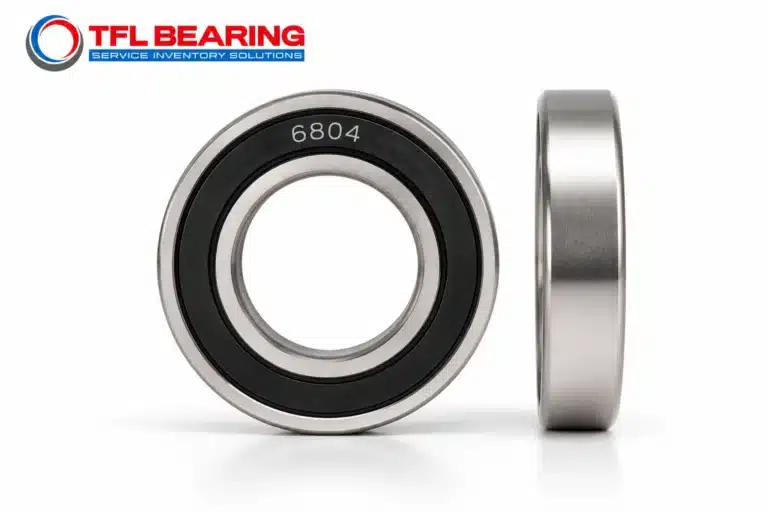
6804 Bearing: Dimensions, Specs, Seal Types and Equivalents
A 6804 bearing is a thin section, single row deep groove ball bearing with a 20 mm bore, a 32 mm outside diameter and a 7 mm width. Many brands sell the same size as 61804. It carries radial loads and light axial loads where space is tight. This guide puts the size, load ratings, […]
6904 Bearing: Dimensions, Load Ratings, Seal Types and Cross Reference
A 6904 bearing is a single row deep groove ball bearing with a 20 mm bore, a 37 mm outside diameter and a 9 mm width. It’s thin, light and built for radial loads at high speed. You’ll find it in bicycles, small electric motors, power tools and compact machines. This guide gives you everything […]
6805 Bearing: Dimensions, Specs, Seal Types and Bike Uses (2026)
A 6805 bearing is a thin, single row deep groove ball bearing that measures 25 mm bore, 37 mm outside diameter and 7 mm width. Most sellers write that as 25x37x7. You’ll find it in bike hubs, suspension pivots, ebike motors, robots and compact machines. SKF and FAG sell the same size as 61805. The […]
6902 Bearing: Dimensions, Seal Types, Specs and Replacement Guide
A 6902 bearing is a single row deep groove ball bearing with a 15 mm bore, a 28 mm outside diameter and a 7 mm width. You’ll often see the size written as 15x28x7. It’s slim and light, so it shows up in bike hubs, small electric motors, compact gearboxes and automation parts. On a […]
Trailer Bearings: Size Chart, Grease, Repacking and Replacement Guide
Trailer bearings are the tapered roller bearings inside each wheel hub that let the wheel spin smoothly on the axle spindle while carrying the load. Every hub has two: a larger inner bearing and a smaller outer bearing. Service them every 12 months or 12,000 miles, and they’ll keep you rolling safely for years. Ignore […]
Gearbox Bearing Guide: Types, Positions, Failure Signs and Selection
A gearbox bearing is the part that holds each shaft inside a gearbox and lets it spin with very little friction. It carries the force from the meshing gears, so the teeth stay lined up, quiet and cool. When one wears out, the noise, heat and damage spread fast. Below, you’ll learn about the bearings […]
6201 Bearing: Dimensions, Specs, Seal Types and Replacement Guide
A 6201 bearing is a single row deep groove ball bearing with a 12 mm bore, a 32 mm outside diameter and a 10 mm width. It’s a light series part, so it’s smaller than the 6301 that fits the same 12 mm shaft. You’ll find it in small motors, fans, scooter wheels and household […]
One Way Bearing: How It Works, Types, Uses and Bad Symptoms
A one way bearing is a bearing that spins freely in one direction and locks solid in the other. Small sprags or rollers inside wedge between two rings when you turn it backward, so torque passes straight through. You already know the idea from a bicycle: you can coast, but pushing the pedals still drives […]
6301 Bearing: Dimensions, Specs, Seals and Replacement Guide
A 6301 is a single row deep groove ball bearing with a 12 mm bore, a 37 mm outside diameter and a 12 mm width. It’s a medium series part, so it carries more load than the smaller 6201 on the same 12 mm shaft. You’ll find it in electric motors, pumps, fans and car […]
Flange Bearing Types: What They Are and How to Choose the Right One
A flange bearing is a bearing with a flat, extended rim (the flange) that lets you bolt it to a surface or seat it in a housing, so the shaft stays exactly where it should. The term actually covers three different parts: bolt on mounted units, flanged ball bearings and flanged sleeve bearings. This guide […]
Thrust Bearing Types Explained: How They Work and How to Choose One
A thrust bearing is a bearing built to carry axial load, the push that runs along a shaft instead of across it. Picture a lazy Susan. Plates press down on it, yet it still turns. That’s the whole idea. If the force runs across your shaft, you need a radial bearing. If it runs along […]
Pillow Block Bearings: Types, Sizes and How to Choose the Right One
Pillow block bearings are mounted bearings that hold a spinning shaft parallel to a flat surface. They use a bolt down housing with a bearing inside. You’ll find them on conveyors, fans, pumps and farm machines. This guide covers the types, how to read sizes, and the mistakes that wear them out early. What Is […]
Compare 8 reliable roller bearing suppliers for quality, support, and fast delivery. Find trusted options for your next industrial or engineering project.
Discover the hidden dangers of counterfeit industrial parts infiltrating supply chains. Learn how to identify fakes, secure genuine components, and protect your business from significant risks and financial losses.