









Quick Verdict: The main difference between cage and cageless (full complement) needle roller bearings is the trade-off between speed and load capacity.
Cageless bearings accommodate more rollers for maximum radial load capacity but are limited to lower speeds due to friction. Caged bearings separate rollers to reduce heat and friction, making them ideal for high-speed applications but with slightly reduced load limits.
⚙️ Engineering Selection Guide
- Choose Cageless (Full Complement) when: You have limited radial space but need to support extremely heavy static or oscillating loads (e.g., construction machinery, pivots).
- Choose Caged Assemblies when: The application involves continuous high-speed rotation (e.g., gearboxes, motors) where heat generation and lubrication flow are critical.
- Friction Factor: Caged bearings have significantly lower friction because the cage prevents rollers from rubbing against each other (counter-rotating contact).
- Lubrication: Cages create internal space that acts as a grease reservoir, whereas cageless designs require more frequent lubrication maintenance.
Needle roller bearings are widely used in modern machinery where compact size and high load capacity are essential. Their unique design allows engineers to achieve strong radial load support in applications where space limitations rule out larger bearing types. Among the most important design distinctions in needle roller bearings is whether they are built with a cage or without one. Understanding the difference between cage and cageless needle roller bearings is critical for selecting the correct bearing and ensuring long-term reliability in industrial systems.
What Is a Needle Roller Bearing
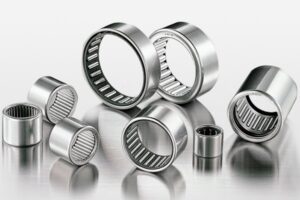
A needle roller bearing is a type of roller bearing that uses long, slender cylindrical rollers known as needle rollers. These rollers have a much smaller diameter compared to their length, allowing a large number of rolling elements to be packed into a small radial space. This design provides high radial load capacity while maintaining a compact profile.
Unlike ball bearings, which rely on point contact, needle roller bearings use line contact between rollers and raceways. This line contact significantly improves load distribution and reduces surface stress, making needle roller bearings suitable for applications that demand durability under heavy radial loads.

Basic Construction of Needle Roller Bearings
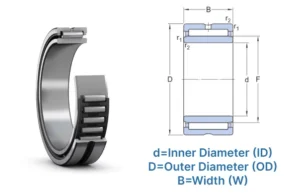
Needle roller bearings consist of needle rollers arranged between an inner and outer raceway. Depending on the design, the bearing may include an inner ring, outer ring, cage, or combinations of these elements. In some configurations, the shaft and housing act directly as raceways, reducing overall bearing size.
The presence or absence of a cage is one of the most important structural differences among needle roller bearings. This feature directly affects load capacity, speed capability, lubrication behavior, and service life.

What Is a Cage in Needle Roller Bearings
A cage in a needle roller bearing is a component that separates, guides, and positions the needle rollers evenly around the bearing circumference. Its primary function is to prevent rollers from contacting each other and to maintain uniform spacing during operation.
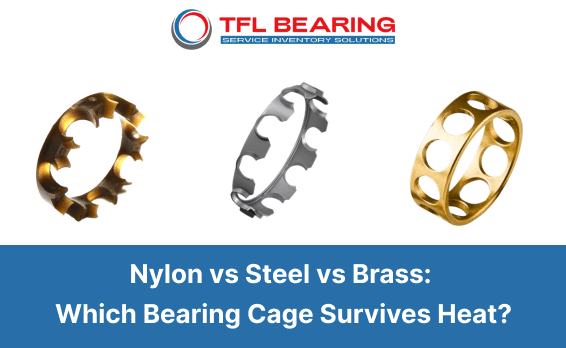
Cages are typically made from steel, brass, or engineered polymers, depending on application requirements. The cage improves bearing stability, reduces friction between rollers, and supports higher rotational speeds.
Cage-Type Needle Roller Bearings
Cage-type needle roller bearings are the most commonly used configuration in industrial applications. The cage holds the rollers in place, ensuring smooth rolling motion and controlled load distribution.
One of the main advantages of cage-type designs is improved speed capability. By preventing roller-to-roller contact, the cage reduces internal friction and heat generation, allowing the bearing to operate efficiently at moderate to high speeds. This makes cage-type needle roller bearings suitable for applications such as gearboxes, electric motors, compressors, and automotive transmissions.
Another benefit is improved lubrication performance. The cage creates space between rollers, allowing lubricant to flow more freely through the bearing, which helps maintain a stable lubrication film and reduces wear.
What Is A Cageless Needle Roller Bearing
Cageless needle roller bearings, also known as full complement needle roller bearings, do not include a cage. Instead, the bearing is filled with the maximum possible number of needle rollers. This design maximizes the contact area between rollers and raceways, resulting in higher radial load capacity.

By eliminating the cage, cageless bearings can support heavier loads than cage-type designs of the same size. This makes them particularly suitable for applications where load capacity is prioritized over speed.
Cageless Needle Roller Bearing Characteristics
The primary advantage of cageless needle roller bearings is their superior radial load capacity. With more rollers sharing the load, contact stress on individual rollers is reduced, improving load distribution under heavy static or slow-moving conditions.
However, cageless designs have limitations. The absence of a cage allows rollers to contact each other directly, increasing friction and heat generation. As a result, cageless needle roller bearings generally have lower speed limits compared to cage-type bearings. Lubrication requirements are also more critical, as increased friction demands effective lubrication to prevent wear.
Load Capacity Comparison
When comparing cage and cageless needle roller bearings, load capacity is a key differentiator. Cageless bearings offer the highest radial load capacity due to their full complement of rollers. This makes them ideal for heavy-duty applications where space constraints prevent the use of larger bearings.
Cage-type needle roller bearings, while offering slightly lower load capacity, still provide excellent performance for most industrial applications. Their balanced design allows them to handle substantial loads while maintaining better speed and lubrication characteristics.
Speed Capability and Operating Limits
Speed capability is another major factor in bearing selection. Cage-type needle roller bearings are better suited for higher rotational speeds because the cage minimizes roller interaction and friction. This results in lower operating temperatures and improved efficiency.
Cageless needle roller bearings are typically used in low-speed or oscillating applications. At higher speeds, the increased friction between rollers can lead to excessive heat and reduced bearing life. Therefore, operating speed must be carefully evaluated when selecting a cageless design.
Lubrication Considerations
Lubrication plays a crucial role in the performance of needle roller bearings, particularly in cageless designs. Cage-type bearings benefit from improved lubricant circulation due to the spacing created by the cage. This helps maintain a consistent lubrication film and reduces wear.
Cageless bearings require more careful lubrication management. Because the rollers are closely packed, lubricant flow is more restricted, and the risk of metal-to-metal contact increases if lubrication is insufficient. In such applications, high-quality lubricants and regular maintenance are essential.
Typical Applications of Cage-Type Needle Roller Bearings
Cage-type needle roller bearings are commonly used in applications where moderate to high speeds and reliable performance are required. These include automotive transmissions, industrial gearboxes, pumps, compressors, and machine tools.
Their balanced combination of load capacity, speed capability, and lubrication efficiency makes them a versatile choice for a wide range of mechanical systems.
Typical Applications of Cageless Needle Roller Bearings
Cageless needle roller bearings are often selected for applications involving heavy loads and low speeds. Examples include construction equipment, agricultural machinery, lifting devices, and industrial presses.
In these applications, the ability to support high radial loads outweighs the need for high rotational speed, making cageless designs an effective solution.
Selection Criteria for Cage vs Cageless Designs
Choosing between cage and cageless needle roller bearings requires careful evaluation of operating conditions. Load magnitude, speed, lubrication method, temperature, and space constraints must all be considered.
If the application involves higher speeds or continuous rotation, a cage-type needle roller bearing is typically the better choice. If the application involves heavy static loads or slow movement, a cageless design may offer superior performance.
Installation and Alignment Considerations
Proper installation is critical for both cage and cageless needle roller bearings. Misalignment or improper fits can significantly reduce bearing life, regardless of design. Shafts and housings must be prepared to meet specified tolerances, especially in configurations where raceways are integrated into the surrounding components.
Care must also be taken during installation to avoid damaging rollers or cages, as even minor damage can compromise bearing performance.
Importance of Technical Guidance
Selecting the correct needle roller bearing configuration often requires detailed technical knowledge. Manufacturer guidance and application resources help engineers understand the trade-offs between cage and cageless designs and avoid costly selection errors.
Detailed explanations of needle roller bearing configurations and application considerations, such as those provided by SDTFL Bearing, support informed decision-making and proper bearing selection in industrial environments.
Conclusion
Needle roller bearings are essential components in compact mechanical systems where high radial load capacity is required. The choice between cage-type and cageless needle roller bearings has a significant impact on load capacity, speed capability, lubrication behavior, and overall performance.
Cage-type needle roller bearings offer better speed performance and lubrication efficiency, making them suitable for a wide range of industrial applications. Cageless needle roller bearings provide maximum load capacity and are ideal for heavy-duty, low-speed environments. Understanding these differences enables engineers and maintenance professionals to select the right bearing for their specific application, ensuring reliability and long service life.
Select the Right Needle Roller Bearing for Your Project
Choosing between cage and cageless designs is critical for your machinery’s efficiency. At SDTFL Bearings, we specialize in high-performance needle roller bearings tailored to your specific load and speed requirements.
Whether you need the high-speed capability of cage assemblies or the heavy-duty strength of full complement designs, our engineering team is here to assist you.
Need technical advice or a quote?
- Email us directly: [email protected]
- Call our experts: +86 158 0663 1151
View Needle Roller Bearings Contact Support
Common Questions: Needle Roller Bearing Selection
What is a full complement needle roller bearing?
A “full complement” needle roller bearing is simply another term for a cageless bearing. It means the space between the races is completely filled (fully complemented) with rollers, leaving no room for a cage. This design maximizes load-carrying capacity.
Why can’t cageless bearings run at high speeds?
In a cageless bearing, adjacent rollers touch each other. Since the surfaces at the contact point are moving in opposite directions, this creates substantial sliding friction and heat. This “roller-to-roller” friction limits the bearing to low-speed or oscillating applications.
Which lasts longer: cage or cageless?
It depends on the application. Under heavy loads with slow movement, a cageless bearing will last longer because it distributes the load across more rollers. However, in high-speed applications, a caged bearing will last significantly longer because it runs cooler and retains lubricant better.
Does a cage reduce load capacity?
Yes, slightly. Because the cage material (steel or polymer) takes up physical space between the rollers, there are fewer rollers in the bearing compared to a cageless design. Fewer rollers mean less total surface area to support the load.