








Planter bearings are highly specialized, heavy-duty components engineered to support critical moving parts on agricultural planting equipment, such as gauge wheels, seed meters, and closing wheels. These rugged units are specifically designed to withstand extreme contamination, shock loads, and high operational speeds, ensuring precise seed depth and maximum crop yield.
Are you tired of dealing with premature bearing failure in your heavy machinery right in the middle of a critical planting window?
You are not alone. The harsh reality of agricultural work means that standard industrial bearings simply cannot survive the relentless assault of soil, moisture, and crop residue. Upgrading to purpose-built planter and seeder bearings is the only guaranteed way to eliminate costly downtime and protect your bottom line.
In this comprehensive technical guide, we will break down exactly what makes a world-class planter bearing. Here is what you will discover:
- Direct OEM cross-reference charts for leading planter brands.
- The microscopic mechanics of maintenance-free sealing technology.
- How radial runout directly dictates your seed trench depth.
- Pro-level installation standards from the factory floor.
The Core Pain Points of Planter Gauge Wheel Bearings
Planting season waits for no one. When a gauge wheel locks up or a seed disc wobbles, the financial impact is immediate. To understand why specialized bearings are required, we first need to dissect the brutal environment they operate in.
Here is the reality of the field.
Contamination from Dust, Mud, and Crop Residue
The primary enemy of any agricultural bearing is contamination ingress. Planters operate in a constant cloud of abrasive silicate dust, wet mud, and tough crop stalks.
If the sealing mechanism is compromised by even a fraction of a millimeter, abrasive particles enter the raceway. This creates a grinding paste with the internal lubricant. The result? Rapid spalling of the ball bearings and ultimate catastrophic failure. Standard single-lip seals are virtually useless in this scenario.
Severe Shock Loads from Uneven Terrain
Fields are rarely perfectly flat. Planters are pulled at speeds of 5 to 10 mph over rocks, hardened tractor ruts, and uneven furrows. This translates to immense, unpredictable dynamic shock loads on the bearing housing.
When selecting these components, we must look beyond basic static load ratings ($C_0$). The dynamic load capacity ($C$) is what keeps the gauge wheel stable during high-speed impacts. As defined by authoritative standards like ISO 281 for rolling bearings, calculating the basic rating life requires accounting for these severe fatigue-inducing conditions.
If the internal geometry of the raceway cannot handle these sudden radial and axial spikes, the bearing will permanently deform.
The High Cost of Premature Failure During Planting Season
Think about the cost of downtime.
A failed planter gauge wheel bearing might only cost a few dollars to replace, but the hours lost repairing it in the field can cost thousands in delayed planting and reduced yield potential. This is exactly why leading farms and distributors are moving away from cheap, generic parts.
To avoid these nightmares, it is crucial to source from reliable agricultural machinery bearing manufacturers who understand the strict metallurgical requirements of modern farming equipment.

OEM Replacement Cross-Reference: John Deere, Kinze & Case IH
Finding the exact replacement part for major planter brands is often the biggest hurdle for procurement teams.
Whether you are rebuilding a John Deere ExactEmerge or outfitting a high-speed Kinze planter, precision compatibility is paramount. Using generic agricultural bearings that “sort of fit” is a guaranteed recipe for premature failure.
Here is a definitive cross-reference guide to help you transition seamlessly to our heavy-duty alternatives.
John Deere & Kinze Planter Bearing Equivalents
John Deere and Kinze planters are known for their rugged performance, and their gauge wheel and seed meter bearings must match that standard. Below are the direct interchange numbers for critical components.
| OEM Brand | OEM Part Number | Application / Location | TFL Bearing Equivalent |
|---|---|---|---|
| John Deere / Kinze | AA21480 / GA2014 | Seed Opener Disk | 204PY3 / 204RY2 |
| John Deere / Case IH | AN212132 / 324461A1 | Gauge Wheel | 5203KYY2 / 5203VVAN |
| Kinze / Great Plains | GA6171 / 822-170C | Gauge Wheel | 5203KYY2 / 5203VVAN |
| John Deere | AA205732 | Closing / Press Wheel | 204RR6 / 205VV |
If you are looking for a broader range of industrial and agricultural replacement parts beyond these specific planter numbers, we invite you to explore the complete TFL industrial bearing product line to find the exact dimensions and specifications you need.
Why Maintenance-Free Bearings Are Non-Negotiable for Planters
Let’s talk about maintenance in the field.
In the middle of the spring planting window, stopping a 24-row planter to manually grease dozens of individual gauge wheels and closing wheels is completely unviable.
This is exactly why modern planter bearings must be engineered as sealed, maintenance-free units. But understand this: not all “sealed” bearings are created equal.
Advanced Triple-Lip Sealing Technology
A standard single-lip rubber seal will fail within hours in a dusty furrow.
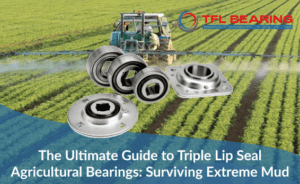
Premium agricultural bearings utilize advanced triple-lip (or heavy-duty shroud) sealing mechanisms. These seals feature three distinct contact points against the inner ring.
- Outer Lip: Acts as a primary deflector against large soil clods, moisture, and tough crop residue.
- Middle Lip: Traps finer, abrasive silicate dust that manages to bypass the first defense.
- Inner Lip: Ensures the vital lubricating grease never escapes the raceway.
High-Performance Lifetime Lubrication
The lubricant inside is just as critical as the forged steel surrounding it.
Our planter bearings are factory-filled with premium, high-temperature polyurea-thickened grease. This specific formulation heavily resists water washout—a critical factor given the moisture levels in early spring soils—and maintains its viscosity across extreme temperature fluctuations during high-speed planting operations.
Expert Insight from Jessica Jia (TFL Bearing Manufacturing):
“I have analyzed the inside of cheap, generic gauge wheel bearings after just one day in the field—the internal raceways are literally packed with a grinding paste of mud and destroyed grease. That is exactly why we highly recommend upgrading to our heavy-duty triple-lip seals for severe agricultural environments. However, every farm’s soil conditions and machinery setups are unique. Every farm’s soil profile is uniquely demanding, which means there is no one-size-fits-all in agriculture. We bring the advanced metallurgy and manufacturing muscle to the table, but you hold the ultimate blueprint. You define the exact specifications your equipment demands, and our factory floor turns those requirements into bulletproof steel.”

Internal Clearance and Radial Runout: The Secret to Planting Accuracy
Most farmers and operators blame the seed meter or the gauge wheel arm for uneven planting depth. The truth is often buried inside the planter bearing itself.
If the gauge wheel or closing wheel cannot maintain a perfectly uniform rotation, the seed will be placed at inconsistent depths. In agriculture, a quarter-inch difference in seed trench depth can result in delayed emergence, uneven plant stands, and ultimately, a significant yield loss. Two critical bearing specifications govern this rotational precision.
How Radial Runout Affects Seed Trench Depth
Radial runout is the measure of how much a rotating object deviates from a perfect circle.
Imagine a planter moving at 8 mph. If a gauge wheel bearing has excessive radial runout, the wheel itself will exhibit a microscopic wobble or vibration. This vibration is transmitted directly through the planter unit and into the soil, creating a jagged, inconsistent seed trench floor rather than a smooth, firm furrow.
Precision-ground raceways are essential to minimize this runout. The geometric accuracy of the inner and outer rings directly impacts the smoothness of the ball’s path, reducing high-frequency vibrations that disrupt the seed drop process.
Choosing the Optimal Internal Clearance for Agricultural Applications
Internal clearance is the total distance the inner ring can be moved relative to the outer ring in the radial direction.
For standard electric motors, tight clearances are preferred. However, agricultural environments are entirely different. Planter bearings operate under high shock loads, sudden temperature changes from morning frost to afternoon sun, and microscopic flexing of the planter chassis.
If a bearing is selected with an internal clearance that is too tight (e.g., C2 or standard clearance), the severe operating conditions can cause the balls to bind against the raceway, leading to rapid overheating and catastrophic failure. Conversely, if the clearance is too loose, the gauge wheel will wobble excessively, destroying the seed trench accuracy.
This is why understanding the specific application—whether it is a high-speed disk opener or a trailing closing wheel—dictates the correct clearance specification (such as C3 or specialized agricultural clearances).
TFL Bearing Installation & Tolerance Standards
Even the highest-quality triple-lip sealed planter bearing will fail prematurely if installed incorrectly. Proper installation practices and understanding tolerance fits are just as critical as the bearing’s design.
Shaft and Housing Fits for Gauge Wheels
The fit between the bearing’s inner ring and the gauge wheel arm shaft, as well as the outer ring and the wheel housing, must be precise. These fits dictate how the bearing handles dynamic loads without slipping or creeping.
A transition or slight interference fit is typically required on the rotating ring to prevent it from spinning on the shaft, which would rapidly wear down the metal and ruin the entire assembly.
Expert Installation Tips to Prevent Seal Damage
The most common cause of early failure in the field is seal damage during installation.
- Never strike the bearing directly: Using a hammer directly on the inner or outer ring, or worse, the seal itself, is a guaranteed way to destroy the microscopic integrity of the sealing lips.
- Apply force to the correct ring: When pressing a bearing onto a shaft, force must only be applied to the inner ring. When pressing it into a housing, force must only be applied to the outer ring.
- Use dedicated installation tools: A proper bearing press or specialized installation sleeves distribute the force evenly, protecting the seals from deformation and the raceways from brinelling.
Customizing Your Specs: You Decide, We Deliver
The agricultural landscape is incredibly diverse. The bearing requirements for planting corn in the heavy, wet clays of the Midwest are drastically different from those needed for dryland wheat in arid regions.
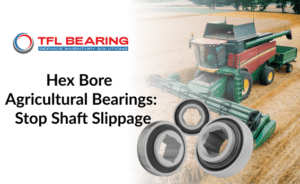
This is why flexibility is key. Whether you need specific bore styles (hex, round, or square), specialized grease fills, or custom shroud designs, you have complete control over the final product. While we can guide you through the technical nuances and provide expert recommendations, the ultimate configuration rests in your hands. If you are developing specialized equipment and need to explore unique dimensional requirements or custom sealing options, you can review our customized bearing services FAQ to understand exactly how we bring your specifications to life on our factory floor.
Wholesale Discounts, Customization & Lead Times
When you are outfitting hundreds of planter row units or supplying a regional network of agricultural dealerships, unit cost and supply chain reliability become just as critical as load capacities and seal designs.
We understand the seasonal pressures of the agricultural industry. A delayed bearing shipment in March can disrupt the entire spring planting schedule. This is why our manufacturing and logistics are structured entirely around B2B efficiency.
Bulk Order Tiered Pricing for Distributors & OEMs
Sourcing premium agricultural replacement parts should not erode your profit margins.
By manufacturing in-house and selling directly to global distributors and OEM planter manufacturers, we eliminate the massive markups typically associated with major brand-name replacement parts. We offer transparent, tiered pricing structures based on volume. Whether you are ordering a single pallet to test our triple-lip seal performance or multiple shipping containers for the upcoming season, your cost per unit drops significantly with scale.
Fast Global Shipping & Consistent Lead Times
Volatility in the global supply chain is a massive risk for equipment manufacturers and parts distributors.
To combat this, we maintain robust raw material inventories and employ agile manufacturing schedules to guarantee consistent lead times. We partner with top-tier global freight forwarders to ensure your heavy-duty planter bearings arrive on schedule, whether by sea freight for massive bulk orders or expedited air freight for critical pre-season shortages.
Ready to upgrade your planter bearing supply chain? Contact our engineering and sales team today to request a customized quote, exact lead times, and free product samples to test in your own agricultural environment.

Frequently Asked Questions
What is the difference between standard industrial bearings and planter bearings?
Standard industrial bearings are designed for clean environments. Planter bearings feature heavy-duty triple-lip seals and specialized polyurea grease to survive extreme dust, mud, and agricultural crop residue without requiring daily maintenance.
Can I cross-reference my OEM John Deere or Kinze bearing with TFL?
Yes. We manufacture direct heavy-duty equivalents for major agricultural machinery brands. For example, the popular John Deere AA21480 gauge wheel bearing is directly replaced by our 204RY2 model, offering identical or superior load and sealing performance.
How often should I replace planter gauge wheel bearings?
This depends heavily on your soil conditions and acreage. However, by upgrading to our maintenance-free, triple-lip sealed bearings, many operations eliminate mid-season replacements entirely, often running multiple heavy seasons before a complete row-unit rebuild is necessary.
Ready to Eliminate Premature Bearing Failure?
Stop losing time and money during the critical planting season. Upgrade to TFL’s heavy-duty planter bearings engineered for maximum yield and zero maintenance.
- Direct OEM Replacements
- Customizable Sealing Options
- Wholesale B2B Pricing