







Are you tired of paying premium prices for replacement bearings at the local tractor dealership just because they come in a branded green or red box? You are definitely not alone.
For decades, agricultural machinery owners and wholesale buyers have been forced to navigate a confusing maze of proprietary part numbers. We promise to reveal the supply chain secrets behind these codes and show you exactly how to identify the standard industrial bearings hidden inside your equipment.
In this ultimate agricultural bearing replacement guide, we will unpack:
- The reality of OEM markups and how to bypass them.
- Step-by-step protocols for accurately measuring any agricultural bearing.
- The engineering secrets behind SKF, FAG, and NTN suffix codes.
- A high-frequency interchange matrix for top tractor and implement brands.
Cracking the Code: The Truth Behind Expensive OEM Part Numbers
To reduce maintenance overhead, you first need to understand how the agricultural parts supply chain actually works. It is one of the industry’s best-kept secrets.
The OEM Markup Reality
Major agricultural machinery brands engineer brilliant combine harvesters, planters, and tillage equipment. However, they generally do not forge their own bearing steel or mold their own seals. Instead, they source these critical rotational components from specialized global bearing manufacturers.
Once a standard high-quality bearing arrives at the OEM facility, it is placed into a branded box and assigned a proprietary part number (such as JD9202 or 842110). This simple repackaging process often comes with a 30% to 60% retail markup. When you buy that box, you are paying for the brand name, not a magically superior piece of steel.
Industry Standard vs. Proprietary Numbers
The vast majority—over 90%—of the bearings spinning inside your farm equipment are built to universal industry standards. Whether it is a standard 6200-series deep groove ball bearing or a 200-series insert bearing with a heavy-duty seal, the underlying dimensions and load capacities are internationally standardized by organizations like ISO and the ABMA.
OEMs assign proprietary numbers specifically to make it difficult for you to shop around. They want to force you back to the dealership parts counter. By learning to cross-reference these proprietary numbers to their true industrial designations, you unlock the ability to source directly from a dedicated agricultural bearings supplier at wholesale or discounted rates.
Expert Insight from Jessica Jia
Many farmers and procurement managers fall into the trap of thinking an OEM bearing is somehow “custom-built” for their specific machine. In reality, once you decode that expensive OEM number, you usually find a completely standard 207-series hex bore bearing or a common agricultural hub assembly. Sourcing the exact same specification—with identical GCr15 steel and triple-lip seals—direct from the manufacturer saves massive overhead without sacrificing a single hour of field reliability.
How to Accurately Measure Agricultural Bearing Dimensions
If the OEM part number on your combine or planter is completely rusted away or illegible, do not panic. The universal language of bearings is written in millimeters and inches. By accurately measuring the physical dimensions of your worn component, you can easily find a replacement from a reputable agricultural bearings supplier.
The Essential Tools: Ditch the Tape Measure
A standard tape measure or a plastic ruler is virtually useless for bearing identification. Agricultural bearings, even those following imperial North American standards, are manufactured with tolerances measured in thousandths of an inch or hundredths of a millimeter.
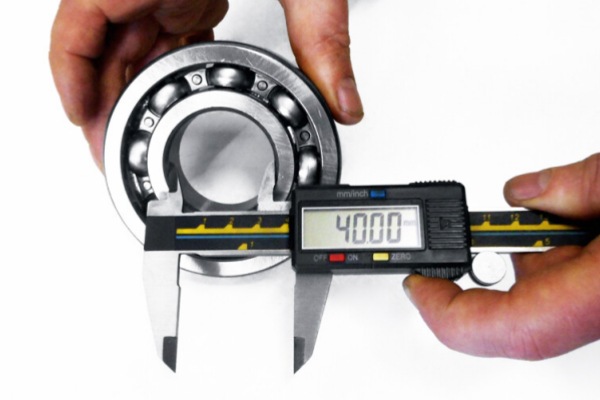
You must use a high-quality digital caliper (calibrated to at least two decimal places) to capture the exact dimensions. A micrometer is excellent for measuring driveshaft wear, but a digital caliper remains the industry standard tool for identifying the bearing unit itself.
Step-by-Step Measurement Protocol
When attempting a cross-reference, you need three primary measurements, always recorded in this specific sequence: Inner Diameter (ID) x Outer Diameter (OD) x Width (W).
- Inner Diameter (Bore): Measure the exact distance across the inside of the inner ring. For specialized non-round agricultural shafts, always measure the distance across the flat surfaces (for hex or square bores), never corner-to-corner.
- Outer Diameter: Measure the exact distance straight across the outside circular face of the bearing outer ring. Pay close attention to the shape: note whether the outer ring is cylindrical (straight) or spherical (curved, designed to swivel and self-align inside a cast-iron flange housing).
- Width (Thickness): Measure the total thickness of the assembly. Note that many agricultural insert bearings feature an extended inner ring on one or both sides. This extension provides critical extra shaft support and space for locking collars.
Expert Insight from Jessica Jia
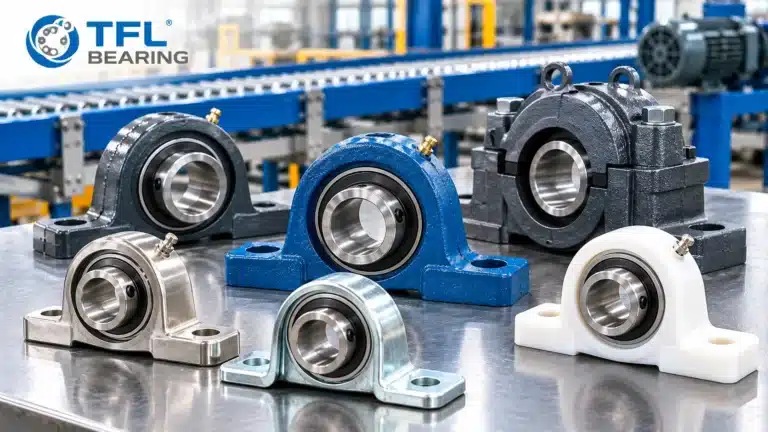
While our online catalog is constantly expanding to showcase our full engineering capabilities, please know that our manufacturing facility produces thousands of high-demand components daily. Whether you need standard Insert Bearings, complete cast-iron Flange Bearing Units, or heavy-duty Hub Assemblies, we have the production lines ready. We provide tailored engineering recommendations. Whether that means standard nitrile seals for regular use or upgrading to premium triple-lip configurations for extreme mud, we equip you with the technical insights so you can make the absolute best choice for your specific field conditions. If you cannot find your specific product category online, simply contact our team directly for immediate wholesale pricing and global availability.
Decoding Suffixes: SKF, FAG, and NTN Agricultural Codes
When you look at the side of a bearing, you will usually see a string of letters and numbers, such as 206-KRRB6 or 6207-2RS1/C3. To an untrained eye, it looks like alphabet soup. To an engineer, it is a complete resume of the bearing’s capabilities.
Why the Suffix Matters More Than the Prefix
In the bearing industry, the base number (such as 6206, 207, or W208) dictates the physical dimensions: the bore size, the outer diameter, and the basic width. If you get the base number right, the bearing will physically fit onto your shaft.
However, in agriculture, the “suffix” (the letters and numbers at the end) is what dictates survival. The suffix tells you about the sealing technology, the internal radial clearance, the cage material, and the type of grease packed inside.
While the dimensional base numbers are universally standardized, every major manufacturer has their own proprietary suffix language. When comparing premium bearing brands like SKF, FAG, Timken, or NTN, understanding how their specific seal codes cross-reference is the key to finding a true drop-in replacement.
The Ultimate Seal & Clearance Glossary
To help you confidently navigate your next wholesale order or machinery repair, here is a decoded glossary of the most critical agricultural bearing suffixes you will encounter in the field.
| Common Suffix Code | Brand Origin / Usage | Engineering Meaning & Agricultural Application |
|---|---|---|
| 2RS / 2RSR / DDU | Generic / FAG / NSK | Standard Rubber Seals (Both Sides): Good for light dust and moisture. Not recommended for heavy tillage or direct mud contact. |
| KRRB / KPPB | Timken (Fafnir) Standard | Heavy-Duty Shroud Seals: Features an extended inner ring and rugged triple-lip seals. The gold standard for planters, balers, and disc harrows. |
| C3 / C4 | Universal Standard | Internal Radial Clearance: Indicates clearance greater than normal (C3) or even larger (C4). Essential for farm equipment to handle heavy shock loads and thermal expansion without seizing. |
| AG / Agri | SKF / Various | Agricultural Hub Unit: Denotes a pre-assembled, greased-for-life hub unit specifically engineered with multi-lip labyrinth seals for extreme contamination. |
| T / TN9 | Universal / SKF | Polyamide (Plastic) Cage: A fiberglass-reinforced cage. It handles misalignment and shock loads better than standard steel cages, making it ideal for high-vibration harvesters. |
By understanding this matrix, you can easily realize that a high-priced OEM bearing stamped with a proprietary brand logo is often just a standard industrial bearing with a KRRB seal and C3 clearance.
High-Frequency Interchange Table: John Deere, Case IH & More
The agricultural industry is dominated by a few major equipment manufacturers. Whether you are running a fleet of green, red, or blue machines, the rotating components inside them are often identical. By cross-referencing these high-frequency OEM part numbers to their universal industrial equivalents, you can streamline your inventory and dramatically cut costs.
The Drop-In Replacement Matrix
Below is a quick-reference interchange matrix for some of the most commonly requested bearings in the North American market. These industrial equivalents are engineered to meet or exceed the dynamic load ratings and sealing requirements of the original parts.
| OEM Brand & Part Number | Machine Application | Standard Industrial Equivalent | Bearing Type / Key Feature |
|---|---|---|---|
| John Deere® JD9248 | Disc Harrows, Tillage | W208PPB5 / DS208TT5 | 1-1/8″ Square Bore, Heavy-Duty Triple-Lip Seal |
| John Deere® AN212132 | Planter Row Units (Gauge Wheel) | 5203KYY2 / 5203VVAN | Double Row Angular Contact, Specialized Ag Seal |
| Case IH® 211587C91 | Baler Drive Rolls, Combines | 206KRRB6 / HPC104KRRB | 1-1/8″ Hex Bore, Extended Inner Ring |
| Case IH® 1968131C1 | Tillage / Cultivators | GW211PPB3 | 1-1/2″ Square Bore, Spherical Outer Ring for Flange |
| Great Plains® 822-095C | Seeders, Coulter Hubs | 203KRR2 / 203RRAR10 | 0.64″ Round Bore, Robust Contamination Sealing |
Disclaimer: OEM names and part numbers are used for cross-reference purposes only. TFL Bearing manufactures premium aftermarket replacements that are fully compatible with these systems.
If your specific OEM part number is not listed in the matrix above, do not worry. This is only a fraction of what is available. By measuring your existing part and consulting a comprehensive agricultural bearings supplier catalog, you can find the exact match for almost any application, from legacy tractors to the latest precision planters.
Why a Drop-In Replacement Reduces Costs by 30%+ (Without Sacrificing Quality)
When procurement managers hear the terms “aftermarket” or “drop-in replacement,” their first concern is often a compromise in field reliability. The reality, however, is that sourcing from a direct agricultural bearings supplier eliminates bloated supply chain margins while delivering identical or superior engineering.
Supply Chain Efficiency
The 30% to 50% cost reduction does not come from using cheaper steel or thinner seals. It comes directly from supply chain efficiency. When you buy an OEM-branded bearing from a local dealership, that single component has already been marked up by the original bearing manufacturer, the tractor OEM, the regional distributor, and finally, the retail dealer.
By purchasing a high-quality drop-in replacement, you are simply bypassing three layers of middlemen. You are acquiring the exact same standard industrial component directly from the source.
Material and Load Capacity Parity
In heavy-duty applications, steel quality is non-negotiable. A reputable aftermarket supplier utilizes the exact same high-purity GCr15 (52100) vacuum-degassed bearing steel as the top-tier global brands. This ensures that the dynamic load rating—the critical metric that determines how much force a bearing can handle before fatiguing—remains identical to the original OEM specification.
In many cases, a direct replacement can actually exceed original specifications by allowing you to upgrade from standard dual-lip seals to heavy-duty triple-lip seals designed specifically for your region’s unique soil and mud conditions.
Wholesale Quality Inspection Standards & Pitfall Guide
If you are responsible for maintaining a large fleet, a cooperative, or an implement manufacturing line, securing reliable discount agricultural machinery bearings through wholesale channels is critical to your profitability. However, the global market is flooded with subpar products. You must know how to audit a supplier.
Evaluating an Agricultural Bearings Supplier
Do not simply choose the lowest bidder on an online marketplace. A true manufacturing partner will operate with complete transparency. Before placing a bulk order, you should always request documentation verifying that their production facility adheres to strict international standards.
For instance, reputable manufacturers ensure their dimensional tolerances and load ratings comply with the rigorous guidelines set by the ABMA (American Bearing Manufacturers Association) or ISO. Look for suppliers who can provide certified metallurgical test reports confirming the purity of their steel and precise heat-treatment curves proving uniform hardening.
Hardware Configuration Options
When you place a wholesale order, you are not limited to whatever the dealership happens to have on the shelf. You gain the ability to specify the exact hardware configuration your equipment demands.
At TFL Bearing, our engineering team is fully prepared to provide professional recommendations regarding housing materials (standard cast iron vs. high-impact ductile iron for extreme cold), internal clearances (C3 vs. C4), and advanced sealing technologies (such as labyrinth or heavy-duty triple-lip seals).
Stop paying a premium for a cardboard box and a proprietary logo. Whether you need a single custom run of hex bore bearings or a massive wholesale order of flange units for the upcoming planting season, reach out to our engineering and sales team today. We will help you cross-reference any OEM number and secure factory-direct pricing on premium, field-proven replacements.

Frequently Asked Questions
Can any standard industrial bearing replace an agricultural OEM bearing?
Not necessarily. While the base dimensions (Inner Diameter, Outer Diameter, and Width) might perfectly match a standard industrial bearing, agricultural environments are brutal. A true agricultural replacement requires specific suffixes indicating heavy-duty seals (like a triple-lip KRRB design) and increased internal clearance (such as C3) to survive mud, dust, and severe shock loads without failing.
Will using an aftermarket drop-in replacement void my machinery’s warranty?
Generally, no. Using a high-quality aftermarket replacement part that meets or exceeds the original equipment manufacturer’s specifications does not automatically void your warranty. The key is ensuring you source premium components from a reputable manufacturer that uses high-purity GCr15 steel and adheres to strict ISO or ABMA dimensional standards.
How do I know if I need a C3 or standard internal clearance for my farm equipment?
Farm machinery operating under heavy vibration, sudden shock loads, or wide temperature variations almost always requires C3 (greater than normal) internal clearance. This prevents the rolling elements from binding when the metal expands. Our engineering team at TFL Bearing will gladly provide data-backed recommendations based on your specific implement, ensuring you have the exact clearance and configuration to maximize your machinery’s lifespan.
Stop Overpaying for OEM Agricultural Bearings
Ready to bypass dealership markups? Let our engineers help you cross-reference your proprietary part numbers. Get factory-direct wholesale pricing on premium drop-in replacements engineered for extreme field conditions.
Request a Cross-Reference & Wholesale Quote Today