








Are you tired of replacing expensive driveshafts just because a standard round bearing and a sheared keyway destroyed the entire assembly during peak harvest season? You are not alone.
In the relentless environment of modern agriculture, equipment downtime is not just an inconvenience—it is a massive hit to your bottom line. By upgrading to geometric locking mechanisms, you can fundamentally prevent the catastrophic failures caused by keyway wallowing and set screw loosening.
In this comprehensive engineering guide, we will unpack the mechanics behind these rugged components, specifically covering:
- The mechanical reasons agricultural machinery relies on geometric bores.
- Exclusive torque transmission lab data comparing hex vs. round bore designs.
- Critical tolerance charts and dimensional standards for North American equipment.
- Pro tips for eliminating shaft wear and maximizing the lifespan of your heavy-duty bearing units.
Why Agricultural Equipment Prefers Hex and Square Bore Designs
Traditional round bore bearings rely on friction, set screws, or keyways to secure the inner ring to the shaft. While effective in clean, stable industrial settings, this conventional approach often fails under the brutal realities of agricultural field operations.
The Harsh Reality of Field Operations
Planters, balers, and combine harvesters operate in the absolute worst conditions for rotating equipment. The bearings are constantly subjected to extreme shock loads, heavy vibrations, and relentless contamination from mud, dust, and crop debris.
When a sudden shock load hits a round bore shaft—such as a disc harrow striking a rock—the force is instantly transferred to the tiny surface area of the keyway. Over time, this intense, localized stress causes the keyway to “wallow out” or shear completely. Once the key fails, the shaft begins to spin inside the bearing’s inner ring, generating immense heat and destroying both components in minutes.
Eliminating Keys and Set Screws for Maximum Reliability
The brilliance of the hex bore and square bore design lies in its simplicity: geometric locking. By matching a hexagonal or square inner ring with a corresponding shaft, the rotational force is distributed evenly across multiple flat surfaces rather than a single stress concentration point.
This design offers several distinct mechanical advantages:
- Zero Slippage: The physical shape makes rotational slippage mathematically impossible as long as the shaft integrity holds.
- No Loosening Hardware: Set screws are notorious for backing out under intense vibration. Geometric bores eliminate the need for them entirely.
- Rapid Assembly and Maintenance: During high-pressure harvest windows, sliding a hex bearing onto a hex shaft takes seconds, requiring no key alignment or specialized locking collars.
Expert Insight from Jessica Jia
Based on extensive feedback from our North American agricultural clients at TFL Bearing, we consistently see that over 60% of premature driveshaft failures in tillage and harvesting equipment stem from keyway wear, not the failure of the bearing’s rolling elements. Switching to a hex bore design fundamentally shifts the mechanical bottleneck. Instead of relying on a fragile keyway to handle immense torque, the entire geometry of the shaft absorbs the load, dramatically extending the maintenance lifecycle of the entire assembly.

Torque Transmission Efficiency & Anti-Slip Mechanisms
In high-draft farming applications, rotational force is both your primary tool and your most destructive enemy. Understanding exactly how torque transfers from the driveline to the implement is the key to preventing mid-season breakdowns.
How Geometrical Locking Prevents Slippage
A standard round shaft bearing relies almost entirely on the shear strength of a tiny steel key inserted into a milled slot. When a heavy load is applied, 100% of the rotational energy is concentrated on the sharp edges of that single keyway.
Conversely, hex bore agricultural bearings and their square counterparts utilize “geometrical locking.” The bearing’s inner ring is broached to perfectly match the polygonal profile of the shaft. This allows the driving force to be distributed evenly across six (or four) large flat surfaces.
This structural shift provides massive upgrades in power transmission:
- Surface Area Amplification: The physical contact area transmitting the load increases exponentially compared to a single point on a keyway.
- Stress Load Distribution: Severe shock loads—like a tillage disc hitting a buried rock—are dispersed safely, preventing localized metal fatigue and micro-cracking.
- Fail-Safe Engagement: Due to the physical shape, catastrophic slippage is mathematically impossible as long as the shaft retains its basic structural integrity.
Torque Tester Lab Data: Hex vs. Round Bores
To quantify this mechanical advantage, engineers regularly conduct rigorous torsional yield tests. When evaluating upgrades within a comprehensive agricultural bearing catalog, ensuring you have an adequate safety margin for peak torque is critical.
Below is a comparative data set illustrating the dramatic difference in failure thresholds when subjecting standard 1-1/8 inch shafts to extreme, sudden torque loads in a testing environment.
| Bore Design (1-1/8″ Shaft) | Power Transmission Mechanism | Average Slippage/Failure Threshold (Nm) | Primary Failure Mode Under Extreme Load |
|---|---|---|---|
| Standard Round Bore | 1/4″ Keyway & Set Screws | 450 – 520 Nm | Keyway shearing, set screw back-out, shaft wallowing |
| Hex Bore | 6-Sided Geometrical Lock | 1,400 – 1,600 Nm | Shaft torsional yield (Bearing structure remains intact) |
| Square Bore | 4-Sided Geometrical Lock | 1,800 – 2,100 Nm | Maximum draft load capacity; shaft twisting at insertion point |
As the test data demonstrates, hexagonal bore designs can handle nearly four times the torsional load before failure. Furthermore, when an overload failure does eventually occur, it is typically the solid steel shaft yielding, rather than the bearing connection violently breaking and sending shrapnel into the machinery.

Size Specifications & Tolerance Charts for Hex/Square Bores
Navigating agricultural bearing dimensions can be a headache, especially when dealing with older equipment and international supply chains.
Here is the truth: A mismatch of even a few thousandths of an inch between the shaft and the hex bore will lead to devastating vibration and premature failure.
Navigating North American vs. Global Standards
In the North American agricultural market, imperial measurements dominate the landscape. The vast majority of planters, seeders, and tillage equipment rely on standard hex shaft sizes such as 7/8″, 1″, 1-1/8″, and 1-1/4″.
However, as global manufacturing standardizes, many modern European and Asian implements utilize metric dimensions (e.g., 22mm, 25mm, or 30mm hex shafts). You cannot force an imperial bearing onto a metric shaft, or vice versa, without compromising the geometrical lock.
Before ordering replacements, always use digital calipers to measure the distance across the flats (not the corners) of your driveshaft.
Crucial Inner Ring Tolerance Limits
Unlike high-speed electric motors that require an interference fit, agricultural bearings need specific clearances. Why?
Because farm equipment operates in harsh environments where thermal expansion and debris ingress are daily realities. A clearance fit allows the bearing to slide onto the shaft during assembly and accommodates minor shaft warping under heavy draft loads.
| Nominal Hex Bore Size | Standard Shaft Tolerance (Across Flats) | Bearing Inner Ring Tolerance | Recommended Fit Type |
|---|---|---|---|
| 1″ (25.4mm) | +0.000″ / -0.003″ | +0.001″ / +0.005″ | Clearance Fit (Slip) |
| 1-1/8″ (28.575mm) | +0.000″ / -0.004″ | +0.002″ / +0.006″ | Clearance Fit (Slip) |
| 1-1/4″ (31.75mm) | +0.000″ / -0.004″ | +0.002″ / +0.006″ | Clearance Fit (Slip) |
Expert Insight from Jessica Jia
I cannot stress this enough: never use a sledgehammer to force a hex bore bearing onto a shaft. If it doesn’t slide on with light tapping, check the shaft for burrs, rust, or twisting. Forcing the fit will preload the internal rolling elements, destroying the raceways before the tractor even leaves the barn.
Installation Guidelines for Agricultural Flange Bearing Units
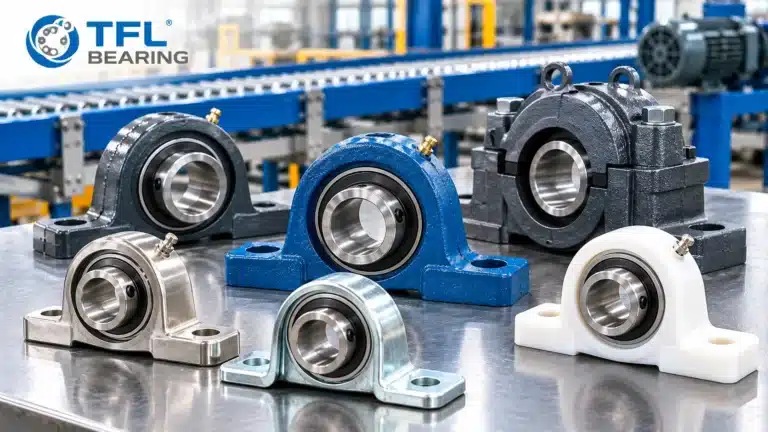
A high-quality hex bearing is useless if the cast iron housing is installed incorrectly. Flange bearing units (often 2-bolt or 4-bolt designs) must be precisely aligned to prevent catastrophic bind.
Alignment Procedures for Heavy-Duty Housings
When mounting flange units on the sheet metal side panels of a combine or baler, you must ensure the shaft passes through the exact center of the bore without binding.
First, loosely install all hardware on both the drive-side and tail-side flange units. Rotate the shaft by hand. If you feel resistance or “catch points,” the housings are not concentric. You must shim the housings or adjust the mounting brackets until the shaft spins freely.
Hardware Selection & Torque Specs
The vibration generated by agricultural machinery will back out improperly torqued bolts in a matter of hours. You need high-tensile hardware (Grade 8 or equivalent) and proper thread-locking compounds.
When discussing hardware options and housing materials (such as standard cast iron versus high-impact ductile iron), please note that our team at TFL Bearing is always happy to offer professional engineering suggestions based on your field conditions, but the final choice of hardware configuration always remains firmly with you, the customer.
Follow this standard sequence for a 4-bolt flange:
- Step 1: Finger-tighten all four bolts.
- Step 2: Snug the top-left bolt, then the bottom-right bolt (criss-cross pattern).
- Step 3: Snug the top-right bolt, then the bottom-left bolt.
- Step 4: Apply final torque specifications using a calibrated torque wrench, following the same star pattern.
Expert Insight from Jessica Jia
Never tighten the mounting bolts fully before the shaft is completely installed and aligned. Tightening the flange first and then forcing the shaft through will create a massive axial preload. This invisible stress will cause the bearing to overheat and seize within the first 50 acres of operation.
Popular North American Hex & Square Bore Models (OEM Interchange)
Finding the exact replacement for your agricultural machinery should not be a guessing game. TFL Bearing manufactures premium hex and square bore insert bearings that serve as 100% drop-in replacements for top-tier brands (including Fafnir/Timken, Peer, and BCA equivalents).
Below is a quick-reference interchange guide for the most highly requested high-torque bearings in the North American market, engineered with our heavy-duty triple-lip seals (often denoted by the “KRRB” or “PPB” suffixes).
| Industry Standard Interchange Number | Bore Shape & Size (Imperial) | Outer Diameter (OD) | Seal Type | Typical Agricultural Application |
|---|---|---|---|---|
| 206KRRB6 / HPC104KRRB | 1-1/8″ Hex Bore | 62 mm | Triple-Lip (Heavy Duty) | Planter Row Units, Baler Drive Rolls |
| 207KRRB12 / HPC105KRRB | 1-1/4″ Hex Bore | 72 mm | Triple-Lip (Heavy Duty) | Forage Harvesters, Conveyor Drives |
| 208KRRB / HPC108KRRB | 1-1/2″ Hex Bore | 80 mm | Triple-Lip (Heavy Duty) | Combine Augers |
| W208PPB5 / AS208-118 | 1-1/8″ Square Bore | 80 mm | Triple-Lip (Heavy Duty) | Disc Harrows, Tillage Equipment |
| W211PPB2 / AS211-112 | 1-1/2″ Square Bore | 100 mm | Triple-Lip (Heavy Duty) | Heavy Tillage, Cultivator Shanks |
Note: All TFL interchangeable insert bearings are manufactured using high-purity GCr15 steel and are fully compatible with standard cast iron or ductile iron 2-bolt and 4-bolt flanged housings.

Troubleshooting Premature Failure from Shaft Wear
Even with the geometrical locking advantages of hex and square bores, agricultural driveshafts are not immune to wear. The harsh reality of field operations means you must proactively monitor the interface between the shaft and the bearing.
Identifying “Fretting Corrosion”
If you pull a hex bearing off a planter driveshaft and notice a fine, reddish-brown or black powder coating the metal surfaces, you are looking at fretting corrosion.
According to tribology standards (such as those studied by the STLE – Society of Tribologists and Lubrication Engineers), fretting corrosion occurs when two unlubricated metal surfaces experience high-frequency micro-movements under heavy load. In agricultural applications, the microscopic clearance between the hex shaft and the bore allows for tiny vibrations. Over time, these vibrations tear microscopic particles from the steel, which instantly oxidize and turn into abrasive “rust dust.”
This dust acts like lapping compound, accelerating the wear until the hex shaft becomes rounded out and fails completely.
Lubrication Strategies for Non-Round Shafts
Agricultural bearings rarely die from old age—they die from contamination and lack of lubrication.
To combat fretting corrosion and seal out abrasive mud, premium bearing units rely on heavy-duty sealing technology. Standard single-lip seals are virtually useless in a tillage environment. You must upgrade to triple-lip seals (or shroud seals) that aggressively wipe the shaft clean as it rotates.
Furthermore, applying a liberal coating of high-moly anti-seize compound or specialized extreme-pressure (EP) grease to the hex shaft before installing the bearing is a critical preventative step. This creates a protective film that dampens the micro-vibrations causing fretting wear.
Expert Insight from Jessica Jia
When inspecting your equipment pre-season, do not just look at the bearing seals. Grab the driveshaft near the bearing housing and try to physically lift or twist it. If you feel any slop or clicking, fretting corrosion has already altered the dimensional tolerances of your shaft. Replacing the bearing alone will not fix the issue; the worn shaft will destroy the new bearing within days.
Procurement Tips for High-Cost-Performance Custom Hex Bore Bearings
Sourcing reliable hex and square bore agricultural bearings requires more than just finding the lowest price per unit. When a single failed bearing can halt a half-million-dollar combine harvester, the true cost of a cheap component becomes painfully obvious.
Material & Seal Upgrades for Extreme Conditions
The foundation of a durable bearing is the steel. Ensure your supplier utilizes high-purity GCr15 bearing steel, subjected to precise vacuum degassing and uniform quenching processes. This guarantees the raceways can withstand extreme shock loads without micro-fracturing.
When evaluating custom orders, pay close attention to the seal design. Can the manufacturer provide custom triple-lip nitrile (NBR) seals or galvanized steel flingers designed specifically for your muddy or dusty operational environment?
Evaluating Manufacturer Capabilities
A trustworthy B2B supplier should operate with total transparency. Before placing a bulk order for OEM agricultural equipment, request detailed metallurgical test reports and dimensional inspection data.
Whether you are upgrading your current product line or need a specialized bore dimension that standard catalogs do not carry, partnering with an experienced manufacturing facility is your best insurance policy against field failures.
To discuss your specific torque requirements, environmental challenges, or to request custom dimensional tolerances, reach out to our engineering team today. We are ready to help you build machinery that outlasts the harvest season.

Frequently Asked Questions
What is the main advantage of a hex bore bearing over a standard round bore?
The primary advantage is geometrical locking. Instead of relying on a fragile keyway or set screws to transmit torque, a hex bore distributes rotational forces evenly across six flat surfaces. This entirely eliminates keyway shearing and shaft slippage, making it ideal for the extreme shock loads common in agricultural applications.
Can I install an imperial hex bore bearing on a metric agricultural shaft?
No. Even if the sizes appear visually similar, using an imperial bearing (like a 1-1/8″) on a metric shaft (like a 28mm or 30mm) will result in improper clearance. Too tight, and you will damage the bearing during installation; too loose, and the resulting micro-vibrations will cause rapid fretting corrosion and destroy both components.
Why do my flange bearing units keep failing on my planter?
Premature failure of agricultural flange bearing units is rarely due to the bearing’s load capacity. It is almost always caused by improper installation alignment, which creates massive axial preload, or inadequate sealing against mud and dust. Upgrading to triple-lip seals and ensuring the shaft spins freely before final torqueing will solve most issues.