Radial load acts perpendicular to a bearing shaft. In a belt-driven motor, it may come from belt tension. In a gearbox, it can result from gear mesh forces. In a conveyor, crusher, pump, or other industrial machine, rotor weight and process forces may also create substantial radial loading.
The important question is not simply whether a bearing carries radial load.
You need to know how much of the external force reaches each bearing, whether the bearing also carries axial load, and how the resulting equivalent bearing load affects calculated fatigue life.
For some radial bearings under a purely radial, constant load, the equivalent dynamic bearing load (P) may be equal to the radial load (F_r). Once axial load, multiple force locations, shock loading, or varying operating conditions are involved, the calculation becomes more application-specific.
This guide explains how to identify radial load sources, estimate bearing reaction loads, understand the difference between (F_r) and (P), evaluate the effect of load on L10 life, and choose an appropriate bearing type.
What Is Radial Load on a Bearing?
A radial load is a force acting perpendicular to the axis of shaft rotation.
If a horizontal shaft is pulled downward or sideways by a belt, gear, pulley, rotor, or process force, the supporting bearings normally develop reaction forces to support that load.
Common sources include:
Load Source
How Radial Load Is Generated
Bearing Consideration
Belt drive
Belt tension pulls the shaft sideways
Bearing reaction and overhung load
Spur gear
Gear tooth force has a radial component
Load direction and shaft deflection
Electric motor
Rotor weight and electromagnetic forces
Clearance, temperature, and alignment
Pump
Impeller and hydraulic forces
Combined radial and axial loading
Conveyor pulley
Belt tension and conveyed material
High continuous radial load
Crusher
Process force and impact
Shock load and static safety
Rolling mill
High process force
Bearing rigidity and load distribution
A common mistake is to treat the external force on a shaft as the load carried by each bearing.
The shaft load and the individual bearing reaction loads are not automatically the same.
The position of the force relative to the bearing supports can substantially change the load carried by Bearing A and Bearing B.
How Do You Calculate Radial Load on a Bearing?
There is no single universal radial-load formula for every machine.
The normal engineering process is:
Identify the force generated by the belt, gear, rotor, pulley, or process.
Identify where that force acts on the shaft.
Locate the bearing support positions.
Use static equilibrium to estimate the reaction at each bearing.
Add other relevant forces and load directions.
Determine the equivalent bearing load required for bearing-life evaluation.
A simple two-bearing shaft example shows why shaft geometry matters.
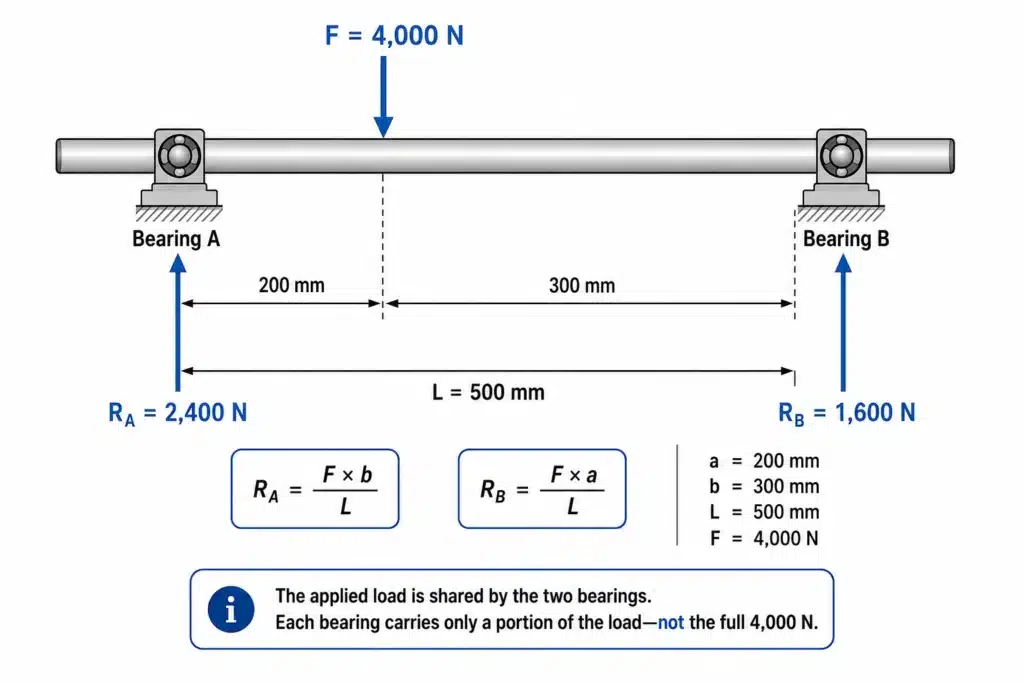
Simple Two-Bearing Shaft Reaction Example
Assume a shaft is supported by Bearing A and Bearing B.
A radial force of 4,000 N acts between the bearings.
Applied radial force (F = 4,000\ N)
Distance from Bearing A to the force (a = 200\ mm)
Distance from the force to Bearing B (b = 300\ mm)
Total bearing span (L = 500\ mm)
For this simplified static arrangement: R_A = \frac{F \times b}{L} R_A = \frac{4,000 \times 300}{500} = 2,400\ N
The reaction at Bearing B is: R_B = \frac{F \times a}{L} R_B = \frac{4,000 \times 200}{500} = 1,600\ N
The two reactions balance the applied 4,000 N force: R_A + R_B = 4,000\ N
The important conclusion is:
The external 4,000 N radial force is not a 4,000 N load on both bearings. In this simplified example, Bearing A carries approximately 2,400 N and Bearing B carries approximately 1,600 N.
In a simplified two-support shaft, an external radial force is distributed between the two bearing reactions according to the force position and bearing span.
This example is intentionally simplified.
An actual bearing arrangement may also include:
overhung pulley or gear loads;
forces acting in several planes;
helical gear axial force;
coupling forces;
bearing preload;
shaft deflection;
housing deformation;
shock or impact loading;
variable duty cycles.
For an overhung pulley located outside the bearing span, the nearest bearing may carry a much higher reaction than the external radial force alone suggests because the overhung force also creates a bending moment.
This is one reason repeated failure of the same bearing position should not be investigated only by checking the bearing’s catalog load rating.
The shaft layout and load position also need to be reviewed.
Radial Load Is Not Always the Same as Equivalent Dynamic Bearing Load
A second common source of confusion is the difference between radial load (F_r) and equivalent dynamic bearing load (P).
(F_r) is the actual radial component acting on the bearing.
(P) is the equivalent dynamic bearing load used in basic rating-life calculations.
For an applicable radial bearing under a purely radial and constant load:
P = F_r
However, many industrial bearings carry both radial load (F_r) and axial load (F_a).
Depending on the bearing design and the relationship between the radial and axial components, the equivalent dynamic load may use a form such as:
P = XF_r + YF_a
where:
(P) = equivalent dynamic bearing load;
(F_r) = radial bearing load;
(F_a) = axial bearing load;
(X) = radial load factor;
(Y) = axial load factor.
X and Y are not universal constants.
Do not take an X or Y value from a different bearing series and apply it to your bearing. The applicable calculation conditions and factors should be checked against the technical data for the selected bearing type and designation.
Bearing fatigue life does not decrease in direct proportion to increasing load.
The basic rating-life relationship used in the ISO 281 framework is:
L_{10} = \left(\frac{C}{P}\right)^p
where:
(L_{10}) = basic rating life in millions of revolutions;
(C) = basic dynamic load rating;
(P) = equivalent dynamic bearing load;
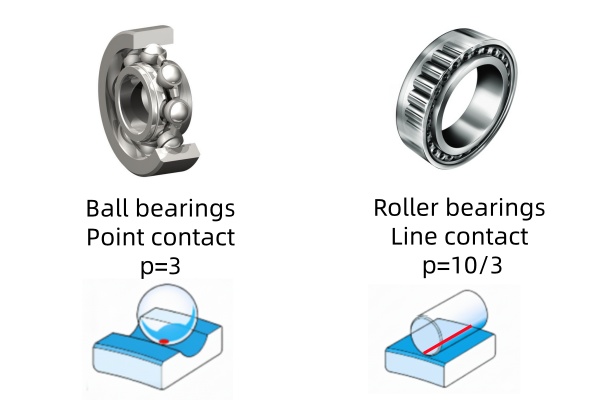
(p = 3) for ball bearings;
(p = 10/3) for roller bearings.
The ISO 281 basic rating-life framework is associated with a 90% reliability basis under the conditions defined by the standard. Lubrication, contamination, operating temperature, material condition, and other factors can require a more detailed life evaluation.
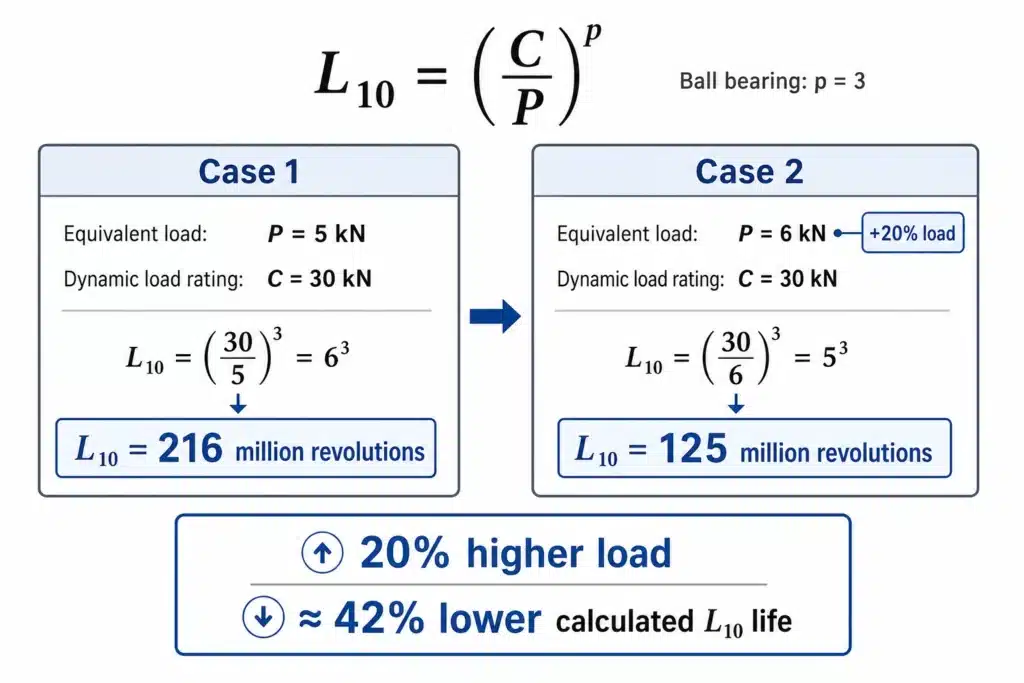
What Happens if Bearing Load Increases by 20%?
Consider a simplified ball-bearing example.
Assume:
C = 30\ kN
At an equivalent load of: P = 5\ kN
the basic calculated life is: L_{10} = \left(\frac{30}{5}\right)^3 L_{10} = 216\ million\ revolutions
Now increase the equivalent load by 20%: P = 6\ kN
The calculated life becomes: L_{10} = \left(\frac{30}{6}\right)^3 L_{10} = 125\ million\ revolutions
In this simplified example:
A 20% increase in equivalent bearing load reduces the calculated basic rating life from 216 million to 125 million revolutions—about a 42% reduction.
This is why a seemingly moderate increase in belt tension, process load, shaft reaction, or unintended preload can have a much larger effect on calculated bearing life.
Because load is raised to a life exponent in the basic rating-life relationship, a moderate increase in equivalent load can produce a much larger reduction in calculated L10 life.
Does the L10 Result Predict Exact Bearing Service Life?
No.
The calculated L10 value is a rating-life result, not a guaranteed field service interval.
Actual performance can be affected by:
lubrication film condition;
contamination;
bearing internal clearance;
mounting fits;
shaft and housing accuracy;
misalignment;
temperature;
speed;
vibration;
shock loading;
current damage in electric motors;
storage and handling damage.
For example, a bearing with an acceptable calculated (C/P) relationship may still fail prematurely if increased contact load is combined with insufficient lubricant film thickness.
There is no single “best radial-load bearing” for every machine.
The bearing route depends on radial load, axial load, speed, shaft size, available radial space, misalignment, shock, lubrication, and the locating/non-locating arrangement.
Operating Condition
Common Bearing Route
Why It May Be Selected
Check Before Selection
Moderate radial load and high speed
Deep groove ball bearing
Low friction and broad speed capability
Axial load, clearance, sealing
High radial load
Cylindrical roller bearing
High radial load capacity and rigidity
Axial locating requirement
High radial load with limited radial space
Needle roller bearing
High load capacity relative to section height
Shaft raceway and alignment
Heavy radial load with misalignment
Spherical roller bearing
Self-aligning capability
Speed, friction, heat
Combined radial and axial load
Tapered roller or angular contact bearing
Designed for combined loading
Load direction and arrangement
Shock-heavy industrial duty
Heavy-duty roller-bearing route
Better load distribution for severe duty
Static safety and housing rigidity
Ball and roller bearing geometries distribute rolling contact loads differently.
Deep Groove Ball Bearings
Deep groove ball bearings are widely used when the application requires relatively low friction, high rotational speed, and radial load support with some axial load capability.
They are common in electric motors, fans, pumps, and general industrial machinery.
However, do not choose a deep groove ball bearing only because the shaft rotates quickly. Internal clearance, fits, operating temperature, sealing, and axial load can change the correct selection.
The NU, N, NJ, NUP, and other configurations do not perform the same axial locating function. The rib arrangement needs to match the shaft’s locating and non-locating requirements.
For example, a bearing with excellent radial load capacity may still be the wrong selection if the shaft arrangement requires axial location in both directions.
Needle Roller Bearings
Needle roller bearings are useful when designers need substantial radial load capacity in a limited radial section.
The compact geometry is an important advantage, but some needle-bearing arrangements require the shaft or housing to act as a raceway.
In that case, nominal shaft diameter alone is not enough. Raceway hardness, surface finish, geometry, and alignment need to be checked.
Spherical Roller Bearings
Spherical roller bearings are frequently considered for heavy radial loads where shaft deflection or angular misalignment cannot be completely avoided.
Typical applications include crushers, vibrating equipment, conveyors, and other severe industrial systems.
Self-aligning capability does not mean mounting accuracy can be ignored. Fits, internal clearance, lubrication, and housing condition still affect bearing operation.
Because load direction and bearing arrangement matter, selection should include the opposing bearing, endplay or preload strategy, and the direction of the axial component.
When Does Radial Load Cause Premature Bearing Failure?
High load is not the only radial-load-related failure mechanism.
A bearing may fail even when the catalog dynamic load rating appears adequate because the real load distribution is different from the original assumption.
Operating Observation
Possible Load-Related Cause
What to Check
Temperature rises after a process-load increase
Higher contact load or lubricant film reduction
Actual load, lubricant, internal clearance
Raceway spalling repeats
Excess equivalent load or poor distribution
(C/P), shaft reactions, alignment
The same bearing position repeatedly fails
Unequal support reaction
Shaft geometry and force position
Raceway shows edge loading
Misalignment or housing deformation
Shaft alignment and housing rigidity
Failure follows belt retensioning
Excess belt-induced radial load
Belt tension and overhung force
Bearing becomes hot after mounting
Fit-induced clearance reduction or preload
Shaft/housing fits and internal clearance
Failure occurs after shock events
Static overload or brinelling
Peak load and static safety factor
Repeated Failure at One Bearing Position
If Bearing A repeatedly fails while Bearing B remains in acceptable condition, do not immediately replace both bearings with a higher-capacity series.
First ask:
Is the external force closer to Bearing A?
Is there an overhung pulley near Bearing A?
Has belt tension increased?
Is the housing at Bearing A distorted?
Is the shaft bending under process load?
Is the bearing fit reducing radial internal clearance?
Is the bearing exposed to additional axial load?
The reaction calculation in the earlier example shows why one bearing may carry substantially more load than another.
Misalignment and Edge Loading
Misalignment can change how load is distributed across rolling elements and raceways.
Instead of the intended load distribution, a concentrated contact region may develop. This can increase local stress even when the total external force has not changed.
Applications with unavoidable shaft deflection or alignment variation may require a self-aligning bearing route, such as a spherical roller bearing, but the entire bearing arrangement still needs to be reviewed.
Radial Load, Lubrication, and Heat
Increasing load can increase contact pressure and make lubricant film formation more demanding.
A temperature increase does not prove that radial overload is the cause. Over-lubrication, excessive preload, reduced clearance, misalignment, seal friction, or excessive speed may produce similar symptoms.
This is why a bearing-temperature problem should be reviewed together with:
recent load changes;
speed;
lubricant type and quantity;
bearing clearance;
shaft and housing fits;
alignment;
drive tension.
What Information Is Needed to Select a Bearing for Radial Load?
For a simple replacement where the existing bearing has operated reliably, the full manufacturer and bearing designation may be enough to begin a cross-reference review.
For a new arrangement or a repeated bearing failure, more application information is normally required.
A simple shaft sketch with dimensions is often more useful than a general statement such as “heavy radial load.”
If you already have an SKF, FAG, NSK, NTN, TIMKEN, INA, or another bearing designation, you can also start with our bearing cross-reference guide and send the complete suffix for interchange verification.
Frequently Asked Questions About Radial Load on Bearings
How much radial load can a bearing handle?
There is no universal radial-load limit for a bearing type. Check the basic dynamic load rating (C), basic static load rating (C_0), equivalent load (P), target life, speed, and actual operating conditions for the specific bearing designation. Two bearings with the same bore diameter can have very different load ratings.
Does increasing radial load reduce bearing life?
Yes. Under the basic rating-life relationship, calculated bearing life decreases nonlinearly as equivalent dynamic load increases. In the simplified ball-bearing example in this guide, increasing (P) from 5 kN to 6 kN reduced calculated L10 life from 216 million to 125 million revolutions.
Is bearing radial load the same as shaft load?
Not necessarily. An external shaft force is distributed through the shaft and its supports. The force position, bearing span, and overhung geometry determine the reaction at each bearing. Individual bearing loads should be calculated from the shaft arrangement.
Which bearing carries more radial load on a two-bearing shaft?
It depends on the position of the applied force relative to the two bearings. In a simple supported shaft, the bearing closer to the applied force normally carries a greater reaction. Overhung forces can produce a different and more severe reaction pattern because of the additional bending moment.
Are roller bearings always better for high radial loads?
No. Roller bearings generally provide high radial load capacity, but the correct choice also depends on speed, axial load, friction, misalignment, available space, shaft design, and mounting arrangement. A cylindrical roller bearing that is excellent for radial load may be incorrect if the shaft requires a different axial locating function.
Is radial load the same as equivalent dynamic bearing load?
No. (F_r) is the radial load component. (P) is the equivalent dynamic bearing load used for rating-life calculations. Under applicable purely radial conditions, (P) may equal (F_r). Under combined loading, bearing-specific load factors may be required.
Can excessive belt tension damage a bearing?
Yes. Increasing belt tension can increase the radial force on the shaft and the reaction loads at the supporting bearings. The effect may be especially severe when the pulley is overhung outside the bearing span.
Why does the same bearing keep failing in the same position?
Repeated failure at one position can indicate unequal reaction load, an overhung force, housing distortion, misalignment, incorrect fits, insufficient lubrication, or additional heat and contamination at that location. Replacing the bearing without checking the bearing position and shaft arrangement may repeat the failure.
What data should I send for radial-load bearing selection?
Send the current bearing designation, shaft diameter, bearing positions, distance between supports, load magnitude and direction, load location, speed, operating temperature, duty cycle, lubrication method, and any available failure photographs or vibration information.
Need Help Reviewing a Bearing Arrangement?
If you are not sure how the radial force is distributed between two bearings, send TFL a shaft sketch, the current bearing designations, bearing positions, load direction, and operating speed.
Our team can review the available application information and help identify bearing types or replacement options for further technical confirmation and quotation.
Request Bearing Selection Review
Use the Bearing Cross-Reference Guide
Engineering note: The calculation examples in this article are simplified educational examples and are not a substitute for a complete shaft-system or bearing-life analysis. Final bearing selection should use the actual load spectrum, bearing manufacturer’s technical data, fits, internal clearance, lubrication, temperature, and machine operating conditions.
{
“@context”: “https://schema.org”,
“@type”: “FAQPage”,
“mainEntity”: [
{
“@type”: “Question”,
“name”: “How much radial load can a bearing handle?”,
“acceptedAnswer”: {
“@type”: “Answer”,
“text”: “There is no universal radial-load limit for a bearing type. Check the basic dynamic load rating C, basic static load rating C0, equivalent load P, target life, speed, and actual operating conditions for the specific bearing designation. Two bearings with the same bore diameter can have very different load ratings.”
}
},
{
“@type”: “Question”,
“name”: “Does increasing radial load reduce bearing life?”,
“acceptedAnswer”: {
“@type”: “Answer”,
“text”: “Yes. Under the basic rating-life relationship, calculated bearing life decreases nonlinearly as equivalent dynamic load increases. In the simplified ball-bearing example in this guide, increasing P from 5 kN to 6 kN reduced calculated L10 life from 216 million to 125 million revolutions.”
}
},
{
“@type”: “Question”,
“name”: “Is bearing radial load the same as shaft load?”,
“acceptedAnswer”: {
“@type”: “Answer”,
“text”: “Not necessarily. An external shaft force is distributed through the shaft and its supports. The force position, bearing span, and overhung geometry determine the reaction at each bearing. Individual bearing loads should be calculated from the shaft arrangement.”
}
},
{
“@type”: “Question”,
“name”: “Which bearing carries more radial load on a two-bearing shaft?”,
“acceptedAnswer”: {
“@type”: “Answer”,
“text”: “It depends on the position of the applied force relative to the two bearings. In a simple supported shaft, the bearing closer to the applied force normally carries a greater reaction. Overhung forces can produce a different and more severe reaction pattern because of the additional bending moment.”
}
},
{
“@type”: “Question”,
“name”: “Are roller bearings always better for high radial loads?”,
“acceptedAnswer”: {
“@type”: “Answer”,
“text”: “No. Roller bearings generally provide high radial load capacity, but the correct choice also depends on speed, axial load, friction, misalignment, available space, shaft design, and mounting arrangement. A cylindrical roller bearing that is excellent for radial load may be incorrect if the shaft requires a different axial locating function.”
}
},
{
“@type”: “Question”,
“name”: “Is radial load the same as equivalent dynamic bearing load?”,
“acceptedAnswer”: {
“@type”: “Answer”,
“text”: “No. Fr is the radial load component. P is the equivalent dynamic bearing load used for rating-life calculations. Under applicable purely radial conditions, P may equal Fr. Under combined loading, bearing-specific load factors may be required.”
}
},
{
“@type”: “Question”,
“name”: “Can excessive belt tension damage a bearing?”,
“acceptedAnswer”: {
“@type”: “Answer”,
“text”: “Yes. Increasing belt tension can increase the radial force on the shaft and the reaction loads at the supporting bearings. The effect may be especially severe when the pulley is overhung outside the bearing span.”
}
},
{
“@type”: “Question”,
“name”: “Why does the same bearing keep failing in the same position?”,
“acceptedAnswer”: {
“@type”: “Answer”,
“text”: “Repeated failure at one position can indicate unequal reaction load, an overhung force, housing distortion, misalignment, incorrect fits, insufficient lubrication, or additional heat and contamination at that location. Replacing the bearing without checking the bearing position and shaft arrangement may repeat the failure.”
}
},
{
“@type”: “Question”,
“name”: “What data should I send for radial-load bearing selection?”,
“acceptedAnswer”: {
“@type”: “Answer”,
“text”: “Send the current bearing designation, shaft diameter, bearing positions, distance between supports, load magnitude and direction, load location, speed, operating temperature, duty cycle, lubrication method, and any available failure photographs or vibration information.”
}
}
]
}
With a decade of engineering experience, I specialize in bearing selection, installation, and technical evaluation. At TFL BEARING, I’ve delivered precision-engineered supply solutions to 200+ global clients. Backed by our 20+ years of supply chain expertise, I ensure reliable performance for demanding applications. Contact me for one-stop procurement solutions.
Nylon vs Steel vs Brass: Which Bearing Cage Survives Heat?
Compare Nylon (TN9), Pressed Steel, and Machined Brass (M) bearing cages under high heat. Explore 4 practical case scenarios to prevent premature cage failure.
Why High-Temp Grease Costs More Than High-Temp Bearings
Discover why repacking bearings with high-temperature grease can cost more than high-temp bearings—and the critical speed traps to avoid before swapping them.
Learn why bearing overheating has no universal temperature limit, how to read temperature trends, and when a hot bearing needs investigation or shutdown.
Bearing vs. Bushing vs. Bare Axle: How to Choose the Right Joint for Your Mechanism
When a shaft, pin, axle, or rotating component needs support, the choice is not simply “use a bearing” or “save money with a hole and pin.” A bare axle, a bushing, and a rolling bearing each solve a different problem. A bare axle offers the simplest structure and the lowest initial cost. A bushing adds […]
How We Sourced 500 Hard-to-Find EZO SRW0ZZ Bearings for an Urgent Order
Finding an EZO SRW0ZZ listing online was not the difficult part. Finding 500 pieces of actual available stock was. A customer came to TFL Bearings with a time-sensitive requirement for 500 EZO SRW0ZZ miniature bearings. The exact part number was already known, but the customer could not obtain the required quantity through local supply channels. […]
Defeating Brackish Water Corrosion in Heavy-Duty Marine Engine Bearings
Discover why brackish water destroys standard marine bearings. Explore the metallurgical advantages of advanced self-lubricating alloys to stop corrosion.
Explore the exact engineering behind heavy-duty marine thrust bearings. Learn how hydrodynamic fluid films prevent failure under massive propeller loads.
Discover why standard greases fail in saltwater. Master the exact maintenance protocols to purge emulsified grease and extend marine bearing lifespans.
Discover why repacking bearings with high-temperature grease can cost more than high-temp bearings—and the critical speed traps to avoid before swapping them.