







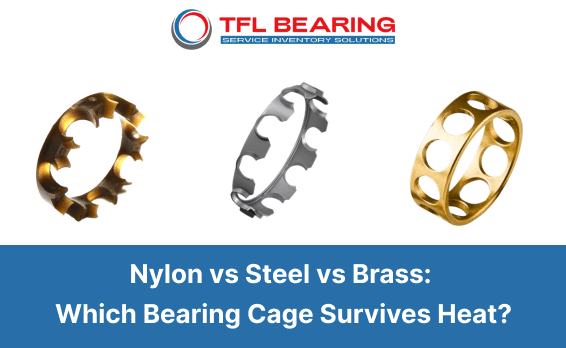
Nylon vs Steel vs Brass: Which Bearing Cage Survives Heat?
Compare Nylon (TN9), Pressed Steel, and Machined Brass (M) bearing cages under high heat. Explore 4 practical case scenarios to prevent premature cage failure.
Read articleCompare leading global bearing brands and explore compatible TFL alternatives by model, product type and application.
View all Brands GuideMatch manufacturer part numbers with interchangeable TFL bearing options and model-selection support.
Browse bearing solutions by equipment, operating environment and industry.
Practical guidance on bearing selection, applications, maintenance and sourcing.
Compare Nylon (TN9), Pressed Steel, and Machined Brass (M) bearing cages under high heat. Explore 4 practical case scenarios to prevent premature cage failure.
Read article
Find answers about quality, orders, technical support and after-sales service.
Use our articles, reference tools and customer resources to support sourcing decisions.
Learn about TFL Bearing, our quality systems and supply capabilities.
View all About & CapabilitiesAccess engineering support and services throughout the purchasing process.
View all Services & SupportExplore customer projects, sourcing partnerships and ways to contact our team.
View all Work With TFL
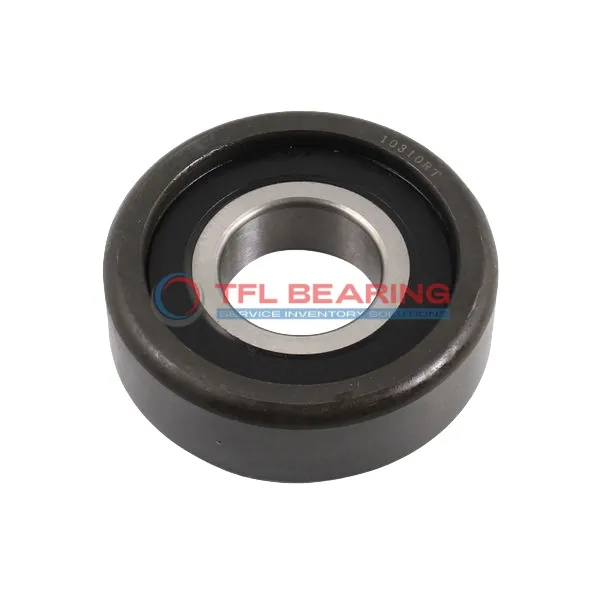
The MG 207 FFM mast guide bearing is a sturdy unit measuring 35mm in inner diameter and 100.35mm in outer diameter, with a width of 28.45mm. Made for heavy-duty use, it handles dynamic loads up to 30,530 N and static loads up to 25,490 N.
Its chamfered edges ensure smooth installation, while the robust construction provides reliable performance in demanding conditions. The bearing weighs just over 1.1kg, offering a good balance of strength and portability.
This model is ideal for mast guidance systems or other applications where precise alignment and load handling are crucial. Its durable design makes it a dependable choice for industrial machinery and equipment.
Compatible with OEM standards, it’s a practical option for replacements or upgrades. Suitable for environments requiring consistent performance under substantial loads.
How Is MG 207 FFM Bearing Engineered for Reliability?
MG 207 FFM Bearing features a robust design with an inner diameter of 35.000 mm and an outer diameter of 100.35 mm, ensuring stability under heavy loads.
Its dynamic capacity of 30,530 N and static capacity of 25,490 N make it suitable for demanding applications.
The chamfered edges reduce stress concentrations, enhancing durability.
With a weight of 1.1113 kg, it balances strength and practicality for various industrial uses.
Industrial Uses of MG 207 FFM Bearing
MG 207 FFM Bearing is commonly used in heavy machinery, such as cranes and lifts, where its robust design handles significant radial loads. The chamfered edges ensure smooth integration with adjacent components.
In automotive applications, MG 207 FFM Bearing supports steering columns and suspension systems, providing stability under varying conditions. Its high dynamic capacity makes it suitable for frequent load changes.
For automation systems, MG 207 FFM Bearing excels in robotic arms and conveyor belts, offering precise movement and durability. The stainless steel construction ensures long-term performance in demanding environments.
Where Is MG 207 FFM Bearing Used?
MG 207 FFM Bearing is ideal for construction equipment, like bulldozers and excavators, where its static capacity withstands heavy impacts. The weight-to-strength ratio balances performance and efficiency.
In agricultural machinery, MG 207 FFM Bearing ensures reliable operation in tractors and harvesters, even in dusty conditions. The corrosion-resistant materials extend its lifespan in outdoor settings.
Built for Heavy-Duty Use: MG 207 FFM Bearing
MG 207 FFM Bearing is a go-to choice for industrial fans and blowers, where its dynamic load capacity handles continuous rotation. The precise dimensions ensure minimal vibration during operation.
For packaging machines, MG 207 FFM Bearing provides smooth motion control, essential for high-speed production lines. Its durability reduces downtime, making it a cost-effective solution.