









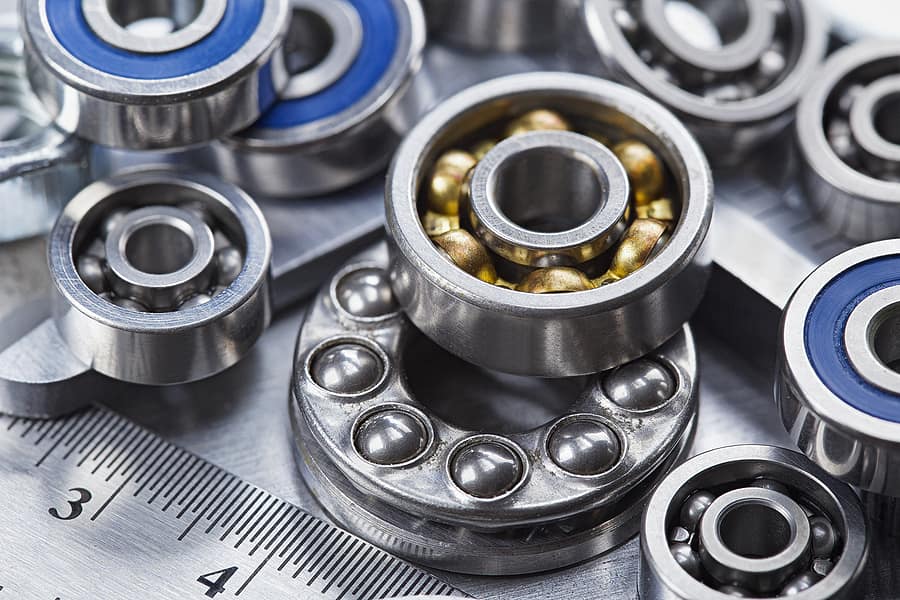
There is no single best lubricant for every ball bearing. Grease is commonly used for standard industrial ball bearings because it stays in place, simplifies sealing, and can reduce routine maintenance. Oil is often considered when additional heat removal, circulation, filtration, or a specialized high-speed lubrication system is required.
The correct choice depends on the bearing type, operating speed, temperature, load, contamination, sealing arrangement, lubricant viscosity, and the original equipment or bearing manufacturer’s recommendations.
Rust and corrosion are visible examples of poor surface protection, but bearing lubrication does much more than prevent rust. A suitable lubricant helps separate contacting surfaces, reduce friction and wear, control heat, and protect the internal bearing components from contamination and corrosion.

Why Is Ball Bearing Lubrication Important?
When two contacting surfaces move relative to each other, friction is generated at the contact interface. In engineering systems, lubrication is used to reduce friction and wear by creating a lubricating film between moving surfaces.
In a ball bearing, the rolling elements and raceways operate under concentrated contact loads. Although the bearing is designed for rolling motion, sliding and microslip can still occur at specific internal contact areas. A suitable lubricant helps maintain separation between metal surfaces and supports the rolling contacts during operation.
Proper lubrication can also help control heat, reduce wear, limit corrosion, and protect against contamination. For this reason, lubricant selection and lubricant condition can have a significant effect on bearing performance and service life.

Grease or Oil: Which Is Better for Ball Bearings?
For many standard ball bearing applications, grease is the more common starting point. It is easier to retain inside the bearing arrangement, is less likely to leak than oil, and can support relatively simple sealing and maintenance arrangements.
Oil becomes more attractive when the lubrication system must also remove heat, circulate lubricant, filter contaminants, or continuously supply lubricant to a high-speed or thermally demanding bearing arrangement.
The decision should not be made from bearing type alone. A deep groove ball bearing in a standard electric motor and a similar-size ball bearing in a high-speed spindle can require very different lubrication strategies.
| Factor | Grease | Oil |
|---|---|---|
| Lubricant retention | Stays in place more easily | Requires appropriate retention/sealing |
| Heat removal | Limited | Better with circulation |
| High-speed use | Depends strongly on grease type and fill | Suitable oil systems can support high-speed operation |
| Contamination protection | Can support sealing arrangements | Requires effective system cleanliness and sealing |
| Maintenance | Often simpler | System monitoring may be required |
| Load suitability | Depends on base oil viscosity and additives | Depends on viscosity and additives |
Grease is not automatically better for heavy load, and oil is not automatically better for every high-speed bearing. Lubricant properties and the complete bearing arrangement must be evaluated together.
Ball Bearing Lubricant Selection by Application
The best lubrication route depends on the bearing arrangement and operating conditions rather than the application name alone. However, some lubrication approaches are more commonly used in specific equipment types.
Use the table below as a starting point, then confirm bearing speed, temperature, sealing, load, and the original equipment or bearing manufacturer’s lubrication requirements.
| Application | Common Lubrication Route | Main Selection Concern |
|---|---|---|
| Standard electric motor | Grease | Temperature, speed, grease life, compatibility |
| Sealed deep groove ball bearing | Factory pre-grease | Confirm whether relubrication is permitted |
| High-speed spindle | Low-friction grease or controlled oil system | Speed factor, heat, fill quantity |
| Industrial pump | Grease or oil depending on arrangement | Temperature, contamination, shaft sealing |
| Conveyor | Grease | Contamination and relubrication interval |
| Circulating process equipment | Oil circulation | Cooling, filtration, viscosity |
These are common lubrication routes, not universal recommendations. The final lubricant type, viscosity, grease specification, fill quantity, and relubrication interval should be confirmed for the specific bearing and operating conditions.
What Should You Check Before Choosing a Ball Bearing Lubricant?
Bearing Speed
Bearing speed affects lubricant selection, heat generation, and the amount of lubricant that should remain in the bearing.
At higher speeds, excessive grease can create churning resistance and increase bearing temperature. Grease suitability should therefore be checked against the bearing speed, mean bearing diameter, grease base oil viscosity, thickener, and the lubricant manufacturer’s speed guidance.
A single universal speed limit does not apply to every grease-lubricated ball bearing.
Operating Temperature
Temperature affects both grease and oil.
As operating temperature increases, lubricant ageing and oxidation can accelerate. The viscosity of the base oil also changes with temperature, which affects lubricant film formation.
Do not select a lubricant only from the maximum temperature printed on a product label. The normal bearing operating temperature, temperature peaks, speed, relubrication strategy, seal material, and expected operating time should also be considered.
Bearing Load
Higher bearing load can make adequate lubricant film formation more demanding. The required base oil viscosity and additive package may change depending on the load, speed, bearing type, and contact conditions.
For heavily loaded or shock-loaded equipment, an extreme-pressure or anti-wear additive system may be considered where appropriate. However, an EP grease should not automatically replace the original lubricant without checking its suitability for the bearing and application.
Contamination and Moisture
Dust, water, process debris, and corrosive contaminants can shorten both lubricant and bearing life.
In contaminated environments, lubricant selection should be reviewed together with the sealing arrangement. Grease can help remain near the bearing and support contamination protection, but it does not replace a suitable seal.
For more detail on ZZ, 2RS, RZ, and other configurations, see our guide to ball bearing seal types and their codes.
Open, Shielded, or Sealed Bearing Design
The bearing closure design changes the lubrication route.
Open bearings may receive grease or oil from the surrounding housing or lubrication system. Shielded and sealed bearings are often supplied pre-greased, but the exact grease fill and relubrication strategy depend on the bearing design and manufacturer specification.
Do not assume that every bearing with a seal follows the same maintenance procedure.
How Do You Choose Grease for a Ball Bearing?
Grease is a semi-solid lubricant mainly made from base oil, a thickener, and additives. The base oil provides much of the lubricating function, while the thickener helps retain the oil and gives the grease its consistency.
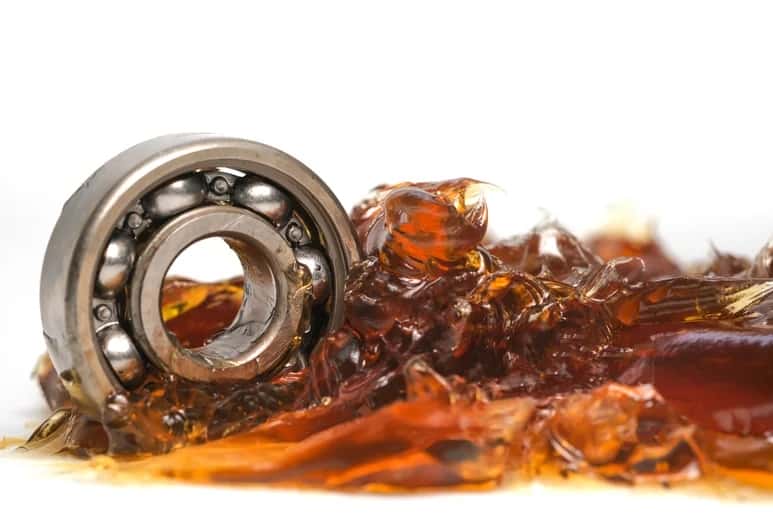
Grease has relatively low fluidity and is less prone to leakage than lubricating oil. It can remain close to the bearing contacts and often simplifies the surrounding lubrication system.
For many industrial bearings, these characteristics make grease lubrication easier to maintain. However, grease should still be selected according to speed, temperature, bearing size, load, and the operating environment.
Base Oil Viscosity
The base oil is one of the most important parts of a bearing grease.
If the effective viscosity at operating temperature is too low for the bearing contact conditions, the lubricant film may be insufficient. If viscosity is unnecessarily high, friction and temperature may increase, particularly at higher speed.
For this reason, selecting grease only by brand, color, or NLGI grade is not enough. Two NLGI 2 greases can use different base oils and be intended for very different operating conditions.
Grease Thickener Type
The thickener gives grease its semi-solid structure and affects properties such as mechanical stability, water resistance, and temperature behavior.
Common thickener systems include lithium, lithium complex, polyurea, calcium-based, and other specialized formulations.
The thickener type becomes especially important when changing grease because two greases are not automatically compatible simply because both are described as bearing grease.
NLGI Grade
NLGI grade describes grease consistency. It does not directly tell you whether a grease is suitable for a particular bearing speed, temperature, or load.
NLGI 2 is common in many industrial applications, but softer or firmer grease may be selected for specific centralized systems, low-temperature conditions, sealing arrangements, or application requirements.
Additives and EP Grease
Additives can improve properties such as oxidation resistance, corrosion protection, anti-wear performance, or extreme-pressure performance.
Heavy load does not automatically mean that every bearing should use an EP grease. The bearing type, speed, lubricant chemistry, and original equipment requirements should be reviewed before changing the additive system.
Grease Compatibility
Mixing different greases can change consistency, oil separation, mechanical stability, and lubrication performance.
Before changing grease, compare the base oil, thickener, additives, and lubricant manufacturer’s compatibility guidance. When compatibility is unknown, simply adding a new grease on top of the old lubricant can create a new failure risk.
How Do You Choose Lubricating Oil for a Ball Bearing?
Lubricating oil consists of a base oil and, where required, an additive package. The base oil establishes key characteristics such as viscosity and viscosity-temperature behavior, while additives may improve oxidation resistance, corrosion protection, anti-wear performance, or other properties.s are crucial for improving the base oil’s performance deficiencies and bestowing it with new qualities.

Oil Viscosity at Operating Temperature
Oil viscosity should be evaluated at the expected bearing operating temperature rather than only at room temperature.
As temperature increases, oil viscosity decreases. The selected viscosity therefore needs to provide suitable lubrication under actual operating conditions without creating unnecessary friction or power loss.
Viscosity index, thermal stability, base oil type, and the additive package may also affect oil selection.
Oil Bath Lubrication
In an oil bath system, part of the bearing or a nearby rotating component passes through the oil and carries lubricant into the bearing.
This is a relatively simple and economical lubrication method for many low- to medium-speed arrangements, including some gearboxes and enclosed machinery.
The oil level needs to be controlled. Excessive oil can increase churning and temperature, while insufficient oil can interrupt lubricant supply.
[KEEP OLD IMAGE — Oil Bath Lubrication]
Suggested Alt Text:
Oil bath lubrication system supplying oil to a rolling bearing
Circulating Oil Lubrication
In a circulating oil system, a pump supplies oil to the bearing and the oil is then returned for filtration, conditioning, or cooling before being reused.
This approach is useful when the lubrication system also needs to remove heat or continuously manage lubricant cleanliness.
Circulating oil systems may be used in high-speed, high-temperature, or continuously operating equipment, but system flow, filtration, oil viscosity, and oil delivery need to match the machine design.
Oil-Air and Oil Mist Lubrication
Specialized high-speed bearing systems may use controlled oil-air or oil-mist lubrication to deliver a small, managed quantity of lubricant to the bearing.
These systems can reduce excess lubricant inside the bearing and are used in selected precision or high-speed applications. They require dedicated equipment and should follow the machine and bearing manufacturer’s design requirements.
Other equipment-specific systems may use drip, splash, or directed oil supply depending on the machine design. These methods should be evaluated as part of the complete lubrication system rather than selected from the bearing alone.
How Much Grease Should You Put in a Ball Bearing?
Do not assume that filling the entire bearing and housing with grease provides better lubrication.
The correct grease quantity depends on bearing design, available free space, rotational speed, housing arrangement, and whether the grease is being used for initial filling or relubrication.
Excessive grease can increase churning friction. The bearing may run hot during the grease distribution or run-in period, and excessive pressure may push grease toward seals or adjacent components.
Insufficient grease or grease that has already lost its lubricating properties can also result in inadequate lubricant supply and increased metal-to-metal contact.
High-speed bearings generally require more careful control of grease quantity. The applicable fill percentage or relubrication quantity should be confirmed from the bearing, equipment, or lubricant manufacturer’s technical guidance.
Do Sealed Ball Bearings Need Relubrication?
Many sealed or shielded ball bearings are supplied with grease already inside the bearing. For bearing designs specified as relubrication-free or lubricated for life, the original grease charge is intended to support the bearing through its designed operating period under the specified conditions.
However, sealed does not automatically mean that every bearing is permanently maintenance-free or that all sealed bearings follow the same lubrication strategy. The correct approach depends on the exact bearing design, seal arrangement, grease specification, operating temperature, speed, and application.
Do not remove the seals or add a different grease to a pre-greased sealed bearing unless the bearing manufacturer or equipment maintenance procedure specifically permits it. Opening the bearing may introduce contamination, damage the seal, or create lubricant compatibility problems.
If a non-relubricatable sealed bearing reaches the end of its grease life or develops lubrication-related damage, replacing the bearing is often more appropriate than washing and repacking it.
For maintenance and replacement work, first check the complete bearing designation and technical specification to confirm whether the bearing is:
- factory pre-greased and relubrication-free;
- designed for periodic relubrication;
- supplied open for lubrication through the surrounding housing or oil system.
The lubrication route should follow the specific bearing and machine design rather than the presence of a seal alone.
Can You Mix Different Bearing Greases?
Do not assume two greases are compatible because they have the same NLGI grade, similar color, or are produced for industrial bearings.
Different base oils, thickeners, and additive systems may interact when greases are mixed. Incompatible combinations can change grease consistency or stability and may lead to excessive leakage or poor lubricant distribution.
If the existing grease is unknown, identify the original bearing or equipment lubricant specification before adding a new grease.
Where a grease change is required, the maintenance procedure may need to include removal or purging of the previous lubricant. The appropriate method depends on the bearing and lubrication system.

Why Does a Ball Bearing Run Hot After Greasing?
If bearing temperature increases shortly after greasing, excessive grease is one possible cause, but it is not the only cause.
| Observation | Possible Cause | What to Check |
| Temperature rises soon after greasing | Excess grease and churning | Grease quantity and run-in behavior |
| Temperature remains continuously high | Incorrect viscosity, preload, fit, or reduced clearance | Lubricant specification and bearing arrangement |
| Grease leaks past the seal | Overfilling or excessive internal pressure | Fill quantity and relief path |
| Noise increases after relubrication | Contamination or grease incompatibility | Grease condition and maintenance cleanliness |
| Temperature increases rapidly with speed | Lubricant viscosity or grease quantity may be unsuitable | Speed, lubricant, and fill quantity |
Over-lubrication increases internal churning and can cause a temporary or sustained temperature rise. In severe cases, excess heat accelerates grease ageing and can reduce lubricant performance.
Under-lubrication can also generate heat. If the lubricant supply is insufficient or the lubricant has deteriorated, the contact surfaces may experience increased friction and wear.
Bearing noise can have several possible causes. See our guide to ball bearing noise and common failure symptoms when abnormal sound occurs together with temperature or lubrication problems.
How Often Should Ball Bearings Be Relubricated?
The expected grease life and relubrication interval depend on several factors, including:
- grease type;
- bearing type and size;
- operating speed;
- operating temperature;
- load;
- contamination and moisture;
- sealing arrangement;
- duty cycle.
Higher operating temperature generally accelerates lubricant ageing, but temperature alone should not be used to set a universal relubrication interval.
Similarly, lubricating every bearing on the same fixed calendar date can result in over-lubrication of some bearings and insufficient lubricant renewal in others.
The relubrication interval should follow the bearing or equipment manufacturer’s recommendation where available. For critical equipment, temperature trends, lubricant condition, contamination, vibration, and changes in operating duty can also be used to review the maintenance interval.
Oil replacement should also be based on the actual lubrication system and operating conditions. Oil temperature, oxidation, contamination, viscosity change, water ingress, filtration, and total oil volume can all affect oil condition.
Common Ball Bearing Lubrication Errors
Using the Wrong Lubricant
Different bearing speeds, temperatures, loads, and operating environments can require different lubricant properties.
A high-viscosity grease selected for a slow, heavily loaded application may create unnecessary friction in a high-speed bearing. A low-viscosity lubricant selected only for speed may provide unsuitable lubrication under a different load and temperature condition.
Always check the complete application rather than selecting a lubricant from one operating parameter.
Over-Lubrication or Under-Lubrication
Excessive grease can increase churning, temperature, grease ageing, and leakage. Too little lubricant—or lubricant that has deteriorated—can result in poor film formation, increased friction, wear, and surface damage.
The correct quantity and replenishment strategy are as important as the grease type itself.
Using Fixed Lubrication Intervals Without Reviewing Operating Conditions
A fixed maintenance date is easy to manage, but bearing operating conditions can change.
Seasonal temperature changes, speed changes, higher production loads, contamination, or changes in the duty cycle can affect lubricant condition. Maintenance intervals should be reviewed when the machine’s actual operating conditions change.
Contamination During Lubrication
Lack of cleanliness is a common maintenance problem.
Bearing lubrication points, grease fittings, seals, tools, and grease-gun tips can carry old grease, dust, metal particles, or other contaminants. If the lubrication equipment is not cleaned and protected, these contaminants may be injected directly into the bearing arrangement.
Use clean lubrication tools, protect lubricant containers, clean grease fittings before relubrication, and avoid leaving grease-gun fittings exposed to workshop contamination.
What Information Is Needed to Select a Ball Bearing Lubricant?
If you are replacing a bearing or reviewing a lubrication problem, start with the complete bearing designation and actual operating conditions.
Useful information includes:
- complete bearing manufacturer and designation;
- bearing type and size;
- open, shielded, or sealed configuration;
- operating speed;
- normal and maximum operating temperature;
- load and duty cycle;
- machine or equipment type;
- current grease or oil specification;
- lubrication method;
- relubrication interval;
- dust, water, or other contamination;
- temperature, noise, leakage, or previous failure symptoms.
For pre-greased bearings, provide the complete bearing suffix whenever possible. The seal, clearance, grease, and special design suffix can affect whether a replacement follows the same lubrication route.
TFL is an independent bearing supplier supporting multi-brand sourcing, bearing interchange, and replacement review. For lubrication-related replacement projects, we can review the available bearing designation and operating information before confirming suitable supply options.
Frequently Asked Questions About Ball Bearing Lubrication
What lubricant is usually used for ball bearings?
Grease is commonly used for many standard industrial ball bearings because it stays in place and often simplifies sealing and maintenance. Oil may be selected when heat removal, circulation, filtration, or specialized high-speed lubrication is required.
Is grease or oil better for ball bearings?
Neither is universally better. Grease is commonly suitable for standard bearing arrangements and longer maintenance intervals. Oil is useful when the lubrication system must remove heat, circulate lubricant, or continuously supply a demanding bearing arrangement.
Can I use oil on a ball bearing?
Yes, if the bearing arrangement and lubrication system are designed for oil lubrication. Oil bath, circulating oil, and specialized controlled-oil systems are used in different applications. The required viscosity and oil supply method should be selected for the actual speed and operating temperature.
How much grease should I put in a ball bearing?
There is no universal full-fill rule. The correct grease quantity depends on the bearing design, free internal space, speed, and housing arrangement. Excess grease can cause churning and temperature rise, particularly in high-speed bearings.
Do sealed ball bearings need lubrication?
Many sealed ball bearings are supplied pre-greased. Bearings specified as relubrication-free or lubricated for life normally rely on the original grease charge under their designed operating conditions. Do not remove seals or add grease unless the bearing or equipment maintenance instructions permit it.
Can different bearing greases be mixed?
Not automatically. Grease compatibility depends on the base oil, thickener, additives, and the stability of the mixed grease. When compatibility is unknown, identify the original lubricant before adding a different grease.
Why does my bearing get hot after greasing?
Excess grease and churning are possible causes, especially when temperature rises shortly after relubrication. Incorrect lubricant viscosity, reduced bearing clearance, excessive preload, misalignment, and insufficient lubrication can also cause bearing temperature to increase.
How often should ball bearings be relubricated?
The interval depends on bearing size, speed, temperature, grease type, load, sealing, contamination, and duty cycle. Follow bearing or equipment manufacturer guidance where available and review the interval when operating conditions change.
Need Help Reviewing a Ball Bearing Lubrication or Replacement Problem?
Send us the complete bearing designation, operating speed, temperature, current lubricant, and a short description of the machine or failure symptom.
TFL can help review the available application information, identify possible replacement bearing routes, and confirm suitable supply options for quotation.
{ “@context”: “https://schema.org”, “@type”: “FAQPage”, “mainEntity”: [ { “@type”: “Question”, “name”: “What lubricant is usually used for ball bearings?”, “acceptedAnswer”: { “@type”: “Answer”, “text”: “Grease is commonly used for many standard industrial ball bearings because it stays in place and often simplifies sealing and maintenance. Oil may be selected when heat removal, circulation, filtration, or specialized high-speed lubrication is required.” } }, { “@type”: “Question”, “name”: “Is grease or oil better for ball bearings?”, “acceptedAnswer”: { “@type”: “Answer”, “text”: “Neither is universally better. Grease is commonly suitable for standard bearing arrangements and longer maintenance intervals. Oil is useful when the lubrication system must remove heat, circulate lubricant, or continuously supply a demanding bearing arrangement.” } }, { “@type”: “Question”, “name”: “Can I use oil on a ball bearing?”, “acceptedAnswer”: { “@type”: “Answer”, “text”: “Yes, if the bearing arrangement and lubrication system are designed for oil lubrication. Oil bath, circulating oil, and specialized controlled-oil systems are used in different applications. The required viscosity and oil supply method should be selected for the actual speed and operating temperature.” } }, { “@type”: “Question”, “name”: “How much grease should I put in a ball bearing?”, “acceptedAnswer”: { “@type”: “Answer”, “text”: “There is no universal full-fill rule. The correct grease quantity depends on the bearing design, free internal space, speed, and housing arrangement. Excess grease can cause churning and temperature rise, particularly in high-speed bearings.” } }, { “@type”: “Question”, “name”: “Do sealed ball bearings need lubrication?”, “acceptedAnswer”: { “@type”: “Answer”, “text”: “Many sealed ball bearings are supplied pre-greased. Bearings specified as relubrication-free or lubricated for life normally rely on the original grease charge under their designed operating conditions. Do not remove seals or add grease unless the bearing or equipment maintenance instructions permit it.” } }, { “@type”: “Question”, “name”: “Can different bearing greases be mixed?”, “acceptedAnswer”: { “@type”: “Answer”, “text”: “Not automatically. Grease compatibility depends on the base oil, thickener, additives, and the stability of the mixed grease. When compatibility is unknown, identify the original lubricant before adding a different grease.” } }, { “@type”: “Question”, “name”: “Why does my bearing get hot after greasing?”, “acceptedAnswer”: { “@type”: “Answer”, “text”: “Excess grease and churning are possible causes, especially when temperature rises shortly after relubrication. Incorrect lubricant viscosity, reduced bearing clearance, excessive preload, misalignment, and insufficient lubrication can also cause bearing temperature to increase.” } }, { “@type”: “Question”, “name”: “How often should ball bearings be relubricated?”, “acceptedAnswer”: { “@type”: “Answer”, “text”: “The interval depends on bearing size, speed, temperature, grease type, load, sealing, contamination, and duty cycle. Follow bearing or equipment manufacturer guidance where available and review the interval when operating conditions change.” } } ] }