







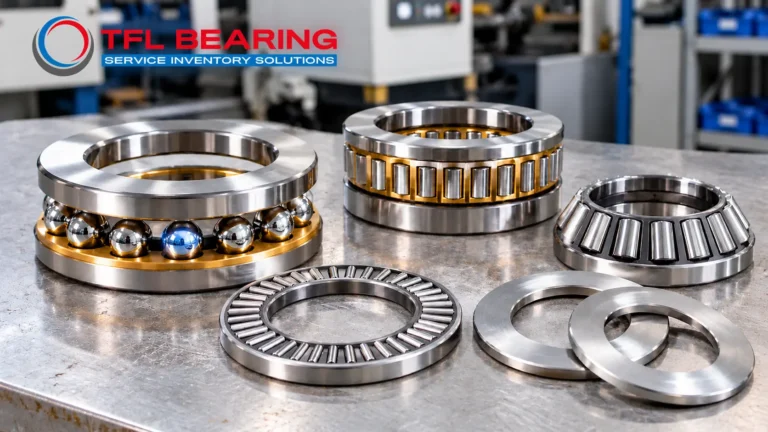
Thrust Bearing Types Explained: How They Work and How to Choose One
A thrust bearing is a bearing built to carry axial load, the push that runs along a shaft instead of across it. Picture a…
Read articleCompare leading global bearing brands and explore compatible TFL alternatives by model, product type and application.
View all Brands GuideMatch manufacturer part numbers with interchangeable TFL bearing options and model-selection support.
Browse bearing solutions by equipment, operating environment and industry.
Practical guidance on bearing selection, applications, maintenance and sourcing.
A thrust bearing is a bearing built to carry axial load, the push that runs along a shaft instead of across it. Picture a…
Read article
Find answers about quality, orders, technical support and after-sales service.
Use our articles, reference tools and customer resources to support sourcing decisions.
Learn about TFL Bearing, our quality systems and supply capabilities.
View all About & CapabilitiesAccess engineering support and services throughout the purchasing process.
View all Services & SupportExplore customer projects, sourcing partnerships and ways to contact our team.
View all Work With TFL
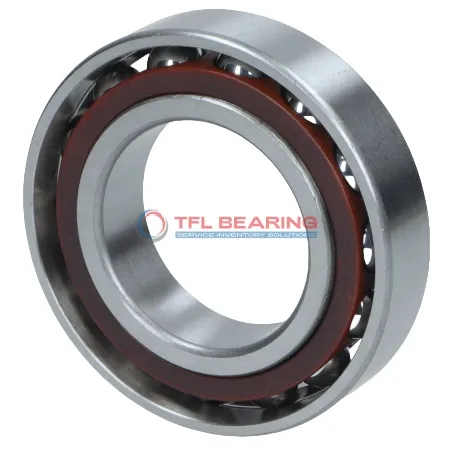
The S71914 ACD/HCP4ADT is a super precision angular contact ball bearing with a 70mm bore and 100mm outer diameter, crafted from durable chrome steel and ceramic balls. It handles radial loads up to 11858 lbf and reaches speeds of 28000 RPM, making it suitable for high-performance applications.
Its sealed design and grease lubrication ensure low maintenance, while the phenolic cage offers excellent durability. The 25° contact angle and matched arrangement (2 bearings << DT) provide stability under angular loads. This bearing operates smoothly in temperatures from -30°C to 110°C and meets P4A tolerance standards for precision. Ideal for machine tools, spindles, or other high-speed equipment requiring accuracy. Weighing 0.57kg, it’s a robust yet lightweight solution. Interchangeable with SKF bearings, it’s a reliable choice for replacements or upgrades.
Performance Features of S71914 ACD/HCP4ADT Bearing
S71914 ACD/HCP4ADT Bearing is designed with a 25° contact angle, optimising load distribution for angular contact applications.
The ceramic balls reduce friction, enhancing speed capabilities up to 28,000 rpm.
Its matched arrangement of two bearings ensures stability and precision in high-performance settings.
The phenolic cage maintains ball alignment, contributing to smooth operation.
With a dynamic radial load capacity of 11,858 lbf, it handles demanding conditions reliably.
The sealed design and grease lubrication minimise maintenance requirements.
Operating between -30°C to 110°C, S71914 ACD/HCP4ADT Bearing performs consistently in varied environments.
Its P4A tolerance class guarantees exceptional precision for critical applications.
Industrial Uses of S71914 ACD/HCP4ADT Bearing
S71914 ACD/HCP4ADT Bearing is commonly used in high-speed machine tools, where its ceramic balls and phenolic cage reduce friction for smoother operation. The sealed design also helps keep contaminants out, extending service life in demanding environments.
Where Is S71914 ACD/HCP4ADT Bearing Used?
You’ll often find S71914 ACD/HCP4ADT Bearing in precision robotics, particularly in articulated arms requiring tight angular control. Its P4A tolerance class ensures consistent performance even under rapid directional changes.
Built for Heavy-Duty Use: S71914 ACD/HCP4ADT Bearing
S71914 ACD/HCP4ADT Bearing handles radial and axial loads effortlessly in industrial pumps and compressors. The matched bearing arrangement with preload enhances stability for critical applications.
Automotive vs Aerospace: Applications of S71914 ACD/HCP4ADT Bearing
In automotive systems, S71914 ACD/HCP4ADT Bearing supports high-performance transmissions, while aerospace applications benefit from its lightweight ceramic balls. Both sectors value its reliability at extreme speeds.
Perfect Fit for Automation: S71914 ACD/HCP4ADT Bearing
S71914 ACD/HCP4ADT Bearing excels in automated production lines, where its grease lubrication reduces maintenance needs. The 25° contact angle provides optimal load distribution for continuous operation.